
A marketing strategy consultant is a senior marketing operator you hire to diagnose why your marketing is underperforming, set the plan that ties marketing to revenue, and hand your team something they can actually run. You are buying judgment and a decision framework, not a bigger to-do list. The engagement is usually short and defined: a review, a strategy, and a 90-day execution roadmap, priced by project or by a monthly retainer.
Most pages on this topic stop at a dictionary definition or a rate card. This one covers the part that decides whether the money is well spent: what actually gets delivered, where strategy ends and execution begins, and how to spot a consultant who ships a deck versus one who moves a number.
Want a specialist to build this for your business? See how CO Consulting’s marketing services work, starting with a diagnostic and audit.
Last reviewed: October 2026
What does a marketing strategy consultant actually deliver?
A marketing strategy consultant delivers three things: a diagnosis of where your marketing loses money, a written strategy that prioritizes the fixes, and a roadmap your team can execute. The output is a decision document with an owner and a timeline attached to each item, not a slide deck that sits in a shared drive. Concrete deliverables vary by engagement, but the core set is consistent.
- Marketing audit and gap analysis: an objective read of channels, messaging, website conversion, and team capability, output as a prioritized list ranked by expected impact and effort.
- Positioning and messaging: a clear ideal customer profile (ICP), value proposition, and the one message that separates you from the field.
- Channel and budget plan: which channels to fund, which to cut, and roughly what to spend, mapped to your sales motion.
- 90-day execution roadmap: sequenced actions with named owners, so the strategy survives contact with a busy team.
- Measurement framework: the two or three numbers that prove the plan is working, with a reporting cadence.
For a deeper look at how these pieces fit into a full plan, see our sales and marketing strategy framework.
Strategy vs execution: what the consultant owns and what stays with your team
A strategy consultant owns the thinking and the plan; your team, an agency, or contractors own the doing. The consultant decides which channels to fund, what the message is, and how success gets measured. Execution (writing the emails, running the ads, building the pages) sits with people who do that work full time. Confusing these two roles is the most common reason an engagement disappoints.
This split matters because a strategy without an execution owner is the failure mode you are paying to avoid. In practice, a good consultant will not hand you a plan and leave. They will name who executes each line, flag the gaps in your current team, and often oversee the first weeks of rollout so the plan does not stall on day two.
| Dimension | Strategy (consultant owns) | Execution (team or agency owns) |
|---|---|---|
| Core question | What should we do and why | How and when we do it |
| Typical output | Positioning, channel plan, roadmap | Ads, content, emails, landing pages |
| Time horizon | 6 to 24 months | Daily and weekly |
| Skill needed | Senior judgment, pattern recognition | Hands-on channel craft |
| Right hire | Consultant or fractional lead | In-house team, freelancers, agency |
When do you need a marketing strategy consultant?
You need a marketing strategy consultant when growth has stalled and you cannot pinpoint why, when you are entering a new market or launching a product, or when you want senior direction without a full-time executive salary. The trigger is usually a decision that is too big to guess at and too expensive to get wrong. If you already know exactly what to do and just lack hands, you need execution help, not strategy.
A few situations where the spend tends to pay off:
- Revenue plateaued and your channels no longer respond to more budget.
- You are about to spend heavily on a launch or a new segment and want a second set of experienced eyes first.
- Founders or a small team are making marketing calls part time and want a real plan they can delegate.
- You have an agency executing tactics but no one setting the direction those tactics serve.
Not sure whether you need a project consultant or an ongoing part-time leader? Our guide on fractional CMO cost in 2026 breaks down the ongoing-leadership option and its pricing.
How much does a marketing strategy consultant cost?
A marketing strategy consultant may cost roughly $75 to $250 per hour for independent advisory work, with senior specialists often reaching $150 to $500 per hour. Comprehensive strategy projects commonly land in the $2,000 to $20,000 range, and ongoing part-time leadership retainers frequently run $5,000 to $15,000 per month. Rates depend on scope, seniority, and your market, so treat these as planning ranges rather than fixed prices.
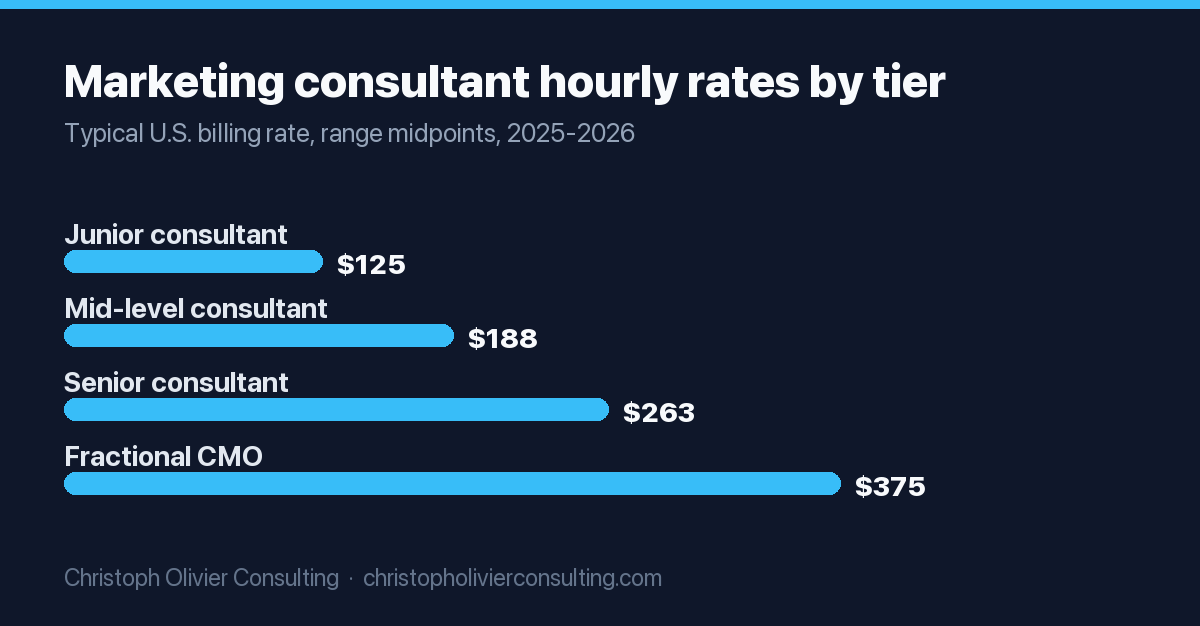
The better way to judge cost is per result, not per hour. A higher-rate consultant who drives a measurable outcome can be cheaper than a low-rate one who produces a strategy no one executes. The table below shows the common engagement models and where each fits.
| Engagement model | Typical range | Best for | Watch for |
|---|---|---|---|
| Hourly advisory | $75 to $500 per hour | Focused questions, second opinions | Scope creep, no clear deliverable |
| Fixed-scope project | $2,000 to $20,000 | Audit, launch plan, full strategy | What happens after the deck ships |
| Monthly retainer | $5,000 to $15,000 per month | Ongoing direction and oversight | Vague hours, no measured outcome |
| Short trial retainer | $5,000 to $7,000 for 30 days | Testing fit before a longer commitment | Too short to see real results |
You can compare these models against a broader menu of engagements on our consulting services page.
What does the engagement process look like, step by step?
A marketing strategy engagement follows a predictable arc: understand the business, audit what exists, build the strategy, and hand off a roadmap with measurement attached. A typical fixed-scope project runs four to eight weeks. Knowing the sequence helps you hold a consultant accountable at each stage instead of waiting for one big reveal at the end.
- Discovery: the consultant interviews leadership and sales, reviews your goals, economics, and past results, and defines what success means in numbers.
- Audit: a channel-by-channel review of spend, messaging, website conversion, and analytics to find where money and attention leak.
- Positioning and ICP: sharpening who you sell to and the message that lands, because a channel plan built on fuzzy positioning fails downstream.
- Strategy and channel plan: deciding what to fund, what to cut, and the rough budget split across channels.
- 90-day roadmap: sequencing the work with named owners and deadlines so execution starts immediately.
- Measurement and handoff: setting the two or three metrics that prove progress, plus a reporting cadence and a check-in to keep the plan on track.
How do you vet a marketing strategy consultant?
Vet a marketing strategy consultant by demanding proof of outcomes, not just a portfolio of logos. Ask for case studies with specific before-and-after numbers, references you can actually call, and their point of view on your specific problem before you sign. The strongest signal is a consultant who asks more questions than they answer in the first conversation and who has worked inside operating businesses, not only inside agencies.
Use this quick scorecard when comparing candidates.
| Signal to check | Green flag | Red flag |
|---|---|---|
| Track record | Named metrics and callable references | Vague claims, logos only |
| First conversation | Asks sharp questions about your economics | Pitches a package before understanding you |
| Deliverable clarity | Writes down scope, owner, and timeline | Open-ended hours, no defined output |
| Execution stance | Names who ships the work | Hands over a deck and disappears |
| Background | Operator experience, not agency only | Only ever billed by the hour |
You can see how we approach this kind of work on our about page.
Consultant vs agency vs fractional CMO: which do you need?
Choose a strategy consultant for a defined plan, an agency for ongoing execution of specific channels, and a fractional CMO for continuous senior leadership across the whole function. They solve different problems and often work together: a consultant sets direction, an agency runs the channels, and a fractional CMO owns the outcome over time. Picking the wrong one wastes budget on capability you do not need.
| Option | What you get | Commitment | Best when |
|---|---|---|---|
| Strategy consultant | A plan and roadmap | Weeks, project-based | You need direction, not hands |
| Marketing agency | Channel execution | Monthly, often 6 to 12 months | You have a plan and need doers |
| Fractional CMO | Ongoing leadership and oversight | Part-time, monthly retainer | You need someone to own results |
The honest answer for many small and mid-sized companies is a sequence: start with a strategy engagement to get the plan right, then decide whether execution belongs with an agency, an in-house team, or a part-time leader who ties it all together.
Work with CO Consulting
Want this done for your business?
- A diagnostic call and an audit of your current marketing and numbers
- A prioritized 90-day plan built for your market
- Execution across SEO and AI search, paid ads, content, funnels and automation
- Weekly check-ins and monthly reporting, led by a fractional CMO
Frequently asked questions
What is a marketing strategy consultant?
A marketing strategy consultant is a senior marketing expert you hire to diagnose where your marketing underperforms, build a plan that ties marketing to revenue, and hand your team a roadmap they can execute. They own the thinking and direction, while execution stays with your team, freelancers, or an agency. Engagements are usually short and defined by a project scope or monthly retainer.
How much does a marketing strategy consultant cost?
Rates commonly run $75 to $250 per hour for independent advisory work, with senior specialists often reaching $150 to $500 per hour. Fixed-scope strategy projects frequently land between $2,000 and $20,000, and ongoing retainers often fall in the $5,000 to $15,000 per month range. Pricing depends on scope, seniority, and market, so treat these as planning ranges rather than quotes.
What is the difference between a marketing consultant and a marketing agency?
A marketing consultant sets strategy and direction, deciding what to do and why, then hands off a roadmap. An agency executes tactics across specific channels like paid search, SEO, or email. Consultants are usually project-based and short term; agencies are ongoing and hands-on. Many companies use a consultant to build the plan and an agency to run it.
When should I hire a marketing strategy consultant?
Hire one when growth has stalled and you cannot identify why, when you are launching a product or entering a new market, or when you want senior marketing direction without a full-time executive salary. If you already know exactly what to do and only lack execution capacity, you likely need hands-on help or an agency instead of a strategy consultant.
What deliverables should I expect from a marketing strategy consultant?
Expect a marketing audit with a prioritized fix list, clear positioning and an ideal customer profile, a channel and budget plan, a 90-day execution roadmap with named owners, and a measurement framework with a reporting cadence. The output should be a decision document with owners and timelines attached, not a slide deck without a path to execution.
How do I vet a marketing strategy consultant before hiring?
Ask for case studies with specific before-and-after metrics, references you can call, and their view on your specific problem before signing. Favor consultants who ask sharp questions about your economics early, write down scope and timelines, name who executes the work, and have operator experience inside real businesses rather than only agency-side or hourly billing.
More Growth, Strategy & Sales guides
- Outbound Lead Generation: The 2026 Playbook (Cold Email, LinkedIn, Calls)
- Personal Branding for Entrepreneurs: A System That Drives Inbound
- Referral Marketing: How It Works and How to Build a Program
- SaaS Content Marketing: A Product-Led Playbook
- SEO for Lead Generation: How to Turn Search Traffic Into Qualified Leads
- Small Business Lead Generation: A Budget-First Playbook