
SEO services are the ongoing work of making your website the one Google and AI assistants choose when a qualified buyer searches for what you sell: technical fixes, pages built around real buyer questions, local and authority signals, and reporting tied to booked consultations instead of vanity rankings. At CO Consulting we run SEO for professional-service firms and 7-figure service businesses, and we run it alongside AI search optimization because your buyers now ask ChatGPT, Perplexity and Google AI Overviews before they ever click a result.
Last reviewed: October 2026
This page is written the way I would want a vendor page written if I were the one buying. You will find exactly what is included, how the first 90 days run, what SEO typically costs on the open market (with sources), the situations where we are the wrong fit, and the compliance guardrails we apply for regulated firms. I am Christoph Olivier, a fractional CMO. The content systems I have built have generated more than 200 million organic views, and I have managed millions in ad spend, so I judge SEO by one standard: does it produce pipeline you can measure. You can read more about how we work on our about page.
What our SEO services include
Our SEO services cover seven workstreams: technical health, on-page optimization, content, local search and Google Business Profile, digital PR and links, AI search optimization, and reporting. Each one has a defined output and a defined measure. You should never pay for an activity you cannot see, so every deliverable below is paired with the number we use to judge whether it worked.
| Workstream | What we do | How we measure it |
|---|---|---|
| Technical SEO | Crawl and index audit, site speed and Core Web Vitals, schema markup, redirects, duplicate and thin page cleanup, XML sitemaps and internal link structure. | Pages indexed vs. submitted in Search Console, Core Web Vitals pass rate, crawl errors resolved. |
| On-page SEO | Title tags, meta descriptions, headings, service page structure, internal links and conversion elements on the pages that already have impressions. | Click-through rate and average position for target queries, conversions per page. |
| Content | Service pages, practice-area or industry pages, and buyer-question articles written from a keyword and intent map, reviewed by your subject expert. | Non-branded organic sessions, rankings for commercial terms, assisted conversions. |
| Local SEO and Google Business Profile | Profile optimization, categories, services, review request process, location pages, citation consistency. | Map pack visibility for priority terms, calls, direction requests and form fills from the profile. |
| Digital PR and links | Original data assets, expert commentary, partner and association mentions, and cleanup of risky links. No bought link packages. | New referring domains from relevant sites, brand mentions, authority trend. |
| AI search optimization (AEO/GEO) | Answer-first page structure, entity and author signals, FAQ and organization schema, citation-worthy data, and monitoring of how AI assistants describe you. | Citations and mentions in AI Overviews, ChatGPT and Perplexity for a tracked prompt set. |
| Reporting | Monthly report and call: what shipped, what moved, what we change next. Lead source tracking wired into your CRM where possible. | Qualified leads, booked consultations and revenue attributed to organic and AI search. |
Not every firm needs all seven at the same weight. A 3-partner estate planning practice in one metro usually needs local SEO and service pages first. A multi-state advisory firm usually needs content depth and authority. The audit in month one decides the mix, and the mix is written into the plan so you can hold us to it.
SEO and AI search optimization in 2026: why we run them together
SEO earns your pages a ranking position. AI search optimization, also called AEO or GEO, earns your firm a citation inside the answer that ChatGPT, Perplexity or Google AI Overviews writes. The two share most of their inputs: crawlable pages, clear answers, expert authorship and outside mentions. Running them as one program avoids paying twice for the same work and covers both ways buyers now research a firm.
The reason this matters is in the click data. Industry studies published in 2025 and 2026 found that when an AI Overview appears, clicks to organic results fall sharply. Pew Research found users clicked a traditional result on 8% of visits with an AI summary, against 15% without one. Ahrefs reported a 58% lower click-through rate for the top-ranking page when an AI Overview was present. Seer Interactive found that brands cited inside the AI Overview earned materially more clicks than brands that ranked but were not cited.
The practical conclusion I draw from those numbers: ranking alone is no longer the finish line. For professional services, the buyer often asks an assistant something like “what does a fee-only financial advisor cost” or “do I need a trust or a will in Texas”, reads a synthesized answer, and then searches the names that answer mentioned. If your firm is the source of that answer, you get the branded search later. If you are not, a competitor does.
So our pages are built to do both jobs. Each important page opens with a direct answer, uses tables for comparisons and costs, names a qualified author, and carries structured data. That format helps Google understand the page, and it gives AI systems a clean passage to quote. We then track a fixed set of buyer prompts across assistants every month, so you see whether your firm is being cited, not just whether it ranks.
If AI visibility is your main concern, our dedicated AI search optimization service goes deeper on prompt tracking, entity work and citation building. Most clients start with the combined program on this page because the foundation is shared.
When our SEO services fit, and when they do not
Our SEO services fit established service firms with a clear offer, a sales process that can handle more inquiries, and the patience to judge results over two to four quarters. They are a poor fit for brand new businesses needing leads this month, for anyone wanting guaranteed rankings, and for firms that cannot give us an hour a month of expert review on content.
| A good fit when | Probably not a fit when |
|---|---|
| You are a professional-service firm or service business doing roughly seven figures or more, with a defined offer and ideal client. | You are pre-revenue or still testing what you sell. Paid search or direct outreach will teach you faster. |
| You can handle more consultations and have someone who follows up within a business day. | Leads already go unanswered. Fix intake first, or SEO just produces more missed calls. |
| You will give a partner or senior expert about an hour a month to review content for accuracy. | Nobody internal can review content. In regulated fields that is a real risk, not a formality. |
| You can commit to a program measured over 6 to 12 months. | You need booked meetings within 30 days. SEO rarely works that fast for competitive terms. |
| You want SEO connected to paid search, content and the rest of marketing under one strategy. | You only want a cheap monthly checklist or a fixed number of backlinks per month. |
| You care about being cited by AI assistants as well as ranking in Google. | You want a ranking guarantee. No honest provider can give one, and Google says so publicly. |
When a firm is not ready for SEO, I will say so on the first call and point to what would work better, which is often paid search for speed or a tighter offer. Our fractional CMO services exist for exactly that kind of whole-funnel decision.
How an SEO engagement works: the first 90 days and after
An engagement starts with a two to four week audit and plan, moves into fixing the issues that block growth and upgrading the pages closest to converting, and then settles into a monthly rhythm of new content, authority work, AI citation tracking and reporting. You approve the plan before execution, and every month ends with a written report and a review call.
- Weeks 1 to 2, discovery and access. We get Search Console, analytics, CRM and website access, interview you about your best clients and your sales process, and confirm which services and locations matter most to revenue.
- Weeks 2 to 4, audit and plan. Technical crawl, content inventory, competitor and SERP review for your money keywords, AI assistant prompt baseline, and a backlink profile check. You get a prioritized 90-day plan with owners and dates.
- Month 2, fix and upgrade. We resolve indexing and speed problems, rewrite titles and service pages that already earn impressions, add schema, and set up conversion and call tracking so later results can be attributed.
- Month 3, build. New service, industry or location pages from the keyword map, the first buyer-question articles, Google Business Profile work, and the first outreach for mentions and links.
- Day 90 review. We compare against the baseline: indexed pages, impressions, positions for target terms, AI citations, and any early leads. We keep what is working, cut what is not, and reset the next quarter’s plan.
- Ongoing, monthly. A steady cadence of new and refreshed content, link and PR work, technical monitoring, AI prompt tracking, and a monthly report and call. Each quarter we revisit priorities against pipeline data, not just traffic.
Content is drafted by us and reviewed by your expert before publishing. That review step adds a few days per piece, and it is the reason professional-service content we produce is accurate enough to be cited.
How much SEO services cost in 2026: market ranges
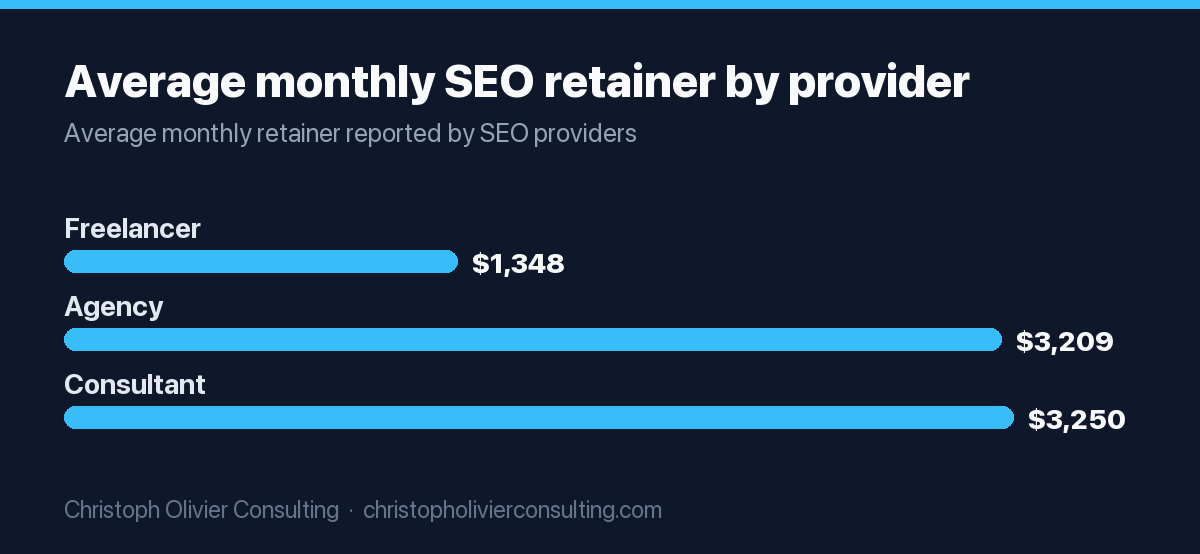
Across recent pricing surveys, most businesses pay between $500 and $5,000 a month for ongoing SEO, with agency retainers averaging around $3,200 a month. The most common hourly band is $75 to $100, though specialist consultants average about $171 an hour, and one-off audits or projects most often land between $2,500 and $5,000. These are market ranges, not a CO Consulting quote.
| Pricing model | Typical market range | What it usually covers |
|---|---|---|
| Monthly retainer, small or local business | $500 to $1,500 per month | Single location, modest competition, local SEO and a few pages a month. |
| Monthly retainer, established firm | $1,500 to $5,000 per month | The most common band. Content, technical, local and link work for a competitive regional or national market. |
| Monthly retainer, competitive or multi-location | $5,000 to $10,000+ per month | Large sites, many locations, heavy content and digital PR, enterprise reporting. |
| Hourly consulting | $75 to $100 per hour most common; consultants average about $171 | Advice, training or audits where your team does the execution. |
| One-off audit or project | $1,500 to $5,000 for most; $25,000+ for large projects | Technical audit, migration support, a content build or a site relaunch. |
Sources: Ahrefs survey of 439 SEO providers (average agency retainer about $3,209 a month, average consultant retainer about $3,250, freelancers about $1,348; most common hourly band $75 to $100; most common project band $2,501 to $5,000) and other published pricing guides. Treat any single number as a midpoint, not a price list. Our own fees depend on scope and are quoted after the audit conversation. For a longer breakdown, read our guide on how much SEO costs.
What drives the cost of SEO
- Competition. Ranking for “estate planning attorney” in a large metro takes more content and authority than ranking in a small town.
- Starting point. A site with indexing problems, thin pages or a history of bad links needs remediation before growth work pays off.
- Number of services and locations. Each practice area or office usually needs its own page and local signals.
- Content volume and expertise. Expert-reviewed content for regulated topics costs more to produce than generic blog posts, and it is the content that tends to rank and get cited.
- Who executes. If your team can publish and edit pages, a consulting model can cost less. If we handle everything, the retainer reflects that.
Red flags of cheap SEO
- Guaranteed rankings or “page one in 30 days”. Google’s own guidance says no one can guarantee a number one ranking.
- A fixed count of backlinks per month for a low fee. Those links are usually bought or from networks that can hurt you.
- Reports that show only rankings for terms nobody searches, or traffic with no lead data.
- Content written without any expert review in a field where accuracy has legal or financial consequences.
- Long lock-in contracts with no defined deliverables, or a provider who will not give you ownership of your accounts and content.
What a ranking is worth: click-through rate by position
Clicks concentrate at the top of Google. First Page Sage’s 2026 benchmark (US data, March to August 2026) puts position one at 22.6% of clicks on results pages without an AI answer, position three at 5.8%, and position ten at 0.5%. That gap is why we prioritize a small set of revenue terms and push them toward the top three, rather than chasing hundreds of page-two rankings that send almost no visitors.
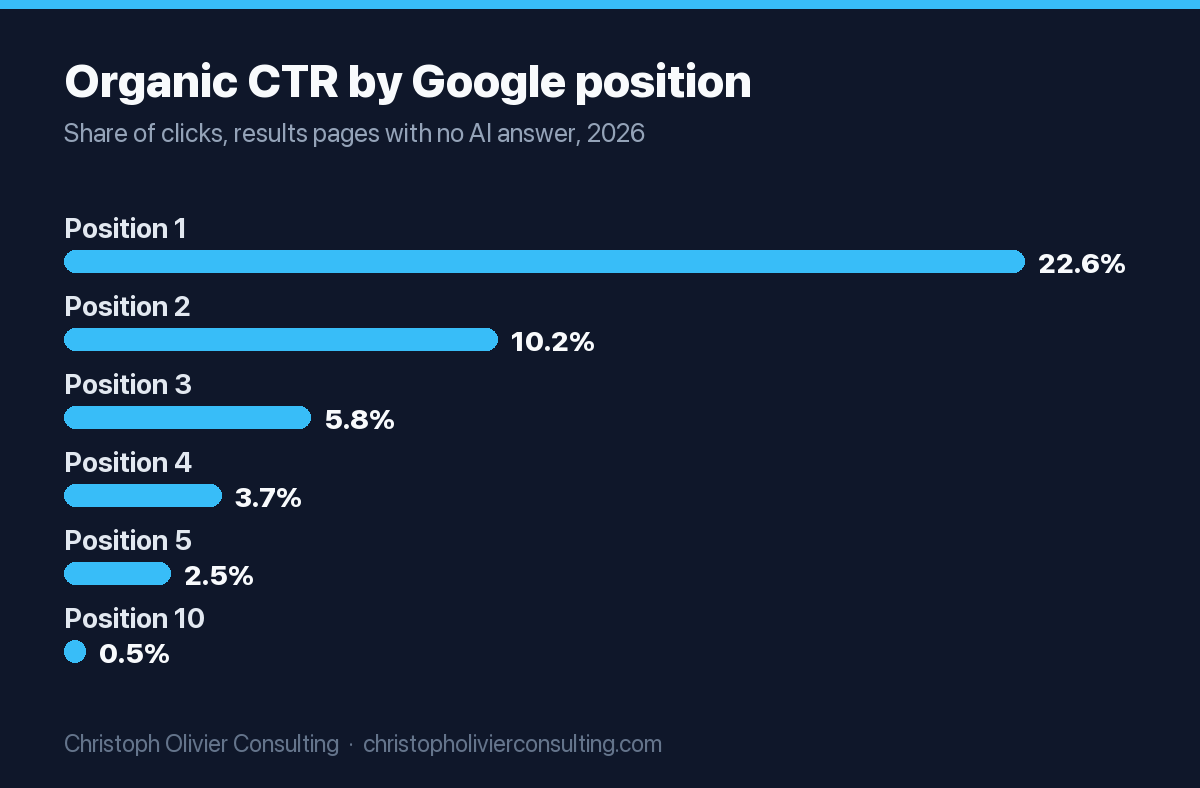
Two caveats. First, these averages fall when an AI Overview, ads or a map pack sits above the organic results, which is common for professional-service searches. In the same benchmark, position one earns just 3.6% of clicks when an AI answer is present, and 7.1% blended across all results pages. Second, for local services the map pack often takes the first clicks, which is why Google Business Profile work sits inside our scope rather than as an extra.
Realistic timelines and how we report results
Google’s own hiring guidance says SEO typically takes four months to a year to show benefits. In our experience, technical fixes and page upgrades can move impressions within weeks, local visibility often improves within one or two quarters, and competitive commercial terms usually take six to twelve months or longer. We report qualified leads and booked consultations, not just rankings.
Timelines depend on your starting authority, how competitive your market is, and how quickly content gets approved. A firm with an older, well-linked domain may see movement sooner. A new domain in a crowded metro may need longer. Anyone who gives you a fixed date for a specific ranking is guessing.
| KPI we report | Why it matters |
|---|---|
| Qualified leads from organic and AI search | Tracked by source in your CRM or call tracking, filtered to leads that match your ideal client. |
| Booked consultations | The number that tells you whether search is feeding your calendar. |
| Revenue or pipeline value attributed | Where your CRM allows it, matched back to the landing page that started the inquiry. |
| Non-branded organic clicks | Growth from people who did not already know your name. |
| Positions for priority terms | A short list of commercial terms, not hundreds of vanity keywords. |
| AI citations | How often assistants cite or mention your firm across a fixed set of buyer prompts. |
Every report answers three questions in plain language: what we shipped, what moved, and what we are changing next. If a tactic is not producing, the report says so. You can see how we present work on our case studies page, and our research library shows the kind of original data we create to earn citations.
SEO for regulated professional firms: compliance considerations
Accountants, attorneys and financial advisors face advertising rules that generic SEO agencies often ignore. Content and page copy must not be false or misleading, should avoid implied guarantees of outcomes, and in some cases needs disclaimers, review or record-keeping. We build those constraints into the process from the start, and your own compliance reviewer always has final say.
The rules vary by profession and jurisdiction, so treat the points below as the issues we plan around, not legal advice:
- Attorneys. ABA Model Rule 7.1 and state equivalents prohibit false or misleading communications about a lawyer’s services. Statements about past results or comparisons with other lawyers can mislead if not framed carefully, and some states require labels, disclaimers or retention of advertising. Websites and search content generally count as communications.
- CPAs and accounting firms. The AICPA Code (section 1.600) bars advertising that is false, misleading or deceptive, and state boards may add their own requirements. We avoid promising specific tax savings or outcomes.
- Financial advisors. Registered investment advisers are subject to the SEC Marketing Rule, which places conditions on testimonials, endorsements and performance presentation. Broker-dealer reps may have FINRA review obligations. We route content through your compliance process before it goes live.
- Everyone. No guaranteed outcomes, accurate credentials, clear authorship, and a dated review on content that cites rules or figures that change.
This is also an SEO advantage. Google’s quality guidance places high weight on expertise and trust for topics that affect money and legal standing, and AI assistants favor sources with named, qualified authors. Compliance-reviewed content with real credentials is the same content that tends to rank and get cited.
Industries we build SEO programs for
We focus on professional-service firms and established service businesses where a single new client is worth thousands of dollars or more. Each industry has its own search behavior, compliance rules and buyer questions, so we keep a dedicated guide for each. Pick your field below to see how we approach it in detail.
| Industry | Typical focus |
|---|---|
| SEO for accounting firms | CPA and bookkeeping practices competing for business and individual clients. |
| SEO for tax planning firms | Proactive tax strategy firms targeting business owners and high earners. |
| SEO for financial advisors | RIAs and planners working inside marketing rule constraints. |
| SEO for estate planning attorneys | Wills, trusts and probate practices that win on local and question-based search. |
| SEO for law firms | Practice-area pages, local visibility and bar-compliant content. |
| SEO for exit planning advisors | Advisors reaching owners several years before a sale. |
| SEO for capital raisers and fund managers | Credibility content for sponsors and fund managers, mindful of offering rules. |
| SEO for business coaches and consultants | Authority content that turns expertise into inbound calls. |
| SEO for HVAC contractors | Local service SEO, map pack work and emergency-intent pages. |
For home and field service businesses, our local SEO playbook for service businesses covers the Google Business Profile and location-page work in more depth.
How to choose an SEO provider
Choose an SEO provider by asking for a written plan tied to your revenue goals, clear monthly deliverables, reporting on leads rather than rankings, full ownership of your accounts and content, and an honest answer on timelines. Ask how they handle AI search and, if you are regulated, how they handle compliance review. A provider who guarantees rankings has answered for you.
Questions I would ask any SEO company, including us:
- What exactly will you deliver each month, and who does the work?
- How will you measure success, and can you connect it to leads in my CRM?
- Which of my pages and keywords will you prioritize first, and why?
- How do you build links, and can I see examples?
- How are you adapting the work for AI Overviews and AI assistants?
- Who owns the content, accounts and data if we part ways?
- What is the notice period, and what happens in the first 90 days?
For deeper reading, we have written three buyer guides: how to choose an SEO company, the SEO services buyer’s guide, and how to hire an SEO service without getting burned. All of our search guides are collected in the SEO guides hub.
How SEO fits with the rest of your marketing
SEO works best as one channel inside a coordinated growth plan, not as a standalone vendor. Organic content feeds email nurture and sales conversations, paid search tests which keywords convert before you invest in ranking for them, and the same expert content powers social and AI visibility. We plan SEO with that whole system in view.
Because CO Consulting is run by a fractional CMO, SEO decisions are made against your full pipeline. If your search content needs a broader editorial engine, see our content marketing services. If you need senior marketing leadership across every channel, see fractional CMO services. You can browse everything we offer on our services page.
Ready to see what search could do for your firm? Book a consultation and we will review your current visibility in Google and AI assistants, tell you honestly whether SEO is the right next investment, and outline what a first 90 days would look like for your market.
Frequently asked questions
What do SEO services include?
SEO services usually include a technical audit and fixes, on-page optimization of titles and service pages, keyword-led content, local SEO and Google Business Profile work, link and digital PR building, and monthly reporting. In 2026 a complete program also covers AI search optimization so your firm is cited in AI Overviews, ChatGPT and Perplexity answers. The right mix depends on your starting point and market.
How much do SEO services cost per month?
Published pricing surveys put most ongoing SEO between $500 and $5,000 a month. Ahrefs found agency retainers averaging about $3,209 a month and freelancers about $1,348. Competitive or multi-location programs can exceed $10,000. These are market ranges, not our quote; real cost depends on competition, site condition, number of services and how much execution you need.
How long does SEO take to work?
Google’s own guidance says four months to a year is typical before you see the benefit of changes. Technical fixes and page upgrades can lift impressions within weeks, local results often improve within one or two quarters, and competitive commercial terms usually take six to twelve months or longer. Timelines depend on domain authority, competition and how quickly content is approved.
Can you guarantee first-page rankings?
No. Nobody can honestly guarantee rankings, and Google’s hiring guidance warns against anyone who claims to. Search results change constantly and depend on factors no provider controls. What we can commit to is a written plan, defined monthly deliverables, transparent reporting on leads and consultations, and a willingness to change tactics when something is not producing.
What is the difference between SEO and AEO or GEO?
SEO aims to rank your pages in search results. AEO and GEO, answer and generative engine optimization, aim to get your firm cited inside AI-written answers from Google AI Overviews, ChatGPT and Perplexity. They share most inputs, including clear answer-first pages, expert authorship, structured data and outside mentions, which is why we run them as one program instead of two.
Is SEO worth it for a professional-service firm?
Often, yes, when one new client is worth thousands of dollars and buyers research before they call. SEO compounds because pages keep earning visits after they are built. It is a weaker choice if you need leads within weeks, cannot handle more inquiries, or have no expert to review content. In those cases paid search or intake fixes usually come first.
Do you work with regulated firms like CPAs, attorneys and financial advisors?
Yes, that is our core focus. We plan around rules such as ABA Model Rule 7.1, the AICPA advertising provisions and the SEC Marketing Rule by avoiding guaranteed outcomes, keeping credentials accurate, and routing content through your compliance reviewer before publishing. Your reviewer has final approval. Requirements vary by state and registration, so we treat them conditionally and never as legal advice.