

Social media marketing for an architecture firm works when you match the platform to the client who hires you: Instagram (plus Facebook for older homeowners) for residential work, LinkedIn for commercial and institutional clients, and LinkedIn plus visible project credits for public-sector RFP work. The content that wins on all of them is the same: your own projects, posted at each stage from site visit to one year after move-in, with every collaborator credited and the photographer’s license checked before you hit publish.
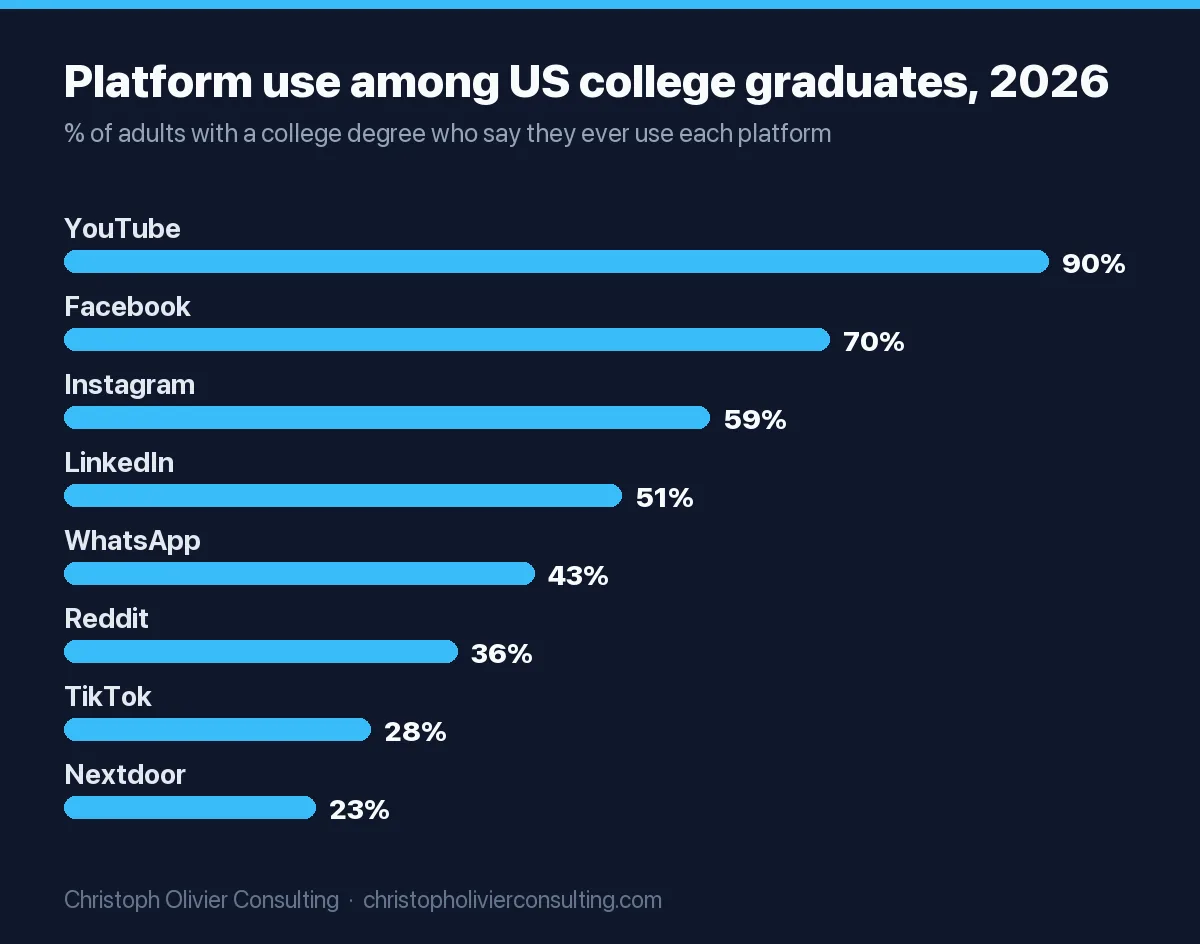
Short answer: Pick one primary platform per client type, not five. In Pew Research Center’s 2026 survey, 51% of US adults use Instagram and 31% use LinkedIn, but among college graduates LinkedIn use rises to 51%. That is the split behind the table below. Post your projects across their whole life, credit everyone, and get a written social media license from your photographer before you post.
Social media distributes your project content; it does not replace it. If you still need the website and case-study system behind your posts, start with our guide to content marketing for architects.
Which social media platform fits which architecture client
The real question is who signs your contracts and where they look. Pick one primary platform and at most one secondary per client type. The “skip” column matters as much as the others.
| Client type | Who decides | Primary platform | Secondary | What each post must prove | Skip |
|---|---|---|---|---|---|
| Residential: custom homes, additions, renovations | Homeowners, often a couple | Facebook if your clients are 50+; Houzz profile; Pinterest boards for search | Taste fit, and that you can handle their kind of site or old house | LinkedIn company page as a lead channel (keep it for hiring) | |
| Multifamily and developer work | Developers, owner’s reps, lenders | LinkedIn (principal profiles first) | Instagram for leasing-quality imagery the developer can share | Unit yield, schedule and entitlement wins on named projects | TikTok, Pinterest |
| Commercial and workplace | Corporate real estate, facilities and HR leaders, brokers | Instagram as a portfolio people check after a referral | Outcomes for named tenants (with permission) and research on how people use space | Facebook ads, Pinterest | |
| Institutional: higher ed, healthcare, private K-12, cultural | Facilities directors, provosts, boards, building committees | YouTube for walkthroughs you can embed in proposals | Relevant building-type experience and the people who will staff the job | TikTok, trend content | |
| Public sector: municipal, state, federal (RFQ and RFP) | Selection panels scoring qualifications | None needed; put effort into the qualifications package | Named key personnel, completed public projects, credits that match your SF330 claims | Anything promotional; panels score documents, not follower counts | |
| Hospitality and retail | Brand owners, operators | LinkedIn for operator relationships | The guest experience in photos and short video | Text-heavy posts |
Two notes on the public-sector row. Federal policy is to select architects “on the basis of demonstrated competence and qualification” (40 U.S.C. 1101, the Brooks Act), so social posts cannot win the job. What they can do is make your key personnel findable and keep your project credits consistent with what you claim in the proposal. Our engineering firm marketing guide covers qualifications-based selection strategy in more depth.
Advertising itself is allowed for architects. The rules that matter on social are about honesty and credit, covered further down.
What the 2026 audience data says
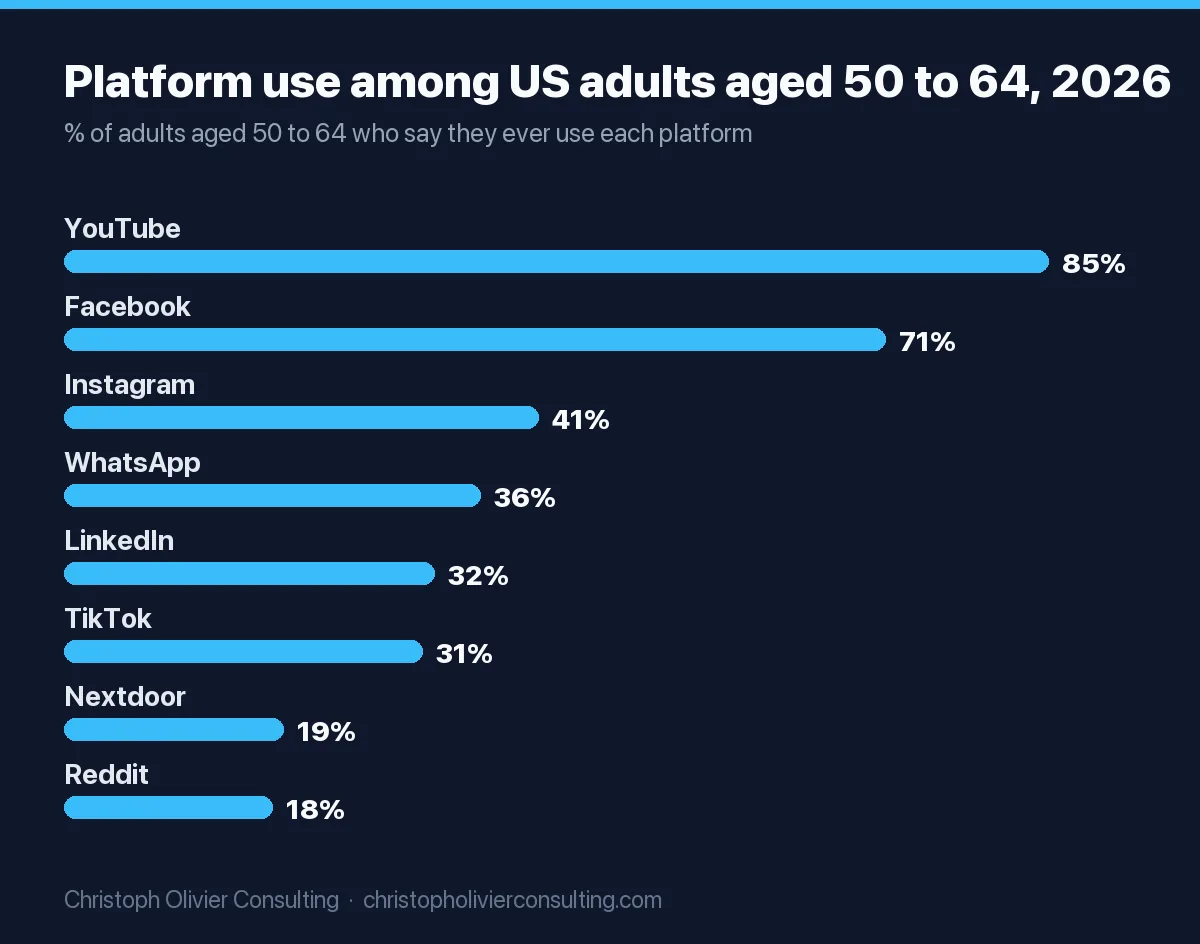
The best public data on who uses each platform comes from Pew Research Center’s “Americans’ Use of Social Media in 2026” fact sheet, published October 19, 2026. It is based on a survey of 5,511 US adults conducted January 30 to June 18, 2026, with a margin of error of plus or minus 1.8 percentage points. The columns below are the groups that matter for architecture clients: older homeowners, high-income households and college graduates (most corporate and institutional decision-makers).
| Platform (% of US adults who use it) | All adults | Ages 50-64 | Ages 65+ | Household income $100K+ | College graduates |
|---|---|---|---|---|---|
| YouTube | 84% | 85% | 65% | 90% | 90% |
| 70% | 71% | 59% | 70% | 70% | |
| 51% | 41% | 21% | 59% | 59% | |
| 31% | 32% | 13% | 45% | 51% | |
| TikTok | 37% | 31% | 11% | 29% | 28% |
| Nextdoor | 18% | 19% | 18% | 23% | 23% |
| Not asked in 2025 or 2026. Pew’s last reading was 36% of US adults in 2024. | |||||
Source: Pew Research Center, 2026. Pinterest 2024 figure from the same fact sheet’s trend table.
Three things in this data change how an architecture firm should plan:
- LinkedIn is a college-graduate platform. It reaches 13% of adults with a high school education or less, 29% with some college and 51% of college graduates. Your commercial and institutional buyers sit in that last group.
- Instagram drops off sharply with age. 79% of adults 18 to 29 use it, but only 41% of those 50 to 64. If your typical residential client is in their 50s or 60s, Facebook (71% and 59% in those age groups) reaches more of them than Instagram does.
- Nextdoor is small but skews toward suburban, higher-income households (23% of suburban adults and 23% of $100K+ households), which is close to the profile of a renovation client.
Platform-reported figures fill in the rest. LinkedIn’s own statistics page lists more than 1.4 billion members, 296 million or more in North America (the US and Canada), and 71 million companies. Pinterest reported 661 million global monthly active users and 107 million in the US and Canada for the quarter ended September 30, 2026, in its third-quarter results filed with the SEC. For a wider set of platform numbers, see our social media marketing statistics for 2026.
Instagram for architecture firms
Instagram is a portfolio that prospects check after a referral or a Google search, and a discovery channel for residential and hospitality work. Three formats do most of the work:
- The project carousel. Instagram allows up to 20 photos and videos in one post, and the orientation you choose (square, portrait or horizontal) applies to every slide, according to Instagram’s help page on multi-photo posts. Plan the sequence: the hero exterior, the problem in one line of caption, the plan or section as slide 3, two or three details, then the credits.
- The short walkthrough Reel. A 20 to 40 second phone walk through a site visit or a finished room. Reels accept aspect ratios from 1.91:1 to 9:16, at 30 frames per second minimum and at least 720 pixels (Instagram reel size help page).
- The single detail post. One image of a junction, material or drawing, with a two-sentence explanation of why it looks the way it does. These are cheap to make and show technical skill.
Put the building type and city in the first line of every caption (“Lake house addition, Traverse City”) because that is how people search inside the app. For broader Instagram mechanics such as Reels distribution and profile conversion, see our Instagram marketing guide for 2026.
LinkedIn for architects: company page vs principal profiles
On LinkedIn, people follow people. A company page is where you publish the official project record. A principal’s personal profile is where you tell the story behind the decisions. Run both, and post on the company page first so principals can reshare with their own comment.
- Company page: project completions, awards, hires, and research. Tag the client organization, the contractor and the consultants so the post shows up for their followers too. BIG, Gensler and Dattner (below) all tag partners in their posts.
- Principal profiles: one decision per post. “Why we kept the 1962 structure” beats “Excited to share our latest project.”
- Document posts: LinkedIn lets you upload a PDF, PPT, PPTX, DOC or DOCX of up to 100MB and 300 pages to a post, and viewers can download it as a PDF (LinkedIn Help). A 6 to 10 page project case study is ideal for institutional and public-sector audiences, because it looks like the proposal content they score. You cannot edit the document after posting, so proof it first.
Our LinkedIn marketing playbook for B2B covers profile setup, connection strategy and paid options in more detail.
What real architecture firms post (checked November 9, 2026)
We looked at the public LinkedIn pages of five firms, from a global practice to a small residential studio. Follower counts and company-size bands are as displayed on each public page on November 9, 2026. Instagram profiles require a login to view, so we report only what we could see on LinkedIn.
| Firm | Size band (as listed) | LinkedIn followers | Recent post formats we saw | What a small firm can copy |
|---|---|---|---|---|
| Gensler | 5,001-10,000 employees | 698,820 | Research posts (Research by Gensler, “The Fandom Effect: Sports Urbanism 2026”); an opening post for Discovery House with the University of Maryland tagged; a construction-process post on the “cut and carve” work at 110 The Queen’s Walk, London | Turn one internal finding into a post. Tag the client on opening day. |
| BIG (Bjarke Ingels Group) | 501-1,000 employees | 612,879 | Construction milestones (the third and tallest steel truss, 290 ft, at the Athletics ballpark in Las Vegas, client tagged); being named AIA New York Center for Architecture Firm of the Year; a partner’s speaking slot announced in Danish for a Copenhagen event | Post construction milestones, not just finished photos. Post talks in the language of the audience. |
| Snøhetta | 201-500 employees | 287,857 | Project stories with hard specifics (NOT A HOTEL RUSUTSU, a 1,200 m² residence in two curved volumes); a multi-image post on the firm’s updated climate targets ahead of COP31, citing a UNEP emissions figure | Put numbers in project captions. Publish your firm position on one issue, with a source. |
| Dattner Architects | 51-200 employees | 15,432 | An award for St. James Terrace (Chicago Athenaeum American Architecture Award, Social Housing); two projects open during Open House New York; an annual photo contest celebrating its built civic work; a managing partner’s board appointment | Use public events (open houses, tours) as post hooks. Run a photo contest of your completed buildings. |
| Flavin Architects | 11-50 employees | 1,284 | Inclusion in the Forbes 2026 list of America’s Top 200 Residential Architects; a Residential Design magazine feature with a client quote | Third-party validation travels further than self-description. Quote the client, with permission. |
The pattern across all five: almost every post is about a named project, person or finding. None post generic tips. A 12-person firm cannot match Gensler’s research budget, but it can match the specificity.
The project lifecycle content system
The fastest way to fill a calendar is to stop inventing topics and post each active project at five stages. Every project you have in progress is a content pipeline.
| Stage | What to post | Who captures it | Best format | Check before posting |
|---|---|---|---|---|
| 1. Site visit | The existing condition and the one constraint you are designing around (slope, setback, an old structure, a tree to save) | Project architect, phone camera | Instagram Reel or single image; LinkedIn text post from a principal | Client OK to show the site. No house numbers or plates for residential. |
| 2. Design detail | A drawing, model or material sample and why you chose it | Designer, scan or phone | Instagram single image; LinkedIn image post | Nothing the client has asked to keep confidential |
| 3. Construction milestone | Structure up, mockup approved, envelope closed | Project architect on site visits | Instagram carousel; LinkedIn post tagging the contractor | Site safety visible in frame. Contractor named correctly. |
| 4. Completion | Professional photos, plan, credits, the brief and outcome | Commissioned photographer | Instagram carousel (up to 20); LinkedIn document post with a 6 to 10 page case study | Photo license covers social. Full credits list. Scope stated accurately. |
| 5. One year later | The building in use, a client quote, a measured result if you have one | Photographer return visit or staff, client | Instagram carousel; principal LinkedIn post on lessons learned | Written quote approval. Measured vs modeled data labeled. |
Stage 5 is the one almost nobody posts, which is why it works. It is also the most persuasive content for institutional buyers, who care about how a building performs after the ribbon cutting.
4-week posting calendar
This calendar assumes three active projects (A is finished, B is in design, C has been occupied for a year), a principal who writes one post a week, and a coordinator who schedules everything. Prep times are our planning estimates for a firm with organized project files, not measured benchmarks. For the mechanics of keeping a calendar alive past month two, see our guide to building a content calendar you actually keep.
| Week | LinkedIn company page | LinkedIn principal profile | Est. prep time | |
|---|---|---|---|---|
| 1 | Mon: Project A completion carousel (10 to 12 slides, credits on the last slide) Thu: Single detail image from Project A | Wed: Project A completion post tagging client, contractor and consultants | Fri: “The one decision that shaped Project A” | 4 to 5 hours (selecting images, writing credits) |
| 2 | Mon: Project B site-visit Reel (20 to 40 seconds) Thu: Project B existing-conditions photo with the constraint in the caption | Wed: Project B “design underway” post with building type and city | Fri: What the site visit changed in the brief | 2 to 3 hours |
| 3 | Mon: Project B material sample or model photo Thu: Team photo at a pin-up, staff tagged | Wed: Document post: 8-page Project A case study PDF | Fri: Credit post naming each consultant on Project A and what they solved | 4 to 6 hours (case study PDF) |
| 4 | Mon: Project C one-year-later carousel with client quote Thu: Reshare of a contractor or consultant post about your project (only if their license allows it) | Wed: Project C one-year-later post, with measured data labeled as measured | Fri: Lesson learned from Project C you will apply next time | 3 to 4 hours (client quote approval) |
That is 12 posts a month from three projects, about 13 to 18 hours of work by our estimate. Repeat the cycle with the next set of projects. If you would rather hand the scheduling to someone else, our breakdown of social media management pricing shows what outsourcing costs.
Instagram and LinkedIn image sizes for architecture posts
Architectural photographers usually deliver horizontal frames, while Instagram’s feed favors vertical. Know the limits before you brief the shoot. All specs below come from the platforms’ own help pages, checked November 9, 2026.
| Placement | Spec | What it means for architecture images | Source |
|---|---|---|---|
| Instagram feed photo | Width 320 to 1080 px kept at original resolution if the aspect ratio is between 1.91:1 and 3:4 (1080 x 566 up to 1080 x 1440). Wider files are sized down to 1080 px; unsupported ratios are cropped. | Export 1080 x 1440 (3:4) for maximum screen height. A 3:2 horizontal frame shows at 1080 x 720. | Instagram Help |
| Instagram carousel | Up to 20 photos and videos; one orientation applies to every slide | Decide vertical or horizontal for the whole set. Ask the photographer for both crops of key views. | Instagram Help |
| Instagram Reels | Aspect ratio 1.91:1 to 9:16; minimum 30 FPS and 720 px; cover photo 420 x 654 px (1:1.55), not editable after upload | Shoot site walkthroughs vertically on a phone at 30 FPS or higher. Pick the cover frame before you post. | Instagram Help |
| LinkedIn Page logo | Recommended 400 x 400 px (minimum 268 x 268); PNG or JPEG, 3MB max | Test the logo on light and dark backgrounds | LinkedIn Help |
| LinkedIn Page cover | 1512 x 256 px | A wide crop of a hero project. Keep key detail centered; edges get trimmed on some screens. | LinkedIn Help |
| LinkedIn link image | 1.91:1 ratio (1200 x 627 px); wider than 200 px. Image-only posts are enlarged to fit the feed. | Set this as the Open Graph image on each project page so shared links look right | LinkedIn Help |
| LinkedIn document post | PDF, PPT, PPTX, DOC or DOCX; up to 100MB and 300 pages; cannot be edited after posting | Use for case studies and project sheets; compress image-heavy PDFs | LinkedIn Help |
Note the crop issue: turning a photographer’s 3:2 frame into a 3:4 Instagram crop is an alteration. Some licenses restrict it. That is the next section.
Photo rights: what your photographer’s license must cover before you post
The photographer owns the copyright in the images, not you, even though you paid for the shoot. The joint AIA and ASMP guide Commissioning Architectural Photography says every license should answer three questions: who will use the images, how and where they will appear, and for how long. Three points in that guide cause most social media problems:
- Licenses do not pass along. In multi-party shoots, expenses and production fees can be shared, but rights licenses “are based on the use each participant makes of the images and are not shared or transferable among the parties.” Your license does not cover your contractor’s Instagram.
- Third parties need their own written license. The guide names design team members, contractors, consultants, product manufacturers, clients, tenants and magazine editors. Possession of the files does not grant the right to use them.
- Late requests cost more. Photographers typically charge third parties who license after the shoot at least as much as the original group paid. The guide advises negotiating a price for future rights up front.
Advertising is a separate use. The same guide lists “trade or consumer advertising” as its own category, apart from website and portfolio use. Treat boosted posts and LinkedIn sponsored content as advertising unless your license says otherwise. Photographers have adapted to social media in different ways. In a Q&A of architectural photographers on Kenneth Caldwell’s site, Tim Griffith describes an optional editorial license line item, priced as a percentage of the base shoot fee, that lets a firm distribute images to online publications and its social media. Alan Karchmer delivers a separate low-resolution set with his copyright notice and the architect’s attribution embedded in the image.
Your owner-architect agreement also matters, because it controls whether you can show the client’s building at all. Our architecture content marketing guide covers the standard AIA B101 photo clause and typical shoot costs.
Usage-rights clause checklist (pass/fail)
Send this to your photographer with the shoot brief. A license passes when every row is in the “Pass” state in writing. Have your attorney review the final wording, since this checklist is a negotiating aid, not legal advice.
| Clause | What to ask for | Pass | Fail |
|---|---|---|---|
| 1. Licensee | The firm plus its principals and employees when posting about the firm’s work | Staff and principals can post on personal LinkedIn and Instagram | Only the firm entity is named; principal posts are uncovered |
| 2. Media | Organic posts on firm-controlled and staff social accounts, on current and future platforms | Social media is named explicitly, not implied by “website” | “Website and printed brochure” only |
| 3. Paid promotion | Boosted posts and sponsored content, with a spend cap or time limit if needed | Included, or priced in the estimate as an option | Silent (treat as not licensed) |
| 4. Term | Perpetual for posts already published; stated years for new posts | Old posts can stay up when the term ends | A 1 to 3 year term that forces you to delete archived posts |
| 5. Territory | Worldwide | Worldwide | A regional limit (social posts are visible everywhere) |
| 6. Crops and edits | Crops to 1:1, 4:5, 3:4 and 9:16; carousel sequencing; slow pan or zoom motion for Reels; logo overlay | Each listed alteration allowed | “No alteration” with no crop exception |
| 7. Credit line | Exact format, for example “Photo: Name” in the caption plus the photographer’s handle tagged | Format written down | Unspecified, so disputes come later |
| 8. Tags and reshares | Whether partners may reshare your post inside the platform, and that downloads for their own posts need their own license | Native reshares addressed in writing | Silence, leading to contractors downloading and reposting |
| 9. Awards and press | Award entries and your own pitches to publications | Award use included; editorial publication terms stated | Assumed; the ASMP guide says editorial rights are not typically granted unless written |
| 10. Deliverables | A web-sized set at least 1080 px wide in both orientations for key views, plus full-resolution masters | Social-ready files delivered with the masters | Only print masters, so staff re-export and re-crop by hand |
| 11. Future rights price | A stated fee for adding uses later (advertising, books, another party) | Price committed in the estimate | “To be negotiated” |
| 12. Releases | Who obtains releases for identifiable people and owner or occupant permission | Responsibility assigned | Unassigned; occupants appear without permission |
AIA Code of Ethics rules that apply to social posts
The 2026 AIA Code of Ethics and Professional Conduct (current as of June 9, 2026) binds AIA members. Its Rules of Conduct are mandatory, and a violation is grounds for discipline by the Institute. Your state licensing board may have separate rules. These six rules are the ones a social post can break:
| Rule | What it says (paraphrased) | How a post breaks it | Fix |
|---|---|---|---|
| 4.201 | No misleading claims about qualifications, experience or performance; accurately state the scope and nature of your responsibilities for work you claim credit for. The commentary says it targets claiming or implying credit for work you did not do. | “Our new library” when you were architect of record and another firm was design architect | “Architect of record. Design architect: [Firm].” on every post about the project |
| 5.301 | Recognize and respect the professional contributions of employees, employers, colleagues and business associates | Completion post that names only the principal | Credits slide or caption with the project team and consultants |
| 4.103 | No knowingly false statements of material fact when speaking in a professional capacity | “LEED Platinum” when the project is only targeting it; wrong award name or year | Post certifications and awards only once confirmed, with the exact name |
| 3.301 | Do not intentionally or recklessly mislead clients or prospects about the results your services can achieve | “Cut energy use 40%” when that number came from a model | Label figures as modeled or measured, and give the period |
| 3.401 | Do not knowingly disclose information a client asked you to keep confidential, or that would harm them | Posting a private residence, or a security-sensitive interior, without consent | Written client approval before any project post |
| 2.301 | Disclose when you are paid, or have an economic interest, when making public statements on architectural issues | A post praising a product the manufacturer paid for or supplied free | State the relationship in the caption |
6 caption templates you can copy
Fill the brackets, delete what does not apply, and keep the first line specific enough to be searchable. Each template matches a lifecycle stage above.
1. Site visit (Instagram or LinkedIn)
[Building type], [neighborhood or city]. First site walk today.
The constraint we are designing around: [one specific fact, e.g. a 9 ft grade change across the lot].
What we will test next: [option A] vs [option B].
Shared with the owner's permission.
2. Design detail
Detail: [element] at [project name], [city].
Why it looks like this: [one sentence: code, climate, budget or craft reason].
Drawn by [name, role]. [Built by @contractor, if under construction.]
3. Completion carousel
[Project name]: [building type], [city], [year].
The brief: "[client's goal in their own words]."
The hard part: [constraint] (slide [n]).
Our role: [architect of record / design architect / interiors].
Team: [@consultant 1], [@consultant 2]. Contractor: [@contractor].
Photos: [Photographer name] [@handle].
4. One year later
One year in at [project name].
What [client role] told us: "[quote, approved in writing]."
What we measured: [metric] over [period], [measured or modeled].
What we would do differently: [one honest lesson].
5. Public or institutional milestone (LinkedIn)
[Agency or institution] opened [facility] on [date].
Our role: [scope], working with [prime or associate firm].
[One verified fact: schedule, budget or program, only if the client has approved it.]
Thank you to [team], [consultants] and [contractor].
Photos: [credit].
6. Award with full credits
[Project name] received the [exact award name, year, category] from [organization].
Credit where it is due: design architect [firm], architect of record [firm], engineers [firms], contractor [firm], photographer [name].
Full project story: [link to project page]
How to tell if it is working
Follower counts are the wrong scorecard. Dattner Architects has about 1/45th of Gensler’s LinkedIn following, and its feed is still full of civic projects, awards and public tours. Track four things each month instead:
- Inquiries that mention social. Add “How did you hear about us?” to your contact form and intake call, with Instagram and LinkedIn as options.
- Website sessions from social in your analytics, split by platform, landing on project pages.
- Shortlist mentions. After interviews, ask the selection contact what they reviewed. Note when a post or case study PDF comes up.
- Saves and shares per project post. These show which building types and stages people find useful, so you can shift the mix.
Give the system two full quarters before judging it. In my view, the most common mistake is posting finished photos only and skipping stages 1, 3 and 5. If you want a second opinion on your platform mix or your first 90 days of posts, you can book a consultation.
Ready to scale your revenue?
Book a free 30-min consultation. We’ll diagnose your growth bottleneck and map out the 3 highest-leverage moves for your business.
Frequently asked questions
What is the best social media platform for architects?
It depends on who hires you. Residential firms do best on Instagram, plus Facebook if clients are over 50. Commercial, institutional and public-sector firms should prioritize LinkedIn. Pew Research Center's 2026 survey found 51% of US college graduates use LinkedIn versus 31% of all adults, while Instagram reaches 51% of all adults but only 41% of those aged 50 to 64.
Should an architecture firm use Instagram or LinkedIn?
Use both, but give each a job. Instagram is the visual portfolio that residential and hospitality prospects check after a referral. LinkedIn is where corporate, institutional and public clients look up your firm and your key people. Post the official project record on the LinkedIn company page and let principals reshare it with their own decision story.
How often should an architecture firm post on social media?
A sustainable pace for a small firm is about three posts a week: two on Instagram, one on the LinkedIn company page, plus one post a week from a principal's personal profile. Feeding that from three active projects at different stages (site visit, detail, construction, completion, one year later) avoids running out of topics. Treat this as a planning cadence, not a platform rule.
Can architects post a photographer's pictures of their projects on Instagram?
Only if your written license covers social media. The photographer owns the copyright. The AIA and ASMP guide to commissioning architectural photography says each license should state who uses the images, where, and for how long, and that licenses are not transferable between parties. Check that the license covers organic posts, paid boosts, crops to vertical formats and staff accounts.
Can a contractor or consultant repost our project photos?
Not on the strength of your license. The AIA and ASMP guide says contractors, consultants, manufacturers and clients each need their own written license from the photographer, because rights are based on each party's use. Native in-app reshares of your post are a gray area, so ask the photographer to address reshares in writing before the shoot.
What size should Instagram posts be for architecture photos?
Instagram keeps photos up to 1080 pixels wide at full resolution when the aspect ratio is between 1.91:1 and 3:4, so 1080 x 1440 gives the tallest feed image. A carousel holds up to 20 photos or videos, but one orientation applies to every slide. Reels accept 1.91:1 to 9:16 at 30 frames per second and at least 720 pixels.
Do architects have to credit consultants and design architects in social posts?
AIA members do. Rule 4.201 of the 2026 AIA Code of Ethics requires accurately stating the scope of your responsibilities for work you claim credit for, and Rule 5.301 requires recognizing colleagues' and associates' contributions. In practice, state your role (for example architect of record) and list the design team, consultants, contractor and photographer on every completion post.