
Last reviewed: October 2026
An AEO roadmap is a 12-month plan that makes your firm easy for AI answer engines to find, quote and cite. It runs in four quarters: fix technical access and entity signals, restructure content so single sentences can be extracted, earn mentions on third-party sites, then measure citation share and iterate. Most firms see early citations within one or two quarters, but compounding results usually take the full year.
This page gives you the quarter-by-quarter plan, a milestone and KPI table, realistic expectations by month, a measurement setup you can build in GA4 this week, and a worked example for justifying the budget to a CFO. It assumes you already have a working website and some SEO history.
What an AEO roadmap is (and what it is not)
An AEO roadmap is a sequenced work plan, not a tactic list. It tells you what to fix first, which pages to rewrite, where to earn mentions and how to prove progress. It sits on top of your SEO program, because answer engines mostly pull from pages that already get crawled, indexed and trusted.
That last point matters. Google states plainly that there are no additional requirements to appear in AI Overviews or AI Mode, and that a page must be indexed and eligible to show with a snippet to be used as a supporting link. Google also says no special schema or AI text file is required. So an AEO roadmap is not a new website. It is a deliberate shift in how you structure answers, build reputation off-site and measure visibility.
If you want the full definitions first, read the complete guide to answer engine optimization. If you are still sorting out where AEO ends and SEO begins, the breakdown of AEO vs SEO vs GEO covers the overlap.
Why plan AEO over 12 months instead of a 90-day sprint
A 90-day sprint can fix access and rewrite a handful of pages, but the strongest drivers of AI visibility are off-site reputation signals that take quarters to build. A 12-month roadmap gives you time to fix foundations, restructure content, earn third-party mentions and then measure whether citation share actually moved.
The case for planning now rests on a few verifiable shifts in how people search:
- Answer engines are mainstream. Google reported on its Q2 2025 earnings call that AI Overviews had 2 billion monthly users and AI Mode had over 100 million. OpenAI said in February 2026 that ChatGPT reached 900 million weekly active users.
- Buyers start research in chatbots. In G2’s March 2026 survey of more than 1,000 B2B software buyers, 51% said they start research with an AI chatbot more often than Google, and 71% rely on chatbots somewhere in the process. That sample is software buyers, not buyers of professional services, so treat it as directional.
- Clicks from classic results are shrinking. Pew Research found Google users clicked a traditional result in 8% of visits when an AI summary appeared, versus 15% without one, and clicked a link inside the summary in only 1% of visits. Ahrefs’ December 2025 data showed an AI Overview correlated with a 58% lower average click-through rate for the top-ranking page.
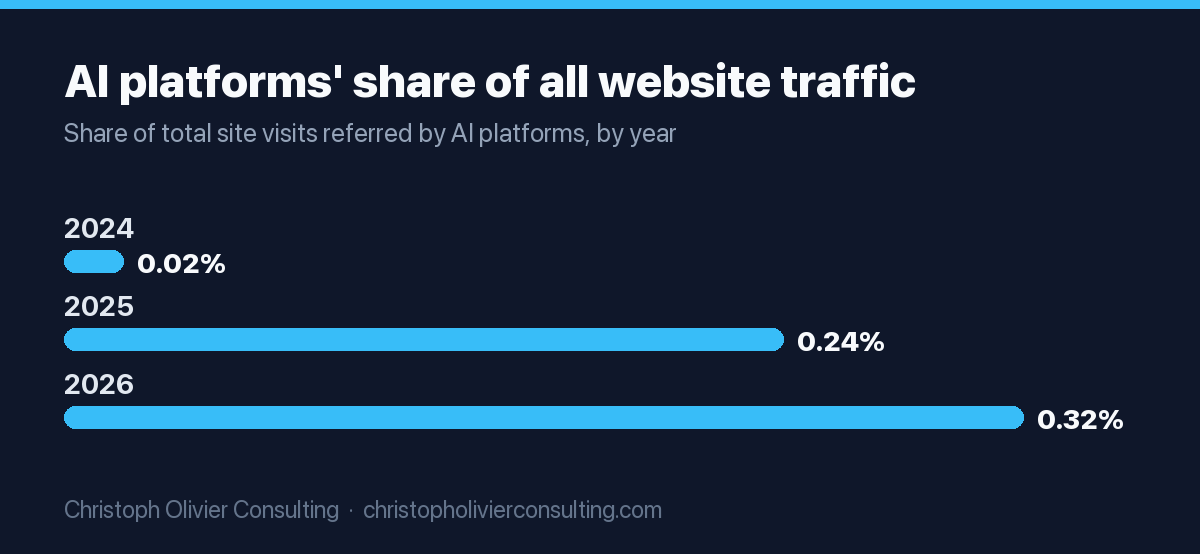
- AI referrals are small but rising fast. SE Ranking’s analysis of 101,574 websites found AI platforms sent 0.32% of all website traffic in 2026, up from 0.24% in 2025 and 0.02% in 2024.
Being cited inside the answer is becoming the visibility that counts, while the click that follows is smaller and later. A 12-month plan lets you build for citation without abandoning the search traffic that still pays the bills.
The AEO roadmap at a glance: milestones and KPIs by quarter
The roadmap has four quarters with one job each: foundation, extractability, off-site authority, and measurement plus iteration. Each quarter has a milestone you can verify and a small set of KPIs. Use the table below as the one-page version you share with partners or a CFO.
| Quarter | Focus | Milestone (verifiable) | Leading KPIs | Lagging KPIs |
|---|---|---|---|---|
| Q1 (months 1 to 3) | Foundation: access, entity, baseline | Prompt set of 50 to 100 buyer questions tracked; AI crawlers allowed; GA4 AI channel live | Baseline mention rate and citation rate per engine; pages indexed | AI referral sessions (baseline only) |
| Q2 (months 4 to 6) | Content restructuring for extractability | Top 20 to 30 revenue pages rewritten answer-first; extractability score recorded before and after | Extractability score; citation rate on prompts mapped to rewritten pages | AI referral sessions; assisted conversions |
| Q3 (months 7 to 9) | Off-site mentions and citations | Target list of 20 to 40 third-party sources worked; profiles and directories corrected | New brand mentions on sources engines cite; branded search trend | Mention rate vs baseline; inquiries that cite AI as the source |
| Q4 (months 10 to 12) | Measurement, pruning, next-year plan | Quarter-over-quarter visibility report; pages refreshed or consolidated; year-two plan approved | Visibility share by topic vs named peers | Pipeline influenced by AI-referred and AI-mentioned leads |
The prompt and page counts are defaults. Scale them to your firm’s size and number of service lines.
Q1, months 1 to 3: foundation, entity and technical access
The first quarter makes sure answer engines can reach your pages, understand who you are and connect your firm to the topics you sell. It also sets the baseline you will measure against all year. Skip the baseline and you will have no honest way to show progress in month nine.
- Build your prompt set. Write 50 to 100 questions a real buyer would ask an assistant, grouped by service line and buying stage. Pull them from sales call notes, intake forms and Search Console queries. Include “who” questions (“best fractional CMO for law firms”) and “how” questions.
- Record the baseline. Run each prompt several times per engine and log whether your firm is mentioned, whether your site is cited, and which other sources are cited. Repeat runs matter, as the measurement section explains.
- Open the doors. Check robots.txt and your firewall. OpenAI states that OAI-SearchBot is what surfaces sites in ChatGPT search, that sites blocking it will not appear in ChatGPT search answers, and that robots.txt changes take about 24 hours to apply. Blocking GPTBot (training) is a separate decision from allowing OAI-SearchBot (search).
- Confirm indexing. Because Google only uses indexed, snippet-eligible pages in AI features, fix noindex mistakes, orphan pages and thin duplicates now.
- Tighten entity signals. Make your firm name, founders, services, locations and credentials consistent on your About page, author bios, Google Business Profile, LinkedIn and directories. Organization and Person schema can help clarify facts, but Google says no special schema is needed for AI features, so treat it as hygiene, not a ranking lever.
- Stand up measurement. Create the GA4 AI channel described below so every later quarter has clean data.
Q2, months 4 to 6: restructure content for extractability
The second quarter rewrites your highest-value pages so an answer engine can lift one or two sentences and use them as a complete, accurate answer. The goal is extractability: each key claim stands on its own, names its subject, and holds up without the paragraph around it.
What answer-first structure looks like
- A two to three sentence answer at the top of the page that directly answers the main question.
- Question-style headings that match how people phrase prompts.
- A 40 to 60 word direct answer as the first paragraph under each heading.
- Tables for comparisons, numbered lists for processes, and specific numbers with linked sources.
- A visible review date and a named, credentialed author.
How to measure sentence-level extractability
No platform publishes an official extractability score, so build a simple internal rubric and apply it the same way every time. Pick the 10 sentences on a page that carry its main claims. Score each one pass or fail on five tests:
- Named subject. It does not start with “it”, “this” or “they” that depend on a prior sentence.
- Complete claim. It answers a question on its own, with no “as mentioned above”.
- Specific. It includes a number, a condition, a timeframe or a named method instead of a vague adjective.
- Sourced or owned. Any statistic links to its primary source; any opinion is clearly attributed to your firm.
- Short enough. Under about 30 words, so it can be quoted without trimming.
Your page score is the share of the 10 sentences that pass all five tests. Record it before and after each rewrite. Then compare it with the citation rate on the prompts that page targets. If scores rise and citations do not, the problem is likely authority or demand, not structure, which points you to Q3.
Q3, months 7 to 9: earn off-site mentions and citations
The third quarter builds the reputation signals that answer engines appear to weigh most: your brand named on other credible sites. On-site work makes you quotable. Off-site mentions make you the firm an engine has reason to recommend when someone asks “who should I hire”.
The best public evidence here is correlational. In an Ahrefs study of 75,000 brands, the factor most strongly linked to AI Overview mentions was branded web mentions, with a correlation of 0.664, ahead of branded anchors at 0.527 and Domain Rating at 0.326. Ahrefs also found 26% of brands studied had zero AI Overview mentions. Correlation is not proof of cause, but it is a strong hint about where to spend Q3.
- Mine your baseline. List the third-party sources engines cited for your prompts: trade associations, industry publications, directories, review sites, podcasts. That is your target list.
- Earn placements that name you. Contributed articles, expert quotes, podcast appearances, conference talks with published recaps, and association resource pages.
- Publish something worth citing. Original data, a benchmark or a clear framework gives other writers a reason to name your firm.
If you want a deeper playbook for this phase, the guide on how to rank on AI assistants covers mention-building in more detail.
Q4, months 10 to 12: measure, prune and iterate
The fourth quarter turns a year of work into decisions. You rerun the full prompt set, compare visibility share against the Q1 baseline and named peers, refresh or consolidate pages that underperform, and write the year-two roadmap from evidence instead of guesses.
- Rerun every prompt with the same method and number of runs as Q1.
- Report mention rate, citation rate and visibility share by service line and by engine.
- Match AI-referred sessions and self-reported “found you through ChatGPT” leads to pipeline in your CRM.
- Refresh pages whose facts or prices are stale. Consolidate near-duplicate pages that compete for the same prompts.
- Drop tactics that showed no movement after two quarters and fund the ones that did.
What results to expect from AEO by month
Realistic AEO expectations are modest early and compound later. In the first three months you should expect fixed access, a measured baseline and perhaps a few new citations on long-tail questions. Months four to six often bring citation gains on rewritten pages. Meaningful pipeline effects, if they come, usually show in the second half of the year.
No one can promise a citation. Answer engines change models, sources and layouts without notice, and results vary by run. Here is a reasonable planning view for a management consultancy or similar professional-service firm with an established site:
| Period | What is realistic | What is not realistic |
|---|---|---|
| Months 1 to 2 | Crawler access fixed, baseline recorded, GA4 channel live, first pages rewritten | Measurable change in leads |
| Months 3 to 6 | Citations on specific, low-competition questions; higher extractability scores; a trickle of AI referral sessions | Being named for broad “best consultancy” prompts |
| Months 7 to 9 | New third-party mentions; mention rate rising on prompts tied to those sources | AI as a top traffic channel |
| Months 10 to 12 | Clear before-and-after visibility share; a few inquiries that cite AI as the source | Attribution that ties every deal to an AI answer |
Keep volume in perspective. If AI platforms send roughly 0.32% of total web traffic on average, per SE Ranking, then AI referral sessions will look tiny next to organic search for most firms. SE Ranking also found AI visitors stayed longer, with an average session of about 9 minutes 19 seconds versus 5 minutes 33 seconds for organic. Judge the program on visibility share and lead quality, not raw session counts.
How to measure AI visibility
Measure AI visibility with three layers: prompt tracking for mention and citation share, GA4 for referral sessions from assistants, and your CRM for leads that say AI sent them. No single layer is complete. AI answers vary run to run, and many AI visits arrive with no referrer and land in Direct.
Layer 1: prompt tracking and citation share
Variation is the core problem. SparkToro’s study of 2,961 prompt runs across ChatGPT, Claude and Google’s AI found less than a 1 in 100 chance that ChatGPT or Google’s AI would return the same list of brands in any two responses. The authors concluded that “ranking position in AI” is not a meaningful metric, while visibility percentage across many runs is reasonable.
So track three numbers per prompt group, each averaged over repeated runs:
- Mention rate: share of responses that name your firm.
- Citation rate: share of responses that link to your domain.
- Visibility share: your mentions divided by all firm mentions in that prompt group, compared with named peers.
Layer 2: AI referral traffic in GA4
Create a custom channel group so AI assistants stop hiding inside Referral. Google’s documentation says custom channel groups apply to reports retroactively, standard properties get two custom groups, and traffic goes to the first channel whose rules it matches.
- In GA4, open Admin, then Data display, then Channel groups, and create a new group.
- Add a channel named “AI assistants” with the condition: Source matches regex
chatgpt\.com|openai\.com|perplexity\.ai|gemini\.google\.com|copilot\.microsoft\.com|claude\.ai - Move the AI assistants channel above Referral so it matches first.
- Save, then check the Traffic acquisition report with the new channel group selected.
ChatGPT search links typically carry a utm_source=chatgpt.com parameter, which is why the rule uses Source and not only the referrer. Expect undercounting anyway, since some assistant traffic arrives without a referrer. For a fuller reporting setup, see the guide to AI search analytics.
Layer 3: self-reported attribution
Add “How did you hear about us?” as a free-text field on your contact form and in intake calls. Tag answers that mention ChatGPT, Perplexity, Gemini or “AI”. For high-value professional services, a handful of these leads per quarter can matter more than any session count.
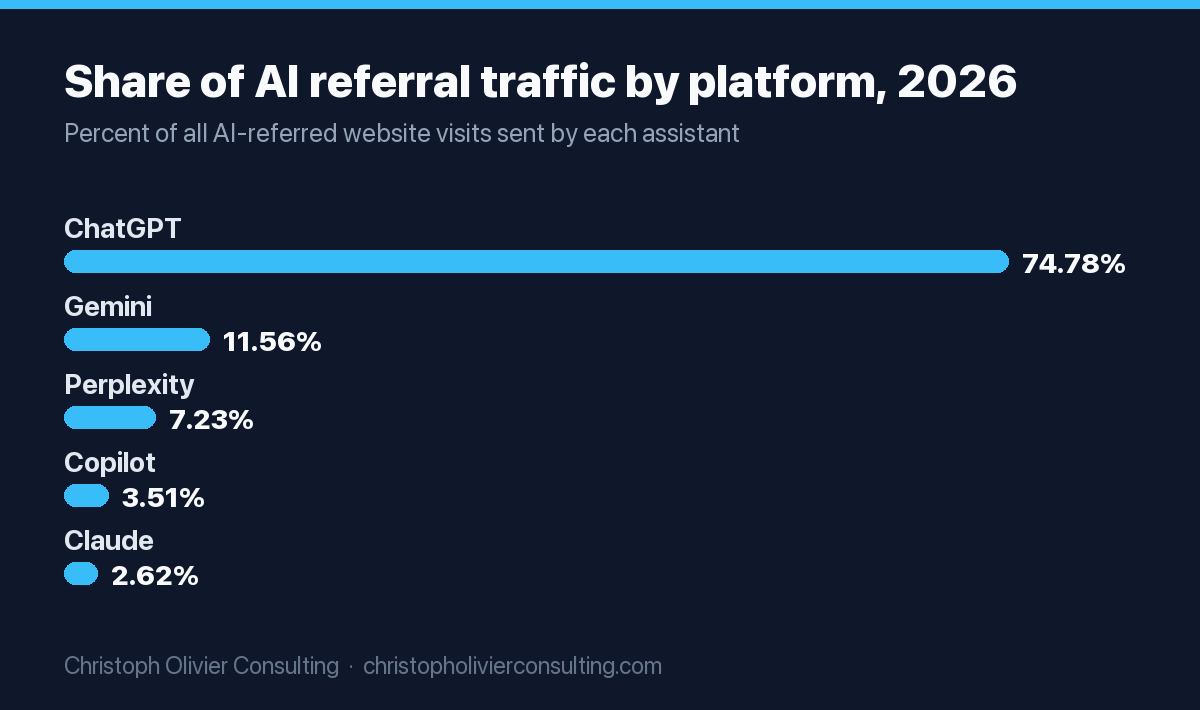
Report all three layers in the same format every quarter so trends are comparable. When choosing which engines to track first, start with where the referrals come from: in SE Ranking’s 2026 data, ChatGPT sent 74.78% of AI referral traffic, Gemini 11.56%, Perplexity 7.23%, Copilot 3.51% and Claude 2.62%.
How to budget an AEO roadmap and justify it to your CFO
Present AEO to a CFO as a time-boxed reallocation with stop and go criteria, not a new open-ended line item. Fund it from existing SEO spend, tie it to verifiable leading indicators each quarter, and agree in advance what result ends the test. That framing turns a speculative bet into a controlled experiment.
Where the money goes
- Measurement: a prompt-tracking tool or a disciplined manual process, plus analyst time.
- Content restructuring: writer and editor hours for the Q2 rewrites.
- Off-site work: PR, contributed content, speaking and directory cleanup in Q3.
- Original research: optional, but often the strongest citation magnet.
Worked example: moving 10% of SEO budget into AEO
The numbers below are hypothetical, chosen to show the structure of the argument. Swap in your own.
Say your firm spends $8,000 a month on SEO, or $96,000 a year. You propose moving 10%, which is $800 a month or $9,600 a year, into AEO measurement and restructuring for two quarters. The pitch to the CFO has four parts:
- The risk: cite the Pew and Ahrefs click data above. If top-ranking pages lose clicks when AI answers appear, some of the current SEO return is already eroding.
- The test: six months, $4,800, spent on a tracking tool or analyst hours plus rewrites of your top 12 service pages.
- The success criteria: mention rate on your core prompt set rises versus the Q1 baseline, extractability scores rise on rewritten pages, and you can see AI referral sessions and at least some self-reported AI leads.
- The decision rule: if leading indicators move, fund Q3 and Q4 at the same or higher level. If nothing moves after two quarters, return the money to SEO.
Many CFOs respond better to a capped, reversible test than to a forecast. Avoid promising revenue numbers you cannot support. If you can show that one closed engagement came from an AI-assisted inquiry, put that single deal value next to the test cost and let the comparison speak.
Common AEO roadmap mistakes to avoid
The most common AEO roadmap mistakes are skipping the baseline, tracking ranking position instead of visibility share, treating schema or AI text files as shortcuts, and stopping before off-site work has time to show. Each one either wastes budget or leaves you unable to prove what worked.
- No baseline. Without Q1 numbers, Q4 reporting turns into anecdotes.
- Single-run checks. Asking ChatGPT once and screenshotting the answer proves very little, given how much answers vary.
- Blocking the wrong bot. Blocking OAI-SearchBot while meaning to block training crawlers removes you from ChatGPT search.
- Abandoning SEO. Google’s AI features draw on indexed, snippet-eligible pages, so weak SEO caps AEO.
In my experience, the firms that get the most from AEO are the ones that treat it as an extension of disciplined SEO rather than a separate project. If you want help turning this roadmap into a plan for your firm, our SEO services include AEO work, and you can book a consultation to talk through where your firm stands today.
Frequently asked questions
How do I build an AEO roadmap for the next 12 months?
Split the year into four quarters. In Q1, build a prompt set, record a baseline and fix crawler access and entity signals. In Q2, rewrite your top pages answer-first so single sentences can be quoted. In Q3, earn mentions on third-party sites that answer engines already cite. In Q4, rerun the prompt set, compare visibility share with the baseline and plan year two.
What results should a management consultancy expect from AEO in the first six months?
Expect foundations more than revenue. In most cases the first six months bring fixed crawler access, a measured baseline, higher extractability scores on rewritten pages and some citations on specific, lower-competition questions. Broad prompts like best consultancy for a sector usually take longer, because they depend on third-party mentions that build over several quarters. No one can promise a specific citation.
How do I measure AI visibility for my firm?
Use three layers. Track a fixed set of buyer prompts across engines, running each several times, and record mention rate, citation rate and visibility share versus peers. Add a GA4 custom channel group that catches referrals from assistants such as chatgpt.com and perplexity.ai. Then ask new leads how they found you and tag answers that mention AI tools.
How do I measure sentence-level extractability for AEO?
Pick the 10 sentences that carry a page's main claims and score each pass or fail on five tests: named subject, complete claim, a specific number or condition, a linked source or clear ownership, and under about 30 words. The page score is the share that pass all five. Record it before and after rewrites and compare it with citation rate.
How do I justify moving 10% of our SEO budget into AEO to my CFO?
Frame it as a capped, reversible test. Show the evidence that AI answers are reducing clicks on top-ranking pages, propose a fixed two-quarter budget drawn from existing SEO spend, and agree success criteria in advance, such as a higher mention rate versus baseline. If leading indicators do not move after two quarters, the money returns to SEO.
Do I need special schema or an AI text file to appear in AI Overviews?
No. Google states there are no additional requirements to appear in AI Overviews or AI Mode, and no special schema or AI text file is needed. A page must be indexed and eligible to show with a snippet. Schema can still help clarify facts about your firm, but treat it as good hygiene rather than a shortcut to citations.
More SEO guides
- Answer Engine Optimization: Complete 2026 Guide
- AEO vs SEO vs GEO: What Matters Most
- AI Search Analytics: How to Measure Visibility and Traffic From AI Search
- Search Engine Marketing for Small Business: A Practical Starter Guide
- How to Hire a Local SEO Company
- Corporate SEO: How Search Works at Enterprise Scale
- All SEO guides →