
B2B lead generation strategies are the repeatable channels a company uses to turn strangers into qualified sales conversations: inbound (SEO and content), outbound (cold email, LinkedIn, calling), paid search and paid social, account-based marketing (ABM), and referrals or partnerships. The teams that win pick two or three that fit their deal size and sales cycle, then sequence the rest as pipeline grows.
Last reviewed: October 2026
Most published lists name ten or fifteen tactics and stop there. That is the wrong problem. The hard part is not knowing that content marketing or cold email exists. It is choosing which one to run first with a limited budget, and knowing when it should start producing meetings. This page gives you the fit-by-effort ranking and a sequencing order, and it links down to the deeper channel playbooks for the two engines most B2B teams run: outbound lead generation and SEO for lead generation.
What counts as a B2B lead generation strategy?
A B2B lead generation strategy is a channel plus a repeatable process that produces qualified leads, meaning contacts who match your ideal customer profile and show buying intent. A single LinkedIn post is a tactic. A weekly posting cadence tied to a lead magnet and a follow-up sequence is a strategy. The difference is repeatability and a defined path from first touch to a sales conversation.
In B2B the buying committee usually has three to ten people and a sales cycle running weeks to many months, so one channel rarely closes a deal alone. A working program combines a demand-capture channel that catches buyers already searching with a demand-creation channel that reaches accounts before they start looking.
The B2B lead generation strategies that work now
The five strategies below cover almost every B2B pipeline built in 2026. Each fits a different deal size, market size, and team. The table ranks them by who they suit and how much sustained effort they take before they produce meetings, so you can match the channel to your situation instead of running all five at once and diluting every one.
| Strategy | Best for | Effort to first results |
|---|---|---|
| Inbound (SEO and content) | Large addressable market, modest to mid deal values, buyers who search | High effort, 4 to 9 months to compound |
| Outbound (cold email, LinkedIn, calling) | Defined target list, mid to high deal values, need pipeline fast | Medium effort, 2 to 6 weeks to first meetings |
| Paid search and paid social | Clear commercial-intent keywords or tight audience, budget to spend | Low to medium effort, days to weeks, stops when spend stops |
| Account-based marketing (ABM) | Small list of high-value accounts, complex long sales cycles | High effort, 3 to 6 months, sales and marketing aligned |
| Referrals and partnerships | Any stage, strong existing customers or complementary vendors | Low ongoing effort, weeks once a formal ask exists |
Inbound: SEO and content marketing
Inbound captures buyers who are already searching for a solution, which is why roughly nine in ten B2B buying processes start with an online search. You publish commercial-intent pages and helpful content, rank for the terms buyers use, and capture leads with gated assets, demo requests, or a free tool. It compounds: a page that ranks keeps producing leads at near-zero marginal cost.
The tradeoff is time. SEO and content usually take four to nine months to compound, so inbound is the strongest core engine for a large market but a poor choice if you need meetings this quarter. The deeper mechanics of turning rankings into booked calls live in our SEO for lead generation guide, and the content marketing pillar covers the format and distribution system.
Outbound: cold email, LinkedIn, and calling
Outbound reaches buyers before they start searching by contacting a researched list directly through cold email, LinkedIn messages, and calls. It is the fastest strategy to first meetings, often two to six weeks, because you control the volume rather than waiting for demand. It works when your list is tight, your messaging is specific to a named problem, and your cadence is consistent.
The risks are deliverability and compliance. Sending from warmed domains, keeping lists clean, and honoring CAN-SPAM opt-out rules protect your sender reputation. Outbound scales linearly with effort and stops the day you stop sending, so most teams pair it with inbound. The full cadence, list-building, and deliverability playbook is in our outbound lead generation guide.
Paid search and paid social
Paid channels buy attention instead of earning it, and they produce leads within days rather than months. Paid search (Google Ads) catches commercial-intent queries at the moment of need; paid social (LinkedIn Ads, Meta) targets by job title, company, or audience list. The advantage is speed and precise testing. The catch is that leads stop the moment spend stops, and B2B clicks can run high in competitive categories.
Paid works best as a demand-capture accelerator on top of an inbound foundation, or to test which offers and audiences convert before you commit content or outbound effort to them.
Account-based marketing (ABM)
ABM flips the funnel: instead of casting wide, you pick a short list of high-value target accounts and coordinate marketing and sales to reach the whole buying committee inside each one. It fits complex deals with long sales cycles and large contract values, where winning twenty accounts matters more than collecting a thousand leads.
ABM demands tight sales and marketing alignment and takes three to six months to show pipeline, so it is a poor first move for an early team. It is the right layer once you have proven demand and want to concentrate resources on the accounts that move revenue.
Referrals and partnerships
Referral and partner leads convert faster and at higher rates than most cold channels because they arrive with trust already attached. The mistake is treating them as luck instead of a system. A structured referral program with a specific ask, a clear moment to make it (right after a customer win), and simple tracking turns satisfied customers into a repeatable source.
Partnerships extend the same idea to complementary vendors who serve your buyer without competing. Both take little ongoing effort once the ask and the tracking exist, which makes referrals one of the highest-return strategies for any stage.
Inbound vs outbound vs ABM: which should you start with?
Start with the channel that matches your market size, deal value, and how fast you need pipeline. Inbound suits a large market with modest deal values and buyers who search. Outbound suits a defined target list, higher deal values, and a need for meetings soon. ABM suits a small set of high-value accounts and long, complex cycles. Most teams end up running two: one to create demand and one to capture it.
| Your situation | Start here | Add next |
|---|---|---|
| Large market, modest deal value, buyers search | Inbound (SEO and content) | Paid search, then referrals |
| Defined list, high deal value, need pipeline now | Outbound | ABM on the best-fit accounts |
| Few high-value accounts, long complex cycle | ABM plus outbound | Inbound for air cover |
| Strong existing customers, tight budget | Referrals and partnerships | Inbound to compound |
How to sequence B2B lead generation by stage and budget
Sequencing beats spreading. Run one demand-capture channel and one demand-creation channel well before adding a third. The order below moves from fastest payback to longest, so a limited budget produces meetings early while the compounding engine builds underneath. Work it top to bottom.
- Fix the offer and the capture path first. Before any channel, define the ideal customer profile, one specific offer (a demo, an audit, a lead magnet), and a landing page with a form or booking link. Traffic without a capture path wastes every dollar that follows.
- Turn on referrals immediately. Ask your best current customers for one introduction each and add a standing referral ask to your delivery process. This is the cheapest pipeline available and needs no ad budget.
- Launch outbound for near-term meetings. Build a tight list of 100 to 300 fit accounts, write problem-specific messaging, and run a multi-touch email and LinkedIn cadence. Expect first meetings in two to six weeks.
- Add paid search to capture active demand. If buyers search for what you sell, run Google Ads on commercial-intent terms to test which offers convert while your organic pages are still young.
- Build inbound as the compounding core. Publish commercial-intent pages and helpful content on a steady cadence. It is slow to start and cheapest at scale, so begin it early even though it pays off last.
- Layer ABM once fit is proven. When you know which accounts close, concentrate coordinated sales and marketing effort on a named list of high-value targets.
- Measure, cut, and reinvest. Track cost per qualified lead and pipeline per channel monthly. Move budget toward what produces booked revenue, not what produces the most raw leads.
How long before B2B lead generation produces pipeline?
Timelines vary by channel. Outbound and paid can produce qualified meetings within two to six weeks because you control volume directly. Referrals move on the timing of your asks, often within weeks. Inbound SEO and content typically take four to nine months to compound, and ABM takes three to six months to show pipeline in accounts with long cycles. Plan for a fast channel and a slow channel running in parallel so you are not waiting on one clock.
Set expectations by deal complexity too. A short-cycle product may convert a lead to a customer in weeks, while enterprise deals with a full buying committee can run six to eighteen months from first touch, which changes how patient your measurement has to be.
How do you measure B2B lead generation?
Measure by pipeline and revenue, not raw lead count. The metrics that matter are cost per qualified lead, lead-to-opportunity rate, opportunity-to-close rate, and pipeline generated per channel. A channel that produces fewer leads at a higher close rate often beats a channel that floods your CRM with poor-fit contacts. Track each channel separately so you can shift budget toward what closes.
Define a qualified lead with sales before you start, using ideal-customer-profile fit plus an intent signal such as a demo request or repeat visits. For channel-level benchmarks and conversion data to sanity-check your own numbers, see our lead generation statistics reference.
Frequently asked questions
What is the best B2B lead generation strategy?
There is no single best strategy; the best one depends on your market size, deal value, and how fast you need pipeline. Inbound SEO and content suit large markets with buyers who search. Outbound suits defined target lists and higher deal values. ABM suits a few high-value accounts with long cycles. Most successful B2B teams run one demand-creation and one demand-capture channel together.
Is inbound or outbound better for B2B lead generation?
Both play distinct roles, so the answer is usually both, sequenced. Outbound produces meetings in two to six weeks because you control volume, making it the stronger near-term choice. Inbound takes four to nine months to compound but delivers leads at near-zero marginal cost once pages rank. Use outbound for pipeline now and build inbound as the compounding engine underneath it.
How much does B2B lead generation cost?
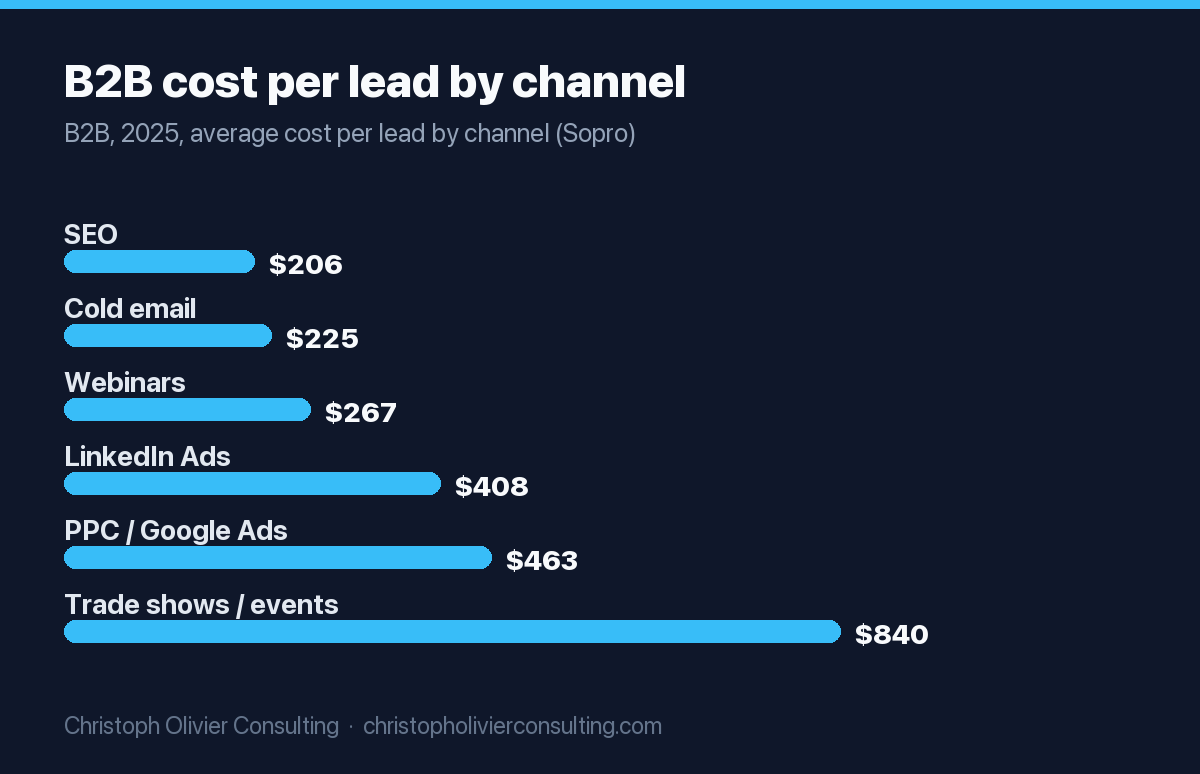
Costs vary widely by channel and market. Outbound and content require mostly labor plus tooling, often in the low thousands per month for a lean team. Paid search and paid social add media spend on top, and B2B clicks can run high in competitive categories. The more useful figure is cost per qualified lead by channel, which lets you compare spend against pipeline rather than against raw lead volume.
How long does B2B lead generation take to work?
It depends on the channel. Outbound and paid ads can produce qualified meetings within two to six weeks. Referrals move within weeks of a formal ask. Inbound SEO and content usually take four to nine months to compound, and ABM takes three to six months to show pipeline. Running a fast channel and a slow channel in parallel avoids waiting on a single timeline.
What is a qualified B2B lead?
A qualified B2B lead is a contact who both matches your ideal customer profile and shows buying intent, such as requesting a demo, downloading a bottom-funnel asset, or returning to key pages. Fit without intent is a prospect, not a lead; intent without fit wastes sales time. Define the qualification bar with sales up front so both teams count the same thing.
How do you generate B2B leads with a small budget?
Start with the cheapest, fastest channels and sequence the rest. Turn on referrals by asking current customers for introductions, then run targeted outbound to a tight list of 100 to 300 fit accounts with problem-specific messaging. Build inbound content in parallel because it is slow to start but cheapest at scale. Add paid search only once you know which offers convert.
More Growth, Strategy & Sales guides
- How to Hire a Content Marketing Consultant
- Content Marketing for Architects: A Project-Led System That Wins Better Work
- Content Marketing for Small Businesses: A Plan You Can Actually Keep
- Email Marketing Lead Generation: How to Turn a List Into Pipeline
- Fractional CMO Services: The Full Scope of What Gets Delivered
- Lead Generation for Real Estate Agents: The Channels That Actually Produce Deals