

A fractional CMO contract template needs four things most free versions skip: a time commitment stated in hours, a fee clause that says what happens to unused hours, an IP clause that actually transfers ownership in writing, and a clause saying the client owns every ad account, analytics property and domain. Below is a complete, plain-English agreement you can copy, with every variable in [brackets], followed by a clause-by-clause table of why each term exists and what each side usually pushes for.
Short answer: A workable fractional CMO agreement covers 17 points: parties, scope, hours, fees, expenses and tools, term and notice, contractor status, confidentiality, IP, account and data ownership, non-solicitation, conflicts, warranties, liability cap, insurance, data protection and governing law. The two clauses that cause the most damage when missing are a signed written IP assignment (US copyright law requires one, per 17 U.S.C. 204(a)) and client ownership of ad and analytics accounts.
Template, not legal advice. This is a drafting starting point written by a marketer, not a lawyer. Contract, tax and employment law differ by state and country. Have your own counsel review and adapt it before either side signs.
The fractional CMO agreement template (copy and edit)
Replace every [bracketed] item. Delete optional sections you do not need. Exhibit A is where the real engagement lives, so fill it in from the proposal both sides accepted.
FRACTIONAL CHIEF MARKETING OFFICER CONSULTING AGREEMENT

This Consulting Agreement (the "Agreement") is made as of [Effective Date] between:

[Client legal name], a [state] [entity type], with its principal office at [address] ("Client"), and

[Consultant legal name], a [state] [entity type, e.g. limited liability company], with its principal office at [address] ("Consultant").

1. SERVICES AND SCOPE
1.1 Consultant will act as Client's fractional Chief Marketing Officer and provide the services described in Exhibit A (the "Services"). Exhibit A is part of this Agreement.
1.2 The Services are marketing leadership: strategy, planning, budget recommendations, team and vendor direction, and reporting. Hands-on production (design, copywriting, ad buying, web development, campaign builds) is excluded unless Exhibit A lists it.
1.3 Work outside Exhibit A requires a written change order (email confirmed by both parties is enough) stating the work, fee and timeline before the work starts.
1.4 Client will name one executive sponsor, [name and title], who can approve deliverables and decisions.

2. TIME COMMITMENT
2.1 Consultant will make available up to [number] hours per [week / month] (the "Monthly Allocation"), including [number] scheduled meetings per [week / month].
2.2 Unused hours [expire at the end of each month / roll over for one month only, capped at [number] hours].
2.3 Hours beyond the Monthly Allocation are billed at $[hourly rate] only if Client approves them in writing in advance.
2.4 Consultant decides when, where and how the Services are performed, subject to the meeting schedule in Exhibit A. Consultant will respond to Client messages within [one / two] business days.

3. FEES AND PAYMENT
3.1 Client will pay a monthly retainer of $[amount], invoiced [on the 1st of each month in advance].
3.2 [Optional] Onboarding fee of $[amount] for the first [30] days, covering the audit and plan listed in Exhibit A.
3.3 Invoices are due net [15] days. Overdue amounts accrue interest at [1.0]% per month or the highest rate allowed by law, whichever is lower. After written notice, Consultant may pause the Services while any invoice is more than [15] days overdue.
3.4 Fees exclude sales, use and similar taxes, which Client pays. Each party pays its own income taxes.
3.5 [Optional] Performance bonus: $[amount] if [specific, measurable metric] reaches [target] by [date], measured from [named report]. No other compensation is tied to results.

4. EXPENSES, TOOLS AND MEDIA SPEND
4.1 Client reimburses pre-approved, documented out-of-pocket expenses at cost. Any single expense over $[250] needs Client's written approval first.
4.2 Software and subscriptions used for Client's marketing (for example CRM, email platform, analytics, SEO tools) are purchased in Client's name, on Client's payment method, unless both parties agree otherwise in writing.
4.3 Consultant's own productivity tools are Consultant's cost.
4.4 Advertising spend and payments to agencies, freelancers and vendors are paid by Client directly and are not part of the retainer. Consultant will not commit Client to any vendor contract without Client's written approval.

5. TERM AND TERMINATION
5.1 This Agreement starts on the Effective Date, runs for an initial term of [3] months, then continues month to month.
5.2 After the initial term, either party may end this Agreement for any reason with [30] days' written notice.
5.3 Either party may end this Agreement immediately if the other materially breaches it and does not cure the breach within [10] business days after written notice.
5.4 On termination, Client pays for Services performed through the termination date, prorated for any partial month, plus approved expenses already incurred. Prepaid fees for periods after termination are refunded within [15] days.
5.5 During the notice period Consultant will deliver a written handover: work in progress, open decisions, vendor contacts, and the location of all files and accounts.
5.6 Sections 6 through 10, 13, 16 and 17 survive termination.

6. INDEPENDENT CONTRACTOR
6.1 Consultant is an independent contractor, not an employee, partner, joint venturer or agent of Client. Consultant may serve other clients, subject to Sections 7 and 11.
6.2 Consultant is responsible for its own taxes, insurance, equipment and benefits and is not eligible for Client's employee benefit plans.
6.3 Consultant has no authority to sign contracts or make commitments on Client's behalf except as Client authorizes in writing.
6.4 Consultant may use subcontractors only with Client's prior written consent and remains responsible for their work and their compliance with this Agreement.

7. CONFIDENTIALITY
7.1 Each party will use the other's Confidential Information only to perform this Agreement, protect it with at least reasonable care, and share it only with people who need it and are bound by similar duties.
7.2 Confidential Information excludes information that is public through no fault of the receiving party, was already lawfully known to it, is independently developed, or is lawfully received from a third party without restriction.
7.3 A party may disclose Confidential Information when required by law, after prompt notice to the other party where lawful.
7.4 These duties last [3] years after this Agreement ends, and for trade secrets, as long as they remain trade secrets.

8. INTELLECTUAL PROPERTY
8.1 "Deliverables" means the plans, strategies, positioning and messaging documents, reports, creative, copy, audiences, campaign structures and other materials Consultant creates specifically for Client under this Agreement.
8.2 Upon [creation / Client's payment of the fees for the period in which each Deliverable is created], Consultant assigns to Client all right, title and interest, including copyright, in the Deliverables. Consultant will sign any further documents reasonably needed to record this assignment.
8.3 Consultant keeps ownership of its pre-existing and independently developed methods, frameworks, templates, checklists and know-how ("Consultant Materials"). Where Consultant Materials are included in a Deliverable, Consultant grants Client a perpetual, royalty-free, non-exclusive license to use them as part of that Deliverable for Client's internal business.
8.4 Client grants Consultant a limited license to use Client's names, logos and materials only to perform the Services. Consultant may name Client as a client in its marketing only with Client's prior written consent.

9. CLIENT ACCOUNTS, DATA AND ACCESS
9.1 Client owns, and will be the registered owner and billing party of, all marketing accounts and assets used for Client's business, including: advertising accounts, analytics properties, tag managers, search console properties, CRM and email platforms, social media pages and business profiles, domain names, website hosting, and all data in them ("Client Accounts").
9.2 Any Client Account that Consultant creates is created in Client's name, using a Client-controlled login or email address, with Client added as the highest-level administrator.
9.3 Client will keep at least [two] of its own employees as administrators on every Client Account. Consultant receives the lowest access level that lets it do the Services and is never the sole administrator.
9.4 Within [two] business days after this Agreement ends, or earlier on Client's request, Consultant will: (a) remove its own access from all Client Accounts, (b) transfer to Client any Client Account or asset still under Consultant's control, and (c) return or delete Client data in its possession, and confirm this in writing.
9.5 Consultant will not withhold access to any Client Account or Client data for any reason, including a fee dispute.

10. NON-SOLICITATION
During this Agreement and for [12] months after it ends, neither party will solicit for employment or engagement any employee or contractor of the other party that it worked with under this Agreement. General job ads not aimed at those people are not a breach.

11. CONFLICTS OF INTEREST
Consultant will not, during this Agreement, provide marketing leadership services to [named direct competitors / businesses that offer [product or service] in [territory]] without Client's written consent. Consultant will disclose any paid relationship (referral fee, commission or equity) with a vendor before recommending that vendor to Client.

12. WARRANTIES
12.1 Consultant will perform the Services in a professional and workmanlike manner.
12.2 Marketing results depend on factors outside Consultant's control, including Client's offer, pricing, budget, sales follow-up and market conditions. Consultant does not guarantee any specific revenue, lead volume, ranking or other result.
12.3 Each party warrants that materials it provides to the other do not, to its knowledge, infringe anyone's rights.

13. LIMITATION OF LIABILITY
13.1 Except for breach of Section 7 (Confidentiality) or Section 9 (Client Accounts), infringement of the other party's intellectual property, or fraud or willful misconduct: (a) neither party is liable for indirect, incidental, special, consequential or punitive damages, or lost profits; and (b) each party's total liability under this Agreement is limited to the fees paid or payable to Consultant in the [3] months before the claim arose.

14. INSURANCE [OPTIONAL]
Consultant maintains professional liability (errors and omissions) insurance of at least $[amount] per claim and will provide a certificate on request.

15. DATA PROTECTION
Each party will comply with privacy and data protection laws that apply to personal data it handles under this Agreement. If Consultant will process Client customer personal data, the parties will sign [Client's data processing addendum / business associate agreement, if required].

16. GOVERNING LAW AND DISPUTES
This Agreement is governed by the laws of [state or country], without regard to conflict-of-law rules. Disputes will be resolved in the [state / federal] courts located in [county, state] [or: by binding arbitration under the rules of [provider] in [city]].

17. GENERAL
17.1 Entire agreement: this Agreement and Exhibit A are the parties' entire agreement on this subject and replace any proposal or prior discussion. If Exhibit A conflicts with this Agreement, this Agreement controls.
17.2 Changes must be in writing and confirmed by both parties.
17.3 Neither party may assign this Agreement without the other's written consent, except to a successor in a merger or sale of substantially all of its assets.
17.4 Notices go to the addresses above or to [notice email addresses], and are effective on confirmed receipt.
17.5 If any provision is unenforceable, the rest remains in effect.
17.6 Neither party is liable for delays caused by events beyond its reasonable control.
17.7 This Agreement may be signed electronically and in counterparts.

SIGNED:

CLIENT: [Client legal name]
By: ____________________  Name: [name]  Title: [title]  Date: [date]

CONSULTANT: [Consultant legal name]
By: ____________________  Name: [name]  Title: [title]  Date: [date]


EXHIBIT A: SCOPE OF SERVICES

A1. Business goals for this engagement: [e.g. build a 12-month marketing plan; hire a marketing manager; cut cost per qualified lead]
A2. In scope: [e.g. marketing strategy and annual plan; budget allocation recommendations; managing [agency names]; leading weekly marketing meeting; hiring support for [role]; monthly board or owner report]
A3. Out of scope: [e.g. writing ad copy; building landing pages; managing social posting; sales management]
A4. Deliverables and dates:
    [Deliverable 1, e.g. marketing audit] by [date]
    [Deliverable 2, e.g. 90-day plan] by [date]
    [Deliverable 3, e.g. KPI dashboard spec] by [date]
A5. Meeting cadence: [weekly 60-minute team meeting; monthly 90-minute review with executive sponsor]
A6. Metrics reviewed monthly (tracked, not guaranteed): [e.g. qualified leads, cost per qualified lead, pipeline value, close rate]
A7. Client inputs needed: [account access by [date]; budget approval process; named internal contacts]
A8. Fees: as stated in Section 3.
If you serve several entities or expect multiple projects under one relationship, the same clauses can be split into a master services agreement (Sections 1 to 17) plus a short statement of work per project (Exhibit A). The legal terms then stay fixed while scope changes.
Fractional CMO contract terms: what to put in each bracket
The brackets are where deals go wrong. This fill-in guide gives a defensible starting value for each one and where that value comes from. Where no public benchmark exists, it says so instead of inventing one.
| Bracket | Sensible starting point | Basis |
|---|---|---|
| Monthly retainer (3.1) | Most published ranges run $3,000 to $15,000 a month | MarketerHire publishes $3,000 to $15,000 a month and $150 to $350 an hour (vendor figures, April 2026). Chief Outsiders publishes retainers from $1,500 to over $30,000 a month for executive-firm partners. |
| Hours (2.1) | State a number, even an approximate one | MarketerHire says $5,000 to $10,000 a month buys 15 to 20 hours a week at Series A to B companies. That is one vendor’s claim, so set your own number from the scope. |
| Overage rate (2.3) | Your retainer divided by the Monthly Allocation, or slightly higher | Arithmetic, not a benchmark. Keeps extra hours from becoming cheaper than committed ones. |
| Initial term (5.1) | [3] months, then month to month | The T2D3 template uses 3 months; O-CMO describes a short initial commitment. No law sets it. |
| Notice period (5.2) | [30] days | T2D3’s template uses 30 days and O-CMO calls 30-day written notice the market norm. It gives time for the handover in 5.5. |
| Cure period (5.3) | [10] business days | Long enough to fix a missed deliverable, short enough not to trap either side. |
| Payment terms (3.3) | Net [15] days, monthly in advance | Retainers billed in advance match how the time is reserved. |
| Expense approval threshold (4.1) | $[250] | A convention, not a rule. Set it below the amount you would want to hear about first. |
| Confidentiality tail (7.4) | [3] years, trade secrets indefinitely | T2D3 uses 3 years. O-CMO describes 2 to 3 years as common. |
| Non-solicit tail (10) | [12] months | T2D3’s template uses 12 months. Check your state’s rules on restrictive covenants. |
| Liability cap (13.1) | Fees from the last [3] months | O-CMO describes one to three months of fees as typical. Clients with big data exposure often negotiate higher. |
| Client admins (9.3) | [2] or more | Google Ads Help warns that an account with only one administrator may lose access to its tags if that user becomes unavailable. |
If you are still deciding what the retainer should be, our breakdown of fractional CMO cost in 2026 walks through rates by engagement model.
How fractional CMO rates vary by provider type
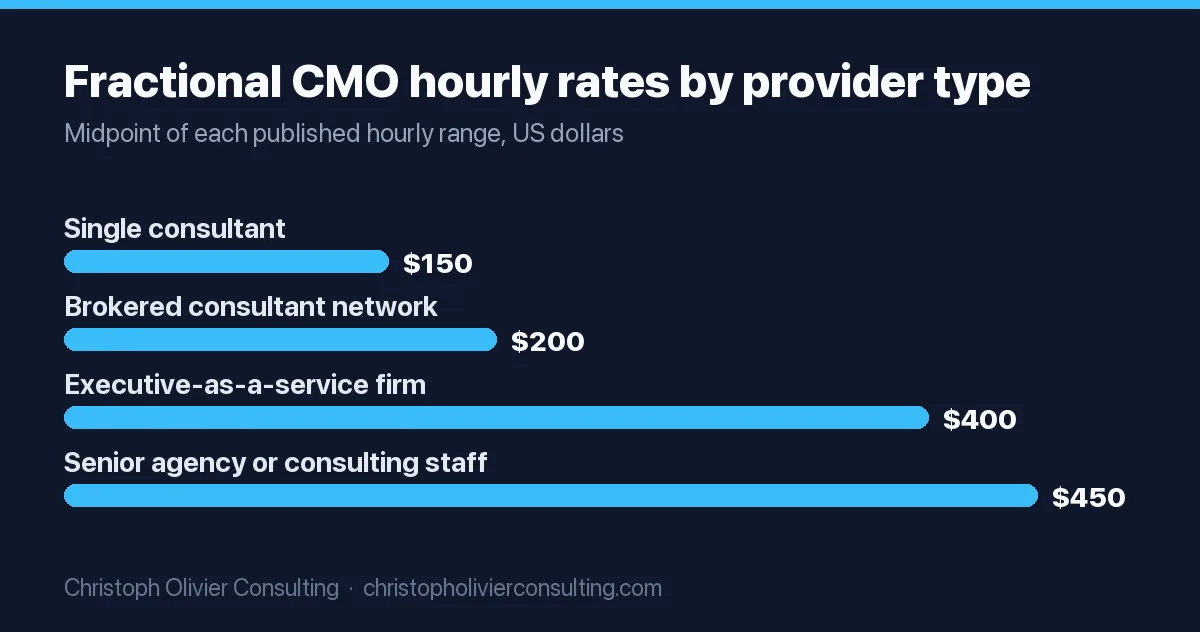
The fee clause is easier to negotiate when both sides know which market they are pricing against. Chief Outsiders, which sells the executive-firm model itself, publishes these hourly ranges by provider type: single consultants at $100 to $200 an hour (some $450 and up), brokered consultant networks at $150 to $250, senior agency or consulting-firm staff at $300 to $600, and executive-as-a-service firm partners at an hourly equivalent of $300 to $500. The chart shows the midpoint of each range.
Clause by clause: why each term matters and what gets negotiated
Use this table in the negotiation call. The middle column tells you what each side is protecting, so you can trade one point for another instead of arguing every line.
| Clause | Why it matters | Client usually asks for | Consultant usually asks for | Common middle ground |
|---|---|---|---|---|
| 1. Scope | Unclear scope is how a strategy role quietly becomes production work. | Broad wording (“all marketing”) | Leadership only, execution excluded | Named exclusions in Exhibit A plus email change orders |
| 2. Hours | A retainer without hours cannot be measured or priced. | Rollover of unused hours | Hours expire monthly | One-month rollover with a cap |
| 3. Fees | Sets cash flow and what stops work if unpaid. | Net 30, paid in arrears | Paid in advance, pause right | Advance billing, net 15, pause only after written notice |
| 3.5 Bonus | Ties some pay to outcomes without making the base fee a gamble. | Large share at risk | No results-based pay | Small bonus on one metric the CMO can influence, measured from a named report |
| 4. Expenses and tools | Software bought on the consultant’s card leaves with the consultant. | Consultant absorbs tools | Client pays all tools | Client-facing tools in client’s name; consultant’s own productivity tools on consultant |
| 5. Term and notice | Defines how fast either side can exit a bad fit. | No minimum term | 6 to 12 month commitment | Short initial term, then month to month with 30 days’ notice |
| 6. Contractor status | The IRS can hold the business liable for employment taxes if it misclassifies a worker without a reasonable basis. | Control over hours and methods | Freedom to set methods and serve others | Client controls outcomes and deadlines; consultant controls how and when |
| 7. Confidentiality | A CMO sees pipeline, margins and plans. | Indefinite, one-way | Mutual, time-limited | Mutual, 3 years, trade secrets indefinite |
| 8. IP | Without a written assignment, the creator can keep copyright. | Everything, including methods | Assignment only after payment; methods retained | Deliverables assigned; Consultant Materials licensed |
| 9. Accounts and data | Ad history, pixels and audiences are hard or impossible to rebuild. | Client owns all, consultant never admin | Enough access to do the job | Client owns and administers; consultant gets the lowest workable role |
| 10. Non-solicit | Protects each side’s team from poaching. | Long tail | Short tail, mutual | Mutual, 12 months, general ads excluded |
| 11. Conflicts | Fractional leaders serve several companies at once. | Non-compete across the industry | No restriction | Named direct competitors only, plus vendor-payment disclosure |
| 12. Warranties | Marketing results depend on things the CMO does not control. | Results guarantee | Effort standard only | Professional standard, no guaranteed results, metrics reviewed monthly |
| 13. Liability cap | One bad campaign should not bankrupt either side. | Unlimited liability | Cap at 1 month of fees | Fees from the last 3 months, with carve-outs for confidentiality and account breaches |
| 16. Governing law | Decides whose courts hear a dispute. | Client’s home state | Consultant’s home state | Defendant’s home state, or arbitration |
Who owns the work: IP and work made for hire
Many contracts written by non-lawyers say “all work is a work made for hire” and stop there. That phrase does less than people think when the CMO is a contractor.
The US Copyright Office’s Circular 30 explains that a work made for hire arises in only two ways: an employee creates it within the scope of employment, or it is specially ordered or commissioned and falls into one of nine statutory categories (a contribution to a collective work, part of a motion picture or other audiovisual work, a translation, a supplementary work, a compilation, an instructional text, a test, answer material for a test, or an atlas), with a written agreement signed by both parties that expressly calls it a work made for hire. If any requirement fails, Circular 30 says, “it is not a work made for hire.”
A marketing plan or positioning document does not obviously fit any of those nine categories. That is why the template uses a direct assignment in Section 8.2 instead. Under 17 U.S.C. 204(a), a transfer of copyright ownership is not valid unless it is in writing and signed by the owner of the rights being transferred. A signed agreement with an assignment clause meets that requirement. A handshake or an invoice does not.
The one real negotiation is timing. Clients prefer ownership on creation. Consultants prefer ownership on payment, so unpaid work stays theirs. The bracket in 8.2 lets you pick, and tying it to payment for each billing period is a fair compromise.
Who owns the ad accounts, analytics and domain
This is the clause most free templates leave out. When a consultant opens the Google Ads account under their own login, or registers the domain in their own name, the client’s history, audiences and conversion tracking can walk out the door with them. Section 9 makes the client the owner and the consultant a guest.
Google’s own permission model makes this concrete. In Google Ads, only the Admin level can give account access, change access levels, accept or reject manager account links, and unlink manager accounts. Standard access can edit campaigns but cannot manage users. That makes Standard the right default for a fractional CMO who directs or audits campaigns.
| Platform | Who should own it | Access to give the fractional CMO | Why |
|---|---|---|---|
| Google Ads | Client, as Admin, with a client payment method | Standard (edit campaigns, run reports) | Per Google Ads Help, Standard users cannot add or remove users or unlink manager accounts; Admins can. |
| Google Analytics 4 | Client, as Administrator at the account level | Editor or Viewer at the property level, as the scope needs | Google Analytics Help says only Administrators can add or modify users, and only account-level Administrators can delete users. |
| Agency manager (MCC) links | Client account linked to the agency’s manager account, not created inside it | Link only; client can unlink | Google says admins of a linked manager account can manage campaigns, so the link is the access, and unlinking ends it. |
| Domain and hosting | Client as registrant, on client billing | Delegated user, never registrant | Whoever holds the registrar login controls the website and the email on that domain. |
| CRM, email platform, social pages | Client account, client billing | Named user seat | Removing one seat on exit is a minute of work. Transferring a whole account is not. |
If an agency also works under the CMO, the setup in our guide to Google Ads MCC for agencies shows how manager accounts link to client-owned accounts.
Exit checklist for Section 9.4 (pass or fail):
- Every ad, analytics, tag manager and search console property lists at least two client employees as top-level administrators. Pass only if yes for every one.
- Every paid tool and ad account bills to a client payment method. Fail if any bills to the consultant.
- The consultant’s user is removed from each platform, and a screenshot of each user list is saved. Pass only with screenshots.
- Manager account links that the client no longer wants are unlinked by a client Admin.
- Domain registrant name and registrar login belong to the client. Fail if the consultant still holds the registrar password.
- Shared drives and documents are owned by a client account, not shared from the consultant’s drive.
- The consultant confirms in writing that client data has been returned or deleted.
Independent contractor status: what the paper can and cannot do
Section 6 says the CMO is a contractor. The label helps, but it does not decide the question. The IRS looks at the whole relationship and groups the evidence into three categories: behavioral control (does the company control how the work is done), financial control (how the worker is paid, whether expenses are reimbursed, who provides tools), and type of relationship (written contracts, employee-type benefits, permanence, and whether the work is a key part of the business). The IRS says there is no set number of factors that decides the answer.
Practical consequences for the contract:
- Section 2.4 lets the consultant control when and how the work is done. Do not override it in Exhibit A with fixed office hours.
- Section 6.2 keeps benefits and equipment on the consultant’s side, which lines up with the IRS financial-control factors.
- If the classification is still unclear, either party can file Form SS-8 for an official IRS determination. The IRS notes it may take at least six months.
- Payments of at least $2,000 in a year to a non-employee for services go on Form 1099-NEC. The IRS 1099 instructions say that threshold rose to $2,000 for tax years beginning after 2025 (it may be adjusted for inflation from 2027), and that Form 1099-NEC is due by January 31.
The Department of Labor rule, as of November 12, 2026. For wage-and-hour purposes, the 2024 Department of Labor rule is still the text in the Code of Federal Regulations (29 CFR part 795). Its economic reality test weighs six named factors: opportunity for profit or loss depending on managerial skill, investments by the worker and the potential employer, degree of permanence, nature and degree of control, whether the work is integral to the business, and skill and initiative. On February 27, 2026, the Department proposed rescinding that analysis and replacing it with the January 2021 version, with modifications, and extending it to the FMLA. Comments closed April 28, 2026. A Federal Register search on November 12, 2026 showed no final rule yet, so check the current status before you rely on either test. State law can apply a different test, which is one more reason to have counsel review the contract.
Non-compete or non-solicit?
A fractional CMO serves several companies by design, so a broad industry non-compete defeats the model. The template uses a mutual non-solicit (Section 10) and a narrow conflict clause naming direct competitors (Section 11).
There is no longer a federal ban to rely on either way. The Federal Trade Commission’s 2024 Non-Compete Clause Rule was set aside by federal courts, and on February 12, 2026 the FTC published a final action removing the rule from the Code of Federal Regulations to conform to those court decisions. Restrictive covenants are therefore a state-law question, and the answer varies by state. That is a good reason to keep Section 11 to named competitors and let counsel check it.
Red flags to fix before anyone signs
Run the draft against these tests. Each is pass or fail.
- Hours: Section 2.1 states a number. Fail if it says “as needed”.
- Exclusions: Exhibit A lists at least three things that are out of scope. Fail if it only lists what is in scope.
- Ownership: Section 8.2 uses the word “assigns” and the agreement is signed by both parties. Fail if it relies only on “work made for hire”.
- Accounts: Section 9 names ad accounts, analytics, domain and CRM as client property. Fail if accounts are not mentioned.
- Exit: Notice period, handover and refund of prepaid fees are all stated. Fail if any is missing.
- Results language: Nothing in the proposal or contract promises a revenue figure, lead count or ranking. Fail if it does.
- Entire agreement: Section 17.1 says the contract overrides the proposal. Fail if the proposal’s sales language could be read as a promise.
- Counsel: A lawyer licensed in your governing-law state has read it. Fail if not.
Before you get to contract stage, it helps to be clear on what fractional CMO services usually include, since that is what Exhibit A has to describe, and on whether you need a fractional CMO at all. If you are new to the model, start with what a fractional CMO does and costs. Consultants setting up their own practice can pair this template with the steps in starting a marketing consulting business. And if you want a second opinion on a scope you are about to sign, you can book a consultation.
Ready to scale your revenue?
Book a free 30-min consultation. We’ll diagnose your growth bottleneck and map out the 3 highest-leverage moves for your business.
Frequently asked questions
What should a fractional CMO contract include?
At minimum: parties, scope with named exclusions, hours per week or month, the retainer and what happens to unused hours, expenses and tools, term and notice, independent contractor status, confidentiality, a written IP assignment, client ownership of ad and analytics accounts, non-solicitation, no guaranteed results, a liability cap and governing law. The template on this page covers all of these in 17 sections plus a scope exhibit.
Is there a free fractional CMO agreement template?
Yes. The agreement on this page is free to copy and edit. Every variable is in brackets, from the retainer and hours to the notice period and governing law. It is a drafting starting point, not legal advice, so have a lawyer licensed in your state review your version before either party signs it.
What are standard fractional CMO contract terms for notice and term?
A common structure is a short initial term, often three months, followed by month-to-month renewal with 30 days' written notice. Published templates from T2D3 and O-CMO both use 30 days. No law sets these numbers, so they are negotiated. Pair the notice period with a written handover and a refund of any prepaid fees.
Who owns the work a fractional CMO creates?
Whoever the signed contract says. US copyright law treats a contractor's work as made for hire only in nine narrow categories with a signed written agreement, per Copyright Office Circular 30. Marketing plans rarely fit, so use a written assignment. Under 17 U.S.C. 204(a), a copyright transfer is valid only in a signed writing.
Should a fractional CMO have admin access to my Google Ads account?
Usually no. Keep the account in your company's name with at least two of your own employees as Admins and give the CMO Standard access. Google Ads Help says Standard users can edit campaigns, while only Admins can manage users and unlink manager accounts. That keeps your history and conversion data under your control.
Can a fractional CMO sign a non-compete?
They can, but a broad industry non-compete conflicts with a model built on serving several companies. The FTC's federal non-compete rule was removed from the Code of Federal Regulations in February 2026 after court decisions, so enforceability depends on state law. A mutual non-solicit plus a clause naming direct competitors is the more workable approach.
Does a fractional CMO need a 1099?
If you pay a non-employee at least $2,000 for services in a year, the IRS instructions require Form 1099-NEC for tax years beginning after 2025, due by January 31. Collect the consultant's tax details before the first payment. The contractor label in the agreement does not settle classification on its own; the IRS looks at the whole relationship.