

A fund positioning strategy is your written answer to the question every institutional LP asks in diligence: why this strategy, run by this team, at this fund size, instead of the competitors you will be asked to name. Build it from one primary edge on one of eight axes (strategy niche, sourcing, sector expertise, check size, geography, team attribution, fund size discipline, terms), back it with documents an LP can check, and state it inside the SEC Marketing Rule and your Regulation D exemption. Below you get a fill-in positioning statement template, a 15-question stress test scored pass or fail, three worked statements for fictional funds, the real data on what LPs screen for, and the exact rule text that limits how you describe performance.
Informational only. This page explains marketing and positioning practice. It is not legal, compliance or investment advice. Have securities counsel review any material you send to investors.
The fund positioning statement template
This is the general positioning format from the positioning statement guide, rebuilt for a fund. The extra sentence on fund size is there because the ILPA questionnaire asks about it directly. Copy it and fill every bracket.
For [LP type] that [gap in their current manager roster], [Fund name] is a [target size, with hard cap] [Fund number] fund that [what you buy or lend to] in [two of: sector, stage, geography, check size]. Unlike [the alternative this LP would otherwise back], we [one repeatable edge], shown by [proof an LP can verify in the data room]. We cap the fund at [amount] because [deal count multiplied by check size].
Each bracket maps to a question an allocator will ask anyway. If you cannot fill one with something specific, that is where your positioning is weak, and it is better to find that out before the first meeting than in one.
| Bracket | Fill it with | Fails if you write | Where the LP tests it |
|---|---|---|---|
| LP type and gap | One segment plus what it lacks, e.g. “single-family offices with no lower-middle-market industrial exposure” | “Institutional and high net worth investors” | Your own LP map; Rede Partners found LPs want “exposure that is complementary to their current line up” |
| Size and fund number | Target, hard cap, and Fund I, II or III | “Up to $500M” with no cap logic | ILPA DDQ 4.3 and 4.4: size versus predecessor, ability to invest at that size |
| Niche | Two concrete filters, e.g. “$3M to $8M EBITDA HVAC and plumbing service companies in the Southeast” | “Sector agnostic” or “opportunistic” | DDQ 4.1: transaction sizes with minimum and maximum, pace, holding period, geography, sector, stage |
| Alternative | A category the LP actually considers: a generalist mid-market fund, a fund of funds, direct deals | “Other managers” | DDQ 11.5: “Describe and list the Fund’s direct competitors” |
| Edge | One mechanism that repeats every year | “Proprietary deal flow” with no mechanism | DDQ 8.5: how sourcing is staffed, conducted and documented |
| Proof | A document: deal log, IC memos, a sourcing spreadsheet with dates | Adjectives (“deep relationships”) | DDQ Appendix F2: “Source of Opportunity” and “Deal Team Member (sourcing)” for every deal |
| Cap reason | Math: number of deals times equity per deal, plus reserves | Nothing, or “market demand” | ILPA Principles 3.0: the strategy “must be well-defined” and deals must match it |
Two sentences is the target length. The statement goes in the strategy block of your fund one-pager and on the edge slide of your deck, word for word, so every document tells the same story.
What LPs actually screen on in 2026
Positioning matters more when capital is concentrating in managers LPs already know. Here is what the most recent primary data shows.
- Emerging managers are getting a shrinking share. The PitchBook 2025 Annual Global Private Market Fundraising Report (data as of December 31, 2025) says the share of capital going to emerging managers “has been declining for more than a decade.” Yet it also counted 1,019 funds from emerging managers that closed in 2025, so the door is narrow, not shut.
- Private equity: 578 PE funds closed globally in 2025, raising $414.2 billion, and 88% of that capital went to experienced GPs. The average time to close a PE fund was 17 months.
- Private debt: 91.7% of debt capital went to experienced managers (PitchBook defines those as managers raising Fund IV or later). First-time debt managers closed 14 funds totaling $2.4 billion, the lowest on record for both figures.
- Real assets: emerging managers received 6.4% of commitments.
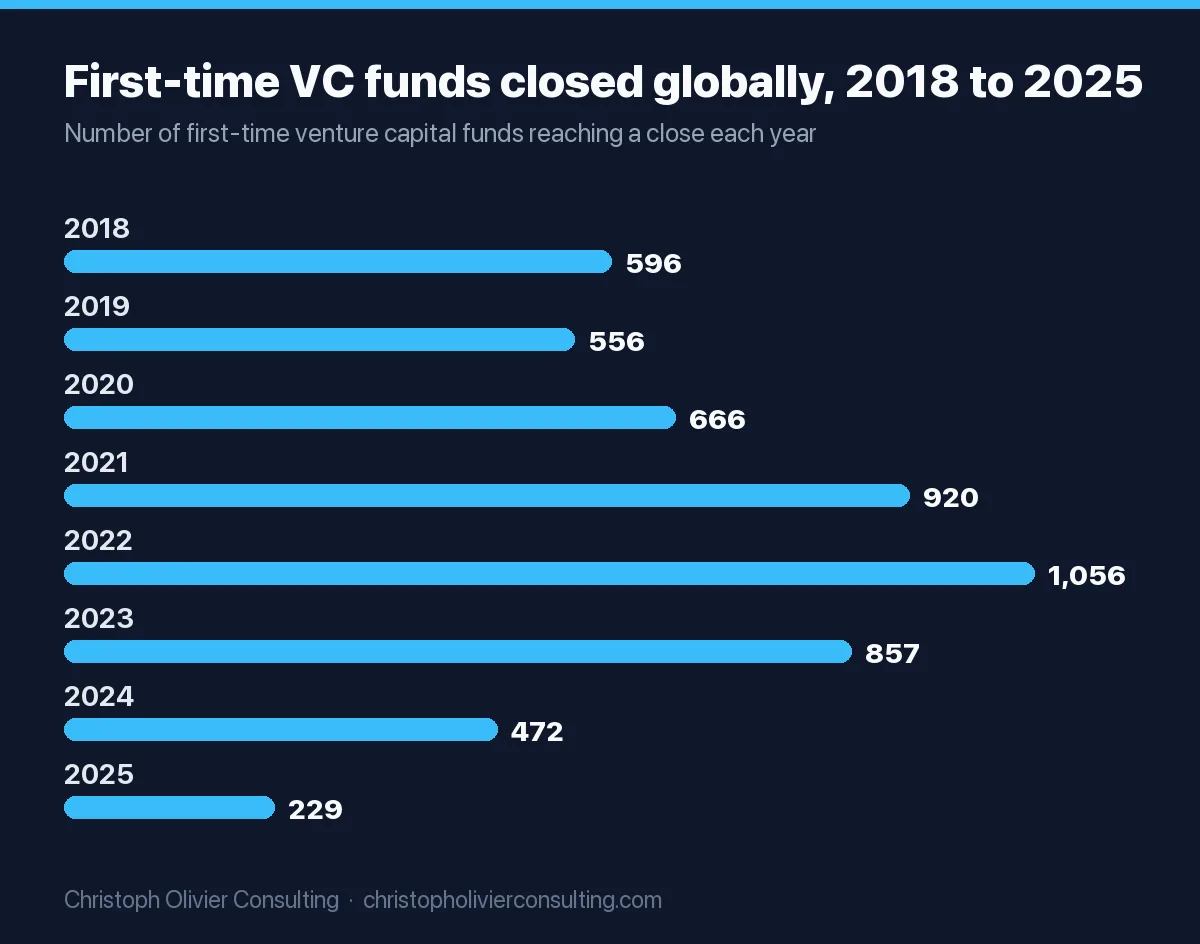
- Venture: first-time VC funds fell from 1,056 closes in 2022 to 229 in 2025, raising $13.0 billion. Median time to close a VC fund in 2025 was 17.0 months; the slowest quartile took 25.7.
Late-reporting funds will push the 2025 counts up somewhat, as PitchBook notes, but not enough to change the direction.
What wins the allocation once you are in the room? In Rede Partners’ September 2024 survey of 68 active, mostly US-based LPs (emerging managers defined as Fund I to III and under $1 billion), 74% named track record as critical, 68% named strategy and 51% named team pedigree. 66% underwrite new emerging-manager commitments to at least a 2.5x net return. Sector interest was strongest in industrials (86%), healthcare (83%) and software (80%), while only 18% expressed interest in growth equity and venture. Rede’s summary of the differentiation point is blunt: LPs want “top talent with a definable edge.”
The ILPA due diligence questions that test your positioning
The ILPA Due Diligence Questionnaire 2.0 (updated November 2021) was built to replace the “lengthy, customized due diligence questionnaires” LPs, consultants and placement agents each sent, so its questions are the common core you should expect. Your positioning statement is a compressed answer to these questions. Write the long answers first; the short statement falls out of them.
| DDQ question | What it asks | What it means for positioning |
|---|---|---|
| 4.1 | Strategy, transaction sizes (including minimum and maximum), pace, holding periods, geography, sector, stage | Your niche has to be stated in numbers, not adjectives |
| 4.2 and 4.3 | Is the strategy, and the target size, “meaningfully different” from the predecessor fund? | Fund II that doubles in size needs a reason in the statement |
| 4.4 | Ability to invest at the targeted size, and the implications for co-investment | The cap-reason sentence of the template |
| 4.22 | How you create value, and how those strengths affect your sourcing, with case studies | Operating edge has to connect to deal access |
| 8.5 | How sourcing is staffed, conducted and documented; how durable your network is | “Proprietary deal flow” needs a log behind it |
| 10.6 and 10.8 | Will all principals invest; how is the GP commitment financed? | Alignment is part of the pitch, not a term-sheet footnote |
| 11.5 | “Describe and list the Fund’s direct competitors” | You must name the alternative, so pick it deliberately |
| Appendix F2 | Every portfolio investment with source of opportunity and the lead, sourcing and diligence deal team members | Attribution claims are checked deal by deal |
The ILPA Principles 3.0 (2019) set the expectations behind those questions. Four lines matter for positioning. The stated strategy “must be well-defined,” investments “should be consistent with the investment strategy that was described when the fund was raised,” and any change should be approved by a supermajority of LPs, so a fuzzy statement is not flexibility, it is a governance problem. For first-time funds, the GP “should provide a budget that lays out the rationale for the management fee proposed.” The GP commitment “should be contributed in cash as opposed to contributed through the waiver of management fees.” And key persons “should devote substantially all their business time to the fund.”
The eight positioning axes, with real public examples
Pick one primary axis that you can prove, and at most two supporting ones. Each example below is documented by the firm itself or in a public filing or fund announcement. Where no clean public example exists, the row says so instead of inventing one.
| Axis | A sharp claim looks like | Documented public example | What the LP checks |
|---|---|---|---|
| 1. Strategy niche | An asset few institutions can access | Arctos Partners, founded 2019, became what Alternatives Watch called “the largest institutional investor in professional sports franchises,” with about $15 billion across its platforms. KKR agreed to buy it in February 2026 at an initial $1.4 billion; Arctos’s site now says it “is now a business of KKR.” | Is the niche big enough to deploy the fund, and why can’t a generalist enter it? |
| 2. Sourcing edge | A repeatable mechanism that produces deals or leaders | Alpine Investors says its CEO-in-Training program has placed aspiring leaders “into CEO and CXO roles” since 2015, alongside a CEO-in-Residence track. The people pipeline is the sourcing and value-creation story. | DDQ 8.5 and 4.22: is the mechanism documented and does it lead to closed deals? |
| 3. Sector expertise | Years inside one sector, with deal count | Thoma Bravo: “We’ve been investing in software since shortly after the dot-com crisis,” about 600 transactions and about $170 billion in AUM as of June 30, 2026. | Deal-level history in that sector (Appendix F2), not only biographies |
| 4. Check size and stage | A stage where larger funds cannot write checks efficiently | Hustle Fund describes itself as investing in “pre-seed software startups,” with “600+ startups backed.” | Portfolio construction: number of companies, ownership, reserves |
| 5. Geography | An underserved region you can name and bound | Drive Capital raised two new funds totaling $1 billion in a June 28, 2022 release for “the underinvested region in North America between the Hudson River and the Rocky Mountains,” which it calls the Driveway. | Deal count from that region and offices or networks inside it |
| 6. Team track record and attribution | Who sourced, led and exited which deals | No clean public example: attribution lives in private data rooms. The test is public, though: DDQ Appendix F2 asks for the sourcing deal team member on every investment, and SEC Rule 206(4)-1(d)(7) sets conditions for prior-firm performance. | IC memos, role descriptions, prior-firm records you have a right to use |
| 7. Fund size discipline | A cap tied to the strategy’s capacity | Hustle Fund IV, L.P. Form D/A (signed March 16, 2026): total offering $50,000,000, $33,015,000 sold, 116 investors, Rule 506(b). A $50 million target is consistent with a pre-seed claim. | DDQ 4.3 and 4.4: size versus predecessor and versus deal capacity |
| 8. Fees, terms and structure | A structure that fixes a real LP or founder problem | Sequoia’s October 26, 2021 announcement of The Sequoia Capital Fund: an open-ended structure where “Investments will no longer have ‘expiration dates,'” replacing what it called “a rigid 10-year fund cycle pioneered in the 1970s.” | Fee model and budget (ILPA 3.0), GP commitment, side letters |
Notice what the examples have in common: each claim is narrow enough that a competitor could not repeat it truthfully. “Software” alone is a sector. “Software since shortly after the dot-com crisis, about 600 transactions” is a position. If your sourcing edge is the strongest of the eight, the tactics in deal flow marketing for fund managers are how you turn it into a documented log.
How to read a competitor’s Form D in five minutes
Private funds file Form D, and Rule 502(c) says filing it is not general solicitation, so the notice is public and you can use your competitors’ filings to sharpen the alternative bracket. Use EDGAR’s full-text search, filter the form type to D, and search the fund family name. Then read five items:
- Item 4, Industry Group: pooled investment fund type (venture capital, private equity, hedge, other).
- Item 6, Federal Exemptions: Rule 506(b) or 506(c), which tells you whether they can market publicly.
- Item 7, Date of First Sale: how long the raise has been open.
- Item 13, Offering and Sales Amounts: target size and how much has been sold so far.
- Item 14, Investors: how many investors are already in, which gives a rough average check.
Worked from the Hustle Fund IV filing above: $33,015,000 sold across 116 investors is an average of about $285,000 per investor. That tells you who their LP base probably is, and whether your fund competes for the same checks.
Positioning stress test: 15 questions an LP will ask
Score your draft statement and the materials behind it. Each question has a pass and a fail. The source column shows where the question comes from, so you know it will be asked. My rule of thumb: do not book institutional meetings with any fail in rows 1 to 8, because those are the positioning itself; rows 9 to 15 can be in progress if you have a date to fix them.
| # | LP question | Pass | Fail | Source |
|---|---|---|---|---|
| 1 | Can you state the strategy in one sentence with numbers? | Check size range, sector, geography, stage in one line | Needs a paragraph or uses “opportunistic” | DDQ 4.1 |
| 2 | Who are your direct competitors? | You name them and the specific difference | “We don’t really have competitors” | DDQ 11.5 |
| 3 | Why can’t an established manager in your sector do this? | A structural reason: size, access, stage, location | “We work harder” or “we are more hands-on” | Rede: “definable edge” |
| 4 | Where did your last 10 deals come from? | Deal log with source and date for each | Anecdotes, no log | DDQ 8.5, F2 |
| 5 | Who personally sourced and led each deal in your track record? | Named per deal, with memos or IC minutes | Team results presented as one person’s | DDQ F2 |
| 6 | Why this fund size? | Deals times check plus reserves equals the cap | Size chosen from what peers raised | DDQ 4.3, 4.4 |
| 7 | What will you not invest in? | A written exclusion list | Everything is “case by case” | ILPA 3.0 stated strategy |
| 8 | Does every document say the same thing? | Identical statement on one-pager, deck, DDQ and website | Three versions of the strategy | Consistency checks in diligence |
| 9 | How is the GP commitment funded? | Cash, from principals | Fee waiver or borrowed money, undisclosed | ILPA 3.0, DDQ 10.8 |
| 10 | What is the management fee budget? | Line-item budget showing why the fee is what it is | “Market rate” | ILPA 3.0, first-time funds |
| 11 | Will key persons be full time on this fund? | Yes, in the LPA, no competing funds | Partner still running another business | ILPA 3.0 time and attention |
| 12 | Can every performance figure be backed up on demand? | Backup file for every number in the deck | Numbers nobody can recompute | Rule 206(4)-1(a)(2) |
| 13 | Is gross performance shown with net, same period and method? | Equal prominence, same table | Gross IRR headline, net in a footnote | Rule 206(4)-1(d)(1) |
| 14 | Are target returns labeled and explained? | Assumptions, risks and a policy behind them | “Targeting 3x” in the headline with nothing behind it | Rule 206(4)-1(d)(6) |
| 15 | Does your public content match your exemption? | 506(b): firm-level education only. 506(c): verification process in place | Live-offering posts while relying on 506(b) | Rules 502(c), 506(b), 506(c) |
Rows 1 to 8 are the positioning. The rest decide whether that positioning survives diligence. The pitch deck and data room guide covers where each piece of proof should sit so an LP finds it before asking.
Three worked positioning statements (fictional funds)
All three funds, their figures and their teams below are fictional. They exist to show the template filled in, scored, and corrected. None describes a real manager.
Fictional example 1: a first-time lower-middle-market buyout fund
Draft: “Ridgeway Service Partners is a lower-middle-market private equity fund focused on growing great businesses with strong management teams.”
Stress test: fails 1, 2, 3, 6 and 7. Nothing in it is checkable.
Rewritten: “For single-family offices with no lower-middle-market industrial exposure, Ridgeway Service Partners Fund I ($150M target, $175M hard cap) buys founder-owned HVAC, plumbing and electrical service companies with $3M to $8M of EBITDA in the Southeast. Unlike generalist mid-market funds that enter at $20M EBITDA and up, we buy before those funds can, through a referral program with 40 regional equipment distributors, shown by a deal log of 212 sourced companies since 2023 with the referring distributor named for each. We cap the fund at $175M because 10 platforms at $12M to $15M of equity each, plus add-on reserves, is what two deal partners can run.”
Why it works: the alternative is a category, not a named rival. The edge is a mechanism (distributor referrals) with a log behind it (DDQ 8.5 and F2). The cap has arithmetic: 10 platforms at an average $13.5M is $135M before reserves.
Fictional example 2: a pre-seed venture fund
Draft: “Prairie Line Ventures backs exceptional founders building the future of B2B software, with access to proprietary deal flow.”
Stress test: fails 1, 3 and 4. “Proprietary deal flow” with no mechanism is the most common fail on this list.
Rewritten: “For fund-of-funds and endowments underweight the US Midwest, Prairie Line Ventures Fund I ($25M target, $30M hard cap) writes $250K to $400K first checks into B2B software companies founded by former operators at Midwest manufacturers and logistics firms. Unlike coastal seed funds that see these founders after their first institutional round, we meet them at formation through a 14-week operator residency we have run four times, shown by 61 alumni companies with founding dates and our first-check dates side by side. We cap the fund at $30M because 45 initial checks at an average $325K uses about half the fund, with the rest held for follow-ons.”
Why it works: geography and stage are the primary axes, the residency is the sourcing proof, and the fund size math is visible: 45 times $325K is $14.6M, about half of $30M.
Fictional example 3: a private credit fund with a performance claim problem
Draft: “Kestrel Equipment Credit delivers top-quartile 14% net returns with downside protection. Our LPs call us the best lender in agriculture.”
Stress test: fails 12, 13 and 14, and raises testimonial and third-party rating issues. If Kestrel’s adviser is SEC registered, “14% net returns” as a target is hypothetical performance under Rule 206(4)-1, “top-quartile” needs a sourced, dated ranking, and an LP quote is a testimonial with its own disclosure conditions.
Rewritten: “For insurance-company and family-office allocators who want asset-backed yield outside corporate direct lending, Kestrel Equipment Credit Fund II ($80M target) makes senior secured loans of $1M to $5M to agricultural equipment dealers, secured by titled equipment. Unlike generalist direct lenders who underwrite the borrower’s cash flow, our two principals spent a combined 22 years running dealer floor-plan books at a regional farm-credit lender, shown by Fund I’s loan tape with collateral values at origination and at exit for every loan.” Performance then appears separately, net and gross with equal prominence, with any target labeled as hypothetical and supported by assumptions, in the materials counsel has reviewed.
Why it works: the edge moved from a return claim, which the rules restrict, to a sourcing and underwriting claim, which they do not. That is the general pattern: positioning built on who you serve and how you win is easier to say in public than positioning built on numbers.
What the SEC lets you say about your differentiation
Two rule sets decide how far a positioning claim can travel. The SEC Marketing Rule decides what an advertisement can say. Regulation D decides who can see it.
SEC Marketing Rule (Rule 206(4)-1)
The rule text applies to any investment adviser “registered or required to be registered” with the SEC, and its definition of advertisement covers communications to prospective investors in a private fund the adviser advises. Compliance has been required since November 4, 2022, per the SEC’s Marketing Compliance FAQ. If you are not registered, many allocators still benchmark your materials against it.
| Positioning claim | Rule paragraph | What the rule requires | Lower-risk way to put it (for counsel to review) |
|---|---|---|---|
| “The leading lender in agriculture” | (a)(2), (a)(7) | No material statement of fact you cannot substantiate “upon demand by the Commission” | A countable fact: “Fund I made 38 loans to equipment dealers in 9 states” |
| “Our edge means better outcomes” | (a)(4) | Benefits only with “fair and balanced treatment of any material risks or material limitations” | State the edge, and the risk that comes with it (concentration in one sector) |
| “Targeting 3x net” | (d)(6) | Targeted or projected returns are hypothetical performance: policies, criteria and assumptions, and risk information required | Keep targets out of the positioning line; present them only with the required support |
| “24% gross IRR” | (d)(1) | Net shown with at least equal prominence, same period, same type of return and methodology | Gross and net side by side, same table and dates |
| “Our best deal returned 5x” | (d)(5) | Extracted performance needs the total portfolio’s results provided or offered promptly | The deal plus the whole fund’s record, as on the verified track record page |
| “Our team’s record at our prior firm” | (d)(7) | The people primarily responsible manage accounts at your firm, accounts sufficiently similar, all similar accounts included, origin disclosed | Attribute by person and deal, with the prior firm named |
| An LP saying “best GP we back” | (b) | Testimonial: disclose clearly and prominently that it comes from a current investor, any compensation, and material conflicts; written agreement if compensated beyond de minimis | Use only with the disclosures, or use a factual re-up statistic you can substantiate |
| “Ranked top-quartile” | (c) | Third-party rating: disclose the date, the period it covers, who created it, and any compensation | Name the ranking source, date and period next to the claim |
| “SEC registered, so our numbers are reviewed” | (d)(3) | No statement that the SEC approved or reviewed the performance | Do not say it |
Two definitions matter in practice. Hypothetical performance includes “targeted or projected performance returns,” so a target IRR in a deck counts. But the definition of advertisement excludes extemporaneous live oral communications, and excludes hypothetical performance given in response to an unsolicited request or to a private fund investor in a one-on-one communication. A target you discuss live in a meeting is treated differently from the same target printed in a deck sent to a list.
The SEC enforces this. On September 11, 2023 it settled charges against nine registered advisers that advertised hypothetical performance to the general public on their websites without the required policies and procedures, with $850,000 in combined penalties ranging from $50,000 to $175,000 per firm.
Regulation D: 506(b) versus 506(c)
Your positioning statement can go anywhere as firm-level education. Once it carries the terms of a live offering, the exemption decides where it can go.
- Rule 502(c) bars general solicitation or general advertising, including any advertisement or article in a newspaper, magazine or similar media, broadcasts, and seminars whose attendees were invited by general solicitation. Filing Form D is not general solicitation.
- Rule 506(b) keeps that ban. There can be no more than 35 purchasers, as counted under Rule 501(e), in any 90-calendar-day period, and each purchaser who is not accredited must have enough knowledge and experience to evaluate the investment.
- Rule 506(c) lifts the ban, but all purchasers must be accredited and you must “take reasonable steps to verify” that they are. For income-based accreditation, the rule lists reviewing IRS forms for the two most recent years as one non-exclusive method.
The Hustle Fund IV filing claims 506(b), which is common for venture funds raising from existing networks. Under 506(b), the public version of your positioning should describe the firm, the sectors and how you think, without offering terms. How to decide which LP segments get which version is covered in investor segmentation and targeting for fund managers.
Run the positioning work in this order
- Answer DDQ 4.1, 8.5 and 11.5 in full writing, with numbers. This takes longer than the statement and is the real work.
- Pull five competitor Form Ds and note exemption, target size, amount sold and investor count.
- Pick one primary axis from the eight above where your proof is a document, not a story.
- Fill the template, then cut it to two sentences plus the cap sentence.
- Score it against the 15 questions. Fix every fail in rows 1 to 8.
- Have counsel review every performance figure, target, testimonial and ranking before anything leaves the building.
- Paste the final statement, unchanged, into the one-pager, the deck’s edge slide, the DDQ strategy answer and your website’s about page.
In my view the first step is the one most worth protecting, because writing the long DDQ answers feels like diligence work rather than marketing, and it is where the positioning actually comes from. If you want an outside read on a draft statement before it goes to LPs, you can book a consultation; the legal sign-off still belongs with your counsel.
Frequently asked questions
What is a fund positioning strategy?
It is the short, defensible answer to why an LP should back your strategy, team and fund size instead of the competitors you will be asked to name in diligence. A working version fits in two sentences plus a fund size sentence: who it is for, the niche, the alternative, one repeatable edge, proof an LP can check, and the math behind the cap.
How do emerging fund managers differentiate from established funds?
Pick one primary axis you can prove with documents: strategy niche, sourcing edge, sector expertise, check size and stage, geography, team attribution, fund size discipline, or terms and structure. Then show why an established manager cannot copy it, for example because the checks are too small for a large fund or the region is outside their network.
What do LPs look for in an emerging manager?
In Rede Partners' September 2024 survey of 68 mostly US-based LPs, 74% named track record as critical, 68% named strategy and 51% named team pedigree, and 66% underwrite new emerging-manager commitments to at least a 2.5x net return. The ILPA DDQ 2.0 then tests the details: strategy in numbers, sourcing, competitors and fund size.
Can I put target returns in my fund positioning statement?
If your adviser is SEC registered, a target return in an advertisement is hypothetical performance under Rule 206(4)-1, which requires policies, the criteria and assumptions used, and information on risks and limitations. Keep targets out of the positioning line itself and present them only with that support, after counsel has reviewed it.
Can I promote my fund's positioning publicly under Regulation D?
Firm-level education about your sectors and thinking is generally different from promoting a live offering. Under Rule 506(b) you cannot use general solicitation, so public content should not carry offering terms. Under 506(c) you can solicit publicly, but every purchaser must be accredited and you must take reasonable steps to verify that. Confirm your approach with counsel.
How long should a fund positioning statement be?
Two sentences plus one sentence on fund size. The first names the LP type, fund, niche and size. The second names the alternative the LP would otherwise back, your one edge, and proof they can verify in the data room. Use the same wording on the one-pager, the deck's edge slide, the DDQ strategy answer and your website.