
Last reviewed: September 2026
By Christoph Olivier
Most accounting firms grow on referrals and long relationships, so the marketing budget question can feel awkward. You are not selling a product off a shelf. You are selling trust, accuracy, and a relationship that may last for decades. That makes it hard to know what a sensible spend looks like, and harder still to know where to put the money once you have it.
This article gives you a practical way to set a marketing budget for a CPA or accounting firm, and a clear method for splitting that budget across the work that brings in the right clients. Every figure here is a general planning range, not a measured benchmark. Treat the numbers as starting points and adjust them to your firm, your market, and your goals.
What a marketing budget actually covers for an accounting firm
Before you argue about the size of the number, agree on what the number pays for. A marketing budget for an accounting firm usually spans seven areas: strategy and positioning, your website, content and thought leadership, search visibility, paid advertising, referral and community activity, and the tools plus people who run all of it.
Two costs get missed most often. The first is the time your partners and staff spend writing, speaking, and following up, which is real money even when no invoice changes hands. The second is the cost of measurement: analytics, a CRM, and someone to read the reports. If you leave those out, your budget will look smaller than the resources you are actually using.
Three ways firms set the total
There are three common methods, and they are not equally good.
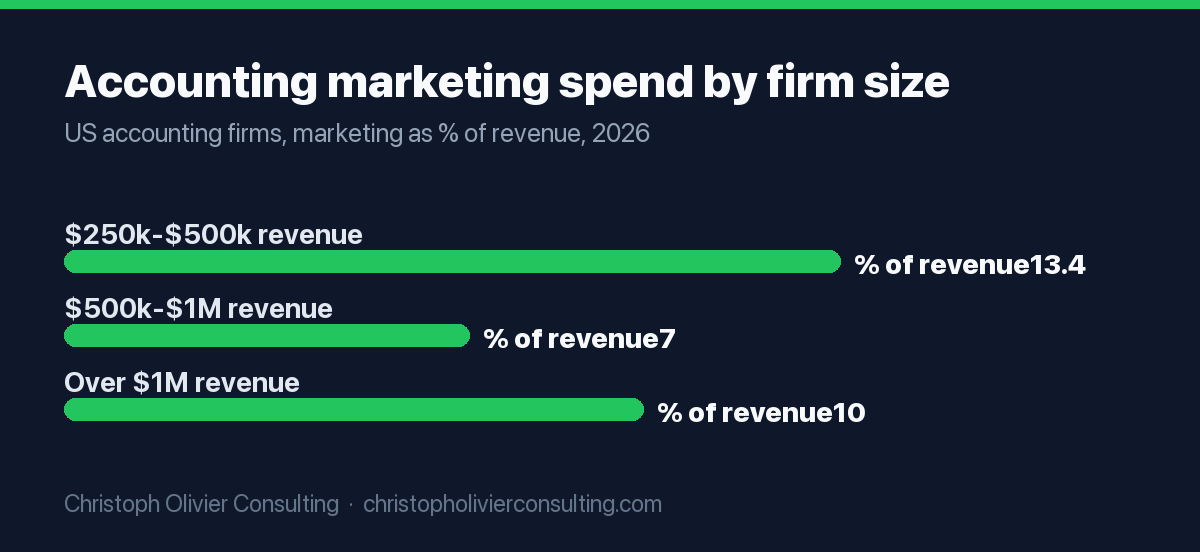
Percentage of revenue. This is the shorthand most owners reach for first. As an illustrative planning range, professional services firms often think in terms of a low single-digit to high single-digit share of gross revenue, with an established firm holding steady at the low end and a firm pushing hard for growth or entering a new niche sitting higher. Treat that as a sanity check, not a rule. It tells you whether your number is roughly in a reasonable zone, nothing more.
Goal-based, or zero-based. You start from the growth you want and work backward to the spend required. This is the method I recommend, because it ties every dollar to an outcome instead of to last year’s number.
Competitive parity. You spend what you think similar firms spend. This is the weakest method. You cannot see their goals, their margins, or their results, so you end up copying a number with no logic behind it.
How to set your number
Work the goal-based method in five steps. You do not need precise data to start, just honest estimates you can refine later.
- Set a target for the year: a revenue figure, or a specific number of new clients in the niches you want.
- Estimate the average annual value of one of those clients, and how many years they tend to stay. That gives you a rough lifetime value.
- Decide how much of that value you are willing to reinvest to win one new client. That is your tolerable acquisition cost.
- Multiply your target number of new clients by that tolerable acquisition cost. That gives you a demand-generation floor.
- Add your fixed foundation costs on top: website, tools, and brand basics that you would pay for regardless of how many clients you chase this year.
The result is a budget you can defend in a partner meeting, because every part of it points at a goal.
Phase the spend across the year
Accounting demand is seasonal, so a flat monthly budget rarely fits. Many firms get more from front-loading brand and content work in the late summer and fall, when prospects start thinking about the coming year, and holding some budget for a focused push before and during filing season when intent is highest. The point is not a fixed calendar. It is to spend when your buyers are actually looking, rather than splitting the total into twelve equal pieces out of habit.
How to allocate the budget
Once you have a total, split it across the work. The table below is an illustrative starting point, not a measured benchmark. The percentages are shares of your marketing budget, and you should shift them based on your firm’s stage and market.
| Category | Illustrative share of budget | What it funds |
|---|---|---|
| Website and foundational SEO | 15 to 25 percent | A fast, clear site and the technical basics that let clients find you |
| Content and thought leadership | 20 to 30 percent | Articles, guides, and email that show expertise and answer client questions |
| Local search and reviews | 10 to 15 percent | Google Business Profile, local listings, and a steady review process |
| Paid search and paid social | 10 to 20 percent | Targeted ads for high-intent searches and niche audiences |
| Referral and partner nurturing | 10 to 15 percent | Events, gifts, and systems that keep referral sources active |
| Tools and measurement | 5 to 10 percent | CRM, analytics, email platform, and reporting |
Stage changes the mix. A newer firm should weight the foundation: website, local search, and a few strong content pieces, because you need to be found and to look credible before ads can work. An established firm with a solid base can push more into content depth and paid channels to reach a specific niche. A firm that lives on referrals should protect the referral and content lines, since those feed the relationships that already drive the business.
One more line item deserves a decision, not a default: who does the work. A firm can hire in-house, retain an agency, or bring in fractional senior help to set direction while junior staff or freelancers execute. Whatever you choose, count that cost inside the budget. Marketing that no one owns tends to stall, and unowned spend is the easiest to waste.
Review the budget against results, not feelings
A budget you never check turns into a habit. Tie it to a short set of measures and look at them every quarter. Track where new inquiries come from, so you know which lines earn clients and which just spend money. Watch how much you pay, on average, to win a client, and compare that against the lifetime value you estimated when you set the number. Keep an eye on the pipeline as well as closed work, because content and search often plant a client months before they call. When a channel keeps producing the right clients, move money toward it. When one goes quiet for two or three quarters, cut it and reallocate. The total matters less than whether each part of it is pulling its weight.
Compliance and the mistakes that cost accounting firms
Marketing for a CPA firm sits under professional conduct rules, so a few guardrails matter. This is general marketing guidance, not legal advice, and you should confirm specifics with your own counsel and your state board.
Two AICPA rules shape most decisions. Under the advertising and solicitation guidance in the Code of Professional Conduct, your marketing cannot be false, misleading, or deceptive. That rules out guaranteed outcomes, exaggerated claims, and comparisons you cannot support. Under the confidentiality rule, you cannot disclose client information without consent, which means you cannot name a client, show their logo, or describe their specific tax result in a case study or testimonial unless they have agreed in writing.
The mistakes I see most often:
- Funding tactics before positioning. Buying ads before you know your niche wastes money on the wrong audience.
- Going dark in busy season. Pausing all marketing from January to April, then restarting cold, throws away the momentum you paid for.
- Using client details without consent. A client name or a specific outcome in a testimonial can breach confidentiality rules even when the client seems happy.
- Making promise-style claims. Language like a pledge to cut a tax bill in half crosses into misleading marketing.
- Spending with no tracking. Without measurement you cannot tell which channel earned the client, so you keep funding guesses.
How this fits the bigger picture
A budget is only the resourcing layer. It works when it sits inside a full marketing plan for CPA and accounting firms that connects your positioning, your services, and the clients you actually want. Set the plan first, fund it with the budget second, then revisit both every quarter as results come in.
Set your number with intent, protect it through busy season, and keep it tied to a plan you can measure. If you want help sizing the budget and building the plan it funds, book a call or start with the hub above.
Frequently asked questions
How much should an accounting firm spend on marketing?
There is no single right number. As an illustrative planning range, professional services firms often plan a low single-digit to high single-digit share of gross revenue, with growth-focused firms at the higher end. Use a goal-based calculation to set your actual figure and treat the percentage only as a sanity check.
Is percentage of revenue a good way to set a marketing budget?
It is a useful sanity check, not a plan. It tells you whether your number is in a reasonable zone, but it does not connect spend to goals. Build the budget from your growth target and expected client value, then compare it against the percentage.
How should a CPA firm allocate its marketing budget?
Split it across website and SEO, content, local search and reviews, paid ads, referral nurturing, and tools. Newer firms should weight the foundation, while established firms can push more into content and paid channels for a specific niche. The shares are starting points, not fixed rules.
Can an accounting firm use client testimonials in marketing?
Only with consent. The AICPA confidentiality rule means you cannot name a client, show their logo, or describe their specific results without written permission, even if they are happy to help. Get the agreement in writing before you publish.
What marketing claims can a CPA firm not make?
Anything false, misleading, or deceptive under the AICPA advertising guidance. That rules out guaranteed outcomes, promises to cut taxes by a set amount, and comparisons you cannot support. Keep claims accurate and specific to what you can actually deliver.
Should accounting firms pause marketing during tax season?
Going fully dark is a common mistake. Demand shifts with the season, so phase the spend rather than stopping it. Keep enough activity running through busy season to hold the momentum you paid to build.
More marketing guides for cpa
- Marketing KPIs for Accounting Firms: What CPAs Should Track
- CRM and Client Follow-Up for CPA and Accounting Firms
- How a CPA or Accounting Firm Gets More Online Reviews and Manages Its Reputation
- How to Build an Accounting Firm Website That Converts Visitors Into Clients
- Lead Magnet Ideas That Attract Qualified Prospects for a CPA or Accounting Firm
- How a CPA Builds a Personal Brand That Wins Trust and Referrals