
Last reviewed: September 2026
By Christoph Olivier
If you run a coaching or consulting practice, marketing budget is one of the hardest numbers to set. You are the product, your pipeline is lumpy, and a single new client can be worth more than a month of ad spend. That makes generic percentages from product companies close to useless for you.
This article gives you a clear way to decide how much to spend on marketing, how to split that money across the work that actually brings coaches and consultants clients, and what to watch so you can tell whether the spend is paying off. Treat the numbers here as general planning ranges, not measured benchmarks for your practice.
What “marketing budget” actually means for a solo or boutique practice
For most coaches and consultants, marketing is not one line item. It is a mix of cash you pay out and time you could otherwise bill. A one-person practice might spend very little cash and a lot of unbilled hours writing, speaking, and following up. A firm with associates might flip that and pay for ads, a fractional marketer, and production help.
So before you pick a percentage, define what you are counting. A useful working definition includes four buckets:
- Cash outlays: ads, software, your website, a copywriter or designer, sponsorships, events.
- Content production: the cost of turning your expertise into articles, talks, videos, or a newsletter, whether you do it or pay for it.
- Tools and infrastructure: your email platform, CRM, landing page tools, scheduling, analytics.
- Your own time: the hours you spend on business development that you could have billed to a client.
If you ignore that last bucket, you will badly underestimate what marketing really costs you and overvalue channels that eat your calendar.
A quick way to set your working number
Once you know what you are counting, you can build a rough budget in an afternoon. List the fixed costs you already carry, like your website, email platform, and scheduling tools. Add the variable costs you expect, like ads, content help, or an event or two. Then add a realistic estimate of the hours you plan to spend on business development, priced at a fair hourly rate. That total is your true marketing budget. Compare it against the new revenue you are trying to create, and if the ratio feels off in either direction, adjust it before you commit, not after three months of spending.
How much to budget: a way to reason about the number
There is no single correct percentage for a coaching or consulting practice, and anyone who quotes you a precise industry figure is guessing. What you can do is reason from your own numbers. Three inputs drive the decision.
1. Your growth stage
A practice that is trying to get known and fill a calendar usually needs to spend a larger share of revenue on marketing than one that is booked out on referrals. Early on, you are buying awareness and proof. Later, you are mostly maintaining a system that already works.
2. Your margins and client value
Coaching and consulting carry high gross margins because the main cost is your time. That means you can often afford to reinvest more of each dollar than a product business can. The higher your average engagement value and the longer clients stay, the more you can justify spending to acquire one.
3. Where your clients come from today
If most of your work arrives through referrals and repeat clients, your marketing job is to protect and widen that flow, which is cheaper. If you are trying to open a new channel like paid search or a paid newsletter, expect to spend more up front before it returns anything.
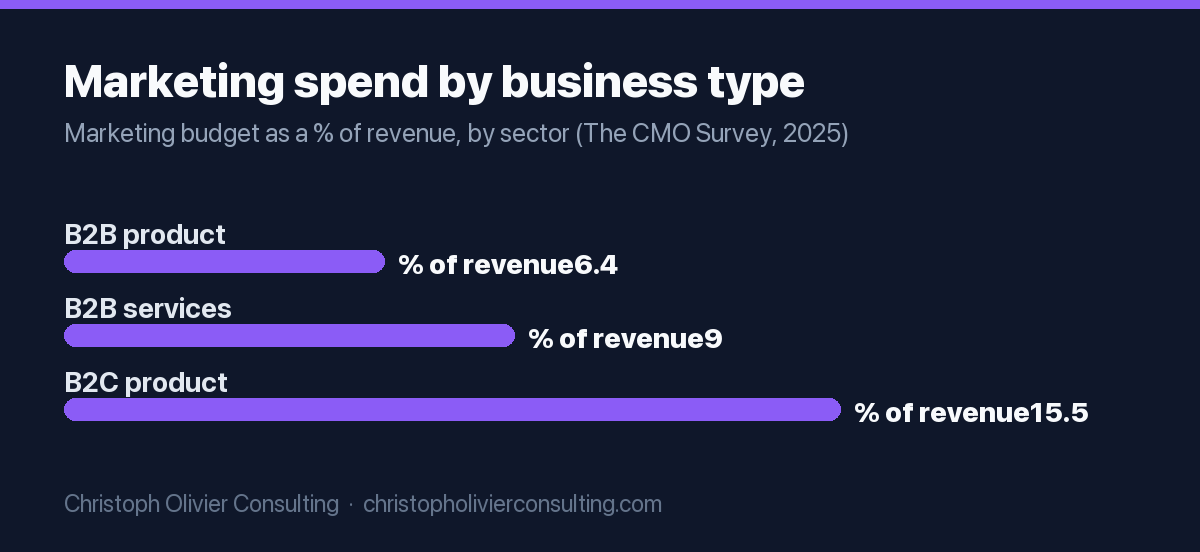
A simple planning approach: estimate the revenue you want to add next year, estimate how many new clients that takes, and work backward to what you can afford to spend to win one client while keeping a healthy margin. That target cost to acquire a client is a far better anchor than any percentage-of-revenue rule. The illustrative ranges people cite for professional-services marketing, often somewhere in the single digits to low double digits as a percent of revenue, are planning starting points only, not measured benchmarks for your practice. Your right number is the one your own math supports.
How to allocate the budget across channels
Once you have a number, the harder question is where it goes. For coaches and consultants, trust and proof do most of the selling, so the allocation should favor channels that demonstrate expertise and stay in front of people who already know you.
The table below shows one way to think about splitting a marketing budget by growth stage. The percentages are illustrative planning ranges to start a conversation, not measured benchmarks, and you should adjust them to your own market and what already works.
| Area | Building awareness | Steady growth | Mostly referral-driven |
|---|---|---|---|
| Content and thought leadership (articles, talks, video, newsletter) | Largest share | Large share | Moderate share |
| Website, SEO, and owned assets | Moderate share | Moderate share | Smaller share |
| Paid ads and sponsorships | Test small | Scale what works | Optional |
| Email, CRM, and nurture tools | Smaller share | Moderate share | Moderate share |
| Referral and partnership activity | Moderate share | Moderate share | Largest share |
A few principles behind that layout. Content is the engine for expertise-based services because it does two jobs at once: it wins search and social attention, and it proves you can think. Your website and email list are assets you own, so money there compounds instead of renting attention. Paid ads can work, but for most coaches they are a supplement to a strong content and referral base, not a substitute for one. And partnerships with people who serve the same clients you want are often the highest-return activity of all, even though they cost more time than cash.
Start small, then move money toward what converts
Do not spread a small budget evenly across eight channels. Pick two or three that fit how your best clients actually found you, fund them properly, and give them enough time to show results. Review the split every quarter and shift money toward whatever is producing qualified conversations. Marketing budgets for a practice your size should be living documents, not a number you set once in January.
It also helps to separate money you spend to keep the current pipeline healthy from money you spend to test something new. The maintenance spend should be steady and predictable. The experimental spend should be small, capped, and judged on clear questions, such as whether a channel can produce a qualified call at a cost you can live with. Keeping those two pools separate stops a failed experiment from draining the work that already brings you clients, and it makes your quarterly review far easier to run.
Compliance and the mistakes that quietly cost you
Coaches and consultants sell outcomes, which is exactly where marketing gets legally risky. In the United States, the FTC treats earnings and results claims as a serious matter. If you advertise income results, business growth, or specific outcomes, you generally need to be able to back up those claims, and testimonials that describe atypical results can create real exposure if they imply typical ones. Keep proof for what you promise, avoid guaranteed-income language, and be careful with testimonials that suggest a client’s result is what everyone gets. This is general marketing guidance, not legal advice, so confirm your specific claims and disclosures with a qualified professional.
Beyond compliance, here are the budget mistakes that hurt coaches and consultants most:
- Ignoring the cost of your own time. A channel that is free in cash but eats ten hours a week is not free. Price your hours in.
- Funding acquisition and starving retention. Keeping and expanding existing clients is usually cheaper than winning new ones. Budget for the relationship, not just the first sale.
- Killing channels too early. Content and SEO take months to compound. Judging them on a few weeks guarantees you quit right before they work.
- Spending on ads before the offer converts. Paid traffic amplifies whatever you already have. If the offer and follow-up are weak, ads just help you lose money faster.
- Making claims you cannot support. Aggressive results promises may lift response and create FTC risk at the same time. That is a bad trade.
How this fits your bigger marketing picture
A budget is one piece of a larger system. The size of the number matters far less than whether your offer, your proof, and your channels are pulling in the same direction. If you want to see how budgeting connects to positioning, content, and lead generation for a practice like yours, our marketing plan for coaches and consultants lays out the full approach and is the natural next step after you have set your spend.
Frequently asked questions
Short answers to the questions coaches and consultants ask most about marketing budgets.
Frequently asked questions
What percentage of revenue should a business coach spend on marketing?
There is no single correct percentage, and precise industry figures are usually guesses. Reason from your own numbers instead: decide how many new clients you want, and what you can afford to spend to win one while keeping a healthy margin. Any percentage you have seen quoted is an illustrative planning starting point, not a measured benchmark for your practice.
Should I count my own time as a marketing cost?
Yes. For a solo or boutique practice, unbilled hours spent writing, speaking, and following up are often your largest marketing cost. Leaving them out makes time-heavy channels look free and skews every budget decision. Price your hours at roughly what you could bill and include them.
Where should a coach or consultant put marketing money first?
For expertise-based services, content and thought leadership plus your owned assets like your website and email list usually come first, because they prove you can think and they compound over time. Partnerships and referrals are high value too. Paid ads tend to work best as a supplement once those foundations convert.
How much should go to paid ads?
Often less than people expect. Ads amplify an offer that already converts, so if your positioning, content, and follow-up are not working, ads mostly speed up losses. Test small, measure the cost to book a qualified call, and scale only the campaigns that clear your target acquisition cost.
Are there legal limits on what my marketing can claim?
Yes. In the US, the FTC expects you to be able to support earnings and results claims, and testimonials implying typical outcomes can create exposure. Keep proof for what you promise and avoid guaranteed-income language. This is general marketing guidance, not legal advice, so review specific claims with a qualified professional.
How often should I revisit my marketing budget?
Review it at least quarterly. Budgets for a small practice should be living documents. Check which channels are producing qualified conversations, shift money toward what converts, and give slower channels like content and SEO enough time to compound before you judge them.
More marketing guides for business coaches
- Marketing KPIs and Metrics Every Business Coach or Consultant Should Track
- CRM and Client Follow-Up for Business Coaches and Consultants
- How Business Coaches and Consultants Get More Reviews and Use Testimonials the Right Way
- How to Build a Business Coaching Website That Converts Visitors Into Booked Calls
- Lead Magnet Ideas for Business Coaches and Consultants
- How a Business Coach or Consultant Builds a Personal Brand That Attracts Clients