

Yes, Claude cites sources when it searches the web. Anthropic’s help center says that with web search on, “every response includes citations, so you can easily verify sources yourself,” and the API’s web search tool attaches a URL, a page title and up to 150 characters of quoted text to every citation. Without web search, Claude answers from its training data (the current models have a reliable knowledge cutoff of June 2026), so there is no live page behind the answer and any reference it writes from memory needs checking.
That split decides how you get cited. Your page can only be quoted when Claude runs a search or fetches a URL. That means Anthropic’s search and user crawlers must be allowed in, the page must be findable in the index Claude’s search draws on, and one passage on it must answer the question on its own. Everything below comes from Anthropic’s help center, API documentation and trust center, plus Brave’s own crawler documentation. It is the Claude chapter of our answer engine optimization guide.
Does Claude cite sources? It depends on the mode
“Claude” covers several products, and each one handles sources differently. This table sorts them by what a reader or developer actually sees.
| Where you use Claude | Does it cite? | What the citation contains | Anthropic source |
|---|---|---|---|
| claude.ai or the apps, web search on | Yes, on every response that uses search | Direct citations, source links and relevant quotes; image results each carry a source link | Help center: web search |
| claude.ai, you paste a URL | Yes, Claude fetches and reads that page | The full content of the article or page you gave it | Help center: web search |
| Any Claude product with no search or fetch | No live citations | Answers come from training data; quotes and references can look authoritative and still be wrong | Help center: incorrect responses |
Claude API, web_search tool | Always; citations cannot be turned off | url, title, encrypted_index and cited_text (up to 150 characters) | Web search tool docs |
Claude API, web_fetch tool | Only if you enable them; off by default | Character ranges inside the fetched page | Web fetch tool docs |
| Claude API, your own documents | When you enable Citations on a document | Character ranges, PDF page ranges or content block ranges | Citations docs |
To switch search on in claude.ai, click the “+” button in the lower left of the chat box, choose “Web search” and check that a checkmark appears. On Team and Enterprise plans an Owner or Primary Owner must first enable it under Organization settings, Capabilities. In the new Claude experience there is no toggle: Claude searches when it decides a search helps. Adding “Search the web” to a prompt makes a search more likely, according to the same help article.
When Claude decides to search (and when it does not)
This list matters more to publishers than any ranking tip, because a question Claude answers from memory cannot cite you. Anthropic’s web search documentation says Claude searches when a request depends on:
- recent events, news or announcements
- current prices, rates, scores or statistics
- specific organizations, people or products whose details might have changed
- an explicit request to search or look something up
It answers directly, without searching, for established facts, math and science basics, coding concepts, creative writing and content already in the conversation. So the pages that can earn a Claude citation are the ones that publish current, specific facts: this year’s fee ranges, a rule that changed, a named vendor’s plan limits, a dated statistic. A timeless “what is X” explainer is the type of question Claude usually answers itself.
Anthropic citations: the Citations feature in the Claude API
If you searched “anthropic citations” or “claude citations” because you build on the API, this is the feature you want. Citations lets Claude ground an answer in documents you send and return the exact passages that support each claim. All active models support it. You switch it on per document:
{
  "type": "document",
  "source": {
    "type": "text",
    "media_type": "text/plain",
    "data": "Your source text..."
  },
  "title": "Engagement letter 2026",
  "citations": { "enabled": true }
}
What comes back depends on the document type:
| Document type | Best for | How it is split | Citation points to |
|---|---|---|---|
| Plain text | Prose, RAG chunks you want cited sentence by sentence | Sentences | Character indices (0-indexed), type char_location |
| PDFs with a real text layer | Sentences | Page numbers (1-indexed) | |
| Custom content | Lists, transcripts, bullet points | No extra chunking; your blocks are used as-is | Content block indices (0-indexed) |
Six details from the docs that trip people up:
- The cited text is free. The
cited_textfield does not count toward output tokens, and it is not counted as input tokens when you pass it back in later turns. - No structured outputs. Citations and structured outputs are incompatible. Enable citations on any document and also send
output_config.format, and the API returns a 400 error. - Scanned PDFs cannot be cited. Image citations are not supported, so a PDF without extractable text has nothing to point to. If you publish research as a PDF, export it with a text layer.
- Convert .docx and .xlsx first. The document block does not accept them; send them as plain text.
- The “index” fields. Document citations carry a
document_indexthat says which of your documents was cited. Web search citations carry anencrypted_indexthat you must pass back unchanged in multi-turn conversations. - Display rule. When you show API output directly to end users, Anthropic’s web search and web fetch docs say citations to the original source must be included.
On quality, Anthropic says the feature returns citations that are “guaranteed to contain valid pointers to the provided documents,” and its launch post reports internal evaluations showing recall accuracy up to 15% higher than most custom implementations. One customer quoted there, Endex, said it “reduced source hallucinations and formatting issues from 10% to 0%.” Those are Anthropic’s and a customer’s figures, not independent tests.
Claude gave you a citation for a paper you cannot find anywhere. What should you do?
Treat it as unverified until you find the paper in a bibliographic database, and do not use it if you cannot. Anthropic’s help center warns that “Claude can display quotes that may look authoritative or sound convincing, but are not grounded in fact,” and tells users not to rely on Claude as a single source for high-stakes decisions. A reference written from memory, with no search result behind it, is exactly that case. Work through these steps:
- Ask where it came from. Paste this: “For each source you cited, say whether it came from a search result in this conversation or from memory. For any from memory, give the DOI, or write ‘unverified’ if you cannot.”
- Search the exact title in quotes on Google Scholar and Crossref Metadata Search. If the title fails, search the first author plus the year.
- Resolve any DOI at doi.org. A DOI that does not resolve, or resolves to a different paper, means the reference is wrong.
- Turn on web search and ask Claude to find the paper and link it. With search on, the citation points to a live page you can open and read.
- If nothing matches, delete the reference and use the thumbs down button so Anthropic sees the error.
- For work that must be cited correctly, give Claude the papers. Upload the PDFs, or on the API use Citations, so every citation points into a document you supplied. Anthropic’s guide to reducing hallucinations adds a final check: have Claude find a supporting quote for each claim and retract any claim it cannot support.
The three Anthropic crawlers and what each one controls
Anthropic documents exactly three bots on its crawler support page (dated April 7, 2026). Two of them decide whether Claude can cite you. One only decides training.
| User agent | What Anthropic says it does | What blocking it does, in Anthropic’s words | Allow it to stay citable? |
|---|---|---|---|
Claude-SearchBot | Crawls the web “to improve search result quality for users” | “Prevents our system from indexing your content for search optimization, which may reduce your site’s visibility and accuracy in user search results” | Yes |
Claude-User | Accesses websites when individuals ask Claude questions | “Prevents our system from retrieving your content in response to a user query, which may reduce your site’s visibility for user-directed web search” | Yes |
ClaudeBot | Collects web content “that could potentially contribute to” model training | Signals “that the site’s future materials should be excluded from our AI model training datasets” | Your choice; Anthropic ties it to training, not search |
The operating rules on the same page:
- All three honor robots.txt and support the non-standard
Crawl-delaydirective. - Rules apply per subdomain, so
blog.example.comneeds its own robots.txt. - Blocking Anthropic by IP address “may not work correctly or persistently guarantee an opt-out,” because it stops the bots reading your robots.txt. Anthropic publishes its crawler IP ranges at claude.com/crawling/bots.json.
- The bots “will not attempt to bypass CAPTCHAs.” A bot-challenge page in front of your content means Claude sees the challenge, not your page.
Two more limits from the API side. The web fetch tool refuses URLs blocked by robots.txt (error url_not_allowed), and it “does not support websites dynamically rendered with JavaScript.” If your answer only appears after a script runs, Claude’s fetch gets an empty shell.
A robots.txt that keeps you citable and opts out of training, matching the template in our AI Search Readiness Study. Delete the ClaudeBot lines if you are happy to be used in training.
# Claude search and user fetches: allow
User-agent: Claude-SearchBot
Allow: /

User-agent: Claude-User
Allow: /

# Model training: your decision (this example opts out)
User-agent: ClaudeBot
Disallow: /

# Everyone else, including Googlebot
User-agent: *
Allow: /
Sitemap: https://www.example.com/sitemap.xml
In that study’s crawl of 419 live small-business sites, 91.2% of robots.txt files did not mention ClaudeBot at all, so for most firms the risk is not a deliberate block. It is a CDN or firewall rule nobody remembers turning on.
What search engine does Claude use?
Anthropic does not publish which index answers a given query. What it does publish is its subprocessor list. The Anthropic Trust Center currently names three subprocessors whose purpose is “Web Search”: Brave Search (all products), TurboPuffer (all products except Claude for Government) and Parallel Web Systems (all products except Claude for Government). Separately, the help center says Claude’s image search is powered by Bing.
The Brave link has the longest public record. Simon Willison reported on simonwillison.net on March 21, 2025 that Anthropic had added Brave Search to its subprocessor list as of March 19, 2025, that Claude’s search function definition included a BraveSearchParams property, and that a test search returned ten citations that exactly matched the same search on Brave. That was 2025. The list has grown since, so treat Brave as one documented input, not the whole system.
Brave’s own crawler page gives you three facts you can act on:
- Googlebot rules carry over. Brave’s crawler “does not advertise a differentiated user agent,” and “if a domain or page is not crawlable by Googlebot, then Brave Search’s bot will not crawl it either.” Block Googlebot from a folder and you have blocked Brave too.
- robots.txt does not deindex in Brave. Brave says robots.txt “is not used to prevent a page from being indexed.” Use a
noindexdirective, then submit the page for re-fetching. - Discovery uses opt-in browser data. Brave’s crawler is “partially powered” by users who opt into the Web Discovery Project in Brave browser settings.
The practical test is simple: search your target question and your page title on search.brave.com. If your page is missing there, check the Googlebot-level crawlability of that URL first.
The Claude citation eligibility audit
Run these twelve checks per page, starting with pages that already get impressions in Search Console. Tests 1 to 7 are access: fail one and nothing else matters. Tests 8 to 12 decide whether Claude picks your passage over another page it also found.
| # | Test | How to run it | Pass | Basis |
|---|---|---|---|---|
| 1 | Claude-SearchBot is not blocked | Open /robots.txt; read the Claude-SearchBot group and the User-agent: * group | No Disallow covering the page in the group that applies | Anthropic crawler page |
| 2 | Claude-User is not blocked | Same file, Claude-User group | Same as test 1 | Anthropic crawler page |
| 3 | ClaudeBot policy is a decision | Look for a ClaudeBot group | Allowed or blocked on purpose, written down | Anthropic: training only |
| 4 | Firewall does not challenge Claude | Run the curl test below | HTTP 200 with real page text, not 403, 429 or a challenge page | Bots do not bypass CAPTCHAs |
| 5 | IP allow-lists include Anthropic | If your firewall verifies bots by IP, compare with bots.json | Anthropic’s published ranges are in the allow-list | claude.com/crawling/bots.json |
| 6 | Googlebot can crawl the page | URL Inspection in Search Console | “Crawl allowed” and indexed | Brave follows Googlebot crawlability |
| 7 | Page is in Brave’s index | Search the exact title on search.brave.com | The page appears | Brave is a listed web search subprocessor |
| 8 | Answer text is in the raw HTML | curl the URL and search for a sentence from the body | The sentence is in the response | Web fetch does not render JavaScript |
| 9 | First sentence carries the fact | Read the first sentence under each H2 | Names the subject and states the number, rule or condition within about 150 characters | API cited_text holds up to 150 characters |
| 10 | Page shows when it was updated | Check the visible date and dateModified | Both present and matching | Search results carry page_age |
| 11 | Every number links to its source | Click each figure on the page | Each one reaches a primary source with a date | Claude searches for “current prices, rates, scores, or statistics” |
| 12 | PDFs have a text layer | Try to select text in each PDF | Text is selectable | Scanned PDFs are not citable |
# Test 4: does your firewall let a Claude-SearchBot request through?
curl -s -o /dev/null -w "%{http_code}\n" -A "Claude-SearchBot" https://www.example.com/your-page/
curl -s -o /dev/null -w "%{http_code}\n" -A "Claude-User" https://www.example.com/your-page/

# Test 8: is the answer in the raw HTML?
curl -s https://www.example.com/your-page/ | grep -c "a sentence copied from your page"
A faked user agent only tests rules keyed on the bot’s name. Real Anthropic traffic comes from the IP ranges in bots.json, which is why test 5 exists. If you want someone to run all twelve with you and fix the failures, book a consultation.
What is not on the list: llms.txt. It is a proposal by Jeremy Howard published September 3, 2024 (revised as v2 on llmstxt.org on August 10, 2026), not a ratified standard, and Anthropic’s crawler and web search pages do not mention it. Our SEO terms glossary tracks its status, including Google’s statement that Google Search ignores these files.
How to write a passage Claude can quote
A web search citation in the API holds a URL, a title and up to 150 characters of the cited passage. Write so that those 150 characters carry your point by themselves. Here is the difference on one of this page’s own questions:
| Before (not quotable) | After (quotable) |
|---|---|
| “There are many factors to consider when deciding how AI crawlers should access your website, and every business is different.” | “Allow Claude-SearchBot in robots.txt: Anthropic says blocking it may reduce your site’s visibility in Claude’s search results.” |
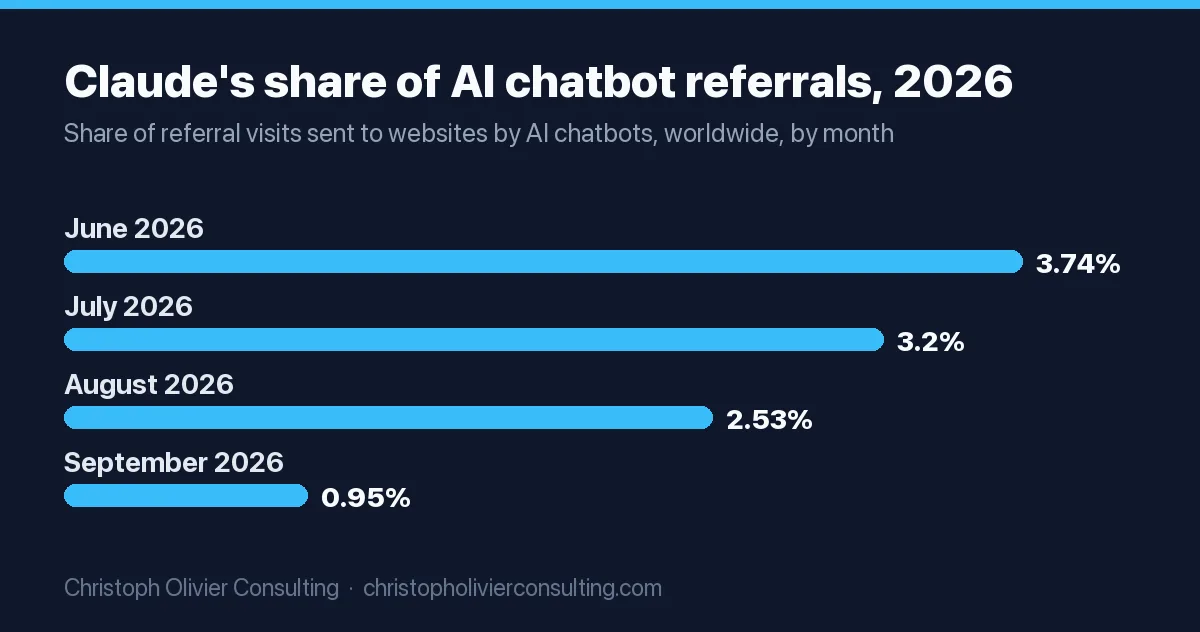
| “Claude has become increasingly popular and is changing how people find information online.” | “Claude sent 0.95% of AI chatbot referrals to websites in September 2026, per StatCounter, behind ChatGPT at 80.47%.” |
The rules behind the rewrite:
- Headings in the searcher’s words. “Does Claude cite sources?” beats “Citation Behavior Overview,” because that is the question Claude turns into a search.
- Subject plus fact in sentence one. No “it depends” openers. The condition goes after the answer.
- Comparisons in HTML tables. Plans, fees, rules by state: a table row survives extraction; a screenshot of a table does not.
- Primary numbers, dated and linked. Claude searches for current figures. A number only your page publishes, with its method stated, gives Claude a reason to cite you rather than a summary of you.
How to get mentioned in Claude when it does not search
When Claude answers without searching, it draws on training data, and Anthropic does not document how any single page shapes those answers. The only documented lever is ClaudeBot: allowing it lets your content be collected for possible future training, and blocking it excludes your future pages. Either way it affects later models, not the ones answering today, whose reliable knowledge runs to June 2026 per Anthropic’s models overview.
My view: for a professional-service firm, chasing training-data mentions is a weak first project. The search path is documented, testable and fast to fix. Get cited when Claude searches, and being described consistently across your own site and the independent sites that mention you does the rest over time.
How to measure whether Claude cites you
Start with the honest baseline: Claude sends little traffic. StatCounter, which tracks AI chatbot referrals across more than 1 million websites, measured Claude’s share of AI chatbot referrals at 3.74% in June 2026 and 0.95% in September 2026 (StatCounter Global Stats). Its October 2026 reading shows a sharp break across every chatbot, with ChatGPT falling from 80.47% to 51.03%, so wait for the series to settle before quoting it. More context on these sources is in our AI search statistics roundup.
GA4. On May 13, 2026, Google Analytics added an AI Assistant channel to the Default Channel Group, and its release note names Claude as an example source. Do not assume it catches every Claude visit:
- Go to Reports, Acquisition, Traffic acquisition, with the primary dimension set to Session default channel group, and look for AI Assistant.
- Switch the dimension to Session source and search for
claude.ai. If it still shows under Referral, the default list is not catching it. - If so, go to Admin, Data display, Channel groups, Create new channel group. Add a channel named “AI search” with the condition Source matches regex
.*(chatgpt\.com|openai\.com|perplexity\.ai|gemini\.google\.com|copilot\.microsoft\.com|claude\.ai).*, then click Reorder and drag it above Referral, as Google’s custom channel groups help instructs.
The full setup, including Search Console filters, is in our guide to tracking AI search traffic in GA4.
Server logs. Filter for Claude-SearchBot and Claude-User in your access logs, check the requests got 200 responses, and confirm the source IPs against bots.json. Claude-User hits on a page mean real people asked Claude something that led it to your URL.
A monthly prompt log. Referrals miss citations nobody clicks, so check citations directly. Pick 10 to 20 questions your buyers ask, in their wording, and run the same set every month in claude.ai with web search on. Copy this log:
| Date | Prompt (buyer wording) | Did Claude search? | URLs cited | Our URL cited? | Competitor URLs cited | Fix to try |
|---|---|---|---|---|---|---|
| 2026-11-03 | “What does a fractional CMO cost for a 20-person accounting firm?” | Yes / No | Paste every citation link | Yes / No | List domains | e.g. add a fee table to the pricing page |
If “Did Claude search?” is No for a prompt, no page can be cited for it, so drop that prompt or rephrase it around something current. If Claude searched and cited competitors, compare their passage with yours against tests 8 to 11 above.
Frequently asked questions
Does Claude cite sources?
Yes, when it searches the web or reads a URL you give it. Anthropic's help center says every web search response includes citations you can check, and the API returns a URL, title and up to 150 characters of quoted text per citation. Without search, Claude answers from training data, so treat any reference it writes from memory as unverified until you find it yourself.
What are Anthropic citations?
Citations is a Claude API feature that grounds answers in documents you supply. You set citations enabled on a document block, and Claude returns the exact passages behind each claim: character ranges for plain text, page ranges for PDFs, block ranges for custom content. The cited text does not count toward output tokens. It cannot be combined with structured outputs, and scanned PDFs without a text layer cannot be cited.
What search engine does Claude use for web search?
Anthropic does not say which index answers a given query. Its Trust Center lists three web search subprocessors: Brave Search, TurboPuffer and Parallel Web Systems. The help center says image search is powered by Bing. In March 2025 Simon Willison showed Claude's search results matching Brave exactly, so checking your page on search.brave.com is a sensible test.
Should I block ClaudeBot in robots.txt?
That is a training decision, not a search decision. Anthropic says blocking ClaudeBot signals that your future content should be excluded from model training. Citations depend on Claude-SearchBot, which indexes pages for search, and Claude-User, which fetches pages when someone asks Claude a question. You can block ClaudeBot and still allow those two, and Anthropic warns that blocking either of them may reduce your visibility.
How do I get mentioned in Claude?
Make your pages citable when Claude searches: allow Claude-SearchBot and Claude-User, make sure Googlebot can crawl the page (Brave follows Googlebot crawlability), keep the answer in raw HTML, and put the fact in the first sentence under a question heading. Mentions without search come from training data, which Anthropic does not document page by page, so the search path is the one you can test and fix.
Can I pay to get cited by Claude?
None of Anthropic's web search, crawler or Citations documentation describes a paid placement or submission program for Claude's answers. Citations come from the pages Claude finds when it searches or fetches. Be wary of any vendor promising guaranteed Claude citations; what you can control is crawler access, indexing and how clearly your page answers the question.
Does llms.txt help Claude cite my site?
There is no documented link. llms.txt is a proposal by Jeremy Howard published September 3, 2024, not a ratified standard, and Anthropic's crawler and web search pages do not mention it. Google says Google Search ignores these files. Adding one does no harm, but it should not come before crawler access and answer-first pages.