

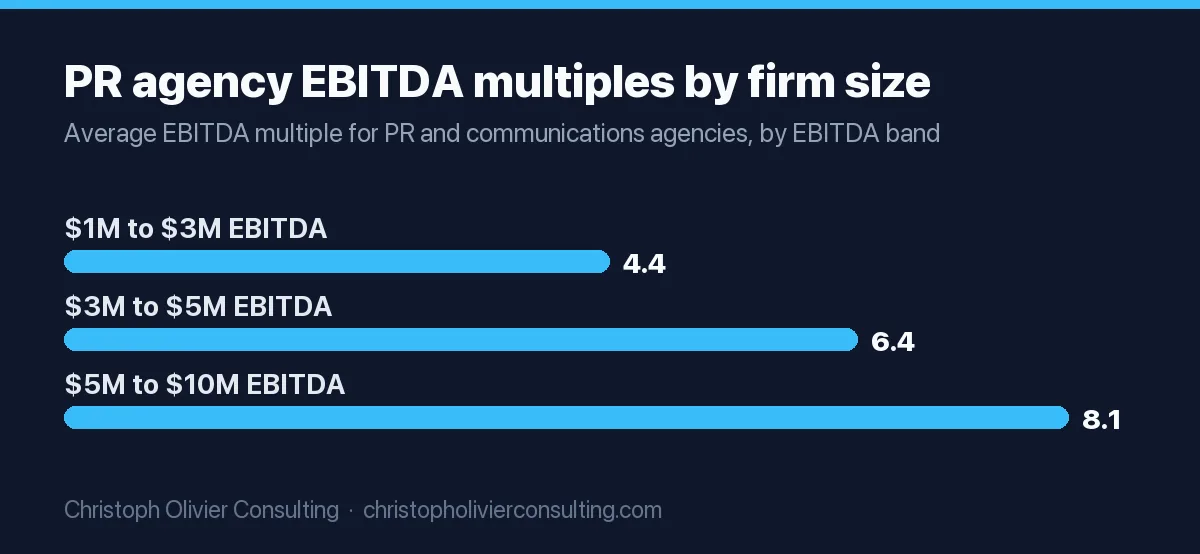
If you own a PR firm and are planning an exit, the 2025 benchmark from marketing services M&A advisor Capital A puts PR and communications agencies at an average of 4.4x EBITDA with $1M to $3M of EBITDA, rising to 8.1x at $5M to $10M. What you actually take home depends on four things buyers test first: client concentration, retainer mix, margin and how much of the business runs through you. If you are an exit planning advisor looking for press, skip to the second half: an earned media plan, pitch templates, the HARO replacements that work in 2026 and the SEC and FINRA lines you should not cross.
This page answers both readings of “exit planning for a PR firm” because both people search for it. It is general information, not legal, tax or investment advice.
Exit planning for a PR firm: what your agency is worth in 2026
There is no single PR agency multiple. Every published figure comes from an advisor’s own deal set, so read them side by side and note the date and basis of each.
| Source | What it measures | Figure | Caveat |
|---|---|---|---|
| Capital A, 2025 EBITDA multiples table | PR and communications agencies, average EBITDA multiple by EBITDA size | 4.4x ($1M to $3M), 6.4x ($3M to $5M), 8.1x ($5M to $10M) | Page is dated April 2024 but labels the table 2025; advisor’s own data |
| FE International, October 2026 | All agency types, adjusted EBITDA bands | 3x to 5x ($500K to $1M), 4x to 6.5x ($1M to $2.5M), 5.5x to 8.5x ($2.5M to $5M), 7x to 12x ($5M+) | Not PR specific; SDE multiples of 2x to 4x below roughly $500K of earnings |
| Productive, updated July 2026 | PR agencies, EBITDA | Around 5x to 7.5x | Credited to retainer-heavy revenue; no deal sample disclosed |
| Rick Gould, Gould+Partners, PR News (2016) | PR firms, valuation and payment multiple | Averages 5x EBITDA | Older figure, useful as a floor reference |
Two rules hold across all four sources. First, PR firms are valued on recast earnings, not revenue. Gould is blunt that firms “are not valued at a multiple of net revenues,” and that firms with operating profit under 15% and flat growth get lower multiples. Second, size moves the multiple more than anything else: Capital A’s PR band nearly doubles between the smallest and largest tier.
Worked example: a $6M PR firm
Say your firm bills $6.0M in net fee revenue at an 18% EBITDA margin after recasting owner perks and a market salary for you. That is $1.08M of EBITDA.
- At Capital A’s 4.4x for the $1M to $3M band: $1.08M x 4.4 = $4.75M headline value.
- FE International’s $1M to $2.5M band (4x to 6.5x) gives $4.32M to $7.02M, but FE reserves the top of that band for firms with no client above 15%, a retainer mix of 60% or more and a margin of 20% or more. At 18% margin you are not there yet.
- FE’s revenue cross-check of 0.4x to 1.0x trailing net revenue gives $2.4M to $6.0M, which tells you the $7M end is unlikely.
- Lift margin from 18% to 22% on the same revenue and EBITDA becomes $1.32M. At the same 4.4x that is $5.81M, about $1.06M more, before any multiple expansion.
Margin is the lever you control fastest. Clients and management depth take longer, which is why the readiness plan below starts 24 months out.
What buyers check first in a PR firm: a pass/fail scorecard
Score your firm against these lines before you talk to a buyer. Each threshold comes from the source named in the row. Any “fix first” result is a reason to delay going to market, not a reason to give up.
| Factor | Pass | Fix first | Where the line comes from |
|---|---|---|---|
| Largest client | No client above 10% to 15% of revenue | Any client above 20%; above 25% raises earnout risk | FE International; Productive flags any client over 10% as a valuation negative |
| Retainer mix | 60% or more of revenue on retainer | Mostly project or campaign work | FE International: retainers above 60% earn one to two turns more than a project shop |
| EBITDA margin (recast) | 20% or more | Under 15% with flat growth | FE International (20%+); Gould (under 15% gets lower multiples) |
| Who sells new business | A managing director or senior team owns the pipeline | You personally run sales | FE International: a founder-owned sales function can pull a digital agency to 3x to 4x |
| Second-tier management | Leaders who own client relationships and a P&L | Clients call you, not the account lead | Gould lists depth of second-tier management as a value factor |
| Equity for key staff | An equity participation plan in place | No retention plan for the people buyers need | Gould, via Bulldog Reporter: buyers want a plan, usually 20% to 25%, in place at sale |
| Financial history | Three full years of recast financials plus the current interim period | Cash-basis books mixed with personal spend | Gould: buyers’ term sheets use recast operating profit for the past three full years |
Scoring: five or more passes and you are ready to run a process. Three or four and you are 12 to 18 months out. Two or fewer and start with the plan below.
Who is buying PR firms right now
Deal flow is real and skewed toward smaller sellers. Law firm Davis+Gilbert’s mid-year 2026 PR M&A tracker counted 44 completed PR deals in the first half of 2026, up more than 20% on the prior-year period. Private equity buyers made up 34% of deal activity. More than 60% of sellers had under $6M in revenue, and integrated or full-service agencies rose from 18% of acquired firms in 2025 to 34% in 2026. The capabilities buyers sought most included data analytics, reputation and crisis management, and content strategy.
The year before ran the other way on size. Davis+Gilbert’s 2025 review found fewer total deals, with nearly 40% involving firms above $10M in revenue, up from 27% in 2024.
Across all marketing services, Capstone Partners’ April 2026 update reports strategic buyers held 68.6% of year-to-date deals, PR segment deal counts rose year over year, and financial sponsors favor “low customer concentration, a high degree of recurring revenue, and advanced technology-enabled offerings.” That last line is your scorecard in a buyer’s own words.
A 24-month exit readiness plan for a PR firm owner
Gould has said the full planning process for a PR firm owner can take five to seven years. If you have two, use them in this order.
- Months 24 to 18: get a baseline valuation and recast your books. Move to accrual accounting, separate personal expenses, set a market salary for yourself and build three years of recast EBITDA. Run the scorecard above and write down every “fix first.”
- Months 24 to 12: fix concentration. If one client is above 20% of revenue, FE International’s advice is to add accounts before going to market. Shrinking the big client is the wrong fix; growing the rest is the right one.
- Months 21 to 12: convert project work to retainers. Put your top project clients on 12-month retainers with defined scopes. Productive notes that yearly contracts are worth more to a buyer than monthly ones.
- Months 18 to 9: take yourself out of the pipeline. Name a managing director or new business lead, hand over at least the top five client relationships and document how pitches are won.
- Months 18 to 9: lock in key people. Put the equity participation or retention plan in writing so the team a buyer is paying for is still there after closing.
- Months 12 to 6: lift margin. Reprice underwater retainers, cut unbilled overservicing and track utilization by account. Every point of margin compounds at the multiple.
- Months 9 to 6: choose an advisor and buyer type. PR-focused M&A advisors include Gould+Partners, The Stevens Group and Berkery Noyes. Decide whether you want a strategic buyer, a holding company, a PE-backed platform or an internal or ESOP route before anyone sends a term sheet.
- Months 6 to 0: prepare the data room. Client contracts with assignment clauses, revenue by client for three years, staff agreements with non-solicit terms, and your recast financials. Everything PR puts a typical exclusivity window at 60 to 90 days once a letter of intent is signed, so have answers ready before then.
If you work with an exit planning advisor on the personal side, our exit readiness checklist covers the owner goals and wealth questions this business checklist leaves out.
How PR agency deals are structured: cash at close, earnouts and rollover
The headline price is not the cash you receive at closing. Here is how the $4.75M example above splits under FE International’s 2026 ranges:
| Deal profile | Cash at close | Earnout | On a $4.75M price |
|---|---|---|---|
| Clean lower-middle-market deal | 60% to 70% | 10% to 20% over one to two years | $2.85M to $3.33M at close; $475K to $950K earnout |
| Structural risk (client above 25%, founder-run sales) | About 50% | 25% to 40% | About $2.38M at close; $1.19M to $1.90M earnout |
| PE-backed platform buyer | As above | As above, plus 10% to 25% equity rollover | Part of your proceeds stays invested in the buyer |
Earnouts pay less than sellers expect. FE International, citing SRS Acquiom data on 2025 private-target deals, reports that 59% of earnouts paid something, but only 21% of total potential earnout dollars were paid. Older PR-specific structures were longer still: Gould described 20% to 35% paid at closing with the balance over four to five years based on performance, and Everything PR describes earnouts tied to revenue or EBITDA retention over two to four years.
Before you sign, get these earnout terms in writing:
- The metric. Revenue retention is easier to hit than EBITDA when the buyer controls your overhead allocation.
- Cost control. Who sets salaries, shared-service charges and new hires during the earnout period.
- Client loss. What happens if the buyer’s own conflict policy forces you to resign an account.
- Length. FE International recommends 12 to 18 months against a private-deal median of 24.
- Your role. Title, reporting line and what triggers acceleration if you are moved out early.
PR and media for exit planning advisors: the earned media plan
If you are the other searcher, an exit planning advisor who wants press, the goal is narrow: get quoted where owners of sellable businesses and their CPAs, attorneys and bankers already read. One quote in your city’s business journal is worth more than a national mention owners never see. Pick outlets by audience, then by effort.
| Outlet | Who reads it | How to get in | Realistic cadence |
|---|---|---|---|
| Your city’s business journal | Local owners, bankers, CPAs | Same-day comment on a local sale, a family business succession or a tax change; ask the M&A or small business reporter for a 15-minute background call | One pitch a month |
| Exit Planning Institute channels | Peers and referral partners | EPI runs the Exit Planning Blog, Annual Exit magazine, the Exit is Now podcast (every other Wednesday), a Thought Leadership Council, the Exit Planning Summit (1,000+ advisors) and local chapters (its homepage lists 28) | Chapter talk once a year; blog or podcast pitch twice a year |
| Referral-partner trade press | CPAs, estate attorneys, bankers | State CPA society and bar association publications take bylines that teach their members how to spot an owner who needs exit planning | One byline a quarter |
| Industry podcasts and trade outlets for owners | Owners in one vertical (HVAC, dental, logistics) | Pitch the value gap specific to that industry, not exit planning in general | One guest spot a month |
| Journalist query services | Whoever the reporter writes for | Answer specific queries within hours (services compared below) | Two or three answers a week |
Podcasts deserve their own plan, and our guide to podcast strategy for exit planning advisors covers booking and repurposing. If you are deciding whether to publish your own research for reporters to cite, our roundup of thought leadership statistics shows what buyers of professional services say about published expertise.
Pitch templates you can copy
Keep pitches short. In Muck Rack’s State of Journalism 2025 data, 69% of journalists prefer pitches under 200 words, 50% say one follow-up is ideal and 51% want it within 3 to 7 days. All three templates below are under 200 words.
1. Local business journal, news hook
Subject: Local angle on [named sale/tax change]: what it means for owners selling in the next 3 years
Hi [Name], your piece on [their recent article] mentioned [detail]. I advise owners of [industry] businesses in [city] on preparing for a sale, and [news hook] changes the math for them in one specific way: [one-sentence insight, no client names].
Three things I can speak to on the record:
1. [Specific point]
2. [Specific point]
3. [Specific point]I am [credential, e.g. CEPA] at [firm], available today until [time] and tomorrow morning. Happy to be background only if that is more useful.
[Name, phone]
2. Podcast guest pitch
Subject: Guest idea for [show]: [one specific, sourced claim about [industry] owners]
Hi [Host], I listened to your episode with [guest] on [topic]. Your audience of [industry] owners keeps asking the question you raised at [minute]: [question].
I would walk through [framework name] in three parts: [part 1], [part 2], [part 3], using anonymized examples from my practice. No product pitch.
Recent appearances: [link]. One-page bio and headshot attached.
3. Reply to a journalist query
Subject: [Query title]: [your one-line answer]
[Two to four sentences that answer the exact question, written so they can be pasted as a quote.]
[Name], [credential], [firm], [city]. [Website]. Available by phone at [number] until [time].
Follow-up, once, 3 to 7 days later: “Following up on my note about [hook]. If timing does not work, I am happy to be a source on [related topic] later this quarter.”
When a placement lands, do not let it sit. Coverage is read once, so pair it with retargeting and remarketing ads for exit planning advisors to keep your name in front of owners who visited your site after reading it. Press releases are a separate tool; our review of press release distribution in 2026 covers when a wire service is worth paying for.
Help a Reporter Out alternatives after Connectively closed
Cision shut down Connectively, the renamed HARO, on December 9, 2024, according to Octiv Digital. In April 2025 Featured.com announced it had acquired HARO from Cision and said HARO would stay free for journalists and sources, supported by newsletter ads. Here is what each option costs now:
| Service | Free tier | Paid plans | Best for an exit planning advisor |
|---|---|---|---|
| Qwoted | Basic: $0, 2 pitches a month, 2-hour delivery delay | Pro: $149.99/month or $1,188/year, 35 pitches a month, instant delivery; Team and Amplify by quote | Business and finance reporters; the free tier is enough to test it for a quarter |
| Featured | Free plan with a daily usage allowance | Lite $29/month billed annually ($39 monthly); Pro $79/month annually ($99 monthly); Pro+ $239/month annually ($299 monthly) | Volume of expert-quote requests, plus HARO requests in one place |
| HARO (now owned by Featured) | Free, ad-supported email digests | Not covered in the acquisition announcement | Broad daily queries; filter hard for business and personal finance |
| Source of Sources | Free, run by HARO founder Peter Shankman, up to three emails a day | None | Its rules ban product pitches and off-topic replies, which suits a compliance-minded advisor |
Prices were checked on the vendors’ own pricing pages on November 1, 2026 and change often.
Compliance rules for advisors talking to the press: SEC and FINRA
Which rule applies depends on the hats you wear. Confirm the details with your compliance officer or counsel before your first placement.
- SEC-registered investment advisers. The Marketing Rule, 17 CFR 275.206(4)-1, has applied since its November 4, 2022 compliance date. Its definition of “advertisement” excludes “extemporaneous, live, oral communications,” so a live interview is treated differently from a written byline, a newsletter or a post where you reshare coverage that offers your advisory services. Anything that is an advertisement may not include a material statement of fact you cannot substantiate on demand, and must give fair and balanced treatment of material risks next to any benefit you describe.
- FINRA-registered representatives. FINRA Rule 2210(f) covers public appearances, including radio and TV interviews and unscripted speaking. Recommend a security and you need a reasonable basis plus disclosure of material conflicts. Scripts, slides and handouts you use count as communications, and a retail communication (written, to more than 25 retail investors in 30 days) needs principal approval before use.
- If you help owners sell. The federal M&A broker exemption, Exchange Act Section 15(b)(13), took effect March 29, 2023 and covers companies with EBITDA under $25M or gross revenue under $250M in the prior fiscal year, according to Sidley Austin. It does not exempt you from state broker-dealer registration, so be careful how you describe your role in the press.
| Before it runs | Ask |
|---|---|
| A quote about valuations | Did I give a range with its source, never a promised multiple for a client? |
| A client story | Is the company unidentifiable by industry, city and size together, and do I have written permission? |
| A ghostwritten byline | Can I substantiate every fact in it, and has compliance approved it? |
| Resharing coverage | Does my repost turn third-party coverage into my own advertisement, and is it archived? |
| A podcast or webinar | Were slides or handouts reviewed, and is the recording retained? |
If you want a second opinion on which outlets and rules fit your registrations, you can book a consultation.
Frequently asked questions
How do you do exit planning for a PR firm?
Start 24 months out. Get a baseline valuation, recast three years of financials, then fix the issues buyers discount: any client above 20% of revenue, project-heavy revenue, margins under 15%, and a founder who still runs new business. Put key staff on a retention or equity plan, choose a PR-focused M&A advisor and buyer type, and build the data room before a letter of intent starts the exclusivity clock.
What multiple do PR firms sell for?
Capital A's 2025 table puts PR and communications agencies at an average of 4.4x EBITDA with $1M to $3M of EBITDA, 6.4x at $3M to $5M and 8.1x at $5M to $10M. Productive cites roughly 5x to 7.5x for PR agencies. Size, client concentration, retainer mix and owner dependence move a firm within those ranges, and firms are valued on recast earnings rather than revenue.
How much of a PR agency sale is paid in cash at closing?
FE International's 2026 benchmarks put cash at close at 60% to 70% of the price in clean lower-middle-market agency deals, with an earnout of 10% to 20% over one to two years. Where a client exceeds 25% of revenue or the founder runs sales, cash at close can fall to about 50% and the earnout can rise to 25% to 40%.
What is the best HARO alternative for exit planning advisors?
Qwoted's free Basic plan (2 pitches a month) is a low-cost way to reach business and finance reporters, with Pro at $149.99 a month for 35 pitches. Featured has a free plan and paid tiers from $29 a month billed annually. Source of Sources is free and bans product pitches. HARO itself returned in 2025 under Featured as a free, ad-supported service.
Is a media interview an advertisement under the SEC Marketing Rule?
The Marketing Rule's definition of advertisement excludes extemporaneous, live, oral communications, so a live interview is treated differently from written material. A byline, newsletter or social post that offers your advisory services can be an advertisement and must meet the rule's substantiation and fair-and-balanced standards. Confirm how your firm treats reposted coverage with your compliance officer.
Should an exit planning advisor hire a PR agency?
Only once you have a clear angle and material reporters can use, such as a named framework or local commentary you can give the same day. Many advisors start alone with one business journal pitch a month, an EPI chapter talk and journalist query services. If you hire help, you remain responsible for every claim published under your name, so review copy against your compliance rules.