
A customer acquisition strategy is your documented plan for which channels bring in new customers, how those channels map to each stage of your funnel, and how you decide what to keep. The strongest strategies pick two or three channels that fit the ideal customer profile (ICP) and the buying motion, then test before scaling. This guide covers channel selection and sequencing, not the cost math (for that, see the section on measurement below).
Last reviewed: October 2026

What is a customer acquisition strategy?
A customer acquisition strategy is a repeatable system for attracting and converting new customers across a chosen set of channels, aligned to your ideal customer profile and your funnel stages. It answers three questions: who you sell to, which channels reach them at each stage, and how you judge whether a channel earns its place. It is a plan for where to spend attention, not a list of every tactic that exists.
Most acquisition plans fail because they chase channels instead of buyers. A useful strategy starts from where your ICP already looks for answers, then works backward to the channels that intercept that behavior. If your buyer researches on Google before talking to anyone, search and content matter more than a cold outbound push.
Map your channels to the funnel first
Every acquisition channel does its best work at a specific funnel stage: awareness, consideration, or conversion. Mapping channels to stages before you spend prevents the common error of judging an awareness channel by conversion metrics. A blog ranking for a problem query builds awareness; a retargeting ad or a free trial closes at conversion. Both matter, but they answer different questions.
The three stages work like this: awareness is a stranger noticing the problem you solve, consideration is a prospect comparing options, and conversion is that prospect deciding to buy. A complete strategy has at least one working channel feeding each stage, so demand created upstream has somewhere to go downstream.
| Funnel stage | Job of the stage | Channels that fit |
|---|---|---|
| Awareness | Reach people who have the problem | SEO and content, paid social, partnerships, PR |
| Consideration | Help prospects compare and trust you | Email nurture, webinars, case studies, outbound |
| Conversion | Turn intent into a signed customer | Paid search, retargeting, free trial, referral offers |
Owned, paid, and earned channels
Acquisition channels fall into three types, and a durable strategy uses all three rather than renting all its demand. Owned channels are assets you control (your site, email list, and SEO content). Paid channels are traffic you rent (Google Ads, LinkedIn Ads, Meta Ads). Earned channels are attention others give you (referrals, reviews, press, word of mouth).
Paid channels turn on fast and turn off the moment you stop paying, which makes them good for testing demand and for high-intent capture. Owned channels compound slowly and lower your blended cost over time. Earned channels convert at high rates because the trust is borrowed from a person the buyer already believes. A common healthy mix is paid for speed, owned for compounding, and earned for conversion quality.
How to choose your first two or three channels
Choose acquisition channels by scoring candidates on audience match, cost to test, and time to a clear signal, then commit to two or three instead of spreading thin. High-performing teams often run five to eight channels at maturity, but they get there by proving one at a time. Trying eight channels at once means none gets the budget or attention to produce a readable result.
- Write your ICP and where they already look. Name the role, company type, and the exact places they research: a search engine, LinkedIn, an industry community, or a peer referral.
- List candidate channels and score each. Rate audience match, cost to run a real test, and how long until you get a usable signal. Drop anything that scores low on all three.
- Pick two or three, not eight. Favor one channel that compounds (SEO or content) and one that gives fast feedback (paid search or outbound).
- Set a test budget and a per-channel target. Define what a qualified lead looks like and the cost per qualified lead you can accept before you start.
- Run each test long enough to decide. A paid test needs enough clicks to judge; a content or SEO test needs months, not weeks.
- Kill or scale on lead quality, not raw volume. A channel with cheaper clicks but weaker leads loses to a pricier channel that sends buyers who close.
- Document the result and revisit quarterly. Channel economics shift as auctions, algorithms, and your offer change.
Which channel fits which business
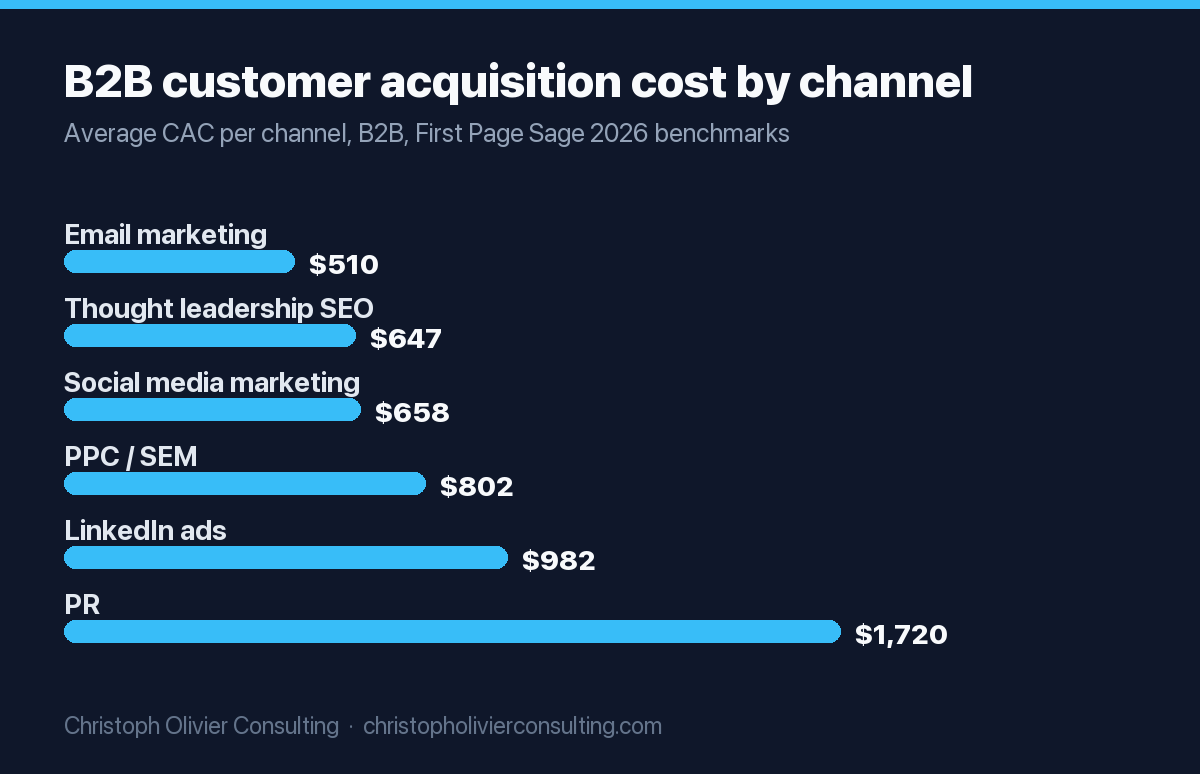
Channel fit depends on your funnel stage, deal size, and sales motion, not on which channel is trendy. The table below pairs common channels with the stage they serve, the condition that makes them a good bet, and a general read on acquisition cost. Treat the cost column as direction, then confirm the real numbers with your own tracking (see measurement below).
| Channel | Best fit when | Relative acquisition cost |
|---|---|---|
| SEO and content | Buyers search before they buy; you can wait for compounding returns | Low over time, slow to start |
| Paid search (Google Ads) | High-intent keywords exist and margins support the click price | Medium to high, fast signal |
| Paid social (LinkedIn, Meta) | You can target a clear role or interest and need reach quickly | Medium to high |
| Outbound (cold email, LinkedIn) | Narrow ICP and larger deals that justify manual effort | Medium, labor heavy |
| Referral program | You have happy customers and a natural reason to share | Low, high conversion quality |
| Product-led (free trial, freemium) | A self-serve product proves value without a sales call | Low marginal cost |
| Webinars and events | Relationship-driven sales and considered purchases | Medium to high |
Sequence channels as you grow
Channel priority should change with company stage, because early testing and mature scaling reward different bets. Early on, use one fast channel to prove demand and message, then add a compounding channel once you know what converts. Adding channels too early splits a small budget into signals too weak to read.
A common sequence looks like this: start with a paid or outbound channel for fast feedback on your offer, layer in SEO and content once messaging is proven, then add referral and partnership channels after you have customers happy enough to vouch for you. Each new channel should earn its place against the ones already working, not just add noise. Our B2B lead generation strategies hub goes deeper on building this pipeline stage by stage.
Retention is part of acquisition
Keeping customers is an acquisition lever, because retained customers lower your blended cost and become an earned channel of their own. Referrals, reviews, case studies, and expansion revenue all start with customers who stayed and succeeded. A strategy that only pours money into the top of the funnel while customers churn out the bottom pays to refill a leaking bucket.
Two practical moves connect retention to acquisition. First, build a referral ask into the moment a customer sees value, so satisfied buyers feed new ones. Second, turn customer outcomes into proof: a documented result is fuel for content marketing and for the case studies that shorten your consideration stage.
Measure what works, then scale
Judge each channel on cost per qualified lead and on the quality of the customers it produces, not on clicks or impressions. Set the target before the test so you have a line to measure against, and give owned channels a longer window than paid ones. The specific cost math, payback windows, and how to calculate customer acquisition cost belong in our dedicated customer acquisition cost guide, which covers the economics this strategy plan points toward.
Tie your measurement to the channels themselves. For search channels, our SEO for lead generation approach shows how to track content back to qualified pipeline. If you want a channel plan built for your ICP and deal economics rather than a generic list, our fractional CMO services can map and sequence the channels most likely to fit.
Common customer acquisition mistakes
Most acquisition strategies stall on a short list of avoidable errors, and naming them upfront keeps a plan honest. The pattern is almost always too many channels, too little patience, or a target buyer defined too loosely to act on.
- Running eight channels at once. Budget and attention spread so thin that no channel produces a readable result.
- Judging awareness channels by conversion math. A blog post is not a checkout page and should not be measured like one.
- Skipping the ICP. A vague target buyer makes every channel look plausible and none look right.
- Scaling on volume instead of quality. Cheap leads that never close cost more than they appear to.
- Ignoring retention. High churn quietly raises the cost of every new customer you acquire.
Frequently asked questions
What is a customer acquisition strategy?
A customer acquisition strategy is a documented plan for which channels bring in new customers, how those channels map to your awareness, consideration, and conversion stages, and how you decide what to keep. It starts from your ideal customer profile and where those buyers already look for answers, then commits to two or three channels rather than chasing every tactic at once.
What are the main customer acquisition channels?
The main channels are SEO and content, paid search, paid social (LinkedIn and Meta), outbound email and social, referral programs, product-led trials, and events or webinars. They divide into owned channels you control, paid channels you rent, and earned channels others give you. A durable strategy uses all three types so you are not renting all of your demand.
How do you choose the right acquisition channels?
Score each candidate channel on audience match, cost to test, and time to a clear signal, then pick two or three. Favor one channel that compounds, such as SEO, and one that gives fast feedback, such as paid search or outbound. Set a target cost per qualified lead before testing, run each test long enough to decide, and scale on lead quality rather than raw click volume.
How many acquisition channels should a business use?
Start with two or three channels and prove them one at a time. Mature high-performing teams often run five to eight channels, but they reach that count by validating each before adding the next. Running eight channels at once usually splits a limited budget into signals too weak to read, so none gets the attention needed to produce a clear result.
What is the difference between customer acquisition and retention?
Acquisition brings in new customers; retention keeps the ones you have. They connect directly: retained, satisfied customers lower your blended acquisition cost and become an earned channel through referrals, reviews, and case studies. A strategy that spends heavily on the top of the funnel while customers churn out the bottom pays repeatedly to refill a leaking bucket.
How much does customer acquisition cost?
Cost varies widely by channel, deal size, and sales motion, so the strategy question (which channels to run) is separate from the economics question (what each costs). Judge channels on cost per qualified lead and customer quality, set targets before testing, and see our dedicated customer acquisition cost guide for the calculation, payback windows, and benchmarks.
More Growth, Strategy & Sales guides
- How to Create a Buyer Persona That Your Team Will Actually Use
- How to Create a Marketing Plan (Step by Step, With Template and Example)
- How to Use LinkedIn for Business: A Beginner's Guide
- Lead Nurturing: How to Turn Slow Leads Into Sales-Ready Buyers
- Marketing Copywriting That Converts: Frameworks, Examples, and a Repeatable Process
- Retargeting vs Remarketing: The Real Difference