

Yes, guest posts still work after Google’s latest updates, but only the editorial kind: an original article that a real publication would run anyway, with one natural link back to you. The link-building version carries the risk. Google’s spam policies (last updated August 28, 2026) still list “links with optimized anchor text in articles, guest posts, or press releases distributed on other sites” as link spam, and a separate site reputation policy covers third-party content placed on a strong site mainly to borrow its rankings. The latest spam update, per Google’s Search Status Dashboard, rolled out from September 24 to October 8, 2026.
Below: Google’s rules quoted word for word, a pass/fail checklist for host sites, published marketplace prices, a pitch email and brief you can copy, and a GA4 and Search Console setup for tracking guest post ROI, with the formulas.
Are guest posts still effective after the latest Google updates?
They are effective for exposure, referral visitors and editorial links. They are ineffective, and risky, as a way to buy or mass-produce links. Google has said the same thing, in stronger terms each time, for more than a decade:
| Date | What Google did | What it means for guest posts |
|---|---|---|
| January 20, 2014 | Google’s Matt Cutts wrote “stick a fork in it: guest blogging is done; it’s just gotten too spammy,” then added that there are “still many good reasons to do some guest blogging (exposure, branding, increased reach, community, etc.).” | The SEO-only version was declared dead. The audience version was not. |
| May 25, 2017 | The Webspam Team published “A reminder about links in large-scale article campaigns”. | Lists four warning signs (quoted below) and tells host sites to vet contributors. |
| September 10, 2019 | Google introduced rel=”sponsored” and rel=”ugc”, and made all three attributes, including nofollow, “hints.” | Paid placements get a sponsored tag. A nofollowed link may still be used as a signal. |
| July 26, 2021 | The link spam update, with a direct warning about sponsored and guest posts. | Algorithmic and manual actions for sites that publish or acquire guest post links “without proper link tags.” |
| December 14, 2022 | The December 2022 link spam update: SpamBrain “can now detect both sites buying links, and sites used for the purpose of passing outgoing links.” | Bought links are neutralized: “any credit passed by these unnatural links are lost.” |
| March 5, 2024 | Site reputation abuse announced with the March 2024 core update, enforced “starting May 5, 2024.” | Hosts that rent out their domain to third-party content are now a target. |
| November 19, 2024 | Google tightened the policy: abuse counts “regardless of whether there is first-party involvement or oversight of the content.” | A host “editing” a placed article does not by itself make it safe. |
| August 28, 2026 | Renamed the site reputation policy and, from August 30, stopped applying its manual actions to searches inside the European Economic Area. | Outside the EEA, including the US, manual actions still apply to the affected section of the host site. |
| June 24, August 18, September 24, 2026 | Three spam updates in one year, per the ranking incident history. | The September entry says only that it “applies globally and to all languages,” not which patterns it targeted, so do not read any of them as a green light. |
The risks, concretely: for you, money spent on links SpamBrain ignores, or a manual action if the pattern is large; for the host, a site reputation manual action on the section that carries your post. That is why good publications say no to most pitches, and why the ones that say yes to everyone are the wrong targets.
Google’s rules for guest posts, quoted word for word
1. The current link spam policy. The spam policies page lists, among its examples of link spam: “Buying or selling links for ranking purposes,” which “includes: Exchanging money for links, or posts that contain links,” and “Advertorials or native advertising where payment is received for articles that include links that pass ranking credit, or links with optimized anchor text in articles, guest posts, or press releases distributed on other sites.” The same page gives the exception: “It’s not a violation of our policies to have such links as long as they are qualified with a rel=”nofollow” or rel=”sponsored” attribute value to the <a> tag.”
2. The older link schemes wording, which many guides still quote. The 2021 version of Google’s link schemes page listed “Large-scale article marketing or guest posting campaigns with keyword-rich anchor text links.” The current page folds that into the “optimized anchor text” line above. Same rule, new address.
3. The 2017 guest post warning signs. Google’s 2017 post says Google “does not discourage these types of articles in the cases when they inform users, educate another site’s audience or bring awareness to your cause or company.” It then lists “factors that, when taken to an extreme, can indicate when an article is in violation”:
- “Stuffing keyword-rich links to your site in your articles”
- “Having the articles published across many different sites; alternatively, having a large number of articles on a few large, different sites”
- “Using or hiring article writers that aren’t knowledgeable about the topics they’re writing on”
- “Using the same or similar content across these articles; alternatively, duplicating the full content of articles found on your own site (in which case use of rel=”canonical”, in addition to rel=”nofollow”, is advised)”
4. The 2021 tagging rule. From the July 2021 post: “we still strongly recommend that site owners apply the appropriate rel values to these links. When we detect sites engaging in either publishing or acquiring links with excessive sponsored and guest posting without proper link tags, algorithmic and manual actions may be applied.”
Put together, this is how the rules sort the situations you will actually face. The same logic, links earned rather than placed, runs through all of the SEO principles taken from Google’s own documentation.
| Your situation | What Google’s text says | What to do |
|---|---|---|
| Unpaid article written for one publication, edited by them, one descriptive link | Not discouraged when it informs users or brings “awareness to your cause or company” | Go ahead. A normal link is fine. |
| The host charges a fee, or you give a product or service for the post | “Exchanging money for links, or posts that contain links” is link spam unless qualified | Require rel=”sponsored” in writing. Judge the buy on audience, not the link. |
| Exact-match commercial anchor, such as “best tax accountant Dallas” | “links with optimized anchor text in articles, guest posts” | Use your brand name, the page title or a plain description. |
| The same article, or a spun version, placed on several sites | “same or similar content across these articles” | Do not. Republish on your own site with rel=”canonical” if needed. |
| Twenty posts a quarter on sites that publish anyone | “published across many different sites” | Cut to a few publications your buyers read. |
| An agency ghostwrites under your name about a topic you do not know | “writers that aren’t knowledgeable about the topics” | Write it yourself or edit it until it is yours. |
Nofollow links in guest posts: which rel value to ask for
Google’s outbound link guide defines three values. Use rel=”sponsored” for “advertisements or paid placements”; nofollow “is still an acceptable way to flag them, though sponsored is preferred.” Use rel=”ugc” for comments and forum posts. Use rel=”nofollow” “when other values don’t apply.” Since 2019 all three are “hints about which links to consider or exclude within Search,” so Google may still read a nofollowed link as context.
In practice: if no money, product or service changes hands, you do not need any attribute. If anything is exchanged, the link needs sponsored or nofollow. If the host nofollows every contributor link as house policy, accept it. The audience and the byline are still worth having.
When a guest post breaks the site reputation policy
The site reputation policy “applies where third-party content is published on a host site mainly because of that host’s already-established ranking signals.” Third-party content alone is fine. The page lists “Columns, opinion pieces, articles, and other work of an editorial nature” as NOT inconsistent with the policy, and it names “freelancers” as third parties, so a bylined guest column is not the target.
A reviewer checks whether the content has “sufficient input, editorial oversight, or contribution from the host site to be considered fully integrated with the main site,” looking at presentation, quality, “stated or implied authorship,” and whether it appears “on multiple other sites in identical or near-identical form.” Google’s own example of a likely action: an unauthored article on a business publication, linking to a CBD marketplace, reachable from no section, copied from a third party.
Your post is on the safe side if it was written for that publication only, carries your real name, was approved by the host’s editor and sits in a normal section on a topic the site covers.
What guest posts are still good for
Set expectations by the numbers. Ahrefs reports that its CMO Tim Soulo asked 500+ bloggers about their guest articles and “the average referral traffic across 239 guest articles was only 50 visits” (Ahrefs guest blogging guide). Do not justify a guest post on clicks alone. Justify it on who those 50 people are and what the placement does for you over time:
- Referral visitors who match your buyer. Fifty partners at mid-size accounting firms beat 5,000 random readers, and GA4 measures this directly.
- Brand and borrowed trust. A byline in the publication your buyers read is a credential you can cite in proposals.
- Author authority. Repeat bylines in two or three trade publications make your name searchable and get you invited back.
- An editorial link. One relevant, in-body link from a site that covers your topic. Treat it as a bonus that follows from the other three, and see our link building guide for how it fits next to digital PR and earned citations.
Should you pursue guest posting for AI visibility?
Yes, if the goal is being mentioned, not being linked. In Ahrefs’ study of 75,000 brands (published May 26, 2025), branded web mentions had a Spearman correlation of 0.664 with how often a brand appeared in Google AI Overviews, against 0.218 for backlink count. The top three factors were all off-site: web mentions, branded anchors (0.527) and branded search volume (0.392). Ahrefs itself stresses that “correlation ≠ causation,” and the sample was domains above DR 40.
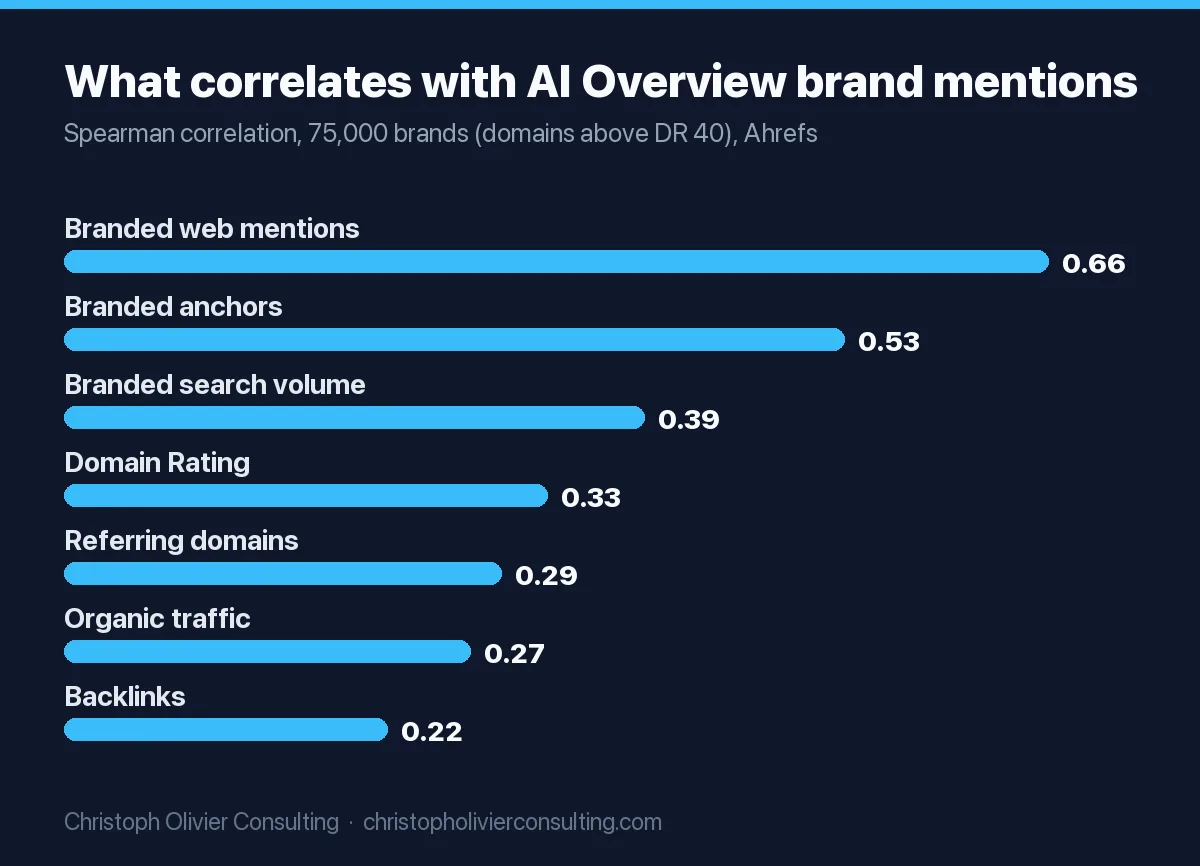
What that means for a guest post: a byline and a few sentences that name your firm and what it does, on a site that AI answers already cite for your topic, likely do more for AI visibility than an extra link on a site nobody quotes. Check the second part yourself: ask ChatGPT, Perplexity and Google your buyers’ questions and note which publications get cited. Then measure the result in GA4, which now files visits from “ChatGPT, Gemini, Deepseek, Copilot, or Grok” under an AI Assistant channel (it excludes AI Overviews and AI Mode). Our guide to tracking AI search traffic in GA4 and Search Console has the full setup.
How to find guest posting sites in 2026
The Ahrefs guest post workflow, step by step
Most “Ahrefs guest post” tutorials skip the part that matters: which steps need which plan. Prices below are from Ahrefs’ pricing page in USD, read November 1, 2026: Starter $29 a month, Lite $129, Standard $249, Advanced $449, with up to 17% off when paid annually. The method is adapted from Ahrefs’ own guide and its Link Intersect help article.
| Step | Ahrefs tool and settings | Plan |
|---|---|---|
| 1. Find publications that link to competitors but not to you | Competitive Analysis, Link Intersect: add up to 10 competitor domains, click “Show link opportunities,” filter by number of intersecting targets, export | Lite ($129) or higher |
| 2. Find blogs that publish on your topic | Content Explorer: broad keyword, “In title,” Domain Rating 30 to 60, “One page per domain,” “Exclude homepages,” “Exclude subdomains,” then the Websites tab | Standard ($249) or higher; the pricing page lists Content Explorer under “All Lite features, plus” |
| 3. Check each candidate’s traffic trend | Site Explorer overview: estimated organic traffic over 12 months and top pages | Lite or higher |
| 4. Pick a topic the host needs | Site Explorer, Top pages, compare to the previous year, sort by traffic change to find their declining posts you could replace | Lite or higher |
| 5. Confirm your link once live | Ahrefs Free on your own verified site, plus Search Console’s Links report | Free |
Semrush covers the same research from its SEO plan at $139 a month, or $117.33 a month billed annually (Semrush pricing). You need one of the two, not both; our comparison of SEO software for small business breaks down the plans. Either way, every traffic figure these tools show is an estimate modeled from rankings, not the host’s analytics. Treat it as a direction, not a fact.
“Write for us” searches: what they find and what to skip
Searches like “write for us” plus your topic, or “contributor guidelines” plus your industry, still surface real publications, but Ahrefs’ guide notes everyone runs the same searches, so those editors are flooded. Walk away from any “write for us” page with a per-post price list or a promise of “dofollow” links. “Write for us general” sites, which accept any topic, fail the most important check below: topical fit.
Host-site vetting checklist: pass or fail
Why you need one: BuzzStream’s 2026 analysis of 257,267 sites listed on link marketplaces found 39.6% had zero estimated monthly organic traffic, the average Domain Rating was 24, and only 1.37% met its High Quality or Top Tier bar (DR 71 or higher and at least 50,000 monthly visits, by Ahrefs estimates). Run every candidate through these ten checks. The thresholds are my rules of thumb for professional-service firms, not Google numbers.
| # | Check | How to run it | Pass | Fail |
|---|---|---|---|---|
| 1 | No payment for a followed link | Read the contributor page; ask in writing | Free editorial, or paid with rel=”sponsored” | Fee for a “dofollow” link |
| 2 | Topic fit | Read the last 10 post titles | 7 or more are in your buyers’ topic | “General” or any-topic site |
| 3 | No link-farm pattern | Scan outbound links in the last 10 posts | Links go to sources and related businesses | Casino, loan or CBD links in unrelated posts |
| 4 | Real organic audience | Ahrefs or Semrush traffic estimate, 12-month trend | Steady or rising, above zero | Zero, or a cliff after a 2024 to 2026 update |
| 5 | Traffic geography | Country split in the same tool | Most traffic from your market | Most traffic from countries you do not serve |
| 6 | Editorial standards | Bylines and bios on recent posts | Named staff or recurring columnists, edited copy | Every post a different one-time “guest” |
| 7 | Indexed and current | Search site:domain.com and sort by recent | Posts from the last 30 days show up | Recent posts missing from Google |
| 8 | Audience proof beyond search | Newsletter, LinkedIn, comments, events | Readers react to posts | No engagement anywhere |
| 9 | Your buyers read it | Ask three clients; check what AI answers cite | At least one names it or it gets cited | Nobody you serve has heard of it |
| 10 | Link placement | Read the guidelines | One in-body or bio link allowed | Links only allowed for a fee |
Scoring: a fail on any of checks 1 to 3 ends it. Then the site needs at least 5 passes on checks 4 to 10. A small trade newsletter with 3,000 subscribers that passes 1 to 3 and 9 can beat a DR 70 site that passes everything except topic fit.
Guest post marketplace prices, from published price pages
Sellers that publish prices list them by Domain Rating and estimated traffic. These figures are copied from each seller’s own page on November 1, 2026.
| Source | What is listed | Published price | Link terms on the page |
|---|---|---|---|
| FATJOE blogger outreach | DR10+ (0 to 1,000 monthly traffic), DR20+, DR30+, DR40+, DR50+, DR60+ (1k to 60k) | $72, $96, $120, $216, $336, $456 per placement | “Do-follow,” “1 Anchor / URL,” “Includes writing” |
| Loganix guest posts | Essential Links: multi-topic sites, DR/DA 30+, 100 to 500+ monthly visits. Authority Links: niche sites, average DR/DA 40+, minimum 1,000 monthly organic traffic | Starts at $200; starts at $400 | Not stated on the summary page |
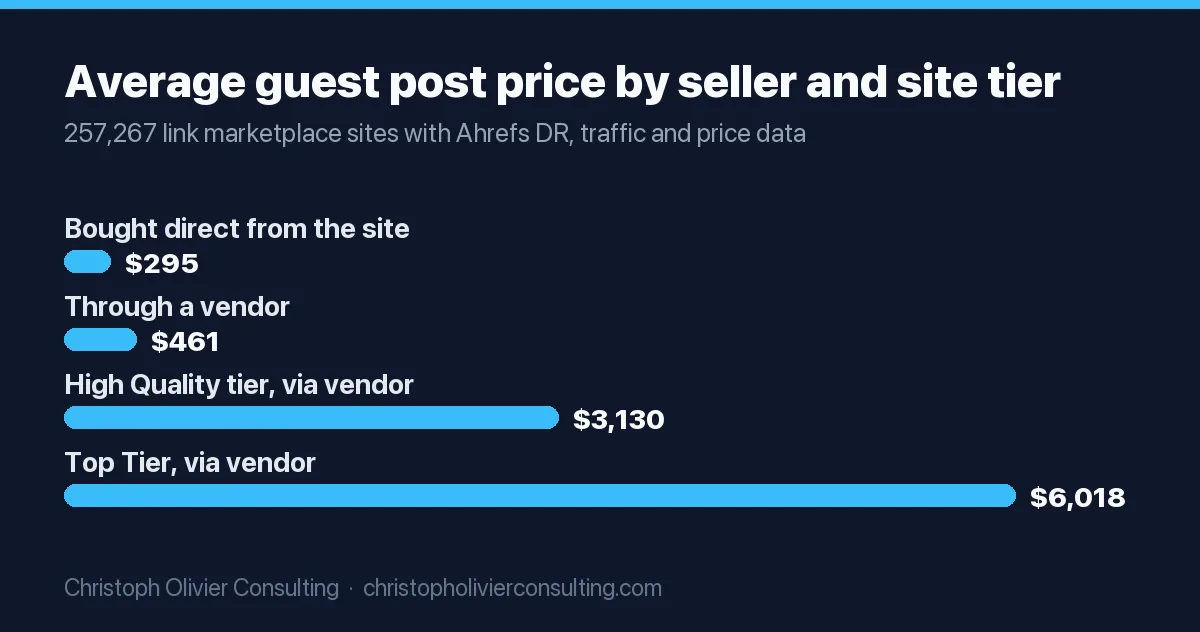
| BuzzStream study (257,267 marketplace sites, updated June 15, 2026) | Average across the marketplace | $295 direct from the site; $461 through a vendor; $3,130 High Quality; $6,018 Top Tier | Not applicable |
The policy risk is the same at every price. Google’s spam policy calls “Exchanging money for links, or posts that contain links” link spam unless the link is qualified with nofollow or sponsored. A paid placement that is sold as followed is exactly that exchange. If you buy placements, ask for rel=”sponsored” and judge the purchase on the audience you reach. And compare it with the alternative: BuzzStream notes its own survey found the average monthly digital PR contract was about $5,500, less than one Top Tier placement.
Copy-ready guest post pitch email
Send it to the named editor, not the contact form. Keep it under 150 words. Offer three angles so the editor can pick one instead of judging yours.
Subject line options: “Pitch: [specific angle] for [Publication]’s [section] readers” or “Following up your [Month] piece on [topic]”
Hi [First name],
Your [Month] piece, “[Article title],” made the point that [specific point]. Most of your readers in [audience, e.g. 10-to-50-person CPA firms] hit the next problem right after: [the problem].
I [one line of credentials: what you do, for whom, how long]. Three angles I could write for [section], each with [the original element: a worked example, data from public filings, a template]:
1. [Headline 1]: [one-sentence angle]
2. [Headline 2]: [one-sentence angle]
3. [Headline 3]: [one-sentence angle]Two published samples: [link], [link]. I will follow your style guide and word count, and the piece will be exclusive to [Publication].
Would one of these fit your calendar for [month]?
[Name], [title, firm]
Follow-up, about five business days later, as a reply in the same thread: “Hi [First name], bumping this in case it got buried. Happy to adjust any of the three angles, or take one you have on your list. [Name].” Send one more around day 12, then stop.
Guest post brief template
Fill this in before you write and send the top half to the editor once they say yes.
| Field | What to fill in | Example |
|---|---|---|
| Publication and section | Exact section the post will run in | [Trade journal], Practice Management column |
| Editor and deadline | Name, agreed date, word count | [Name], first draft by Dec 4, 1,400 words |
| Reader | Who reads this section and what they already know | Managing partners at 10 to 50 person firms |
| Working title | The angle the editor approved | “The 3 fee conversations that lose clients in January” |
| Original element | What their staff writers have not published | A worked fee-increase example with real math |
| Sources | Primary sources you will cite | Government data, the study itself, not a blog summary |
| Link plan | One in-body link to a genuinely useful page, descriptive anchor, rel per host policy | Anchor: “fee increase letter template” |
| Bio | Two sentences plus one tagged link | Bio link with UTM parameters (see below) |
| Disclosure | Anything paid or exchanged, and the rel value agreed | None, or rel=”sponsored” |
| Tracking | UTM link, publish date, baseline date range | Logged in the placement sheet on publish day |
How to track the ROI of guest posts: setup and formulas
There is no guest post ROI benchmark worth quoting, and most pages ranking for this question list metrics without a method. This setup uses free Google tools and gives you one number per placement.
Step 1: tag the bio link with UTM parameters
Google’s URL parameters help page says to “always use utm_source, utm_medium, and utm_campaign,” that values are case sensitive, and gives a blog referral example using utm_medium=referral. Use the same naming standard as the rest of your marketing; ours is in the digital analytics metrics guide.
| Parameter | Rule for guest posts | Example |
|---|---|---|
| utm_source | Host site, lowercase, no spaces | tradejournal |
| utm_medium | Always referral (GA4’s Referral channel reads “referral,” “app” or “link”) | referral |
| utm_campaign | yyyy-mm_guest-post_topic | 2026-12_guest-post_fee-increases |
| utm_content | Which link was clicked | bio-link |
Full link: https://yoursite.com/fee-increase-template/?utm_source=tradejournal&utm_medium=referral&utm_campaign=2026-12_guest-post_fee-increases&utm_content=bio-link
My preference is to leave the in-body editorial link clean. Editors often strip parameters anyway, and GA4 still records the visit with the host’s domain as the session source as long as the browser sends a referrer. If the host’s links carry rel=”noreferrer”, which per MDN tells the browser “to omit the Referer header,” an untagged visit lands in Direct. That is the case the tagged bio link covers.
Step 2: GA4 referral traffic and key events
- Mark the actions that matter as key events: in Admin, under Data display, click Events and click the star next to the event, per Google’s key events page. For a service firm that is a consultation request, a booked call or a phone click. Standard properties allow up to 30 key events.
- Open Reports, Acquisition, Traffic acquisition. Set the primary dimension to Session source / medium and search for the host’s domain. You will see the clean referral row and your tagged row side by side.
- Add the two rows’ sessions and key events for the placement total, and log the first 90 days in one sheet with the leads that reached your CRM.
Step 3: branded search lift in Search Console
Google added a branded queries filter to the Performance report on November 20, 2025, and made it available to all eligible sites on March 11, 2026. It uses an “AI-assisted system” to classify queries, works only on top-level properties (not URL-path or subdomain properties) and needs enough query volume. Apply the Branded filter and compare two equal windows:
Branded lift = (branded clicks in the 28 days after publish minus branded clicks in the 28 days before) ÷ branded clicks in the 28 days before.
Then run the same formula on non-branded clicks. If branded clicks rose 15% while non-branded rose 14%, the guest post did not cause the lift; the whole site moved. Only the gap between the two is a signal, and only if nothing else launched that month.
Step 4: assisted conversions
Few people book a call on their first visit from a guest post. GA4 shows the earlier touches in two places, both under Advertising, Attribution, per Google’s attribution overview: the Attribution paths report, and, where your property has it, the Conversion attribution analysis report (Beta), added January 16, 2026 per GA4’s what’s new page, whose “Assisted conversions (Last Click)” view shows “touchpoints that engaged customers early in their journey but weren’t the final click.” The default lookback window for non-acquisition key events is 90 days, which suits a professional-service sales cycle.
Step 5: log the link itself
Check the live post: link present, anchor as agreed, rel value as agreed. Confirm Google has found it in Search Console’s Links report, remembering it “isn’t a comprehensive list” and “doesn’t specify if a link is marked as nofollow.” Ahrefs Free on your verified site is a second check.
The formulas, with a worked example
The example numbers are illustrative, not results from a real campaign. Replace them with your own.
| Metric | Formula | Example |
|---|---|---|
| Cost per placement | (hours × hourly rate) + fees + tool share | (8 h × $150) + $0 + $43 (one third of Ahrefs Lite) = $1,243 |
| Cost per referral session | cost ÷ referral sessions in 90 days | $1,243 ÷ 110 = $11.30 |
| Key event rate | key events ÷ referral sessions | 3 ÷ 110 = 2.7% |
| Cost per key event | cost ÷ key events (direct plus assisted) | $1,243 ÷ (3 + 2 assisted) = $248.60 |
| Attributed gross profit | new clients × first-year revenue × gross margin | 1 × $12,000 × 60% = $7,200 |
| Guest post ROI | (attributed gross profit minus cost) ÷ cost | ($7,200 minus $1,243) ÷ $1,243 = 479% |
| Branded lift gap | branded lift minus non-branded lift | 22% minus 6% = 16 points |
Count a client only if the CRM shows a guest post touch on their path, and decide before publishing what result would make you stop pitching that publication. If you want help building the placement sheet and the GA4 setup for your firm, you can book a consultation. If the bigger gap is producing pieces editors want, a content marketing consultant is usually the cheaper fix than more outreach.
Frequently asked questions
Are guest posts still effective after the latest Google updates, and what are the risks?
Yes, for editorial posts written for one publication your buyers read. Google's spam policies, updated August 28, 2026, still call paid or optimized-anchor guest post links link spam, and the site reputation policy targets content placed on a strong site to borrow its rankings. The risks are links Google ignores, a manual action for you, and a manual action on the host's section.
What do experts recommend for tracking the ROI of guest posting campaigns?
Tag the bio link with utm_source, utm_medium=referral and utm_campaign, mark consultation requests as GA4 key events, and read the host's row in Traffic acquisition. Add assisted conversions from GA4's attribution reports and compare branded versus non-branded Search Console clicks before and after publishing. ROI is attributed gross profit minus cost, divided by cost.
How do I find guest post opportunities in Ahrefs?
Use Link Intersect under Competitive Analysis to list sites linking to up to 10 competitors but not you, available from Ahrefs Lite at $129 a month. On Standard, at $249, Content Explorer can search a topic 'In title' with Domain Rating 30 to 60 and one page per domain. Treat Ahrefs traffic figures as estimates, not the host's analytics.
Should guest post links be nofollow?
Only if something was exchanged. Google says links tied to money, products or services must carry rel="sponsored" or rel="nofollow", with sponsored preferred. An unpaid editorial guest post can carry a normal link. If a host nofollows all contributor links as policy, accept it: the audience, byline and brand mention still have value, and Google treats nofollow as a hint.
Should I pursue guest posting for AI visibility?
Yes, if you aim for mentions on sites AI answers already cite. In Ahrefs' study of 75,000 brands, branded web mentions correlated with AI Overview visibility at 0.664, against 0.218 for backlinks. That is correlation, not proof. Name your firm and what it does in the post and bio, then watch GA4's AI Assistant channel.
Are 'write for us' guest posting sites safe to use in 2026?
Some are real publications, but many are link sellers. BuzzStream's 2026 analysis of 257,267 marketplace sites found 39.6% had zero estimated organic traffic. Skip any site with a per-post price list, guaranteed dofollow links, or a 'general' any-topic focus, and run the rest through a pass/fail check on topic fit, traffic trend and editorial standards.
How much does a guest post cost?
Published prices start low: FATJOE lists $72 to $456 per placement by Domain Rating tier, and Loganix starts at $200 and $400. BuzzStream's 2026 study puts the marketplace average at $295 direct and $461 through a vendor, with High Quality sites averaging $3,130. Paying for a followed link breaks Google's link spam policy unless it is tagged sponsored.
More Growth, Strategy & Sales guides
- House Cleaning Marketing: The Recurring-Revenue Playbook
- Painting Company Marketing: Cost Per Booked Job by Channel
- Wedding Planner Marketing: How to Book More Weddings in 2026
- Welcome Email Sequence: The 5-Email Series You Can Copy
- Auto Repair Shop Marketing: The Cost-Per-Customer and LTV Math That Sets Your Priorities
- Coffee Shop Marketing: The Frequency Economics That Beat One-Time Discounts
- All Growth, Strategy & Sales guides →