

The most famous ads of all time are Volkswagen’s “Think Small” (1959), the Marlboro Man (1955), Nike’s “Just Do It” (1988), De Beers’ “A Diamond Is Forever” (1948), Apple’s “1984” (1984) and Dove’s Campaign for Real Beauty (2004). Advertising Age ranked “Think Small” the best campaign of the 20th century and Dove the best of the 21st. For a single TV commercial, the usual answer is Apple’s “1984”, although The Drum’s 2022 expert vote put Honda’s “Cog” first.
Below are 18 famous advertisements sorted by decade. Each one has the brand, agency, year, the idea in one line, the impact on record with its source, and one move a small or service business can copy this quarter. Where a popular statistic falls apart under checking, it is flagged in the table near the end instead of repeated.
Famous ads by decade: the quick list
| Decade | Year | Brand and ad | Agency | The idea in one line | Impact on record |
|---|---|---|---|---|---|
| 1940s | 1948 | De Beers, “A Diamond Is Forever” | N.W. Ayer & Son | A stone that lasts forever stands for love that should | No. 6, Ad Age top 100 |
| 1950s | 1955 | Marlboro, the Marlboro Man | Leo Burnett Co. | A filter cigarette recast as a cowboy’s smoke | No. 3, Ad Age top 100 |
| 1950s | 1959 | Volkswagen, “Think Small” | Doyle Dane Bernbach | The small car is the smart car | No. 1, Ad Age top 100 |
| 1960s | 1962 | Avis, “We Try Harder” | Doyle Dane Bernbach | Being No. 2 means we have to work harder for you | No. 10, Ad Age top 100; slogan ran 50 years |
| 1970s | 1971 | Coca-Cola, “Hilltop” | McCann Erickson | A Coke as a small act of world harmony | 100,000+ letters to Coca-Cola |
| 1980s | 1981 | Absolut, the Absolut Bottle | TBWA | The bottle is the ad, every time | No. 7, Ad Age top 100 |
| 1980s | 1984 | Apple, “1984” | Chiat/Day | The Mac frees you from conformity | Cannes Grand Prix; No. 12, Ad Age top 100 |
| 1980s | 1984 | Wendy’s, “Where’s the Beef?” | Dancer Fitzgerald Sample | Rivals sell you bun; we sell you beef | No. 47, Ad Age top 100 |
| 1980s | 1988 | Nike, “Just Do It” | Wieden+Kennedy | Everyone is an athlete who decides to start | No. 4, Ad Age top 100 |
| 1990s | 1993 | California Milk Processor Board, “Got Milk?” | Goodby Silverstein & Partners | You only notice milk when it runs out | No. 79, Ad Age top 100 |
| 1990s | 1997 | Apple, “Think Different” | TBWA\Chiat\Day | Apple belongs with the people who changed things | 1998 Emmy; 2000 Grand Effie |
| 1990s | 1999 | Guinness, “Surfer” | AMV BBDO | Waiting for the perfect wave, as myth | Most awarded commercial of 1999 |
| 2000s | 2003 | Honda, “Cog” | Wieden+Kennedy | The car’s own parts prove the engineering | No. 1, The Drum World’s Best Ads (2022) |
| 2000s | 2004 | Dove, Campaign for Real Beauty | Ogilvy | Real women, not models, define beauty | No. 1, Ad Age 21st century list |
| 2010s | 2010 | Old Spice, “The Man Your Man Could Smell Like” | Wieden+Kennedy | Talk to the woman who buys the body wash | Sales doubled by July 2010 (agency); No. 4, Ad Age 21st century |
| 2010s | 2011 | Coca-Cola, “Share a Coke” | Ogilvy Sydney | Your name on the bottle | Rolled out to 80+ countries |
| 2010s | 2012 | Red Bull, Stratos | No agency; Red Bull’s own broadcast team | Sponsor a jump from the edge of space | No. 5, Ad Age 21st century list |
| 2010s | 2014 | Always, #LikeAGirl | Leo Burnett | Turn an insult into a statement of strength | 2015 Emmy; 7 Clios |
“Ad Age top 100” means Advertising Age’s Top 100 Advertising Campaigns of the Century (1999). “Ad Age 21st century” means its Top 15 Ad Campaigns of the 21st Century (2015). Where the two lists give a different year from other records, the row uses the year in the agency or brand’s own account.
Who ranks the best ads of all time, and what each list says
Three expert rankings carry most of the weight when people argue about the best advertisements ever. They disagree, which is useful: each measured something different.
| Ranking | Who judged | No. 1 | Also near the top |
|---|---|---|---|
| Ad Age, Top 100 Campaigns of the 20th Century (1999) | Ad Age staff; essay by critic Bob Garfield | Volkswagen “Think Small” | Coca-Cola “The pause that refreshes” (2), Marlboro Man (3), Nike “Just Do It” (4), McDonald’s “You deserve a break today” (5) |
| Ad Age, Top 15 Campaigns of the 21st Century (2015) | Industry judges voting on 50 nominees | Dove Campaign for Real Beauty | Nike+ (2), BMW Films (3), Old Spice (4), Red Bull Stratos (5) |
| The Drum, World’s Best Ads (2022) | Reader nominations ranked by top creative directors | Honda “Cog” | Guinness “Surfer” and Apple “1984” |
Garfield set three tests for the 1999 list: the campaign was a watershed for advertising or popular culture, it created a category or made the brand No. 1 in one, or it was simply unforgettable. Ad Age’s 2015 judges were given the same three questions. The Drum’s 2022 list covers TV and video only and was scored by creative directors, which explains why a pure piece of craft like “Cog” beats campaigns that sold more.
1940s and 1950s famous ads
De Beers, “A Diamond Is Forever” (1948)
Agency: N.W. Ayer & Son. Copywriter Frances Gerety coined the line in 1947, according to De Beers’ history; Ad Age dates the campaign 1948 and ranks it No. 6.
The idea: Tie a mined stone to a promise that is meant to last.
Impact: Garfield’s essay argues that before this line, “the diamond solitaire as the standard token of betrothal did not exist,” and that the diamond engagement ring became expected “virtually worldwide.” Ad Age later named it the best slogan of the 20th century.
Copy the move: Attach your service to a moment the client already treats as a milestone. An estate planner can own “the week after the first grandchild,” a CPA can own “the first year you hire staff.”
Marlboro, the Marlboro Man (1955)
Agency: Leo Burnett Co. Ad Age ranks it No. 3 and dates it 1955.
The idea: Filter cigarettes were seen as a women’s product, so Burnett put them in the hands of a cowboy and made no health claims at all.
Impact: Marlboro had been sold with the line “Mild as May.” Within a year of the cowboy ads it went from a minor brand to the fourth best-selling cigarette in America, and by 1972 it led the industry. Garfield called it “the most successful ad symbol of all time” and, in the same sentence, “a symbol of enslavement to an addictive drug.”
Copy the move: Repositioning by audience works. If your firm is seen as “for small clients,” show the larger client you want in every image and case study. Never use the Marlboro tactic of steering attention away from a real risk.
Volkswagen, “Think Small” (1959)
Agency: Doyle Dane Bernbach. Copywriter Julian Koenig and art director Helmut Krone worked under William Bernbach.
The idea: A tiny photo of the Beetle on a mostly empty page, headline “Think small.” The small car is the sensible car.
Impact: No. 1 on Ad Age’s 1999 list. Garfield wrote that the “droll, conversational, self-deprecating style of the copy was as important a feature” as the engine and the 34 miles per gallon. The layout broke the rules of 1959 car ads: black and white, sans serif type, a full stop after the headline.
Copy the move: State the thing prospects hold against you, then say what it buys them. “We’re a four-person firm. You will never be handed to a junior.” Put it above the fold.
1960s and 1970s famous ads
Avis, “We Try Harder” (1962)
Agency: Doyle Dane Bernbach. Ad Age lists it at No. 10 under 1963; Adweek dates the debut to 1962, when Avis was struggling to keep up with Hertz.
The idea: We are No. 2, so we have to try harder for you.
Impact: The line stayed in use for 50 years, until a 2012 rebrand. Doyle Dane Bernbach appears nine times in the Ad Age top 100 by our count, more than any other agency, and two of those entries are in the top 10.
Copy the move: If you are not the market leader, say so and attach a specific promise to it: “Not the biggest firm in the county. Every call returned the same business day.”
Coca-Cola, “Hilltop” (1971)
Agency: McCann Erickson. Creative director Bill Backer wrote the idea on a napkin in January 1971, according to Coca-Cola’s own history.
The idea: Young people from around the world on an Italian hillside, singing “I’d like to buy the world a Coke.”
Impact: The shoot cost more than $250,000 and Coca-Cola received more than 100,000 letters praising the ad, while radio stations were flooded with requests for the song. A version by studio group the Hillside Singers reached No. 13 on the Billboard Hot 100. Oddly, “Hilltop” is not in Ad Age’s top 100; Coke’s 1970 “It’s the real thing” is, at No. 53.
Copy the move: Lead with how the client feels after working with you, then name the deliverable. “Tax season without the 11 p.m. emails” beats “comprehensive tax preparation.”
1980s famous ads
Absolut, the Absolut Bottle (1981)
Agency: TBWA, for US importer Carillon. The first ad showed the bottle under a halo with the headline “Absolut Perfection.”
The idea: One asset, the bottle, in a new witty setting every time, with a two-word headline.
Impact: No. 7 in Ad Age’s top 100. Absolut became the best-selling imported vodka in the US in 1985, the campaign ran for more than 15 years, and the brand entered the AMA’s Marketing Hall of Fame in 1992 alongside Coca-Cola and Nike. Garfield called it “a neat trick for a product that is by law and by its very nature a flavorless commodity.”
Copy the move: If your service looks like a commodity, pick one fixed format and repeat it for a year: the same photo style, the same two-word headline structure, the same story shape in every post. Recognition comes from repetition, not novelty.
Apple, “1984” (1984)
Agency: Chiat/Day. Copy by Steve Hayden, art direction by Brent Thomas, creative direction by Lee Clow, directed by Ridley Scott.
The idea: A runner smashes Big Brother’s screen; the Macintosh will make sure 1984 is not like 1984. The computer never appears.
Impact: Its only US national airing was during Super Bowl XVIII on January 22, 1984. It won the Cannes Lions Grand Prix that year, Ad Age named it the Commercial of the Decade, and in 1995 Ad Age put it at the top of its 50 greatest commercials. It is No. 12 on the 1999 campaign list.
Copy the move: Name the status quo your buyer resents, such as surprise invoices or six-week response times, and cast your firm as the exit. You do not need to name a competitor to have an enemy.
Wendy’s, “Where’s the Beef?” (1984)
Agency: Dancer Fitzgerald Sample. Written by Cliff Freeman, directed by Joe Sedelmaier.
The idea: Three women at a rival called “Big Bun” get a huge bun around a tiny patty, and Clara Peller demands, “Where’s the beef?”
Impact: First aired January 10, 1984. Walter Mondale used the line against Gary Hart in a televised debate on March 11, 1984. Wendy’s sales rose 31% to $945 million by 1985. The footnote matters: after Wendy’s dropped Peller in 1985, the chain went through a two-year sales slump. No. 47 in Ad Age’s top 100.
Copy the move: Show, with humor, the gap clients run into elsewhere. A bookkeeper could show the “full-service” firm whose full service is a PDF once a year.
Nike, “Just Do It” (1988)
Agency: Wieden+Kennedy. Dan Wieden adapted the line from Gary Gilmore’s last words, “Let’s do it,” according to his 2022 obituary in the Boston Globe.
The idea: Three words that fit a pro athlete and a beginner equally well. The first TV spot, in July 1988, featured Walt Stack, an 80-year-old who ran 17 miles every morning.
Impact: No. 4 in Ad Age’s top 100. The Globe reports that Nike’s PR director told The Washington Post in 1989 the company had “gotten zillions of letters from consumers who’ve told us it’s made them change their lives.”
Copy the move: Write to who the client wants to become. A fitness studio’s line is about the person who shows up at 6 a.m., not about the equipment.
1990s famous ads
“Got Milk?” (1993)
Agency: Goodby Silverstein & Partners, for the California Milk Processor Board. The launch spot, “Aaron Burr,” was directed by Michael Bay.
The idea: A history buff misses a $10,000 radio trivia prize because his mouth is full of peanut butter and the milk carton is empty.
Impact: No. 79 in Ad Age’s top 100 and licensed nationally from 1995. The campaign claims over 90% awareness in the US, but the same record notes it raised milk sales in California with no substantive evidence of effect nationwide. Fame and sales are not the same thing.
Copy the move: Sell the moment of lack. An IT support firm shows the 9 a.m. board meeting with a dead projector; an HVAC company shows the first hot night in June. Deprivation is easier to picture than benefit.
Apple, “Think Different” (1997)
Agency: TBWA\Chiat\Day, Los Angeles. The “Crazy Ones” spot set black and white footage of rule breakers to a short manifesto.
The idea: Apple belongs with the misfits who changed things, and so does anyone who buys one.
Impact: It won the 1998 Primetime Emmy for Outstanding Commercial and the 2000 Grand Effie, the US effectiveness award, at a time when Apple was losing share to Windows PCs.
Copy the move: Borrow meaning from people your buyers already respect, but only ones you can honestly stand next to. A law firm that serves founders can feature its founder clients (with permission) instead of stock handshakes.
Guinness, “Surfer” (1999)
Agency: AMV BBDO. Directed by Jonathan Glazer and shot in Hawaii over nine days.
The idea: Surfers wait for the perfect wave, and the white water turns into galloping horses.
Impact: It won more awards than any other commercial in 1999, and a 2000 Channel 4 and Sunday Times poll voted it the best ad of all time. In 2022 The Drum named it as one of the two ads “Cog” edged out for first place.
Copy the move: One strong image beats five features. Pick the single picture that sums up your work, such as the signed closing table or the finished roof at dusk, and build the campaign around it.
Popular ads of the 21st century
After 2000 the most popular ads earned much of their reach on YouTube and social feeds, not only bought airtime. If you want the newest examples, our roundup of innovative marketing campaigns from 2025 and 2026 picks up where this list stops.
Honda, “Cog” (2003)
Agency: Wieden+Kennedy. Directed by Antoine Bardou-Jacquet, with a production budget of about £1 million.
The idea: A two-minute chain reaction built only from the parts of a disassembled Honda Accord.
Impact: First broadcast on April 6, 2003, during ITV’s coverage of the Brazilian Grand Prix. Honda’s UK site got more traffic in the next 24 hours than all but one UK car brand got all month, and 10,000 people asked for a brochure or a DVD of the ad. Because 120-second slots were so expensive, the full version aired only a handful of times. Ranked No. 1 by The Drum in 2022.
Copy the move: Make the inside of your work visible. A dental lab can film each step of a crown; an accounting firm can show the 40-item checklist behind a “simple” return.
Dove, Campaign for Real Beauty (2004)
Agency: Ogilvy, with work from London, Toronto, Dusseldorf, New York and Chicago.
The idea: Women who look like your customers, not models, in Dove’s ads, starting with Toronto billboards that asked drivers to vote “fat or fit?”
Impact: It started with research. Dove’s 2004 Real Truth About Beauty study surveyed 3,200 women aged 18 to 64 in ten countries by phone between February 27 and March 26, 2004, and found only 2% chose “beautiful” to describe their looks. Ad Age’s 2015 judges ranked it No. 1 of the century; it was the only campaign every judge picked. Ad Age reported that Dove’s sales grew from $2.5 billion to “well over $4 billion during the campaign.” The 2006 film “Evolution” won two Cannes Lions Grand Prix.
Copy the move: Find one honest number in your own records that your buyers will recognize, such as “[X]% of our clients waited more than a year before calling us,” and build a campaign on it.
Old Spice, “The Man Your Man Could Smell Like” (2010)
Agency: Wieden+Kennedy Portland. Starring Isaiah Mustafa in one continuous take.
The idea: Talk straight to the women who buy most men’s body wash.
Impact: The insight was that 60% of body wash purchases are made by women, and the goal was a 15% sales lift. According to the agency, Red Zone body wash sales were up 60% year on year by May 2010 and had doubled by July. The follow-up “Response” campaign filmed 186 video replies to fans and celebrities in two and a half days. It won the Cannes Film Grand Prix and the 2010 Emmy for Outstanding Commercial, and Ad Age’s 2015 list ranks it No. 4.
Copy the move: Identify who really picks the vendor. In many service firms it is the office manager, the spouse or the CFO, not the person who signs. Write one ad to that person by name.
Coca-Cola, “Share a Coke” (2011)
Agency: Ogilvy Sydney, for Coca-Cola South Pacific.
The idea: Replace the logo on one side of the bottle with one of Australia’s 150 most popular names.
Impact: It was the first time any brand in Australia had run this type of campaign, and it later ran in more than 80 markets. Ogilvy estimated it lifted Coke’s category share in Australia by 4% and young-adult consumption by 7%; both are agency estimates.
Copy the move: Put the client’s name and numbers on the work before they buy. A proposal that opens with the prospect’s own name and figures (for a made-up example, “Smith Dental: 3 chairs, 41% of new patients from Google”) gets read; a 30-page capabilities deck does not.
Red Bull, Stratos (2012)
Agency: None credited; Red Bull’s own broadcast and editorial teams documented it. No. 5 on Ad Age’s 21st-century list.
The idea: Fund and film Felix Baumgartner’s freefall jump from 24 miles above the earth in October 2012.
Impact: The jump broke five records, according to Guinness World Records, as reported in Ad Age’s write-up. Red Bull’s spokeswoman told Ad Age, “Red Bull Stratos was not an advertising campaign,” yet the footage later ran in Red Bull ads.
Copy the move: Sponsor or create one event your customers care about more than your ads. A garden center can run the town’s garden tour; a wealth firm can host the only free Medicare enrollment night in the county.
Always, #LikeAGirl (2014)
Agency: Leo Burnett, Toronto and Chicago, for Procter & Gamble. Directed by Lauren Greenfield.
The idea: Ask adults and girls to “run like a girl,” film the difference, and turn the insult into a statement of strength.
Impact: The film won seven Clios and had 48 million YouTube views by September 2014, and it won the 2015 Primetime Emmy for Outstanding Commercial.
Copy the move: Take on a dismissive phrase your audience hears about itself, such as “trades are a fallback career” for a contractor that is hiring, and answer it with real people on camera.
What the Ad Age top 100 reveals about famous ads
By our tally of the published list, 65 of Ad Age’s 100 campaigns launched between 1950 and 1989, and only three came from the 1990s. Garfield noted that only seven used celebrities, eight relied on sex and four played on fear. The oldest entry is Ivory Soap’s “99 and 44/100% Pure” from 1882.
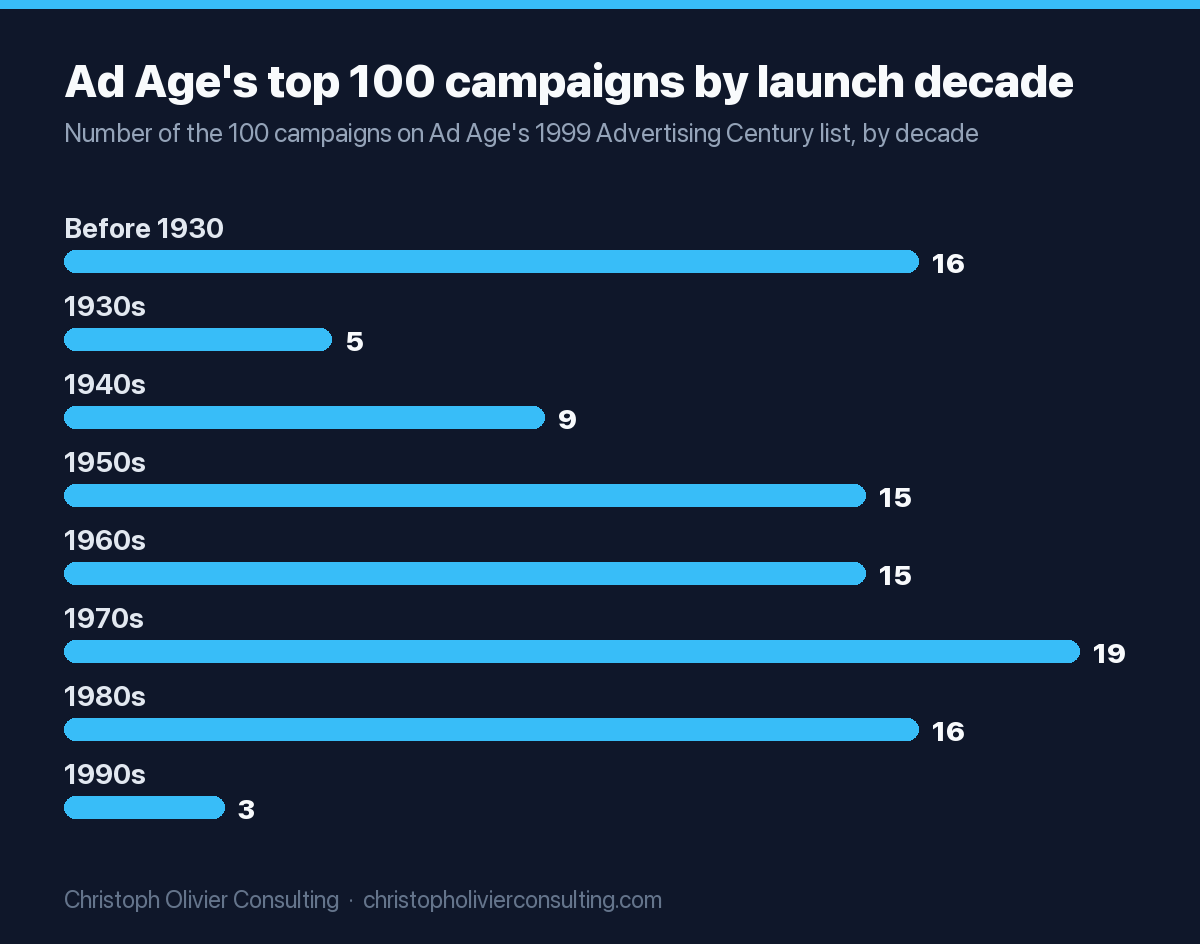
The other pattern is concentration. Doyle Dane Bernbach has nine entries and N.W. Ayer seven. A distinctive point of view, applied for years, mattered more than celebrity, shock or budget. For the longer arc from print to AI, see our history of advertising.
Famous ad statistics to treat with caution
These popular figures did not hold up, or need a qualifier, when checked against the sources above.
| Popular claim | What the sources show | Safe way to say it |
|---|---|---|
| Apple’s “1984” sold $150 million of Macs | Art director Brent Thomas cited about $3.5 million of Macs sold just after it aired (Wikipedia). Figures conflict. | Cite the single national airing and the awards. |
| Dove sales went from $2 billion to $4 billion in three years | Ad Age’s own 2015 write-up says $2.5 billion to “well over $4 billion” over the whole campaign, about ten years. | Use Ad Age’s wording and time frame. |
| Only 4% of women call themselves beautiful | The 2004 Dove study says 2% overall; 4% is women aged 18 to 29. | Use 2%, with the study as the source. |
| “Just Do It” grew Nike’s share from 18% to 43% | Repeated in Wikipedia’s entry without a Nike filing behind it. | Avoid, or check Nike’s annual reports first. |
| Marlboro sales went from 18 million to 6 billion in a year | The figures mix cigarettes and dollars in the source text. | Say it became the fourth best-selling brand within a year. |
| Old Spice sales doubled | Reported by Wieden+Kennedy, the agency, for one product line. | “Red Zone body wash sales doubled by July 2010, according to the agency.” |
Steal the move: a worksheet for small businesses
You cannot buy a Super Bowl slot, but every famous ad above rests on a move that costs nothing. Use this table to pick the one that fits your situation, fill in the line, and test it for four weeks on one channel.
| Your situation | Famous ad to copy | Fill-in line | Measure |
|---|---|---|---|
| Prospects say you are too small | “Think Small” | “We’re [small fact]. So you get [specific benefit].” | Reply rate on cold email |
| A bigger competitor owns the market | “We Try Harder” | “We’re not [leader]. That’s why we [measurable promise].” | Booked calls from the landing page |
| Your service looks like a commodity | Absolut | Same image format, two-word headline, every week for a year | Branded search volume in Search Console |
| Clients only call when something breaks | “Got Milk?” | “[Worst moment] is not the time to look for [your service].” | Calls in the slow season |
| Someone else picks the vendor | Old Spice | “Hey [real decider], [problem you fix for them].” | Inquiries naming the decider’s role |
| You have data nobody else has | Dove | “[X]% of our clients [surprising finding].” | Shares, press mentions, links |
| Your quality is invisible | Honda “Cog” | Film the steps nobody sees, in order, with no voiceover | Video completion rate |
| A competitor’s offer is thin | “Where’s the Beef?” | Show the gap with humor, no names | Quote requests |
Here is a hypothetical worked example. A four-partner accounting firm keeps losing pitches to a 200-person regional firm. It picks the Avis row and writes: “We’re not the biggest firm in Dayton. That’s why a partner answers your email by 5 p.m.” It checks the promise against its own records first, then runs two landing page versions, the old “Full-service accounting you can trust” and the new line, with the same $500 of search ads each over four weeks, and keeps whichever books more calls. Our guide to writing a unique selling proposition covers how to stress-test the promise before you publish it.
- Write the objection in the exact words prospects use, from call notes or lost-deal emails.
- Pick one row above. Famous campaigns rarely did two things at once.
- Prove the promise from your own records, or change the promise.
- Keep it under eight words and say it out loud. If a client would not repeat it, rewrite it.
- Test it against your current line on the same channel and budget for four weeks, judged on booked calls.
If your shortlist still reads like every other firm’s, I am happy to look at it with you on a consultation call.
Frequently asked questions
What is the most famous ad of all time?
There is no single official answer, but Volkswagen's "Think Small" (Doyle Dane Bernbach, 1959) is the strongest pick: Advertising Age ranked it the best campaign of the 20th century in 1999. For the 21st century, Ad Age's 2015 judges ranked Dove's Campaign for Real Beauty first. For a single TV commercial, most lists name Apple's "1984."
What are the top 10 advertising campaigns of all time?
Advertising Age's 1999 top 10 are: Volkswagen "Think Small," Coca-Cola "The pause that refreshes," the Marlboro Man, Nike "Just Do It," McDonald's "You deserve a break today," De Beers "A diamond is forever," the Absolut Bottle, Miller Lite "Tastes great, less filling," Clairol "Does she or doesn't she?" and Avis "We try harder."
What is the most famous commercial of all time?
Apple's "1984" is the usual answer. It aired nationally only once, during Super Bowl XVIII on January 22, 1984, won the Cannes Lions Grand Prix, and Ad Age put it at the top of its 50 greatest commercials in 1995. The Drum's 2022 expert ranking picked Honda's "Cog" from 2003 instead, ahead of Guinness "Surfer" and "1984."
What are the best ads of the 21st century?
Ad Age's 2015 Top 15 Ad Campaigns of the 21st Century ranked Dove's Campaign for Real Beauty first, then Nike+, BMW Films, Old Spice's "The Man Your Man Could Smell Like" and Red Bull Stratos. Dove was the only campaign every judge picked. Always #LikeAGirl, which won the 2015 Emmy for Outstanding Commercial, came after that list was published.
What makes an ad famous?
Ad Age judged campaigns on three tests: was it a watershed for advertising or popular culture, did it create a category or make the brand No. 1, or was it simply unforgettable. Most famous ads also rest on one simple idea and a real buyer insight. Only seven of Ad Age's top 100 used celebrities, eight used sex and four played on fear.
What is the oldest famous ad still remembered?
The oldest entry on Ad Age's top 100 campaigns list is Ivory Soap's "99 and 44/100% Pure" from 1882, followed by Uneeda Biscuits' Boy in Boots (1899) and the Victor Talking Machine Co.'s "His master's voice" (1901). Sixteen of the 100 campaigns on the list started before 1930.
Can a small business copy famous ad campaigns?
Yes, because the moves behind famous ads cost nothing: admit a weakness and reframe it, talk to the person who really chooses, show the moment your service is missing, or publish one honest number from your own records. Pick one move, write a line under eight words, and test it against your current line for four weeks on booked calls.
More Paid Advertising guides
- The History of Advertising: From Print to AI, and What Each Shift Teaches Marketers
- What Is an Ad? Definition, Types, and the 5 Parts Every Advertisement Has
- What Does an Advertising Manager Do? Role, Skills, Salary
- The Ideal Facebook Ads Image Size for Maximum Impact
- Retargeting vs Remarketing: The Real Difference
- Retargeting Ads: A 2026 Playbook
- All Paid Advertising guides →