

Medical device marketing is the work of getting clinicians and hospital buyers to adopt a regulated product while every claim stays inside what your FDA pathway allows you to say. A workable medical device marketing plan runs in three phases (pre-clearance, launch, growth), and each phase has its own legal limits: before clearance you may not promote an investigational device as safe or effective, and after clearance your claims are capped by your indications for use and by whether your device is 510(k)-cleared, PMA-approved, De Novo-authorized or 510(k)-exempt.
This page gives you the plan template by phase, a wording and claims table for each pathway, a pass/fail claims-review checklist, the AdvaMed and Open Payments rules that shape marketing medical devices to physicians, and how GPOs and value analysis committees decide. It is a marketing framework, not legal advice. Have regulatory counsel review your claims.
Medical device marketing plan template by launch phase
Build the plan around the regulatory clock, not the calendar. The table below is the commercialization roadmap most device teams need: what you are allowed to say in each phase, the marketing work that fits, and the gate that has to be met before you move on.
| Phase | What you may say | Marketing work | Materials to build | Gate to next phase |
|---|---|---|---|---|
| 1. Pre-clearance (in clinical study or submission under review) | Investigational device: no promotion and no claim that it is safe or effective (21 CFR 812.7). 510(k) pending: you may advertise or display it, but you may not take orders or be prepared to take orders (FDA CPG Sec. 300.600). | Map target accounts and buying committees. Recruit consultants for advisory boards under written fair market value agreements. Draft the claims matrix from the proposed indications. Set up the medical, legal and regulatory (MLR) review workflow. | Draft claims matrix, account list, committee map, draft value dossier, booth plan with a “pending” display policy. | Clearance letter, approval order or De Novo grant in hand. Claims matrix rewritten to the final indications for use, word for word. |
| 2. Launch (roughly the first 12 months after authorization) | Only claims that map to the final indications for use, with the correct authorization wording. Unapproved-use science only through separate, disclosed channels. | Peer-to-peer training, proctoring and case observation with trained consultants. Value analysis committee submissions at first accounts. GPO and IDN contracting. HCP-facing web pages and search. | Evidence summary, physician champion kit, VAC submission packet, in-service plan, rep talk track, evaluation agreement template. | A set number of accounts through VAC approval and into repeat use, with no assets pulled for claim problems. |
| 3. Growth (year 2 onward) | Same label. A new indication, patient group or setting is a regulatory project first (new 510(k) or PMA supplement), then a marketing project. | Account-based programs at named health systems, published outcomes, health economics for payors and committees, expansion into new sites of care. | Published data reprints with required disclosures, payor dossier, case studies from public sources, account plans. | Expansion decisions tied to evidence and label changes, not to campaign ideas. |
Copy this skeleton into your plan document and fill each line with your own data:
- Authorization and wording: pathway [510(k) / PMA / De Novo / exempt], number [K/P/DEN number], exact indications for use [paste], approved wording [“FDA-cleared” etc.].
- Claims matrix: [claim], [IFU sentence it rests on], [evidence source], [required risk statement], [MLR approval ID].
- Sites of care: [hospital / ambulatory surgery center / office], with clinical champion, VAC or approver, economic buyer and GPO affiliation for each target account.
- Evidence and economics package: [studies], [cost and workflow model], [coding and coverage information], kept separate from clinician promotion.
- HCP program: [number] consultants, documented legitimate need, FMV rate card, written agreements, Open Payments tracking owner.
- Channels by phase: [conferences], [peer education], [HCP web pages], [account-based ads], [email], each with an owner and budget.
- Review workflow: MLR turnaround target [days], claims-review checklist below applied to every asset.
- Phase gates and metrics: accounts with VAC submissions, VAC decisions, evaluations completed, accounts in repeat use, assets returned for claim issues.
The commercial strategy decisions underneath this plan (direct sales or distributors, pricing and contract structure, which sites of care first) follow the same logic as any considered B2B launch. The go-to-market strategy playbook covers those choices, and this page stays on what is specific to devices.
What you can claim depends on your FDA pathway
The single most common error in medical device marketing materials is using the wrong authorization word. FDA uses a different verb for each pathway, and two federal regulations treat implied “approval” as misbranding. Use this table as the source of truth for every brochure, booth graphic and web page.
| Pathway | Say | Never say | How to test a new claim |
|---|---|---|---|
| 510(k) (substantial equivalence) | “FDA-cleared” or “510(k) cleared.” FDA’s 510(k) page says the order “clears” the device. | “FDA approved.” Under 21 CFR 807.97, a substantial equivalence determination “does not in any way denote official approval,” and any representation that creates that impression “is misleading and constitutes misbranding.” | Would the claim require a new 510(k)? FDA lists marketing “for a new or different intended use” as a trigger, so a claim that would trigger one is not consistent with your labeling. |
| PMA (premarket approval) | “FDA-approved.” FDA calls PMA “the most stringent type of device marketing application” on its approvals and clearances page. | Approval for anything beyond the approved indications. | FDA’s three-factor test for communications consistent with labeling (below). New indications for use need an approved PMA supplement first under 21 CFR 814.39(a)(1). |
| De Novo (novel low to moderate risk) | “Granted De Novo marketing authorization” or “FDA-authorized.” The De Novo page says FDA “grants” the request and the device “is authorized to be marketed.” | “FDA approved,” which signals a PMA. Prefer FDA’s own words, granted and authorized, over “cleared.” | Three-factor test. The SIUU guidance defines a De Novo device’s required labeling as the labeling approved during De Novo review. |
| 510(k)-exempt (most Class I, some Class II) | Factual class and exemption status, or nothing about FDA at all. FDA says about 572, or 74%, of Class I devices are exempt from premarket notification. | “FDA cleared,” “FDA approved,” or “FDA registered” used as a badge. 21 CFR 807.39 says registration “does not in any way denote approval” and implying approval from it is misbranding. | Check the limitations of exemption for your device type at 21 CFR 862.9 through 892.9, per FDA’s exemptions page. A claim that falls outside them requires a 510(k). |
Your marketing helps define your intended use
Under 21 CFR 801.4, intended use means the “objective intent” of the people responsible for the labeling, and that intent “may, for example, be shown by labeling claims, advertising matter, or oral or written statements by such persons or their representatives.” In plain terms, a rep’s slide, a LinkedIn post or a booth headline can be evidence of a new intended use. The same section says a firm is not treated as intending an unapproved use solely because it knows clinicians use the device that way. Knowledge is not the problem. Promotion is.
The three-factor test for PMA and De Novo devices
FDA’s June 2018 guidance on medical product communications that are consistent with the FDA-required labeling applies three factors: how the information compares to the conditions of use in the labeling, whether it increases the potential for harm relative to the labeling, and whether the labeled directions for use enable safe and effective use under the conditions described. Failing any one makes the communication inconsistent with the labeling. For 510(k)-cleared and 510(k)-exempt devices, the same guidance says firms do not need the three factors. They ask instead whether the communication would trigger a new 510(k) or fall outside the exemption limits.
Who polices medical device advertising: FDA or FTC
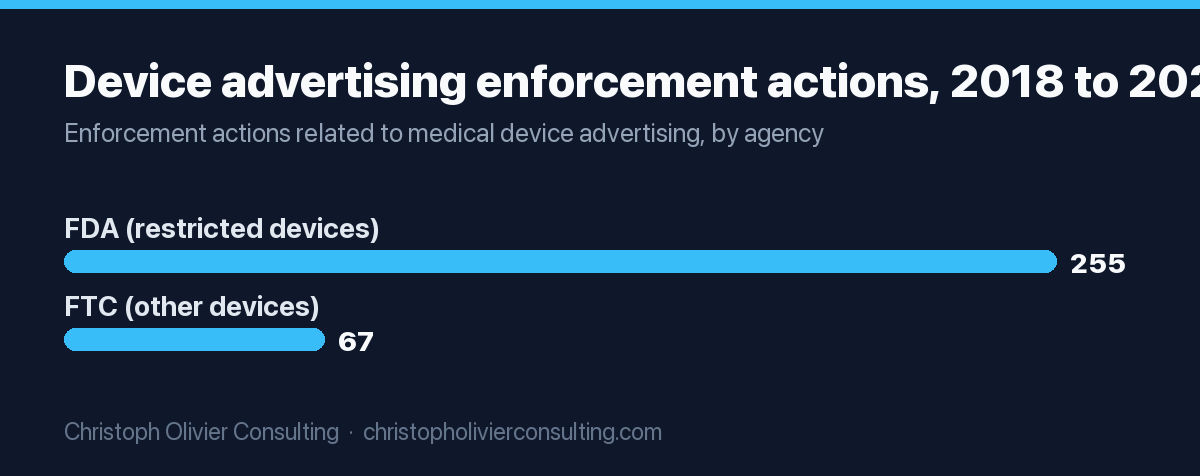
A 2023 GAO report, Medical Advertising: Federal Oversight of Devices, explains the split: FDA has primary responsibility for advertising of restricted devices, and the FTC for all devices that are not restricted. Restricted device ads must be truthful and carry “a brief statement of the intended uses of the device” plus “relevant warnings, precautions, side effects, and contraindications” under 21 U.S.C. 352(q) and (r).
For FTC-jurisdiction devices, the FTC’s Health Products Compliance Guidance requires “competent and reliable scientific evidence,” generally randomized, controlled human clinical testing. Its Example 49 is the one every device marketer should read: an ab belt cleared as a Class II muscle stimulator, advertised as “FDA Approved” next to dramatic weight-loss claims. The FTC calls that deceptive because clearance does not mean FDA authorized the specific claim. More real cases sit in our roundup of false advertising examples.
Off-label questions: the SIUU guidance and its status
Clinicians may use devices off-label, and they will ask your team about it. FDA’s January 2025 guidance, Communications From Firms to Health Care Providers Regarding Scientific Information on Unapproved Uses of Approved/Cleared Medical Products, covers PMA, 510(k) and De Novo devices. Its cover page on fda.gov states: “The information collection provisions in Q2, Q4, and Q5 of this guidance are under OMB review. This guidance is not for current implementation.” Treat it as FDA’s stated direction and confirm current status with counsel. Its separation rules are concrete:
- Exhibit halls: FDA “strongly recommends” dividing booth space so SIUU material has a dedicated area apart from promotion.
- Websites: a separate web page, and no direct links from promotional pages to it.
- Email: separate messages from promotional email.
- Rep visits: not “attached to or intermingled with” promotional material.
Each SIUU communication should carry disclosures, including a statement that the use is not approved and safety and effectiveness have not been established, the approved uses, a copy of the labeling, contraindications, relevant serious risks, and any authors who were paid by the firm. Our explainer on what commercial marketing means shows how pharma builds the same wall between commercial and medical affairs.
Claims-review checklist: pass/fail rules by clearance type
Run every asset through these checks before it goes to MLR review. Any single fail sends the asset back. The rules come from the regulations and guidance cited above. Row 11 is my own recommendation, not a quoted rule.
| # | Check | Pass | Fail | Applies to |
|---|---|---|---|---|
| 1 | Authorization wording | Uses the exact word for your pathway from the table above | “Approved” on a 510(k) or De Novo device; “cleared” or “approved” on an exempt device | All |
| 2 | “FDA registered” or registration number shown | Absent, or stated as a plain fact with no implied endorsement | Used as a trust badge or next to performance claims (21 CFR 807.39) | All, especially exempt |
| 3 | Indication match | Every clinical claim maps to a sentence in the indications for use | A condition, outcome or anatomy not in the IFU | All |
| 4 | Patient population and setting | Same population (age, disease stage) and setting (hospital, home) as the labeling | New population or setting, which would need a new 510(k) or PMA supplement | 510(k), PMA |
| 5 | Three-factor test | Passes all three CFL factors | Fails any one factor | PMA, De Novo |
| 6 | Exemption limits | Claim stays inside the .9 limitations for the device type | Claim falls outside them | 510(k)-exempt |
| 7 | FDA status next to outcome claims | Status stated separately from results claims | “FDA cleared” placed beside results the clearance did not cover (FTC Example 49 pattern) | All |
| 8 | Substantiation | Each performance or comparative claim cites the study behind it | Superiority over a named rival without head-to-head data | All |
| 9 | Risk information | Restricted device ads include intended uses and relevant warnings, precautions, side effects and contraindications | Benefits only, in any format, including short-form ads | Restricted devices |
| 10 | Off-label separation | SIUU material on its own page, email or booth area, with the full disclosures | Linked from, bundled with or retargeted from promotional assets | PMA, 510(k), De Novo |
| 11 | Paid search and keywords | Keywords match on-label conditions and procedures | Bidding on conditions the device is not indicated for | All |
| 12 | Pre-clearance assets | No safety or effectiveness claims; no order forms or pricing for 510(k)-pending devices | “Proven,” “safe,” “effective” for an investigational device, or taking orders before clearance | Investigational, 510(k) pending |
| 13 | Health economics content | Accurate, objective, supported, aimed at committees or payors | Economic promises tied to purchase commitments or free services | All |
Marketing medical devices to physicians: the rules that shape every touchpoint
Physicians are the demand side of device adoption, and almost every way you reach them is governed by two sets of rules: the AdvaMed Code of Ethics (voluntary, but adopted widely) and the federal Open Payments program (mandatory reporting). AdvaMed’s board approved revisions on October 6, 2025, effective November 1, 2025, expanding guidance on handling data. An Arnall Golden Gregory analysis describes the update as a new Section XIV on data-driven technologies plus minor Section I edits. The interaction rules below come from the restated Code text AdvaMed hosts.
| Tactic | Allowed under the AdvaMed Code | Not allowed | Section |
|---|---|---|---|
| KOL, speaker and proctor programs | Legitimate need identified in advance, vetted consultants, fair market value pay, written agreements | Selecting or paying consultants as a reward for past use or an inducement for future purchases; sales controlling who is hired | II |
| Meals with a presentation | Occasional, modest meals subordinate to a bona fide scientific, educational or business discussion | Meals for a whole office staff when not everyone attends; “dine and dash” without a rep present; guests | VII |
| Leave-behinds and swag | Modest educational or patient benefit items | Branded pens, notepads and mugs, even of minimal value; gift cards, wine, holiday gifts; tablets or phones | VIII |
| Entertainment | None | Entertainment or recreation “in any form,” including golf or sporting events, regardless of value or consulting status | IX |
| Off-label questions | Responses by authorized personnel, truthful, identified as unapproved or uncleared | Reps improvising off-label answers | X |
| Reimbursement support | Accurate, objective coverage, coding and health economics information | Free services that remove an expense the provider would otherwise carry | XI |
| Evaluation units | Reasonable quantities; capital equipment on written terms for a set period with title retained | Open-ended “evaluations” that function as free equipment | XII |
| Reps in the OR | Present only at the request and under the supervision of an HCP, transparent about their role | Interfering with clinical decisions | XIII |
Open Payments (Sunshine Act) thresholds for 2026
Device manufacturers report payments and transfers of value to covered recipients: physicians, physician assistants, nurse practitioners, clinical nurse specialists, certified registered nurse anesthetists, certified nurse-midwives and teaching hospitals, per the CMS glossary. The CMS data collection page lists these thresholds:
| Program year | Small payment threshold | Annual aggregate threshold |
|---|---|---|
| 2025 | $13.46 | $134.54 |
| 2026 (current) | $13.82 | $138.13 |
| 2027 | $14.31 | $143.01 |
Payments below the small threshold drop out only while the yearly total for that recipient stays under the aggregate. CMS states that once the aggregate is exceeded, “all payments or other transfers of value must be reported.” Worked example: a rep provides a $12 in-service lunch to the same surgeon 11 times in 2026. Total: $132, under $138.13, so none are reportable. A 12th lunch brings the total to $144, and all 12 become reportable. Data for each year is collected January 1 to December 31, submitted February 1 to March 31, and published by June 30, per the Open Payments program page. For Program Year 2025, CMS published 17.07 million records worth $14.67 billion. Assume every consulting fee you pay will be searchable by the surgeon’s peers.
Channels to physicians that hold up under review
- Peer-to-peer education: proctoring, preceptorships and podium talks by contracted surgeons. The Code lists these as bona fide consulting services when Section II controls are in place.
- Medical conferences: promotional booth for on-label content, a physically separate SIUU area if you share unapproved-use science, and a staffing rule that only authorized personnel answer off-label questions.
- Hands-on evaluation: evaluation units under Section XII terms, tracked for Open Payments where reportable.
- HCP web pages and email: on-label pages built around the procedure and the indication, with SIUU content kept on unlinked separate pages and separate sends.
- Account-based programs: when your market is a few hundred health systems, coordinated ads, content and rep outreach to named accounts fit better than broad demand generation. The account-based marketing statistics page has the sourced adoption and cost data.
Selling to hospital buyers: GPOs and value analysis committees
A surgeon who wants your device still has to get it through supply chain. Two gatekeepers matter most. Group purchasing organizations are, in GAO’s words in GAO-15-13, “purchasing intermediaries that negotiate contracts for medical products and services.” The five largest national GPOs that GAO studied were “predominately funded by administrative fees collected from vendors,” and those fees totaled about $2.3 billion in 2012. If your target hospitals buy through a GPO contract, being off contract is a cost and paperwork hurdle your champion has to argue past.
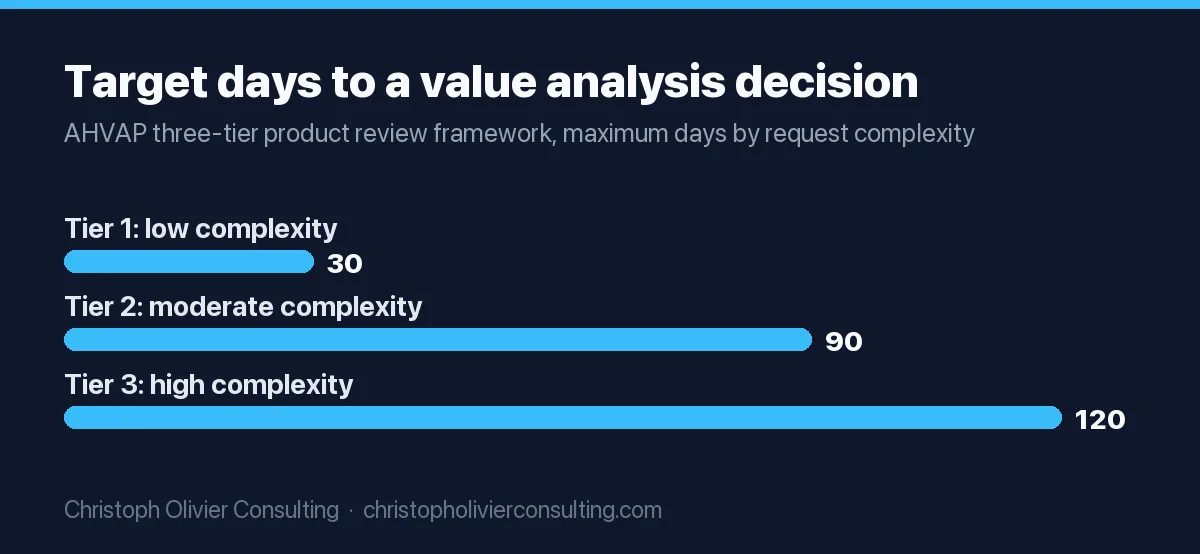
Value analysis committees decide whether a new product enters the building. The Association of Healthcare Value Analysis Professionals’ 2025 position statement on a standardized product review process sets a three-tier framework with target decision times by complexity.
| AHVAP tier | Examples AHVAP gives | Target decision time | What the request needs |
|---|---|---|---|
| Tier 1: low complexity | Urinals, bandages, incise drapes, oxygen tubing | 30 days or less | Product details, supporting documentation, pricing; sample review by end users |
| Tier 2: moderate complexity | Safety venipuncture supplies, syringes, dressings | 90 days or less | Same, plus a focused trial if needed and a literature review |
| Tier 3: high complexity | Implantable devices, surgical robots, AI diagnostic tools, ventilators | 120 days or less | Comprehensive documentation: clinical studies, regulatory approvals, cost details and pricing; multidisciplinary review; ROI and total cost of ownership modeling |
A published account shows why your materials must work without you in the room. In Olson, Obremskey and Bozic (Clinical Orthopaedics and Related Research, 2013), Vanderbilt’s committees met monthly with 10 physicians and six administrators or supply chain officers, and “no industry representatives are permitted to be present or to present.” Over two years, 92% of products presented were approved, 5% approved with stipulations and 3% rejected. The physician champion presents. Your job is the packet they carry.
Build a VAC packet that answers a Tier 3 reviewer in one pass:
- Clearance letter, approval order or De Novo grant, plus the indications for use.
- A one-page evidence summary with every study cited and its limitations stated.
- Pricing, the GPO contract status, and what current product it replaces.
- A cost and workflow model with your assumptions visible, so finance can change them.
- Training and in-service plan, including staff hours.
- Coding and coverage information that is accurate and objective, per AdvaMed Section XI.
For payors and population-level committees, FDA issued a revised draft guidance in June 2026, Drug and Device Manufacturer Communications With Payors, Formulary Committees, and Similar Entities, covering health care economic information for devices. FDA labels it “Not for implementation,” so treat it as a signal that a separate health economics content track for committees is legitimate, and keep that track away from clinician promotion.
Medical device digital marketing: settings that keep you compliant
Digital marketing for medical devices follows the same claim rules as print. What changes is how easily one asset connects to another. Set these controls before launch:
- Site architecture: on-label product and procedure pages in the main menu; any SIUU content on separate pages with the full disclosures and no direct links from promotional pages, as the SIUU guidance recommends.
- Retargeting: exclude SIUU page visitors from promotional retargeting audiences, so the two do not get bundled in a clinician’s feed. This is my practical recommendation for applying the separation principle.
- Short-form ads: for restricted devices, plan how each format delivers the intended uses and risk information that 21 U.S.C. 352(r) requires, for example through a linked landing page reviewed by MLR.
- Keyword lists: audit them against the indications for use every quarter (checklist row 11).
- Comments and testimonials: a written moderation policy for off-label questions and adverse event mentions on your social channels, with a route to authorized personnel.
- Attribution: track by account and committee stage (VAC submission, decision, evaluation, repeat use), not by clicks alone, because a device sale closes in a committee.
Lead scoring, nurture flows and sales handoff work as in any committee-led B2B purchase. Our B2B marketing strategy template has a copy-ready handoff agreement and a 12-month roadmap you can adapt to the phase gates above. If you want a second set of eyes on a launch plan or claims matrix, you can book a consultation.
Frequently asked questions
Can a 510(k) medical device be marketed as FDA approved?
No. Under 21 CFR 807.97, a 510(k) substantial equivalence determination does not denote official FDA approval, and any representation that creates that impression is misleading and constitutes misbranding. Say FDA-cleared or 510(k) cleared. Reserve FDA-approved for devices with a premarket approval (PMA), and use granted or authorized for De Novo devices, which are FDA's own terms.
What should a medical device marketing plan include?
A medical device marketing plan should include the authorization pathway and exact indications for use, a claims matrix tying each claim to the label and its evidence, a committee map for each site of care, an evidence and economics package, an HCP program with fair market value contracts and Open Payments tracking, channels by launch phase, an MLR review workflow, and phase gates such as value analysis committee approvals and repeat use.
How do you market medical devices to physicians?
Reach physicians through peer-to-peer education, proctoring, hands-on evaluation, medical conferences and on-label HCP web content. Every touchpoint runs through the AdvaMed Code: consultants need a legitimate need, fair market value pay and written agreements; meals must be modest and tied to a presentation; branded gifts and entertainment are not allowed. Payments to physicians are reportable to CMS Open Payments.
What is the Open Payments reporting threshold for 2026?
For Program Year 2026, CMS lists a small payment threshold of $13.82 and an annual aggregate threshold of $138.13 per covered recipient. Payments under $13.82 are excluded only while the recipient's yearly total stays under $138.13. Once the total exceeds it, all payments must be reported. CMS lists $14.31 and $143.01 for 2027.
Can you market a medical device before FDA clearance?
Only in limited ways. Under 21 CFR 812.7, you may not promote or test market an investigational device or represent it as safe or effective. For a device with a pending 510(k), FDA's CPG Sec. 300.600 says you may advertise or display it, but you may not take orders or be prepared to take orders. Pre-clearance work is best spent on account mapping, claims drafting and review workflows.
What does a hospital value analysis committee need from a device company?
AHVAP's 2025 framework asks high-complexity requests, such as implants or surgical robots, for comprehensive documentation: clinical studies, regulatory approvals, cost details and pricing, followed by multidisciplinary review and ROI or total cost of ownership modeling, with a decision target of 120 days or less. Many committees bar vendors from the room, so the physician champion presents your packet.
Can medical device companies talk about off-label uses?
Companies may not promote unapproved uses, but FDA's January 2025 SIUU guidance describes how firms can share truthful scientific information on unapproved uses with health care providers, separate from promotion and with set disclosures. The guidance itself states it is not for current implementation while some provisions are under OMB review. The AdvaMed Code adds that only authorized personnel should respond.
More Growth Consulting guides
- Healthcare Marketing: How Practices Attract and Keep Patients
- B2B Digital Marketing: A Channel Strategy Playbook
- Car Dealership Marketing: Cost Per Sold Unit by Channel
- Business-to-Business Marketing Strategy for Small and Midsize Firms
- What Does Marketing Do? The 7 Jobs a Marketing Function Actually Performs
- Types of Websites: What Each Is For and Which One Your Business Needs
- All Growth Consulting guides →