
Last reviewed: October 2026
The most famous ads of all time include Volkswagen’s “Think Small” (1959), Avis’s “We Try Harder,” Coca-Cola’s “Hilltop” (1971), Apple’s “1984,” Nike’s “Just Do It” (1988), Dove’s Campaign for Real Beauty (2004) and Old Spice’s “The Man Your Man Could Smell Like” (2010). Advertising Age ranked “Think Small” the best campaign of the 20th century and Dove’s Real Beauty the best of the 21st.
This guide covers 14 famous ads with the year, the agency, the core idea, what the record actually shows about results, and the one principle a small or service business can borrow from each. Every figure links to the source it came from. Where a popular statistic could not be traced to a solid source, it is flagged rather than repeated.
Famous ads at a glance: year, agency and principle
The table below lists 14 of the best ad campaigns of all time in date order. Each row gives the brand, campaign, launch year, agency, the recognition or result on record, and the transferable principle. Use it as a quick reference, then read the sections below for what each campaign did and why it still matters.
| Campaign | Year | Agency | On the record | Principle to borrow |
|---|---|---|---|---|
| De Beers, “A Diamond Is Forever” | 1948 | N.W. Ayer & Son | No. 6, Ad Age top 100 | Attach your product to a ritual |
| Volkswagen, “Think Small” | 1959 | Doyle Dane Bernbach | No. 1, Ad Age top 100 | Admit the obvious flaw, then reframe it |
| Avis, “We Try Harder” | 1962/63 | Doyle Dane Bernbach | No. 10, Ad Age top 100 | Turn second place into a promise |
| Coca-Cola, “Hilltop” | 1971 | McCann Erickson | 100,000+ letters praising the ad | Sell a feeling bigger than the product |
| Absolut, the Absolut Bottle | 1981 | TBWA | No. 7, Ad Age top 100 | Make one visual asset do all the work |
| Apple, “1984” | 1984 | Chiat/Day | Cannes Grand Prix; No. 12, Ad Age | Name an enemy your buyer already resents |
| Wendy’s, “Where’s the Beef?” | 1984 | Dancer Fitzgerald Sample | Sales up 31% (Time) | Dramatize the competitor’s gap with humor |
| Nike, “Just Do It” | 1988 | Wieden+Kennedy | No. 4, Ad Age top 100 | Speak to the customer’s identity, not specs |
| California milk, “Got Milk?” | 1993 | Goodby Silverstein & Partners | 90%+ US awareness (campaign claim) | Sell the pain of running out |
| Apple, “Think Different” | 1997 | TBWA\Chiat\Day | 1998 Emmy; 2000 Grand Effie | Borrow meaning from people your buyer admires |
| Dove, Campaign for Real Beauty | 2004 | Ogilvy | No. 1, Ad Age 21st-century list | Start from research your buyer recognizes |
| Old Spice, “The Man Your Man Could Smell Like” | 2010 | Wieden+Kennedy | Body wash sales doubled by July 2010 (agency) | Talk to the person who actually buys |
| Coca-Cola, “Share a Coke” | 2011 | Ogilvy Sydney | Category share up 4% (Ogilvy estimate) | Put the customer’s name on the work |
| Always, #LikeAGirl | 2014 | Leo Burnett | 2015 Emmy; 7 Clios in 2014 | Flip an insult your audience hears daily |
“Ad Age top 100” is Advertising Age’s 1999 Advertising Century list. Other sources are linked below.
How the best ad campaigns of all time were chosen
A campaign made this list if a credible ranking named it, it changed advertising or popular culture, and its story can be checked against a primary or near-primary source. Fame alone was not enough. Each entry also had to teach a principle that works without a national budget.
The strongest single reference is Ad Age’s Advertising Century ranking. Its editor, Bob Garfield, set out three ways a campaign could qualify:
- It was a watershed that changed the culture of advertising or popular culture as a whole.
- It created a category, or it made the brand the No. 1 player in its category.
- It was simply unforgettable.
For campaigns after 1999, this guide leans on Ad Age’s later Top 15 Ad Campaigns of the 21st Century, as reported by WPTV, plus the major creative awards: Cannes Lions, the Clios, the Effies and the Primetime Emmy for Outstanding Commercial, whose winners list includes three campaigns covered here. If you want the longer story of how the industry got here, read our history of advertising.
Famous ads of the 20th century that rewrote the rules
The 20th-century classics mostly ran in print, radio and network TV, when a handful of channels reached most households. They still matter because the ideas were simple enough to survive any medium. Each one below includes what ran, why it worked, what the record shows, and how a service business can borrow the move.
Volkswagen, “Think Small” (1959)
Doyle Dane Bernbach placed a tiny photo of the Beetle on a mostly empty page with the headline “Think small.” Art director Helmut Krone and copywriter Julian Koenig made it under William Bernbach. Ad Age ranked it No. 1 of the century. Garfield’s essay credits the “droll, conversational, self-deprecating style of the copy” as being as important as the car’s 34 miles per gallon.
Why it worked: Americans were buying bigger cars. Instead of hiding the Beetle’s size, the ad made smallness a sign of good sense.
Apply it: If you are a smaller firm, say so, then explain what the size buys the client, such as direct access to a partner.
Avis, “We Try Harder” (1962)
Avis was No. 2 to Hertz in car rentals. Doyle Dane Bernbach, the same agency, chose to embrace that second-place status and turned it into a reason to rent: when you are No. 2, you try harder. Ad Age ranked it No. 10, listing it under 1963.
Apply it: Being smaller than the market leader is a credible promise of attention. Write the line your clients would say about you if asked why they stayed.
De Beers, “A Diamond Is Forever” (1948)
N.W. Ayer & Son wrote the line, and Ad Age ranked it No. 6. Garfield argues that before De Beers tied diamonds to eternal romance, the diamond solitaire “as the standard token of betrothal did not exist,” and that the engagement ring is now expected “virtually worldwide.” That is category creation through a single idea.
Apply it: Connect your service to a moment that already matters to the buyer: a business sale, a first hire, a retirement date.
Coca-Cola, “Hilltop” (1971)
McCann Erickson creative director Bill Backer conceived the “I’d like to buy the world a Coke” idea in January 1971. Coca-Cola’s own history says the spot was filmed outside Rome, cost more than $250,000, and drew more than 100,000 letters praising the ad, while radio stations were flooded with requests for the song.
Why it worked: It sold togetherness and let the product ride along.
Apply it: Lead with the outcome the client feels, such as relief, pride or a calmer Monday, before the deliverable.
Absolut, the Absolut Bottle (1981)
TBWA built a long-running print campaign around one asset: the bottle itself, shown in a new clever setting each time. Ad Age ranked it No. 7, and Garfield credits Absolut with building a burgeoning market for premium vodka, “a neat trick for a product that is by law and by its very nature a flavorless commodity.”
Apply it: If your service looks like a commodity, pick one distinctive asset, a phrase or a signature color, and repeat it everywhere.
Apple, “1984” (1984)
Chiat/Day’s 60-second launch spot for the Macintosh, directed by Ridley Scott, had its only national US broadcast during Super Bowl XVIII on January 22, 1984. It won the Cannes Lions Grand Prix that year, and Ad Age later named it the Commercial of the Decade. The 1999 top 100 list ranks it No. 12.
Why it worked: It cast the buyer as a rebel and an unnamed, conformist rival as the enemy. It never showed the computer.
Apply it: Name the status quo your buyer is tired of, such as surprise invoices, and position your firm as the way out.
Wendy’s, “Where’s the Beef?” (1984)
Created by Dancer Fitzgerald Sample and first aired on January 10, 1984, the spot showed actor Clara Peller staring at a huge bun with a tiny patty at a fictional rival called “Big Bun.” The line entered politics when Walter Mondale used it against Gary Hart, and Time reported Wendy’s sales jumped 31% to $945 million.
Apply it: Show, with humor, the gap your clients find elsewhere.
Nike, “Just Do It” (1988)
Wieden+Kennedy co-founder Dan Wieden adapted the line from the last words of a death-row inmate, “Let’s do it,” according to the Boston Globe’s 2022 obituary. It first appeared in a July 1988 TV ad featuring Walt Stack, an 80-year-old who ran 17 miles every morning. Ad Age ranked the campaign No. 4.
Why it worked: The line fits a pro athlete and a weekend jogger equally well. It sells self-image, not shoes.
Apply it: Write to who your client wants to become. A brand archetype can keep that voice consistent across every ad.
“Got Milk?” (1993)
Goodby Silverstein & Partners created the line for the California Milk Processor Board. The launch spot, “Aaron Burr,” directed by Michael Bay, shows a man who can’t answer a radio trivia question because his mouth is full of peanut butter and the milk carton is empty. The campaign claims over 90% awareness in the United States.
Apply it: Show what goes wrong when the client lacks your service. The pain of missing out often sells better than praise.
Apple, “Think Different” (1997)
TBWA\Chiat\Day’s “Crazy Ones” spot paired black-and-white footage of famous rule-breakers with a short manifesto that begins “Here’s to the crazy ones.” Steve Jobs chose the Richard Dreyfuss narration over his own. The spot won the 1998 Emmy for best commercial and the 2000 Grand Effie, during a period when Apple was rebuilding its reputation.
Apply it: Associate your brand with values and role models your buyers already respect, then live up to them.
Popular ads of the 21st century: the award-winning campaigns
The most popular ads of the 21st century spread through search, YouTube and social feeds rather than only paid airtime. Ad Age’s Top 15 of the century put Dove’s Real Beauty first and Old Spice fourth. These campaigns show that a strong idea can now earn reach that money alone cannot buy.
Dove, Campaign for Real Beauty (2004)
Dove’s campaign started with research. The Real Truth About Beauty report, a telephone survey of 3,200 women aged 18 to 64 in ten countries, found that only 2% chose “beautiful” to describe their looks. Ogilvy built the campaign on that finding, and Ad Age ranked it No. 1 of the 21st century. Its 2006 “Evolution” film won two Cannes Grand Prix.
Apply it: One honest finding from your own client records can anchor a campaign for years.
Old Spice, “The Man Your Man Could Smell Like” (2010)
Wieden+Kennedy started from an insight that women make 60% of body wash purchases, so the ad spoke to them directly. The goal was a 15% sales lift. According to the agency, Red Zone body wash sales were up 60% year over year by May 2010 and had doubled by July. The spot won the Cannes Film Grand Prix and an Emmy in 2010.
The follow-up “Response” campaign filmed 186 video replies to fans and celebrities in two and a half days.
Apply it: Identify who really chooses. In many service firms it is an office manager or spouse, not the named client.
Coca-Cola, “Share a Coke” (2011)
Ogilvy Sydney printed Australia’s 150 most popular names on millions of bottles, inviting people to find and share a bottle with friends. Ogilvy estimated it raised Coke’s category share by 4% and young-adult consumption by 7%. It later rolled out to more than 80 countries.
Apply it: A proposal or report built around the client’s name, numbers and goals reads like it was made for one person, because it was.
Always, #LikeAGirl (2014)
Leo Burnett ran a social experiment on what people mean by doing something “like a girl,” then turned the insult into a statement of strength. Directed by Lauren Greenfield, the three-minute film won seven Clios including a Grand Clio, had 48 million YouTube views by September 2014, and won the 2015 Emmy for Outstanding Commercial.
Apply it: If your audience hears a dismissive phrase about themselves, such as “small business owners don’t need a plan,” take it on directly.
What Ad Age’s top 100 list reveals about famous ads
Ad Age’s 1999 ranking is heavily weighted to the decades of mass media. By a tally of the published list, 65 of the 100 campaigns launched between 1950 and 1989, and only three came from the 1990s. Garfield noted that only seven used celebrities, eight relied on sex and four played on fear.
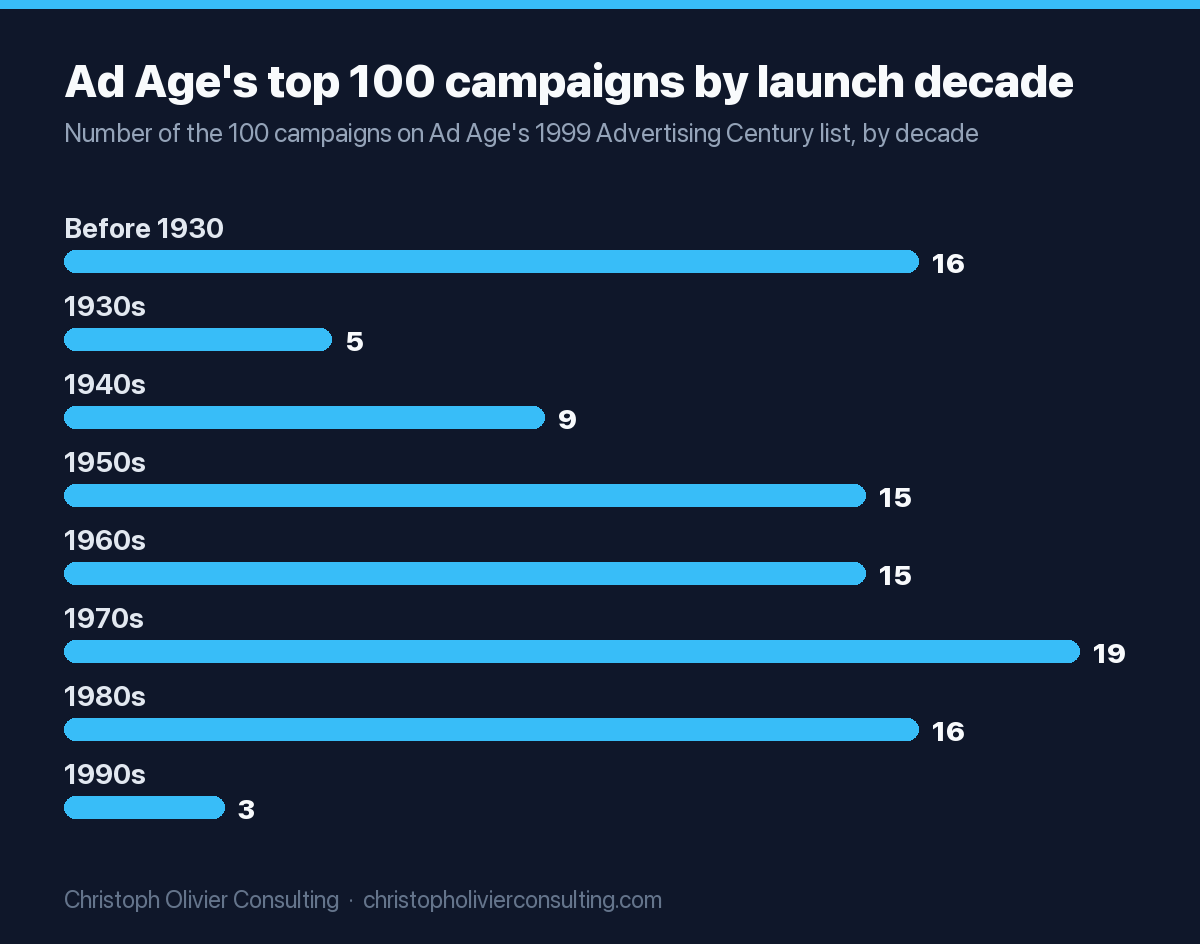
The other pattern is concentration. Doyle Dane Bernbach appears on the list more than any other agency, including No. 1 and No. 10. The lesson for a modern marketer is that a distinctive point of view, applied consistently, mattered more than celebrity, shock or budget.
Famous ad statistics to treat with caution
Many famous ads carry statistics that get repeated far more often than they get checked. Some are exaggerated, some conflict between sources, and some trace back to student case studies. Confirm any of them against the original source before you quote it. These came up while researching this guide.
| Popular claim | What the sources show | How to use it |
|---|---|---|
| Apple’s “1984” drove about $150 million in Mac sales within weeks | Widely repeated, but the Wikipedia entry cites art director Brent Thomas describing about $3.5 million in Macs sold just after the ad ran. Figures conflict. | Cite the awards and the single national airing, not a sales number. |
| Only 2% (or 4%) of women call themselves beautiful | The original 2004 Dove report says 2% overall; 4% is the figure for women aged 18 to 29. | Use 2% with the report as the source. |
| “Just Do It” grew Nike’s share from 18% to 43% | Traced in Wikipedia’s article to a mini case study, not Nike filings. | Avoid, or check Nike’s annual reports first. |
| Avis went from a loss to a profit in a single year | Repeated widely and summarized from Adweek, but the Adweek article we read did not state figures. | Describe the strategy; skip the dollar figures. |
| Old Spice sales doubled | Reported by Wieden+Kennedy, the agency that made the ad, for one product line. | Say “according to the agency” and name the product. |
The 7 principles behind the most famous ads
Across eight decades, the most famous ads share a short list of moves. None depends on a Super Bowl budget. Each can be tested in a single email, landing page or local ad. These seven recur most often in the campaigns above.
- One idea, stated simply. If it takes a paragraph, it is not the idea yet.
- Honesty about a weakness. Volkswagen and Avis turned a flaw into proof of character.
- A clear enemy. Apple’s conformity, Wendy’s tiny patty, Always’s insult.
- The buyer as hero. Nike and Dove put the customer, not the product, at the center.
- A real insight. Old Spice knew who bought body wash. Dove started from survey data.
- A repeatable asset. The Absolut bottle, the Coke name label, the Avis line that ran for decades.
- Emotion first, product second. “Hilltop” and “Think Different” barely mention what they sell.
These map neatly onto the AIDA model: the idea earns attention, the insight builds interest, the emotion creates desire, and a clear next step closes the loop. A service business also needs the last step, so pair the idea with a specific call to action.
How to apply famous ad thinking to a service business
You do not need a national budget to use these principles. A professional-service firm or a seven-figure service business can test a famous-ad style idea on a homepage headline, a LinkedIn post or a small paid campaign, and judge it on booked calls.
- List the uncomfortable truths. Write down what prospects say is wrong with you: too small, too new, too expensive, too far away.
- Pick one and reframe it. Ask what that weakness gives the client. Small can mean senior attention. Expensive can mean fewer surprises.
- Find one fact you can prove. Pull it from your own records, such as average response time or client tenure. Never borrow a statistic you cannot source.
- Write the line in under six words. Test it out loud. If a client would not repeat it, rewrite it.
- Test it small. Run two versions on the same channel for two to four weeks and compare replies or booked calls, not likes.
If you are unsure whether something counts as an ad at all, such as a case study page or a sponsored newsletter slot, our explainer on what an ad is covers the formats.
Worked example: an Avis-style ad for a small accounting firm
Here is a hypothetical example of the process above. Imagine a four-partner accounting firm competing against a large regional firm. Prospects say it is “too small.” Using the Avis move, the firm stops apologizing for its size and makes it the promise, so the ad says something only this firm can say.
| Step | Generic version | Famous-ad version |
|---|---|---|
| Weakness | Hidden: “Full-service accounting” | Stated: “We’re the small firm.” |
| Reframe | “Experienced team” | “So a partner answers your call.” |
| Proof | “Client focused” | A real, verifiable number from firm records, such as average reply time |
| Line | “Your trusted partner” | “Small firm. Partner on every file.” |
| Next step | “Contact us” | “Book a 20-minute call with a partner” |
The generic version could belong to any firm. The famous-ad version could only belong to this one, which is the whole point. The same structure works for a law practice or an agency.
Famous ads earn their place because they made a simple idea impossible to forget. If you want help finding that idea for your own firm, you can book a consultation and we can look at your positioning together.
Frequently asked questions
What is the most famous ad of all time?
There is no single official answer, but two campaigns top the major rankings. Advertising Age's 1999 Advertising Century list ranked Volkswagen's "Think Small" (Doyle Dane Bernbach, 1959) as the best campaign of the 20th century. For a single TV commercial, Apple's "1984" is the usual pick: it won the Cannes Grand Prix and Ad Age named it the Commercial of the Decade.
What are the top 10 advertising campaigns of all time?
Ad Age's top 10 of the 20th century are: Volkswagen "Think Small," Coca-Cola "The pause that refreshes," the Marlboro Man, Nike "Just Do It," McDonald's "You deserve a break today," De Beers "A diamond is forever," the Absolut Bottle, Miller Lite "Tastes great, less filling," Clairol "Does she or doesn't she?" and Avis "We try harder."
What is the best ad campaign of the 21st century?
Advertising Age's Top 15 Ad Campaigns of the 21st Century ranked Dove's Campaign for Real Beauty first. It launched in 2004 after Dove's own global study found only 2% of women chose "beautiful" to describe their looks. The same list included Nike+, BMW's "The Hire," Old Spice's "The Man Your Man Could Smell Like" and Red Bull Stratos.
What makes an ad campaign famous?
Most famous ads share a few traits: one simple idea, a real insight about the buyer, an emotional payoff ahead of product features, and a line or visual repeated for years. Ad Age's criteria were whether a campaign changed advertising or culture, created or won a category, or was simply unforgettable. Few relied on celebrities, sex or fear.
Which famous ads won the most awards?
Award records are spread across several shows, so totals are hard to compare. Among famous ads, Apple's "1984" won the Cannes Grand Prix, Old Spice's 2010 spot won the Cannes Film Grand Prix and an Emmy, Always #LikeAGirl won seven Clios in 2014 and the 2015 Emmy, and Apple's "Think Different" won a 1998 Emmy and the 2000 Grand Effie.
Can a small business learn from famous ad campaigns?
Yes. The principles behind famous ads, such as admitting a weakness, naming an enemy, or speaking to the real buyer, cost nothing to apply. A small or service business can test one idea on a homepage headline, an email or a modest paid campaign, then judge it on booked calls or replies rather than likes or views.
More Paid Advertising guides
- The History of Advertising: From Print to AI, and What Each Shift Teaches Marketers
- What Is an Ad? Definition, Types, and the 5 Parts Every Advertisement Has
- What Does an Advertising Manager Do? Role, Skills, Salary
- The Ideal Facebook Ads Image Size for Maximum Impact
- Retargeting vs Remarketing: The Real Difference
- Retargeting Ads: A 2026 Playbook
- All Paid Advertising guides →