
Last reviewed: September 2026
The AIDA model maps the four mental steps a buyer moves through before acting: Attention, Interest, Desire, and Action. It gives copywriters and marketers a running checklist so a headline earns a read, the read builds want, and the want turns into a click, reply, or purchase. This guide defines each stage, shows how to write for it, and marks where the model stops being useful.
What is the AIDA model?
The AIDA model is a copywriting and advertising framework that breaks a buyer’s decision into Attention, Interest, Desire, and Action. Advertising pioneer Elias St. Elmo Lewis sketched it in 1898, and Edward Strong formalized it in the 1920s. It survives because the sequence tracks a plain human pattern: notice, care, want, then act.
Read AIDA as a diagnostic, not a script. When a page fails, the four letters tell you where the leak sits. A weak first line loses Attention. Thin proof stalls Desire. A buried button kills Action. You can use the same lens on our marketing copywriting work and across a full-funnel marketing program.
The four stages of AIDA explained
Each AIDA stage has a single job and a single question the reader is silently asking. Attention answers “is this for me?” Interest answers “why should I keep reading?” Desire answers “why this option?” Action answers “what do I do now?” The table below pairs each stage with its goal and common tactics.
| Stage | Reader’s question | Job of the copy | Common tactics |
|---|---|---|---|
| Attention | Is this for me? | Interrupt and qualify | Specific headline, a striking image, a named pain |
| Interest | Why keep reading? | Make the problem feel real | Relevant detail, a short story, a surprising figure |
| Desire | Why this option? | Turn a want into preference | Benefits over features, proof, testimonials, a demo |
| Action | What do I do now? | Remove friction and ask | One clear call to action, low risk, next step spelled out |
How to apply the AIDA model to your copy
Applying AIDA means writing each block against its stage job, then checking that each block earns the next. Draft in order, keep one idea per paragraph, and lead with what the reader gets rather than what your product contains. The steps below turn the four letters into a repeatable writing pass.
- Attention: open with a headline that names the reader or the pain in concrete terms, not a slogan. Cut any throat-clearing first line.
- Interest: in the next two or three sentences, prove you understand the problem. Use one specific detail or number so the reader feels seen.
- Desire: present your offer as the fix, translate features into outcomes, and back the claim with proof such as a result, testimonial, or short case.
- Action: ask for one thing. State the exact next step, reduce the perceived risk, and place the call to action where the desire peaks.
For deeper structural help on qualifying and message order, see our approach to sales and marketing strategy.
AIDA across channels: ads, email, and landing pages
The four stages map cleanly onto the parts of most assets, so you can assign each letter to a real slot. In email the subject line carries Attention and the preview text carries Interest. On a landing page the hero handles Attention and Interest while the body and button handle Desire and Action. The table shows the mapping.
| Channel | Attention | Interest | Desire | Action |
|---|---|---|---|---|
| Subject line | Preview text and opener | Body proof and offer | Button or reply ask | |
| Paid ad | Hook line and visual | First body line | Benefit and social proof | Click call to action |
| Landing page | Headline and hero image | Subhead and problem block | Benefits, proof, FAQ | Primary button |
AIDA stage drop-off: an illustrative example
Fewer people reach each later stage than the one before, which is why AIDA is often drawn as a funnel. The chart below uses illustrative example values, not measured benchmarks, to show the shape of that fall from Attention to Action. Real rates vary widely by channel, offer, and audience, so treat these numbers as a teaching sketch and measure your own.
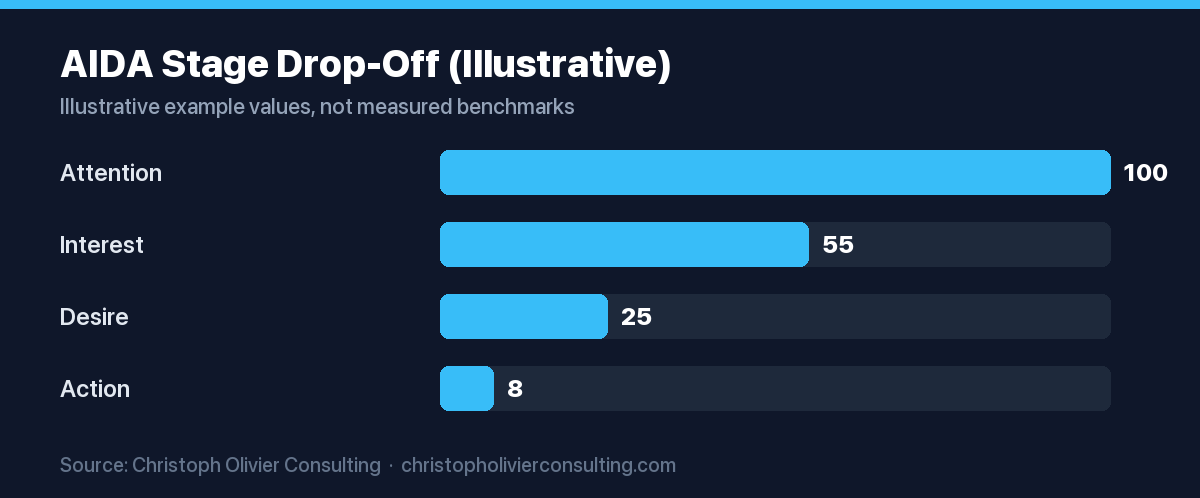
The takeaway holds even if your figures differ: small gains at wide stages carry down, so a clearer headline that keeps more people past Attention lifts every stage after it.
Limits of the AIDA model and modern extensions
AIDA is a useful starting frame, but it stops at the sale and treats buying as one straight line. Real buyers loop back, compare options, and keep evaluating after purchase, which the original four letters ignore. Several extensions try to patch this, as the table shows, though each adds letters rather than fixing the linear assumption.
| Variant | Added stage | What it addresses |
|---|---|---|
| AIDA | None | The original four steps to a purchase |
| AIDCA | Conviction (before Action) | The rational “this is the right choice” beat |
| AIDAS | Satisfaction (after Action) | What happens after the sale, loyalty and repeat |
Consumer research has reframed the journey as a loop rather than a funnel, where buyers form a consideration set, add and drop options, purchase, then feed loyalty back into the next decision. Use AIDA to draft and diagnose a single asset, and use a loop view when you plan retention and expansion.
A worked AIDA example
Here is the model applied to one short B2B email for a fractional CMO service. Each line is labeled by its stage so you can see the sequence do its job. The pattern transfers to any offer once you swap the specifics.
Attention: “Your marketing has no one owning the number.” Interest: “Founders tell me leads are flat, the agency reports on clicks, and no one connects spend to revenue.” Desire: “A fractional CMO sets the strategy, holds the pipeline target, and manages the vendors, for a fraction of a full-time hire.” Action: “Book a 20-minute fit call this week.” To see how this fits a wider engagement, review our services.
Frequently asked questions
What does AIDA stand for?
AIDA stands for Attention, Interest, Desire, and Action. It is a marketing and copywriting framework that describes the four stages a person tends to move through before buying: first noticing a message, then caring about it, then wanting the offer, and finally taking a step such as clicking, replying, or purchasing. Marketers write each part of an asset to match one of these stages.
Who created the AIDA model and when?
Advertising pioneer Elias St. Elmo Lewis outlined the ideas behind AIDA in 1898, and Edward Strong helped formalize the four-stage sequence in the 1920s. The model predates digital marketing by decades, yet it stays in use because the pattern of notice, care, want, and act reflects a basic order in how people respond to persuasive messages across most channels.
How is AIDA different from a marketing funnel?
AIDA is a copy-level framework for one message or asset, while a marketing funnel describes the wider path across many touchpoints from awareness to purchase and beyond. The two overlap because AIDA is often drawn as a funnel shape, but a full funnel usually adds stages like retention and referral. AIDA is best for drafting and diagnosing a single piece of copy.
Is the AIDA model still relevant in 2026?
AIDA remains a helpful drafting and diagnostic tool, especially for ads, emails, and landing pages. Its main weakness is that it treats buying as a straight line and stops at the sale, while real buyers loop back, compare, and keep evaluating afterward. Many teams pair AIDA for single-asset copy with a loop or full-funnel view for retention and expansion planning.
What are the main AIDA extensions?
Two common extensions add a letter to cover a gap. AIDCA inserts Conviction between Desire and Action to name the rational moment when a buyer decides the choice is right. AIDAS adds Satisfaction after Action to gesture at loyalty and repeat purchase. Both extend the original four stages rather than fix its linear assumption, so use them as reminders, not rules.
How do I write the Desire stage without overpromising?
Translate features into concrete outcomes, then back each claim with proof you can defend, such as a real result, a testimonial, a demo, or a specific figure. Use conditional language for any claim you cannot guarantee, and avoid assured-outcome wording. Strong Desire copy makes the offer feel like the right fit for a named problem, not a promise of results everyone will get.
More marketing guides for rank on ai: get cited by ai search
- Best Landing Page Builder in 2026: How to Choose
- The 12 Brand Archetypes: A Practical Reference for Choosing Yours
- Call to Action Examples That Convert (With Before and After Rewrites)
- CMO Salary in 2026: Base, Bonus, and Total Comp by Company Size
- Color Psychology in Marketing: What Colors Signal and How to Use Them
- What Is a Customer Success Manager? Role, Metrics, and Salary
- Rank on AI: Get Cited by AI Search