
Last reviewed: September 2026
Weight loss clinic marketing works best as a coordinated system: local search that captures medication-specific demand, a consultation funnel that turns interest into booked visits, and messaging that stays inside FTC and platform rules. This guide gives you the channel economics, the compliance guardrails for GLP-1 promotion, and a 90-day plan you can run. It is written for owners and marketers of medical weight loss practices, not as legal advice.
How weight loss clinic marketing works in the GLP-1 era
Most GLP-1 patients search by medication or by “near me” intent, then compare clinics on trust signals before booking a consultation. Winning practices rank locally for those searches, answer clinical questions honestly, and make the next step obvious. Demand is high, but so is scrutiny, so every claim has to be defensible.
Patients rarely convert on the first touch. They read, they check reviews, they compare pricing transparency, and they weigh whether a program feels medically supervised. Your job is to be present at each of those moments with clear, conditional language about what treatment may involve.
For a broader view of how service businesses win search demand, see our guide to SEO for professional services.
Cost Per New Patient by Channel
Cost per new patient varies widely by channel. In 2026 US benchmarks, paid search runs roughly $120 to $200 per acquired patient, paid social sits somewhat lower but faces heavy restrictions, organic SEO trends toward $40 to $90 per lead once rankings hold, and patient referrals convert around $50. These are midpoint estimates and shift by market and competition.
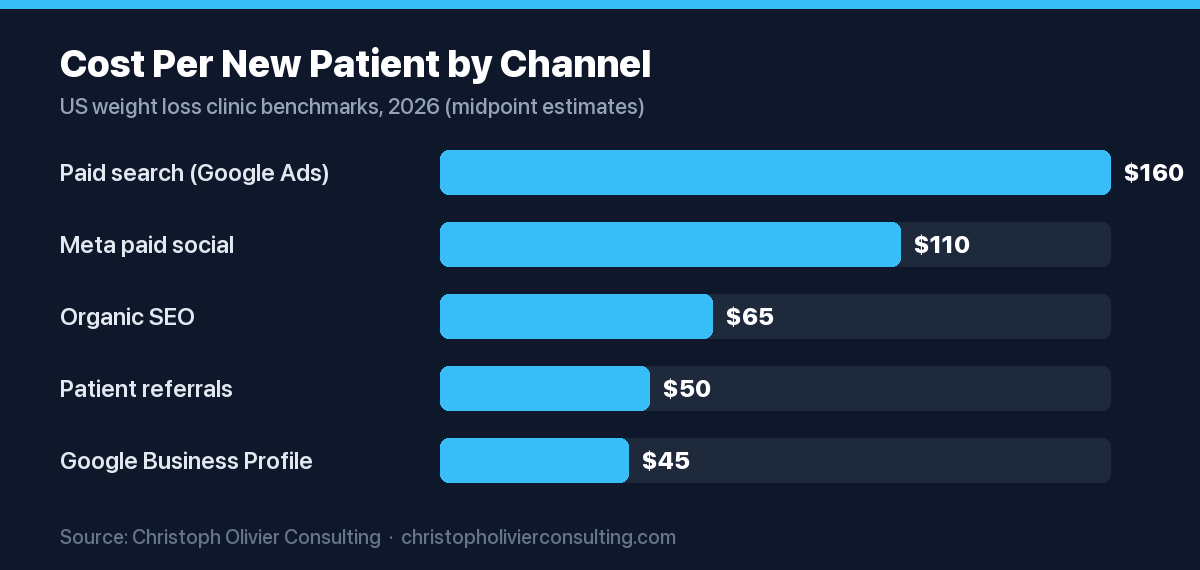
The table below compares the channels most weight loss clinics rely on. Use it to sequence spend, not as a promise of any one result.
| Channel | Typical cost per new patient (2026) | Speed to results | Best use |
|---|---|---|---|
| Paid search (Google Ads) | $120 to $200 | 2 to 4 weeks | High-intent capture, fast starts, competitive markets |
| Meta paid social | $90 to $140 | 2 to 4 weeks | Awareness and retargeting, within strict health-ad rules |
| Organic SEO | $40 to $90 (per lead) | 3 to 6 months | Compounding local demand, lower long-run cost |
| Google Business Profile | $30 to $60 | 4 to 8 weeks | Map-pack visibility and review-driven trust |
| Patient referrals | ~$50 | Ongoing | Highest-converting, lowest-cost, needs a system |
Reported patient lifetime value for GLP-1 programs often ranges from $3,000 to $8,000 across 12 to 24 months of care, which is why a $160 acquisition cost can still be efficient. Model your own numbers before scaling any channel. See how we approach small business lead generation for the underlying method.
Recommended Marketing Budget Split
New practices without historical data can start with a 40/30/20/10 split: 40% to search (SEO plus Google Ads), 30% to referrals and partnerships, 20% to reviews and listings, and 10% to experimental channels such as paid social and direct mail. Most clinics allocate 8% to 12% of gross revenue to marketing overall and adjust as data arrives.
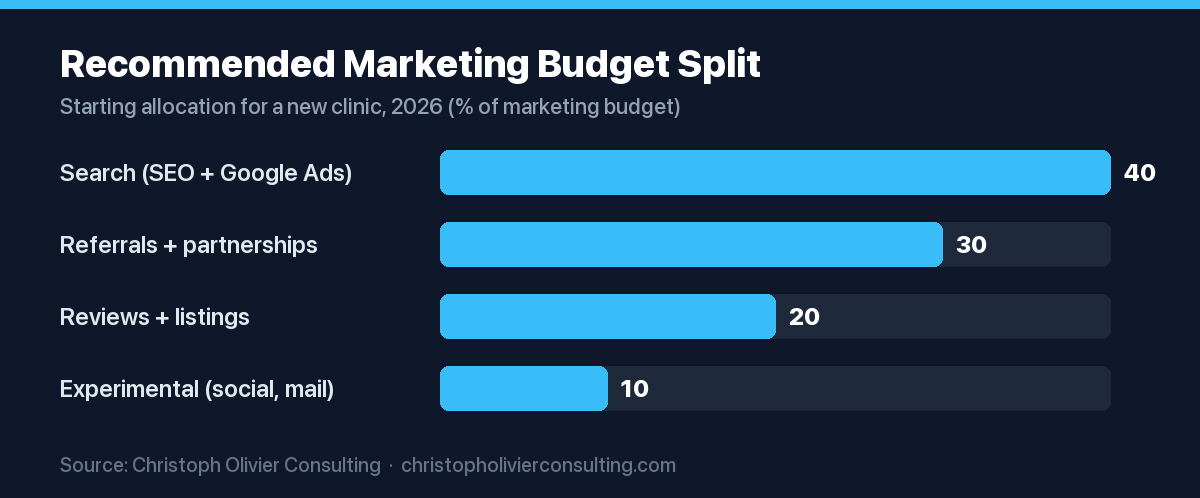
Treat these percentages as a starting hypothesis. Once you can measure cost per booked consultation by channel, shift budget toward what proves out in your market.
Compliant messaging: FTC and Meta rules you cannot ignore
The FTC treats several weight-loss claims as inherently false, so never use them. Its “Gut Check” guidance flags claims that a product or program causes substantial loss without diet or exercise, works no matter what a person eats, guarantees permanent loss after stopping treatment, or works for everyone. Frame outcomes conditionally, disclose typical results, and avoid guaranteed-result language.
Before-and-after imagery and testimonials draw regulatory attention. Cherry-picking best cases, hiding generally expected results, or implying every patient will match a shown outcome can trigger enforcement, so pair any testimonial with clear context and typical-result disclosure.
Meta restricts weight-loss and body-image advertising. Ads may be limited or rejected when they use before-and-after images, imply negative self-perception, or target audiences by sensitive health attributes. Personalized-attribute rules also limit how you can target people who may be interested in weight loss, so build audiences from broad interest and geography rather than assumed health status. State medical boards add their own rules on how GLP-1 medications may be promoted, so confirm requirements in every state you serve. This is general information, not legal advice; have counsel review your creative.
Local SEO for weight loss clinics
Local SEO decides who appears when a patient searches “weight loss clinic near me” or a medication name plus a city. The levers are a complete Google Business Profile, consistent name, address, and phone data across directories, recent reviews, and dedicated location and service pages that answer real clinical questions.
Medication-specific and city-specific landing pages help because patients search by treatment, not by your brand. Each page should describe the program honestly, list what a consultation covers, and use conditional language about eligibility and outcomes.
Building a consultation funnel that books
A consultation funnel turns anonymous search traffic into booked medical visits. The core path is a fast landing page, a short eligibility or interest form, immediate confirmation, and a reminder sequence that reduces no-shows. Speed of follow-up is the single biggest lever on conversion.
Keep intake forms short and compliant, avoid collecting sensitive health detail you do not need yet, and route qualified inquiries to a same-day or next-day human touch. Paid social can support the top of this funnel through social media lead generation when creative stays inside platform health rules.
Reviews, reputation, and patient retention
Reviews and retention protect your acquisition math. A steady flow of recent, authentic reviews lifts map-pack ranking and consultation conversion, while structured retention keeps patients through the 12 to 24 month treatment window that drives lifetime value. Ask for reviews at moments of genuine progress, and never incentivize or script them.
Retention programs such as check-in cadences, refill reminders, and progress reviews reduce churn and lower blended acquisition cost over time. Every retention message still follows the same conditional, non-guaranteeing standard as your ads.
A 90-day weight loss clinic marketing plan
This is a practical sequence for a clinic starting or resetting its marketing. Adjust pacing to your budget and staff capacity, and validate each step with your own numbers before scaling.
- Days 1 to 15: Complete and verify the Google Business Profile, fix name, address, and phone consistency, and publish a compliant core service page.
- Days 16 to 30: Launch high-intent Google Search Ads to core “near me” and medication terms, with conversion tracking on booked consultations.
- Days 31 to 45: Build the consultation funnel: landing page, short intake, confirmation, and a reminder sequence to cut no-shows.
- Days 46 to 60: Stand up a review-request workflow and start publishing medication-specific and location pages for organic SEO.
- Days 61 to 75: Test compliant Meta retargeting, keeping creative free of before-and-after imagery and sensitive-attribute targeting.
- Days 76 to 90: Review cost per booked consultation by channel, then reallocate budget toward what proved efficient.
Want this run for you? See our consulting services.
Frequently asked questions
How much does weight loss clinic marketing cost?
Most clinics spend $1,200 to $3,000 per month on marketing services, or roughly 8% to 12% of gross revenue, depending on market size and whether paid ads run alongside SEO. Cost per new patient in 2026 ranges from about $40 to $90 per organic lead up to $120 to $200 for paid search. Model your own numbers before scaling any single channel.
Can I advertise GLP-1 weight loss treatment on Facebook?
You can, but Meta restricts weight-loss and body-image advertising. Ads that use before-and-after images, imply negative self-perception, or target people by sensitive health attributes may be limited or rejected. Build audiences from broad interest and geography, keep creative conditional, and expect a stricter review. State medical rules on GLP-1 promotion also apply, so have counsel check your creative first.
What weight loss claims does the FTC prohibit?
The FTC treats several claims as inherently false: that a product or program causes substantial loss without diet or exercise, works no matter what someone eats, causes permanent loss after stopping treatment, or works for everyone. Avoid guaranteed-result language entirely, frame outcomes conditionally, and disclose typical results whenever you show a testimonial or progress story.
How long does SEO take for a weight loss clinic?
Organic SEO typically shows meaningful ranking and traffic gains in three to six months, while paid search can produce booked consultations within two to four weeks. Many clinics run both so paid ads deliver early volume while SEO lowers blended acquisition cost over time. Google Business Profile improvements often show in four to eight weeks.
What is the best marketing channel for a medical weight loss clinic?
There is no single best channel; a coordinated mix performs best. Paid search captures high-intent demand fast, local SEO and Google Business Profile build compounding low-cost visibility, and referrals convert at the lowest cost once you have a system. A common starting split is 40% search, 30% referrals, 20% reviews and listings, and 10% experimental channels.
How do I reduce no-shows for weight loss consultations?
Fast follow-up and a reminder sequence are the strongest levers. Confirm the booking immediately, send reminders before the visit, and route qualified inquiries to a same-day or next-day human touch. Keep intake forms short and compliant, and avoid collecting sensitive health detail you do not need before the consultation.
More marketing guides for rank on ai: get cited by ai search
- Average Cost Per Lead by Industry (2026 Benchmarks)
- Cosmetic Dentist Marketing: A Cost-Per-Case Playbook for 2026
- Foundation Repair Marketing: The Cost-Per-Booked-Job Playbook
- Garage Door Company Marketing: The 2026 Channel and Cost Guide
- Hair Restoration Marketing: A 2026 Cost Per Consult Playbook
- Kitchen Remodeling Marketing: A Channel Plan That Books High-Ticket Projects
- Rank on AI: Get Cited by AI Search