
Kitchen remodeling marketing works best when it treats a remodel as a high-ticket decision that takes weeks or months, not a same-day service call. The channels that actually book projects are local search, a strong Houzz and portfolio presence, high-intent paid search, and a consultation funnel that moves a homeowner from saved photos to a signed contract. Cost per qualified lead ranges widely, from roughly $37 on organic search to about $350 on paid social.
Last reviewed: September 2026
What kitchen remodeling marketing costs per lead by channel
Cost per qualified lead for kitchen remodeling in 2026 spans from about $10 to $63 on SEO and Google Business Profile at maturity, up to $250 to $450 on Meta lead ads. Organic search and Local Services Ads deliver the lowest cost per booked project because the intent is higher. Paid social is the most expensive per qualified lead and works better for retargeting than for cold acquisition.
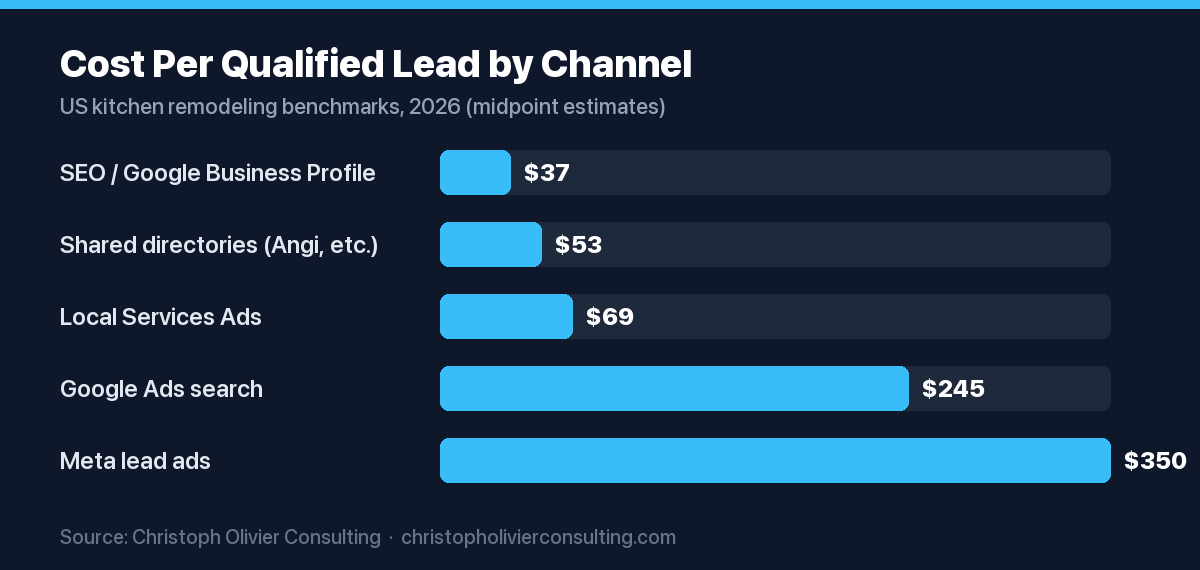
| Channel | Cost per qualified lead | Intent | Notes |
|---|---|---|---|
| SEO and Google Business Profile | $10 to $63 | High | Compounds over time; lowest cost at maturity |
| Local Services Ads | $25 to $112 | High | Google-screened, pay per lead, map-pack placement |
| Shared directories (Angi, Modernize, Thumbtack) | $20 to $85 | Mixed | Leads are often sold to several contractors at once |
| Google Ads search | $90 to $400 | Very high | New campaigns run $120 to $180; scaled ones fall to $70 to $110 |
| Meta lead ads | $250 to $450 | Low to mid | Best for retargeting and warm audiences, not cold reach |
Read cost per booked project, not cost per lead in isolation. An exclusive $110 search lead that closes at 20 percent beats a shared $30 directory lead that closes at 4 percent. See how to connect spend to closed revenue in our guide to small business lead generation.
Why kitchen remodel leads behave differently from other home services
Kitchen remodel leads are high-consideration and high-ticket, so they convert on a longer clock than emergency trades. The median major kitchen remodel runs about $55,000 nationally, with larger kitchens near $75,000 and high-end projects above $100,000. A homeowner spending that much researches for weeks, saves dozens of photos, and interviews several firms before booking a consult.
Two consequences follow. First, the visual transformation is the product, so a portfolio does more selling than a feature list. Second, speed-to-lead still matters, but nurture matters more, because most buyers are comparing three or four firms rather than hiring the first to answer.
The channels that book kitchen remodeling projects
Four channels carry most booked kitchen remodels: local SEO and Google Business Profile, Houzz and portfolio platforms, high-intent paid search with Local Services Ads, and reviews plus referrals. Each plays a distinct role across the long decision cycle, from first inspiration to the final quote comparison.
Local SEO and Google Business Profile
Local SEO captures homeowners searching “kitchen remodeler near me” or “kitchen remodel [city]” at the moment they want a quote. Fully complete your Google Business Profile with categories, service areas, and project photos, then build city and project-type pages on your site. This is the lowest cost per booked job once it matures.
Houzz and a project portfolio
Houzz is where homeowners save inspiration and compare remodelers before reaching out, and for kitchens it matters more than for most trades. A complete Pro profile with photos organized by project type and recent reviews earns saves and inquiries. A Houzz Pro subscription runs about $60 to $150 per month.
Paid search and Local Services Ads
Paid search and Local Services Ads buy visibility for the highest-intent queries while your organic presence builds. Local Services Ads place you in the Google-screened block and charge per lead, while search ads let you bid on “kitchen remodel” project terms. Expect a higher cost per lead than organic, offset by faster volume.
Reviews and referral networks
Reviews and referrals lower acquisition cost because they convert warm prospects at a higher rate. Ask for a Google and Houzz review at project close, and build referral relationships with realtors, interior designers, and past clients. For social proof programs, pair this with social media lead generation.
Build a portfolio-led content and Houzz presence
Portfolio-led content turns visual proof into search and social visibility. Publish full project case studies with before and after photos, the budget band, the scope, and the timeline, then repurpose each one across Houzz, Instagram, and your Google Business Profile. This positioning strategy sits at the center of our approach to SEO for professional services.
Give each project page a clear structure: the homeowner goal, the design solution, the materials, and the outcome. Photos should be professionally shot and consistently styled, because a weak gallery undercuts every other channel you run.
Run the consultation funnel from saved photo to signed contract
The consultation funnel is the sequence that converts a browsing homeowner into a booked in-home or showroom consult, then into a contract. Because the decision is slow and the ticket is large, the funnel needs prompt first contact plus a structured nurture that keeps you present while the buyer compares options.
- Capture the lead with a form that asks for project type, rough budget band, and timeline, so you can qualify before you drive.
- Respond within minutes by text and phone, and confirm the consult with a calendar link.
- Send a pre-consult packet: relevant project photos, a process overview, and a range of budget tiers.
- Run the in-home or showroom consult, then deliver the design and quote on a set date rather than an open one.
- Nurture undecided prospects with monthly project stories and reviews until they are ready to sign.
Track the two ratios that decide profit: lead to booked consult, and consult to signed contract. Improving either lifts return on every channel above.
How to lower your cost per qualified lead
You lower cost per qualified lead by shifting spend toward exclusive, high-intent channels and by tightening qualification before a consult. Add budget and timeline questions to your forms, negative-keyword out repair and rental searches, and move budget from shared directories toward SEO, Local Services Ads, and referrals as those mature.
Then compound the gains. Improve close rate with a repeatable consult process, raise average project value with tiered proposals, and recycle every finished kitchen into new portfolio content. If you want a plan built around your market and margins, review our consulting services.
Frequently asked questions
How much does a kitchen remodeling lead cost in 2026?
Kitchen remodeling leads cost from about $10 to $63 on SEO and Google Business Profile at maturity, $25 to $112 on Local Services Ads, $20 to $85 on shared directories, $90 to $400 on Google Ads search, and $250 to $450 on Meta lead ads. Judge channels by cost per booked project rather than by cost per lead alone.
What is the best marketing channel for kitchen remodelers?
There is no single best channel; the strongest programs combine local SEO and Google Business Profile for low-cost booked jobs, Houzz and a portfolio for visual proof, and Local Services Ads or paid search for fast high-intent volume. Local SEO usually delivers the lowest cost per booked project once it matures, while paid search fills the pipeline sooner.
Is Houzz worth it for kitchen remodeling companies?
For kitchen remodelers, Houzz is often worth the roughly $60 to $150 monthly Pro cost because homeowners use it to save inspiration and compare firms before reaching out. Since the visual transformation is the product, a complete profile with photos organized by project type and recent reviews can generate qualified inquiries that other trades would not see from the platform.
How long is the kitchen remodel sales cycle?
A kitchen remodel is a high-consideration, high-ticket purchase, so the sales cycle commonly runs several weeks to a few months. Homeowners save photos, set a budget, and interview multiple firms before booking a consult. That length is why nurture, prompt follow-up, and a structured consultation process matter as much as the first click or call.
How can a kitchen remodeler lower cost per lead?
Shift budget toward exclusive high-intent channels such as SEO, Local Services Ads, and referrals, and reduce spend on shared directory leads sold to several contractors. Add budget and timeline questions to forms to qualify earlier, use negative keywords to filter repair and rental searches, and raise close rate with a repeatable consult process so each lead produces more revenue.
More marketing guides for rank on ai: get cited by ai search
- Locksmith Marketing: A 2026 Playbook for Booked Jobs and Beating Lead-Gen Spam
- Logo Design Cost in 2026: What You Pay by Source
- Water Damage Restoration Marketing: The 2026 Playbook for More Booked Jobs
- Weight Loss Clinic Marketing: A Compliant Playbook for GLP-1 Growth
- Average Cost Per Lead by Industry (2026 Benchmarks)
- Cosmetic Dentist Marketing: A Cost-Per-Case Playbook for 2026
- Rank on AI: Get Cited by AI Search