
Water damage restoration marketing is won by the company that shows up first in emergency local search, answers the phone in minutes, and carries the review count that makes an anxious homeowner stop shopping. The math is unusual for home services: clicks can run $91 to $251, yet a single booked job often clears $3,800 to $10,500, so the winners are not the biggest spenders but the fastest responders with the deepest local trust.
Last reviewed: September 2026
What water damage restoration marketing actually rewards
Water damage restoration marketing rewards three things: visibility at the exact moment of panic, response speed measured in minutes, and social proof that outweighs the fear of hiring a stranger during a flood. Everything else is secondary. A homeowner with water rising in a basement does not read your blog. They call the first credible name they see.
That urgency changes the economics. Emergency intent means high commercial value per click and per call, so wasted spend hurts fast and won jobs pay back fast. Your job as the marketer is to protect the moment between the search and the booked estimate.
Christoph Olivier works with home service firms on exactly this problem through SEO for professional services, where emergency intent and local ranking decide revenue more than brand awareness ever will.
Why this niche is different from other trades
Water damage restoration sits at the extreme end of home services cost and urgency. Keywords here reach the highest cost per click of any home service category, close rates on a booked estimate run high, and much of the invoice is paid by insurance rather than the homeowner. That mix makes channel choice a financial decision, not a branding one.
Two facts shape every plan. First, average job value is large: Angi puts a typical water damage job near $3,860, mitigation plus rebuild work averages roughly $10,500, and the average insurance claim pays close to $11,098. Second, demand is unplanned and instant, so slow follow up loses the job to the next result on the page.
The channels that book emergency jobs
Five channels do the heavy lifting: Google Business Profile and local organic search, Local Services Ads, paid search, referral and insurance networks, and reviews. Each has a different cost per booked job and a different speed to first revenue, so the right mix depends on how fast you need work and how long you can invest.
The table below sets the table stakes. Read cost per lead against your own close rate to get a true cost per booked job, because a cheap lead with a poor close rate can cost more than an expensive lead that converts.
| Channel | Typical cost per lead | Lead to job close | Cost per booked job | Speed to first revenue |
|---|---|---|---|---|
| Referral and insurance networks | $0 to $100 | High | ~$90 | Weeks to months to build |
| Local SEO and Google Business Profile | $75 to $150 at maturity | Medium to high | ~$180 | 6 to 12 months |
| Local Services Ads | $89 to $315 (median ~$148) | Medium | ~$290 | Days |
| Google Ads paid search | $150 to $676 (CPC $91 to $251) | Medium | ~$700 | Days |
| Shared lead marketplaces | $130 to $2,250 per lead | Low (shared) | ~$1,400 | Immediate |
Sources for these ranges include 99 Calls, PushLeads, Angi, ALM Corp, and NAIC claim data reviewed in September 2026. Treat them as national midpoints, not promises for your ZIP code.
Cost per booked job by channel
Cost per booked job is the only number that compares channels fairly. It folds lead price and close rate into one figure you can rank. On honest 2026 midpoints, referral and organic search deliver the cheapest booked jobs, Local Services Ads and paid search sit in the middle, and shared lead marketplaces cost the most because leads are resold and close rates fall.
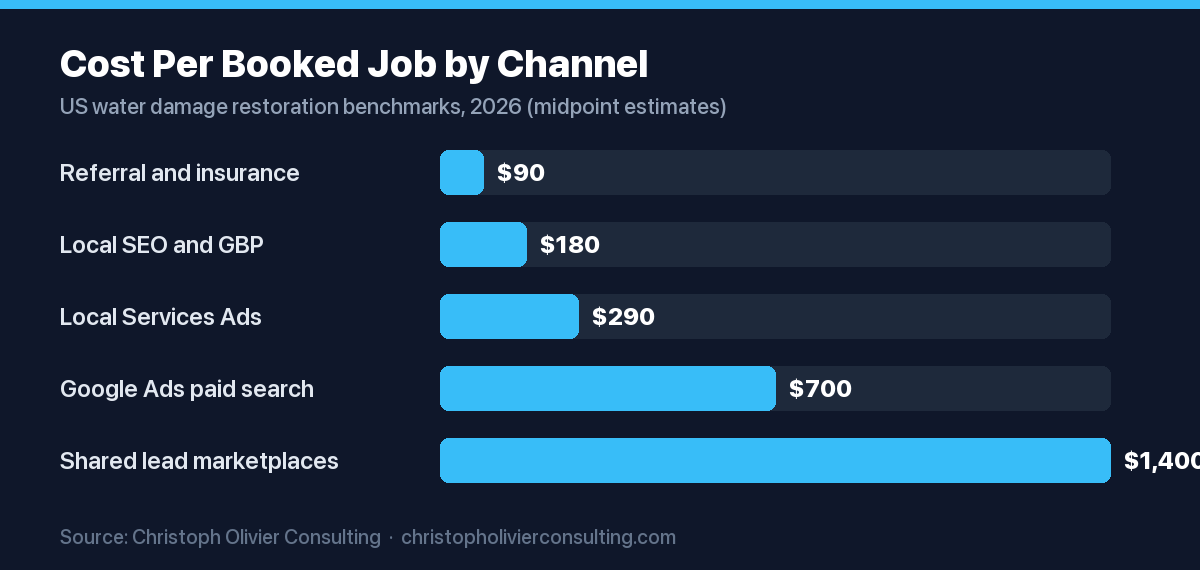
The chart below ranks the five channels by estimated cost per booked job. Use it to sequence your budget: build the cheap durable channels while paying for the fast ones, then shift spend as your organic pipeline matures.
One caution. A $700 booked job from paid search is still profitable against a $3,800 to $10,500 job value, so expensive does not mean unaffordable. It means you must track every channel to actual revenue, not to lead count.
Speed to lead is the intake system that decides who wins
Speed to lead is the single highest impact fix in water damage restoration marketing. A firm that answers in 5 minutes beats one that answers in 30, and headlines that promise a 30 minute response can convert far better than price led messaging. Ad spend only pays back if the phone gets answered and the estimate gets booked.
Build the intake before you scale the ads. The steps below turn more of your paid and organic leads into booked estimates.
- Answer every call live, 24 hours a day, with a trained human, not a machine.
- Return web form and Local Services Ads leads within 5 minutes during working hours and within 15 minutes overnight.
- Lead with response time in every ad and landing page, since speed converts better than a price claim.
- Text the caller a confirmation and a photo of the technician or truck before arrival.
- Book the on site estimate on the first call rather than promising a callback.
- Track speed to first contact for every lead source and coach the slow ones.
Christoph builds these intake systems as part of a wider small business lead generation program, because a faster funnel lowers cost per booked job on every channel at once.
Local search and Google Business Profile
Local organic search is the lowest long term cost per lead in the category, and the map pack captures a large share of near me and 24 hour searches. A complete Google Business Profile with service descriptions, weekly posts, and fresh photos is the highest return work you can do because it earns free calls once you rank.
Build separate pages for burst pipe cleanup, basement flooding, sewage backup, and mold remediation rather than one generic water damage page. Each service page can rank for its own intent and each city page can capture near me demand. This is slow, 6 to 12 months to compound, but it produces the cheapest booked jobs you will ever get.
Local Services Ads and paid search
Local Services Ads and Google paid search buy visibility while your organic rankings grow. Local Services Ads charge per lead, carry the Google Screened badge that emergency callers trust, and in September 2026 average about $148 per charged lead for water damage work, with a range of roughly $89 to $315. They sit at the top of the results and are hard to skip.
Classic paid search costs more per click, from $91 to over $250 in premium metros, so reserve it for high intent terms and tight geographies where the map pack is already locked up by established firms. Pair every campaign with a fast intake, or the high click price simply funds missed calls.
Referral and insurance networks
Referral and insurance networks produce the cheapest booked jobs once they exist, often near $90 per job, because a plumber, adjuster, or property manager who trusts you sends work at little to no acquisition cost. The trade off is time, since these relationships take weeks to months to build and depend on reliable field performance.
Target three referrer types: insurance adjusters who assign mitigation work, plumbers who find the water first, and property managers who own recurring risk. A simple quarterly touch plan and fast, clean jobsites keep the referrals flowing.
Reviews and reputation
Reviews are the trust layer that makes every other channel convert. A homeowner choosing between two map pack results during a flood picks the one with more recent, higher rated reviews, so a steady review flow lifts click through and close rate at the same time. Reviews are earned marketing that costs nothing but process.
Ask for a review at job completion by text, respond to every review including the critical ones, and keep the count growing month over month. Pair this with social proof content and short before and after videos shared through social media lead generation to reinforce credibility with people not yet searching.
A 90 day plan to book more jobs
A focused 90 day plan fixes intake first, then buys fast visibility, then builds the durable channels that lower cost per booked job over time. Sequence matters, because paid traffic wasted on a slow phone is money set on fire.
- Weeks 1 to 2: fix intake. Staff 24 hour live answering, set a 5 minute response rule, and add response time to your headlines.
- Weeks 2 to 4: complete the Google Business Profile, publish weekly posts and photos, and turn on Local Services Ads with call tracking.
- Weeks 4 to 8: build service specific and city pages, launch a review request text after every job, and start paid search on your top three high intent terms.
- Weeks 8 to 12: open referral outreach to plumbers, adjusters, and property managers, and review cost per booked job by channel to reallocate budget.
For firms that want this run end to end, Christoph Olivier offers fractional marketing leadership through his consulting services and broader SEO for professional services practice.
Frequently asked questions
How much does it cost to market a water damage restoration business?
Cost per lead ranges widely by channel in 2026. Referrals run $0 to $100, mature local SEO $75 to $150, Local Services Ads about $148 median, and Google paid search $150 to $676 with clicks from $91 to $251. Judge each channel by cost per booked job against a job value of $3,800 to $10,500, not by lead price alone.
What is the best marketing channel for water damage restoration?
There is no single best channel, only a best sequence. Referral networks and local SEO deliver the cheapest booked jobs but take months to build, so pay for Local Services Ads and paid search for immediate work while your organic pipeline matures. Run the fast paid channels and the slow durable ones at the same time for the lowest blended cost per job.
Why are water damage keywords so expensive on Google Ads?
Water damage restoration carries the highest cost per click in home services, from $91 to over $250 in premium metros, because intent is urgent, jobs are high value, and much of the invoice is paid by insurance. Advertisers bid hard for a click that can turn into a job worth thousands, which pushes prices up in competitive markets.
How fast should I respond to water damage leads?
Respond within 5 minutes during working hours and within 15 minutes overnight. Firms that answer in 5 minutes beat those that take 30, and ads that promise a 30 minute response can convert far better than price focused headlines. Slow follow up sends the job to the next company on the results page, so intake speed protects your entire ad budget.
Do Local Services Ads work for restoration companies?
Yes. Local Services Ads sit above search results, charge per lead rather than per click, and carry the Google Screened badge that emergency callers trust. In September 2026 they average about $148 per charged lead for water damage work, with a range near $89 to $315. Pair them with a fast intake so paid leads become booked estimates.
How long does SEO take for a water damage restoration company?
Plan on 6 to 12 months for local SEO to compound into steady booked jobs. Build the Google Business Profile, publish service specific and city pages, and grow reviews month over month. It is the slowest channel to start but delivers the lowest long term cost per lead, which is why you run paid ads alongside it in the meantime.
More marketing guides for rank on ai: get cited by ai search
- Weight Loss Clinic Marketing: A Compliant Playbook for GLP-1 Growth
- Average Cost Per Lead by Industry (2026 Benchmarks)
- Cosmetic Dentist Marketing: A Cost-Per-Case Playbook for 2026
- Foundation Repair Marketing: The Cost-Per-Booked-Job Playbook
- Garage Door Company Marketing: The 2026 Channel and Cost Guide
- Hair Restoration Marketing: A 2026 Cost Per Consult Playbook
- Rank on AI: Get Cited by AI Search