

Cosmetic dentistry cost per lead on Google search runs from about $73 to $213 in 2026 data. LocaliQ’s 2026 Search Advertising Benchmarks put the average dental lead at $72.97 on an $8.00 click, and Delmain’s account data puts cosmetic leads at $119.62 and Invisalign leads at $212.63. Whether that is cheap or expensive depends on the case: six porcelain veneers average about $10,590 in fees, a single implant about $2,695. Below are the sourced numbers, the cost-per-case math for each procedure, the SEO build that ranks for “veneers near me” searches, and the advertising rules that catch cosmetic practices out.
Want a specialist to build this for your business? See how CO Consulting’s marketing services work, starting with a diagnostic and audit.
Cosmetic dentistry cost per lead and advertising cost: the 2026 numbers
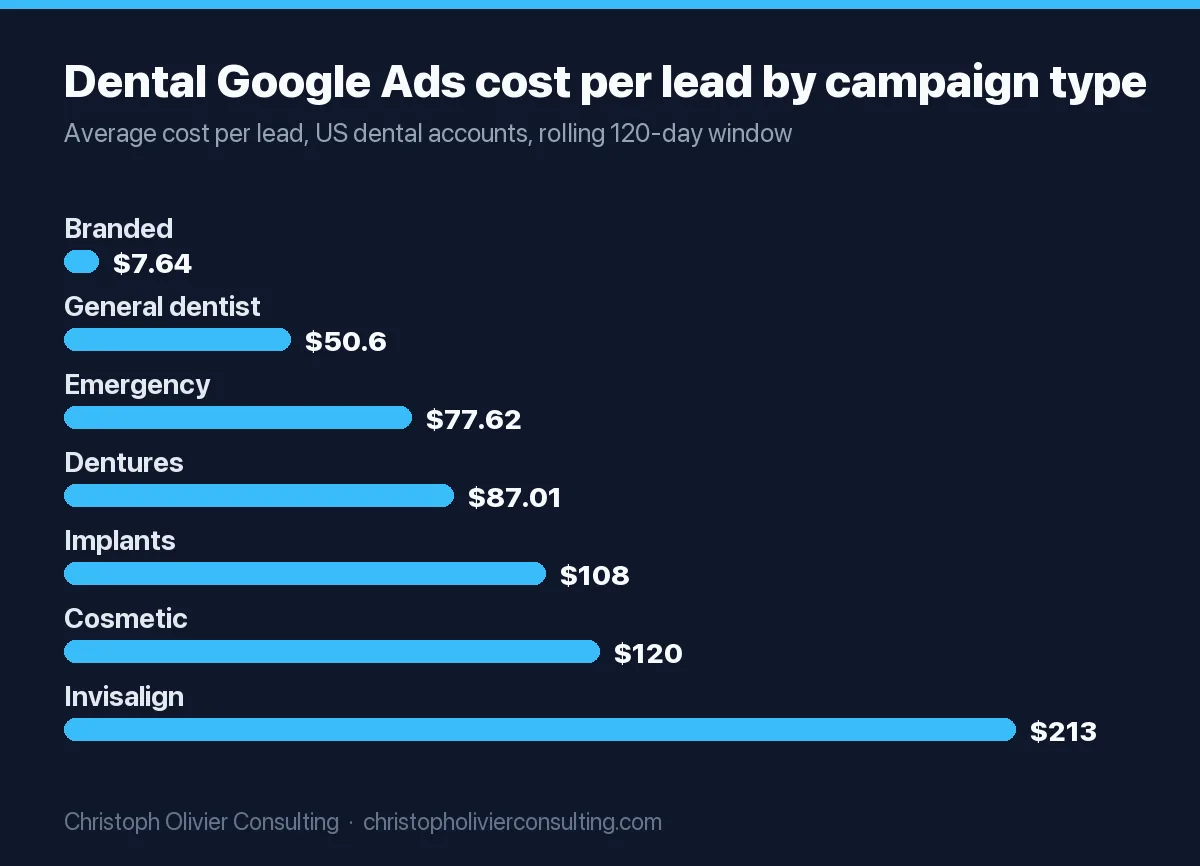
Two public datasets are worth using. LocaliQ publishes an annual benchmark across its search clients, updated June 1, 2026, with a “Dentists & Dental Services” category. Delmain, a dental marketing agency, published campaign-level numbers by treatment type from a rolling 120-day window of its US dental accounts. Neither is cosmetic-only across the board, so read them together.
| Source and segment | Avg. cost per click | Lead conversion rate | Avg. cost per lead |
|---|---|---|---|
| LocaliQ 2026: Dentists & Dental Services | $8.00 | 10.67% | $72.97 |
| LocaliQ 2026: all industries | $5.42 | 8.18% | $66.69 |
| Delmain: branded searches | $2.71 | 29.9% | $7.64 |
| Delmain: general dentist | $5.88 | 11.9% | $50.60 |
| Delmain: implants | $8.26 | 6.3% | $107.63 |
| Delmain: cosmetic | $6.90 | 4.5% | $119.62 |
| Delmain: Invisalign | $4.57 | 3.5% | $212.63 |
Caveats you should know before quoting these. LocaliQ’s dental category blends general, emergency and cosmetic advertisers. Delmain’s cosmetic row comes from 13 campaigns and its Invisalign row from 12, and Delmain itself calls that data directional. Its cost-per-lead figures also do not exactly equal cost per click divided by conversion rate, and the post does not explain why.
Three things the numbers say clearly:
- Cosmetic leads cost more because fewer clickers convert, not because clicks are pricier. A cosmetic click ($6.90) is cheaper than an implant click ($8.26), but only 4.5% of cosmetic clickers became leads versus 11.9% on general-dentist campaigns. That makes a cosmetic lead about 2.4 times the cost of a general-dentist lead.
- Invisalign is the most expensive lead in the set, about 4.2 times a general-dentist lead, on the cheapest clicks. Aligner shoppers compare a lot of offers before they fill in a form.
- Branded search is nearly free at $7.64 a lead. Keep a small brand campaign running so competitors bidding on your name do not take those patients.
At the category level, LocaliQ’s dental cost per lead is only about 9% above its all-industry average; the gap opens up inside dental, by procedure. Our average cost per lead by industry benchmarks put dental next to the other verticals.
How much does cosmetic dentistry marketing cost per month?
A cosmetic practice running SEO plus paid search typically pays three things: an SEO or website retainer, ad spend, and ad management. Very few dental agencies publish prices. One that does is Redefine Web, whose dental SEO pricing page (May 8, 2026) lists four tiers for a single location.
| Line item | Published price or range | Source |
|---|---|---|
| Dental SEO, entry tier (“Visibility”) | $999 per month | Redefine Web |
| Dental SEO, mid tier (“Traffic”) | $1,499 per month | Redefine Web |
| Dental SEO, upper tier (“Scale”) | $2,499 per month | Redefine Web |
| Multi-location or DSO (“Enterprise”) | From $4,500 per month | Redefine Web |
| Ongoing dental SEO, market range | $750 to $5,000 per month | DesignRush, combining two cited ranges |
| Hourly SEO rate (all industries) | About $106 per hour | DesignRush, average of its top 50 SEO agencies |
Worked example: a budget for 4 new veneer cases a month
Start from the number of cases you want, not from a percentage of revenue. Assume your own tracking shows 15% of paid leads become accepted cases (for example, half book a consult and 30% of consults accept treatment). Replace that with your real rate.
- Leads needed: 4 cases divided by 0.15 equals about 27 leads.
- Ad spend at Delmain’s cosmetic cost per lead: 27 times $119.62 equals $3,229.74 per month.
- Add an SEO retainer at the $1,499 tier: about $4,729 per month before any ad management fee.
- Revenue at stake: 4 cases of six veneers at the $1,765 per-tooth average is $42,360 in fees.
On those assumptions, marketing is about 11% of the veneer fees it produces. If your close rate is 10% instead of 15%, ad spend rises to about $4,785 for the same four cases, which is why intake and consult skills matter as much as the ads.
Cost per case for veneers, Invisalign and implants
Fee figures below come from the Synchrony Average Procedural Cost Studies (2023 and 2024, conducted by ASQ360 Market Research for CareCredit across all 50 states and DC). They are national averages; your fees and your market will differ. Cost per lead is Delmain’s treatment-level figure. The 15% lead-to-case rate is the same illustrative assumption as above.
| Case | Average fee | Cost per lead | Cost per case at 15% close | Marketing as % of fee | Close rate needed to stay under 10% of fee |
|---|---|---|---|---|---|
| Porcelain veneers, 6 teeth ($1,765 per tooth, 2023 study) | $10,590 | $119.62 (cosmetic) | $797.47 | 7.5% | 11.3% |
| Clear aligners ($5,108, 2023 study) | $5,108 | $212.63 (Invisalign) | $1,417.53 | 27.8% | 41.6% |
| Single implant ($2,695 per tooth, 2023 study) | $2,695 | $107.63 (implants) | $717.53 | 26.6% | 39.9% |
| Teeth whitening ($583, 2024 study) | $583 | $119.62 (cosmetic) | $797.47 | 136.8% | Not reachable |
How to read it:
- Veneers are where paid search pays. A multi-tooth case absorbs a high cost per lead with room to spare.
- Aligners and single implants only work with strong closing or follow-on value. You need roughly a 40% lead-to-case rate to keep acquisition under 10% of the fee, or you need to count multi-unit implant cases and future hygiene visits. Orthodontists face the same aligner math with different rules; our orthodontist marketing playbook works it out per start.
- Do not buy whitening leads on their own. Use whitening as a page and an add-on offer, and let SEO and existing patients carry it.
The formula to run with your own numbers: maximum cost per lead equals case fee, times the share of the fee you will spend to acquire it, times your lead-to-case rate. For veneers: $10,590 times 10% times 15% equals $158.85. Any cosmetic campaign that delivers leads under that number is profitable on those terms.
SEO for cosmetic dentists: the pages that rank for procedure searches
Cosmetic patients search by procedure and city (“veneers Austin”, “dental implants cost near me”), so the ranking unit is one strong page per procedure plus a Google Business Profile that matches. Generic “cosmetic dentistry” pages that list six services in one scroll rarely rank for any of them.
Google Business Profile: pick the primary category deliberately
Whitespark’s 2020 Local Search Ranking Factors study, as cited by Sterling Sky, ranked primary category as the top map pack factor. Sterling Sky, a local SEO agency, reports moving a New York City practice’s primary category from Cosmetic Dentist to Dentist; the listing ranked better for “dentist” and kept its “cosmetic dentist” rankings. Its general advice is Dentist as primary in most cases, with Cosmetic Dentist as one of the nine secondary slots. If more than half your production is cosmetic, test the reverse and watch rankings for 4 to 6 weeks before deciding.
One page per procedure, built like this
| Page | Queries it should own | Must include | Compliance trap |
|---|---|---|---|
| Porcelain veneers | veneers [city], veneers cost [city], porcelain vs composite veneers | Your fee per tooth or a range, number of visits, prep vs minimal-prep, a labeled gallery, who is not a candidate | “Permanent perfect smile” style promises (see Texas 108.57 below) |
| Dental implants | dental implants [city], implant cost, All-on-4 [city] | Single vs full-arch fees, CBCT and surgery steps, healing timeline, who places the implant | Implant ads are surgical, which limits ad targeting (see Google Ads below) |
| Clear aligners or Invisalign | Invisalign [city], Invisalign cost, aligners vs braces | Fee range, monitoring schedule, refinements policy, retainer cost | Implying orthodontic specialist status as a general dentist |
| Teeth whitening | teeth whitening [city], in-office vs take-home | Both options with prices, sensitivity notes, how long results last | “Guaranteed shades whiter” claims |
| Smile makeover | smile makeover cost, smile makeover [city] | Real combinations with fees, for example the Synchrony study’s veneers plus gum contouring (full mouth) at $4,250 | Galleries without the procedures listed |
| Bonding and contouring | dental bonding cost, chipped tooth repair | Per-tooth price (study average $431 for bonding), lifespan, when to choose veneers instead | Comparative “best in town” claims without substantiation |
Three build details most cosmetic sites miss:
- Put the price on the page. A cosmetic patient comparing three practices clicks the one that answers “how much.” In California, follow the exact-price rule below.
- Mark up the practice as a schema.org Dentist, a type that inherits from LocalBusiness and MedicalBusiness, with the same name, address and phone as your Business Profile.
- Write a dentist bio that states training accurately and, for a general dentist, says so. That is both an E-E-A-T signal and an ethics requirement, covered below.
Keep hygiene recall and new-patient specials off the cosmetic pages so each page targets one intent; those belong to the general side of the practice that our dental marketing guide covers.
Before and after photos and testimonials: the rules in three states
Galleries do much of the selling on a cosmetic site, and they are the most regulated part of it. The ADA Code of Professional Conduct (advisory opinions revised to October 2025), Section 5.F, says no dentist may advertise “in a manner that is false or misleading in any material respect,” and 5.F.2 lists statements “likely to create an unjustified expectation about results.” State law adds specifics. Confirm your own state with its dental board before publishing.
| Rule | California (B&P Code 651) | Texas (22 TAC 108.57) | Florida (Rule 64B5-4.002) |
|---|---|---|---|
| Before and after images | Must state in a prominent location, in readable type, what procedures were performed; views must be comparable so poses and lighting do not distort results; must state the same results may not occur for all patients | Only actual patients of record; written patient consent first; ad must say “Actual results may vary.” | No image-specific rule in the text; general ban on ads likely to create false, unjustified expectations of favorable results |
| Models | Using a model without clearly stating it is a model violates 651(a) | Photos must be of actual patients of record | Not addressed |
| Testimonials | Banned if misleading by omitting material facts | Banned from anyone who is not a patient of record, or without disclosing the person’s identity and credentials | Not addressed in this rule |
| Guarantees and prices | Price ads must be exact; no “as low as,” “and up” or “lowest prices” | No guarantee of future satisfaction; a refund-if-unsatisfied offer is allowed | Ad must name the Florida-licensed dentist who takes responsibility for it; “sleep dentistry” only with a general anesthesia permit |
Sources: California B&P Code 651(b)(3), (b)(8) and (c); 22 Tex. Admin. Code 108.57(c)(7), (c)(8) and (d); Fla. Admin. Code 64B5-4.002(2), (3)(d) and (7).
Federal privacy applies everywhere. Under HIPAA, “full face photographic images and any comparable images” are listed identifiers (45 CFR 164.514(b)(2)(i)(Q)), and using protected health information for marketing requires the patient’s written authorization (45 CFR 164.508(a)(3)). Get a signed marketing authorization for every gallery case, separate from the treatment consent.
Gallery caption template that meets the strictest of the three
Patient of Dr. [Full Name], General Dentist. Procedures performed: [8 porcelain veneers, upper arch; in-office whitening]. Before and after photos taken with the same camera, lighting and position, unretouched. Actual results may vary; the same results may not occur for all patients. Shared with the patient’s written authorization.
Can you advertise as a cosmetic dentistry specialist?
Generally no. Cosmetic dentistry is not one of the 12 specialties recognized by the National Commission on Recognition of Dental Specialties and Certifying Boards: dental anesthesiology, dental public health, endodontics, oral and maxillofacial pathology, oral and maxillofacial radiology, oral and maxillofacial surgery, oral medicine, orofacial pain, orthodontics and dentofacial orthopedics, pediatric dentistry, periodontics and prosthodontics.
What the rules let you say instead:
- ADA 5.I: general dentists may announce the services they offer, must avoid anything that expresses or implies specialization, and must state the services are provided by general dentists.
- ADA 5.I.1: a general dentist may only announce being “certified,” a “diplomate” or similar in a non-specialty area if the credential required a full-time program of at least 12 months plus a psychometric oral and written exam, the dentist discloses being a general dentist, and the ad states that the area “is not recognized as a specialty area” by the National Commission or the state.
- Texas 108.54 and 108.55: “specialist” language is limited to the same 12 areas, and a general dentist advertising specialty services must put “General Dentist” or “General Dentistry” directly after the dentist’s name, in a font no smaller than the largest font used for the services (108.55, 108.54).
| Risky headline | Safer rewrite |
|---|---|
| Austin’s Cosmetic Dentistry Specialist | Dr. Jane Doe, General Dentist. Porcelain veneers, implants and whitening in Austin |
| Board-certified cosmetic dentist | Name the credential, add “general dentist” and the not-a-recognized-specialty sentence, or leave it in the bio only |
| The best veneers in Dallas | Veneers in Dallas: fees, visits and real patient results |
Google Ads for cosmetic dentists: structure and policy
Run cosmetic search as separate campaigns per procedure (veneers, implants, aligners) with their own budgets, so a cheap whitening click never eats the veneer budget. Then check two policy limits before you plan audiences.
- Health targeting limits. Google’s health in personalized advertising policy covers “invasive medical procedures, including cosmetic surgery, surgical procedures, or injections.” Campaigns in sensitive categories cannot use advertiser-curated audiences: Customer Match, your data segments (remarketing), audience expansion and lookalikes are listed as not supported in Google’s personalized advertising policy. Implant surgery fits that wording; Google does not name dental procedures, so treat veneer and whitening campaigns as possibly flagged and plan on keyword, location and predefined Google audiences.
- Your ad copy still answers to your state. Google approval does not make “as low as $899 per tooth” legal in California.
Settings I would use on day one, as opinion rather than a benchmark: phrase and exact match on procedure-plus-city terms, a negative list that includes cheap, free, jobs, school, course, kit, DIY and insurance-only terms, call tracking on every ad, and one landing page per procedure built on the patterns in our lead generation landing pages guide. Judge each campaign by cost per accepted case from your practice software, never by cost per form fill.
Financing ads: CareCredit offers and Truth in Lending triggers
Financing lines sell cosmetic cases, and they are regulated ad copy. CareCredit’s standard promotion is “No interest if paid in full within 6, 12, 18 or 24 months” on purchases of $200 or more, and it is a deferred interest offer; CareCredit lists a 32.99% purchase APR for new accounts opened as of May 30, 2024 (CareCredit). Regulation Z sets what each phrase triggers.
| Ad copy | What it triggers | What the ad must add |
|---|---|---|
| “Veneers from $199 a month” (in-house or installment plan) | Amount of a payment, 12 CFR 1026.24(d)(1)(iii) | Down payment, repayment terms over the full term, and the APR using that term |
| “Pay over 24 months” | Number of payments or repayment period, 1026.24(d)(1)(ii) | Same three disclosures |
| “No interest for 12 months with CareCredit” | Deferred interest offer, 12 CFR 1026.16(h) | “If paid in full” before the period, in immediate proximity to each “no interest” claim, plus a nearby statement that interest is charged from the purchase date if the balance is not paid in full in time |
| “0% financing” on a credit card plan | Open-end triggering term, 1026.16(b); the official commentary treats negative terms like “no interest” as triggers | Finance charges that could apply, the APR, whether it is variable, and any membership fee |
| “Financing available. We accept CareCredit.” | None of the listed triggering terms | Nothing extra under these sections |
Practical rule: put the general line in ads and on service pages, and keep payment amounts and promotional terms on one financing page that carries the full disclosures. Ask your financing provider for its approved advertising language before you write your own.
Reviews and testimonials without breaking Google or FTC rules
The FTC and Google set different bars, and Google’s is stricter. The FTC’s Consumer Reviews and Testimonials Rule (16 CFR Part 465, effective October 21, 2024) bans fake reviews, incentives conditioned on positive sentiment, undisclosed insider reviews and review suppression, but allows neutral incentives. Google’s prohibited content policy bans incentives of any kind, “such as payment, discounts, free goods and/or services,” and bans selectively soliciting positive reviews. So no whitening touch-up in exchange for a Google review, and no sending only happy veneer patients the link. Ask every patient at the same step, for example at the seat-and-reveal appointment, with a text link. Our guide to getting more Google reviews has the request scripts. When you reply, never confirm someone was a patient or mention treatment.
Hiring a cosmetic dentistry lead generation agency: five questions to ask
- How do you charge? Retainer plus ad spend is standard. Be careful with pay-per-patient models: the ADA Code (5.F.4) says a dentist “is generally not permitted to make payments to another person or entity for the referral of a patient,” and treats certain commercial referral services as fee splitting.
- Do I own the ad account, the website and the call tracking numbers? If not, your history leaves with the agency.
- Will you report cost per accepted case by procedure? An agency that reports only leads and clicks cannot tell you whether aligner spend is profitable.
- Who checks copy against my state’s rules? Ask for the process for galleries, financing lines and “specialist” language.
- What happens to my Google Business Profile if we part ways? You, not the agency, should be the primary owner.
A 90-day plan for a cosmetic practice
| Window | Work | Done when |
|---|---|---|
| Days 1 to 15 | Set up call tracking and a lead sheet that records procedure, consult booked, case accepted and fee. Pull your real lead-to-case rate for the last 90 days. | Every lead has a source and a procedure tag |
| Days 1 to 30 | Compliance pass: dentist bio states “General Dentist” where required, gallery captions updated, financing lines moved to one disclosed page, signed marketing authorizations on file. | No page uses “specialist” or “as low as” language your state restricts |
| Days 15 to 45 | Build or rebuild the veneer and implant pages first (highest fees), then aligners and whitening. Set GBP categories, services and photos to match. | Each page shows a price, a labeled gallery and one booking action |
| Days 30 to 60 | Launch separate veneer and implant search campaigns plus a brand campaign. Set your maximum cost per lead from the formula above. | Campaigns run inside your maximum cost per lead for two straight weeks |
| Days 45 to 90 | Same-step review requests to every patient. Weekly speed-to-lead check on calls and forms. | Review count rising every week; every web lead called back the same business day |
| Day 90 | Compare cost per accepted case by procedure. Cut or fix the worst campaign, add budget to the best. | A budget decision based on cases, not clicks |
If you want a second set of eyes on your cost-per-case numbers before you raise spend, you can book a consultation.
Work with CO Consulting
Want this done for your business?
- A diagnostic call and an audit of your current marketing and numbers
- A prioritized 90-day plan built for your market
- Execution across SEO and AI search, paid ads, content, funnels and automation
- Weekly check-ins and monthly reporting, led by a fractional CMO
Frequently asked questions
What is a good cosmetic dentistry cost per lead?
On Google search, LocaliQ's 2026 benchmarks put the average dental lead at $72.97, and Delmain's account data shows cosmetic leads at $119.62, implant leads at $107.63 and Invisalign leads at $212.63. A good number is one below your own maximum: case fee, times the share you will spend to acquire it, times your lead-to-case rate. For six veneers at 10% and a 15% close rate, that is $158.85.
How much does cosmetic dentistry advertising cost per click?
LocaliQ's 2026 Search Advertising Benchmarks list an $8.00 average cost per click for dentists and dental services, against $5.42 across all industries. Delmain's treatment-level data shows $6.90 for cosmetic campaigns, $8.26 for implants and $4.57 for Invisalign. Clicks are not the main cost driver: cosmetic clicks convert to leads at only 4.5%, which is what pushes cost per lead up.
How much does cosmetic dentistry marketing cost per month?
Plan for an SEO retainer plus ad spend plus management. Redefine Web publishes dental SEO tiers of $999, $1,499 and $2,499 a month for one location, and DesignRush cites a $750 to $5,000 market range. Ad spend should come from your case goal: four veneer cases at a 15% close rate and a $119.62 cost per lead need about $3,230 a month.
How do you do SEO for cosmetic dentists?
Build one page per procedure (veneers, implants, aligners, whitening, smile makeover, bonding), each with your fee or fee range, the visit timeline, a gallery that lists the procedures performed and who is not a candidate. Match your Google Business Profile categories and services to those pages, mark up the practice as a schema.org Dentist, and follow your state's before and after and specialty-claim rules.
Can a dentist advertise as a cosmetic dentistry specialist?
Generally no. Cosmetic dentistry is not one of the 12 specialties recognized by the National Commission on Recognition of Dental Specialties and Certifying Boards. The ADA Code says general dentists may announce cosmetic services but must not imply specialization and must state they are general dentists. Texas requires the words General Dentist directly after the name in ads for specialty services.
Do financing offers like CareCredit need disclosures in dental ads?
Yes, when the ad states certain terms. Under Regulation Z, a payment amount or repayment period triggers disclosure of the down payment, repayment terms and APR. A deferred interest line such as no interest if paid in full within 12 months must show the period and the words if paid in full next to each claim. A plain we accept CareCredit line triggers nothing extra.
More Growth, Strategy & Sales guides
- Foundation Repair Marketing: The Cost-Per-Booked-Job Playbook
- Garage Door Company Marketing: The 2026 Channel and Cost Guide
- Hair Restoration Marketing: A 2026 Cost Per Consult Playbook
- Kitchen Remodeling Marketing: A Channel Plan That Books High-Ticket Projects
- Locksmith Marketing: A 2026 Playbook for Booked Jobs and Beating Lead-Gen Spam
- Logo Design Cost in 2026: What You Pay by Source
- Dermatology Marketing Strategies by Service Line for 2026
- All Growth, Strategy & Sales guides →