

Marketing decides who the business serves, what it sells to them, at what price, through which channels, and how buyers hear about it and get persuaded to buy. US marketing education breaks that work into 7 core functions of marketing: channel management, marketing-information management, market planning, pricing, product/service management, promotion and selling. Below is where that list comes from, what each function looks like inside a 7-figure service business, the weekly tasks a small team runs, the org chart by stage with BLS pay, and a scorecard that shows which functions your firm is neglecting.
The 7 core functions of marketing, and who defines them
The list comes from MBA Research, the consortium of member states that writes business and marketing standards and course guides for US high school career and technical education (CTE) programs. Its Marketing Principles course guide organizes the course into Marketing Basics plus seven function units: Market Planning, Product/Service Management, Channel Management, Pricing, Promotion, Marketing-Information Management and Selling. State standards copy the same seven. Utah’s Marketing 1 strands and standards and Oklahoma CareerTech’s Marketing I badge both describe the course as exploring “the seven core functions of marketing” and list them with a one-line purpose each.
- Channel management: how the product or service reaches the final user.
- Marketing-information management: gathering and using market research and customer data.
- Market planning: choosing the target market and the strategy to reach it.
- Pricing: setting prices that maximize profit and support perceived value.
- Product/service management: deciding what to offer, improving it and retiring what no longer earns its place. Oklahoma’s wording is “why products live and die”.
- Promotion: informing buyers about the offer (advertising, content, PR, email, social).
- Selling: convincing a specific customer that the offer is the best choice.
Why other sites list “financing” and “distribution” instead
If you searched “7 marketing core functions” you probably saw a second version. ClickUp’s article, for example, lists promotion, selling, product or service management, marketing information management, pricing, financing and distribution, and Marketer Milk’s uses the same seven under slightly different names. Neither cites where the list comes from. The current MBA Research framework has no financing unit and calls distribution “channel management”, while it adds market planning. If you are studying for a CTE or DECA style exam, use the MBA Research names. If you are running a business, the difference matters less than whether each job has an owner.
| MBA Research name (current) | Name in the older web list | Plain question it answers | Closest of the 4 Ps |
|---|---|---|---|
| Channel management | Distribution | How does the buyer get access to us? | Place |
| Marketing-information management | Marketing information management | What do we know, and is it true? | None (feeds all four) |
| Market planning | Not in the list | Who exactly are we for, and what is the plan? | None (sets all four) |
| Pricing | Pricing | What do we charge, and how is it packaged? | Price |
| Product/service management | Product/service management | What do we sell, add or drop? | Product |
| Promotion | Promotion | How do buyers hear about us? | Promotion |
| Selling | Selling | How does one buyer get to yes? | Promotion (personal selling) |
| Not in the current list | Financing | Can the buyer afford it, and can we fund the plan? | Price |
The functions are a finer cut of the marketing mix. Our guide to the 4 Ps of marketing covers the mix itself; the seven functions add the two jobs the 4 Ps leave implicit, research and planning.
What does marketing do? The AMA’s definition, word for word
The American Marketing Association publishes the reference definition on its Definitions of Marketing page:
“Marketing is the activity, set of institutions, and processes for creating, communicating, delivering, and exchanging offerings that have value for customers, clients, partners, and society at large.”
The AMA says its definitions are “reviewed and reapproved/modified regularly by a panel of five scholars who are active researchers”, and the panel listed on that page is its 2017 panel (the companion marketing research definition on the same page is marked “Approved 2017”). Read the four verbs as a job description and they map straight onto the seven functions:
| Verb in the AMA definition | Functions that do it | What it means in a service firm |
|---|---|---|
| Creating | Market planning, product/service management, marketing-information management | Deciding which clients to serve and designing the service lines and packages they will buy |
| Communicating | Promotion | Website, search, content, ads, email, events, PR, referral partner updates |
| Delivering | Channel management | How a prospect reaches you and how the service is delivered: referral partners, booking, intake, office or virtual |
| Exchanging | Pricing, selling | Fee structure, proposals, the consult call and the signed engagement letter |
What marketing is expected to do has shifted from era to era; our history of marketing timeline traces those eras with dates.
The 7 functions inside a 7-figure service business
Textbook definitions stop at “what”. This table shows the “what does it look like on Monday” version for an illustrative firm: a 14-person engineering or accounting practice billing about $3M a year, with one in-house marketer and outside help. One row per function: the work, the weekly tasks, the one number that tells you it is working, and the tool category that carries it.
| Function | What it looks like at a $3M service firm | Weekly tasks | Metric to watch | Tool category (examples) |
|---|---|---|---|---|
| 1. Channel management | Referral partners (banks, attorneys, architects), Google Business Profile, online booking, intake line, virtual meetings | Log referrals by source; one partner touch (lunch, update, co-hosted webinar); check that every inquiry got a reply the same business day | Inquiries by source, and referral partners who sent at least one lead this quarter | CRM with source fields (HubSpot, Salesforce), scheduling (Calendly), call tracking (CallRail) |
| 2. Marketing-information management | CRM hygiene, lead source tracking, search data, win/loss notes, client feedback | Update the pipeline report; review Search Console queries; tag every closed or lost deal with a reason | Share of new clients with a known source (aim for every one) | Analytics (GA4, Google Search Console), CRM reports, survey tools |
| 3. Market planning | Picking two or three target segments (for example, owner-managed manufacturers in two states) and an annual plan with a budget | Check spend and leads against the plan; move one task forward on the quarterly plan | Revenue from target segments as a share of new revenue | Spreadsheet or plan doc, project management (Asana, Monday) |
| 4. Pricing | Fee structure: hourly vs fixed fee vs retainer, minimum engagement, annual rate review | Review discounts and write-offs on proposals sent this week; flag scope creep on fixed-fee jobs | Realization rate (billed vs standard fees) and average engagement size | Proposal software, practice or time-and-billing system |
| 5. Product/service management | Service lines and packages, for example a fixed-fee “annual compliance package” vs ad hoc hours; retiring low-margin work | Note client requests you could not serve; collect one service delivery issue for the monthly review | Gross margin by service line; share of revenue from packaged offers | Practice management system, BI or spreadsheet by service line |
| 6. Promotion | Website, one or two in-depth articles a month, paid search on high-intent terms, LinkedIn, an email to past clients, local PR | Publish or update one page; check paid search terms and budget pacing; send or schedule the email; post twice on LinkedIn | Qualified inquiries per month and cost per qualified inquiry | CMS (WordPress), ad platforms (Google Ads, LinkedIn Ads), email platform |
| 7. Selling | Consult calls run by partners, written proposals, follow-up sequence, case studies | Review open proposals older than 14 days; send follow-ups; prepare one case study or one-pager sales asked for | Consult-to-client close rate and days from first call to signed letter | CRM pipeline, e-signature, proposal templates |
The metrics in that table are the ones to put on a single dashboard. If you need help turning them into targets, our marketing goals examples include SMART goal wording for B2B service firms.
Channel management: in services, the channel is access
Product companies think of channels as wholesalers and retailers. A service firm’s channels are the routes a buyer takes to reach a person who can help: a referral from a banker, a map listing, a booking link, a phone line answered by someone who can qualify the call. The most common failure here is not promotion, it is a slow or broken intake. Test it yourself once a quarter: submit your own web form and call your own number at 4:30 pm on a Friday.
Marketing-information management: know where every client came from
This is the function that stops the budget argument from being opinion. The minimum standard is a required “lead source” field in the CRM that is filled in before a deal can be marked won, plus a written reason on every lost proposal. Without those two fields the other six functions are guessing.
Market planning: choose before you promote
Market planning answers “who are we for, and what will we do this year to win them”. In a service firm the useful output is one page: target segments, the offer for each, the channels, the budget and the targets. Our step-by-step guide on how to create a marketing plan has a one-page template you can fill in.
Pricing: the function with the most direct effect on profit
Pricing is the only function that changes revenue without changing the number of clients. Worked example for the illustrative $3M firm at a 15% net margin ($450,000 profit): a 3% fee increase with no client loss adds $90,000 of revenue, and because costs do not change, all $90,000 drops to profit. That is a 20% profit increase from one decision ($90,000 / $450,000). The same $90,000 from new clients would need $600,000 of new revenue at a 15% margin. The math only holds if clients stay, which is why pricing sits in marketing: value has to be communicated before the price is raised.
Product/service management: decide what you sell, and what you stop selling
Here the job is packaging and pruning. Turning open-ended hourly work into a named, fixed-scope package makes it easier to promote, price and sell. Pruning means looking at margin by service line once a quarter and dropping or repricing the line that keeps losing money.
Promotion: the visible part, and the one people mistake for all of marketing
Promotion covers advertising, content, SEO, email, social, events and PR. In a small firm it is usually split between an in-house generalist and specialists for paid media. Two of our role guides describe the work in detail: what an advertising manager owns, and the weekly, monthly and quarterly cadence of PPC management.
Selling: where marketing hands off, and where it should not let go
MBA Research lists selling as a marketing function, which surprises owners who see sales as a separate department. In professional services the partner who delivers the work usually sells it, so marketing’s part is preparing the ground: case studies, proposal templates, follow-up sequences and a clean handoff of every qualified inquiry. If your firm is debating whether this should sit under “marketing” or “commercial”, our explainer on commercial marketing sets out who owns what.
What does a marketing team actually do each week?
Here is a weekly calendar for a small team: one marketing lead (in-house or fractional, about one day a week), one marketing specialist (full time) and an outside freelancer or agency for paid media and design. Each block is tagged with the function it serves, so you can see that all seven get time, not only promotion.
| Day | Marketing lead | Marketing specialist | Agency or freelancer | Functions covered |
|---|---|---|---|---|
| Monday | 30-minute numbers review: inquiries by source, cost per qualified inquiry, open proposals | Update CRM sources and the weekly dashboard; tag last week’s won and lost deals | Paid media pacing and search terms check | Marketing-information management, promotion |
| Tuesday | Approve this week’s content and offers | Write or update one web page or article; build the email | Design assets for the week | Promotion, product/service management |
| Wednesday | Referral partner call or meeting | Publish content; schedule LinkedIn posts; check Google Business Profile reviews and replies | Ad copy and landing page tests | Channel management, promotion |
| Thursday | 20-minute sales and marketing huddle with partners: proposals older than 14 days, lost-deal reasons, what sales needs | Draft follow-ups and the case study or one-pager sales asked for | Report on test results | Selling, marketing-information management |
| Friday | Check spend and results against the quarterly plan; decide next week’s priority | Test the intake: form, phone, booking link; log issues | Next week’s budget changes | Market planning, channel management |
Two jobs do not fit a weekly rhythm. Monthly: review discounts, realization and margin by service line (pricing, product/service management). Quarterly: run five win/loss interviews, refresh target segments and reset the plan (marketing-information management, market planning). If a function never appears on the calendar, it is not being done, whatever the org chart says.
Marketing org chart by company stage, with BLS pay
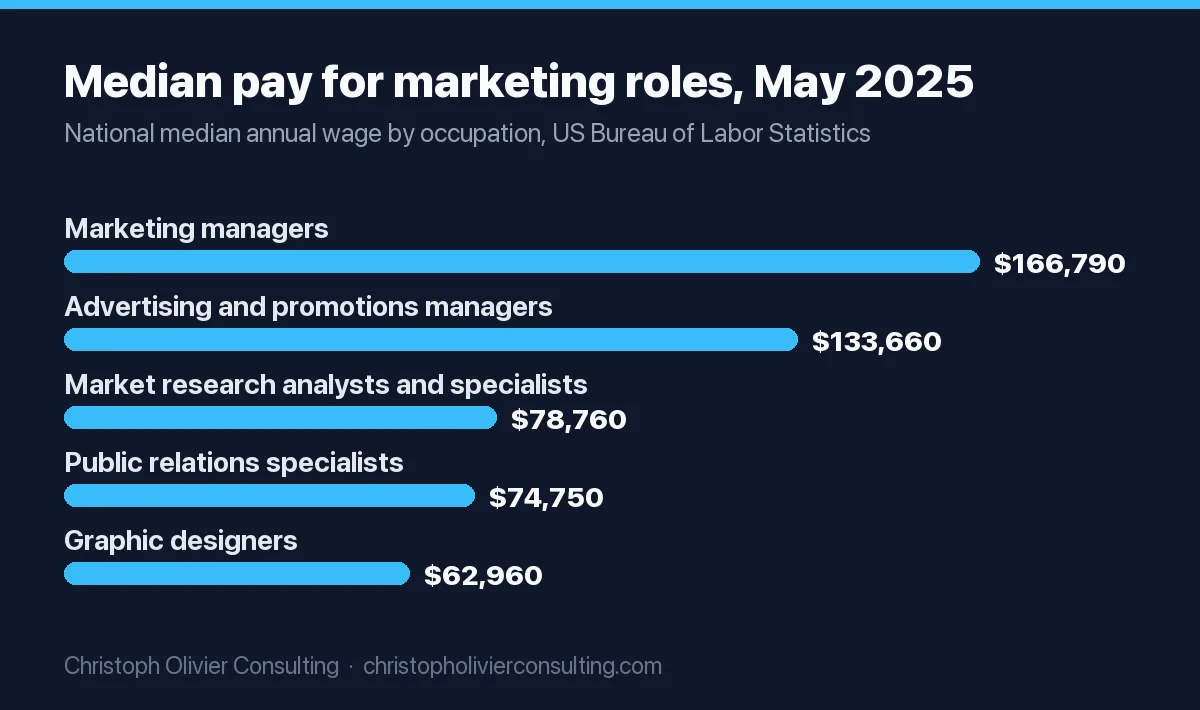
Small firms do not need seven people for seven functions. They need each function assigned. The staging below is an editorial rule of thumb, not a published standard; the pay figures are national medians from the Bureau of Labor Statistics Occupational Outlook Handbook, May 2025 data, for marketing managers and advertising and promotions managers, market research analysts and marketing specialists, public relations specialists and graphic designers.
| Stage (annual revenue) | Typical marketing team | Who covers which functions | BLS median pay for the in-house roles (May 2025) |
|---|---|---|---|
| Under $1M | Owner plus freelancers | Owner: market planning, pricing, product/service, selling. Freelancers: promotion. Marketing-information management often missing | No in-house marketing hire |
| $1M to $5M | One marketing specialist, a fractional or part-time marketing lead, an agency for paid media | Lead: planning, pricing input, information. Specialist: promotion, channel upkeep, sales support. Partners: selling | Market research analysts and marketing specialists: $78,760 |
| $5M to $20M | Marketing manager, one or two specialists, designer or PR support, agencies | Manager owns the plan and the dashboard; specialists split promotion and information; selling shared with business development | Marketing managers: $166,790. Specialists: $78,760. PR specialists: $74,750. Graphic designers: $62,960 |
| $20M and up | Marketing director or CMO, managers by function (brand, demand, advertising), operations analyst | Each function has a named owner; pricing and product often shared with finance and practice leaders | Marketing managers: $166,790. Advertising and promotions managers: $133,660 |
BLS pay varies widely by metro and industry, and medians exclude benefits. A fractional lead covers the same planning and information work at a fraction of a full-time manager’s salary, which is why the $1M to $5M stage is where most firms use one.
Which marketing functions is your firm neglecting? A 21-point scorecard
Score each statement 1 if it is true today and you could show evidence in five minutes, 0 if not. Three checks per function, so each function scores 0 to 3 and the total runs to 21.
| Function | Check 1 | Check 2 | Check 3 |
|---|---|---|---|
| Channel management | You know your top three referral sources by name and how many leads each sent last quarter | Every web inquiry gets a human reply the same business day | A prospect can book a first call online without a phone call |
| Marketing-information management | Every client won in the last 90 days has a recorded lead source | Every lost proposal has a written reason | You have spoken to at least three recent clients or lost prospects this quarter about why they chose |
| Market planning | You can name your two or three target segments in one sentence each | A written plan with budget and targets exists for this year | Someone compared results to that plan in the last 30 days |
| Pricing | Rates or fixed fees were reviewed in the last 12 months | You know your realization rate or average discount | Proposals offer at least two options or tiers |
| Product/service management | You know gross margin by service line | At least one service is sold as a named, fixed-scope package | You added, changed or dropped a service in the last year based on data |
| Promotion | Something new or updated was published in the last 30 days | You know cost per qualified inquiry for each paid channel | Past clients received a useful email or update in the last 90 days |
| Selling | Open proposals are followed up on a fixed schedule | You know your consult-to-client close rate | Sales has at least three current case studies or proof points to send |
How to read it:
- Any function at 0 or 1 is neglected. Fix the lowest one first, even if your total is high, because one missing function caps the others: great promotion feeding a broken intake still loses the lead.
- Total 0 to 9: marketing is mostly promotion done in bursts. Start with marketing-information management (lead source field, lost-deal reasons) so the next decisions rest on data.
- Total 10 to 16: the basics run. The usual gaps are pricing and product/service management, which owners treat as finance or operations questions.
- Total 17 to 21: each function has an owner. The work now is raising targets, not adding activities.
In my experience, the function service firms neglect most is marketing-information management, because nobody is assigned to the lead source field and it looks like admin. If your scorecard shows two or more functions at 0 or 1 and you want a second opinion on where to start, you can book a consultation and bring the scorecard.
Frequently asked questions
What are the 7 core functions of marketing?
As taught in US marketing education by MBA Research and state CTE standards, the 7 core functions are channel management, marketing-information management, market planning, pricing, product/service management, promotion and selling. Together they cover deciding who to serve, what to offer, what to charge, how buyers reach you, how they hear about you and how each one is persuaded to buy.
What does marketing do in a business?
Marketing decides who the business serves, shapes the offer and its price, sets up the channels buyers use to reach it, promotes it and supports the sale. The American Marketing Association defines it as the activity, set of institutions, and processes for creating, communicating, delivering, and exchanging offerings that have value for customers, clients, partners, and society at large.
Who came up with the 7 functions of marketing?
The current list of seven is the framework used by MBA Research, the consortium that writes business and marketing standards and course guides for US high school career and technical education. Its Marketing Principles course guide is built on the seven function units, and state standards such as Utah's Marketing 1 and Oklahoma CareerTech's Marketing I repeat the same seven.
Is financing one of the 7 functions of marketing?
Only in an older version of the list that still circulates online, which names financing and distribution. The current MBA Research framework drops financing, calls distribution channel management and adds market planning. If you are preparing for a CTE or DECA style exam, use the MBA Research names: channel management, marketing-information management, market planning, pricing, product/service management, promotion and selling.
How do the 7 functions of marketing relate to the 4 Ps?
They are a finer cut of the same mix. Product/service management matches Product, pricing matches Price, channel management matches Place, and promotion plus selling match Promotion. Marketing-information management and market planning sit underneath all four Ps, because research and planning decide how each P is set.
What does a marketing team do each week?
A small team typically reviews leads and spend on Monday, produces and publishes content midweek, meets referral partners, holds a short sales and marketing huddle on open proposals, and checks results against the plan on Friday. Pricing and service line margins get a monthly review, and win/loss interviews and plan resets happen quarterly.
How much do marketing managers make?
According to the Bureau of Labor Statistics, the median annual wage for marketing managers was $166,790 in May 2025, and $133,660 for advertising and promotions managers. Market research analysts and marketing specialists had a median of $78,760. Pay varies widely by metro area and industry, and medians exclude benefits.
More Growth, Strategy & Sales guides
- 12 Marketing Strategy Frameworks Compared
- How to Build a Marketing Technology Stack
- Martial Arts School Marketing: A Playbook to Fill Mats and Keep Students
- Med Spa Marketing: How to Attract and Keep Clients in 2026
- Media Buying: A Practical Guide to Programmatic, Direct, Models, and Fraud
- Mortgage Marketing: A Loan Officer’s Playbook for Funded Loans
- All Growth, Strategy & Sales guides →