
Martial arts school marketing works when it runs as one local system: get found in search and maps, turn interest into a paid trial, then follow up fast until the prospect books and shows. Most schools spend between $150 and $300 in combined time and ad cost to sign one new student, and the schools that track a few numbers each week cut that figure while raising retention. This playbook is written for owners who want a repeatable engine, not a list of one-off tactics.
Last reviewed: September 2026
Cost per enrolled student by channel
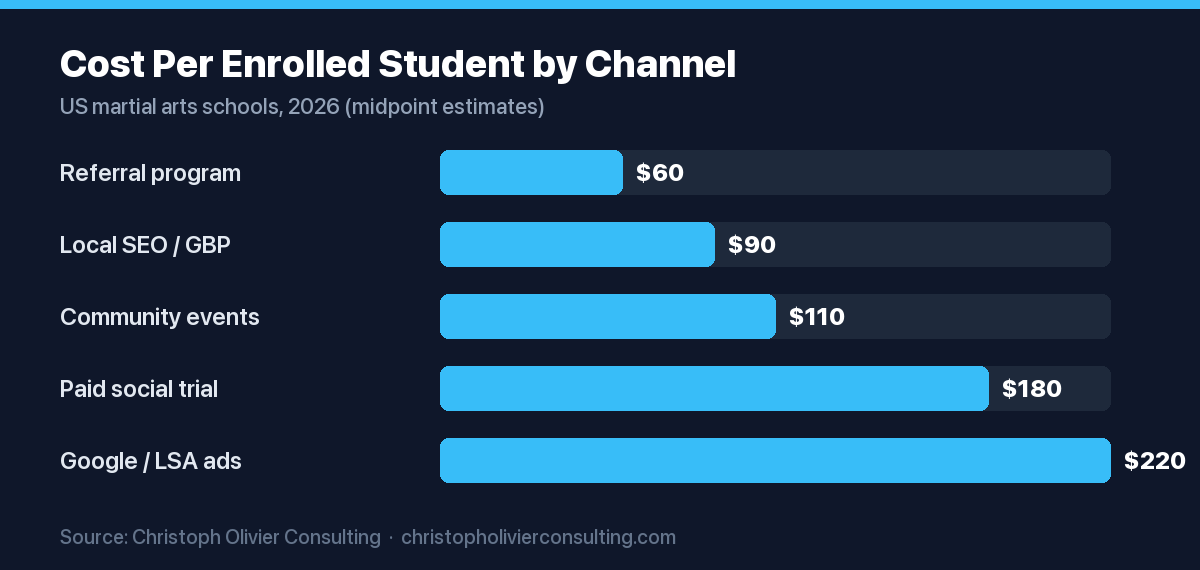
Cost per enrolled student is your total marketing spend on a channel divided by the members who signed because of it. Referral and organic local search sit lowest, usually near $60 to $110 per member, while paid search and paid social run higher at roughly $180 to $220 because you pay per click and then absorb trial-to-member drop-off. The table and chart below use practitioner midpoints you can adjust to your own numbers.
| Channel | Typical cost per enrolled student | Speed | Best use |
|---|---|---|---|
| Referral program | $40 to $80 | Fast | Highest ROI; convert warm prospects |
| Local SEO and Google Business Profile | $60 to $120 | Slow (3 to 6 months) | Compounding, low ongoing cost |
| Community events and school partnerships | $80 to $140 | Medium | Awareness plus warm trials |
| Paid social trial offer | $140 to $220 | Fast | Volume of new trials |
| Google Ads and Local Services Ads | $180 to $260 | Fast | High-intent, ready-to-enroll searchers |
Read the chart as a priority order, not a verdict. Paid channels cost more per student but deliver bookings this week, so a healthy school funds paid ads for volume while building referral and local search to pull the blended cost down over time. For a wider view of how these channels feed each other, see our guide to small business lead generation.
How to set your monthly marketing budget
Set your budget by school size and revenue, not by copying another gym. New schools with 0 to 50 members usually invest $500 to $1,500 a month, established schools of 50 to 150 members run $1,500 to $3,500, and large schools above 150 members spend $3,500 to $7,000. Across all sizes, 5% to 12% of gross revenue reinvested in marketing is a common and defensible band.
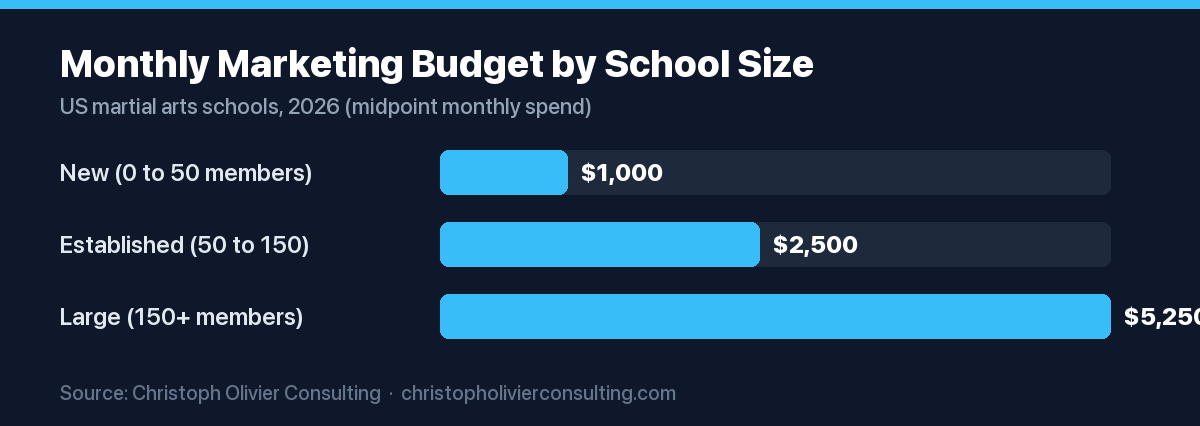
The chart below shows the midpoint monthly spend at each tier. Whatever tier you sit in, split the budget so one channel drives immediate trials and one builds long-term visibility.
- Reserve 40% to 60% for the channel that books trials fastest today, usually paid search or paid social.
- Put 20% to 30% into local SEO, your Google Business Profile, and reviews for compounding return.
- Hold 10% to 20% for referral rewards and community events.
- Keep a small test budget of 5% to 10% for one new idea per quarter.
If you are building your first plan from scratch, our framework for fractional marketing leadership and services shows how to stage spend as the school grows.
Local SEO and Google Business Profile
Local search is where ready-to-enroll parents and adults look first, so a complete Google Business Profile is the single highest-return free asset a school owns. Verify your primary category, add secondary categories, list each program as its own service, post real class photos weekly, and run a steady review request cadence. Then build program pages that match searches like “kids karate in [city]” or “BJJ near me.”
- Complete every profile section and add 20 or more genuine photos of real classes.
- List programs individually: children’s classes, adult self-defense, and competition training, each with its own description.
- Add a booking link so prospects can request a trial straight from the profile.
- Ask happy students for a review at belt tests and milestone moments.
- Publish one program page per audience and keep them fast on mobile.
Local search takes three to six months to pay off, which is why you run it alongside paid ads rather than instead of them. Our overview of SEO for professional services covers the on-page and review signals that move local rankings.
Trial offers and paid social that convert
A structured paid trial converts far better than an open-ended free class because it sets a clear next step and filters for intent. A three-class pass or a two-week beginner course with a defined curriculum outperforms a single free lesson. Schools that pair a paid intro offer with fast follow-up convert 60% to 80% of trials into members.
Paid social earns the trial; the follow-up earns the membership. Run short clips of drills, beginner week-one explainers, and student milestones on Instagram and TikTok, then send every lead into a same-day response sequence.
- Send an automated confirmation the moment a lead requests a trial.
- Call personally within 60 minutes to book the class.
- Text 24 hours later if the prospect has not booked.
- Make one final outreach 48 to 72 hours after the inquiry.
Follow-up alone can cut cost per enrolled student sharply; disciplined schools report moving that number from roughly $412 down to about $196 by fixing the response process. For creative and channel detail, see our guide to social media lead generation.
Referral and community programs
Referral is the lowest-cost and stickiest channel because members recommend you to people who already trust them. Around 74% of buyers say word of mouth shapes their decision, and referral-sourced students convert about 30% faster and stay longer than paid-ad leads. Reward both sides with gear credit, a private lesson, or a waived enrollment fee.
Community programs feed the same warm pipeline. Host a free class on the last Saturday of each month, sponsor a youth sports league, or co-host a tournament with a nearby school. These build awareness and hand you trial-ready prospects at a fraction of paid-ad cost.
Retention across belt progression and membership LTV
Retention decides whether marketing pays back, because acquisition cost only makes sense against lifetime value. A student who stays 18 months at $150 a month is worth about $2,700, so keeping cost to acquire that member under one-third of value, roughly $900 or less, protects your margin. Strong schools lose no more than about 4% of active members a month.
| Metric | Healthy benchmark | Why it matters |
|---|---|---|
| Monthly member churn | 4% or lower | Protects revenue and LTV |
| Annual retention (BJJ) | 70% to 80% | Signals curriculum and culture fit |
| Trial-to-member conversion | 60% to 80% | Measures your follow-up system |
| Member LTV (18 mo at $150) | About $2,700 | Sets your acquisition ceiling |
| Target cost per enrolled student | Under $900 | Keeps CAC below one-third of LTV |
Tie retention to visible progression. Belt milestones, a clear beginner curriculum, and email nurture between tests give students a reason to keep showing up, which lifts LTV and lets you spend more to win each new member.
A 30-day plan to grow enrollment
You do not need every tactic at once. Sequence the highest-return moves first, prove the follow-up works, then scale paid spend. This 30-day plan gets a school from scattered effort to a measurable enrollment engine.
- Week 1: Complete the Google Business Profile, add photos, and publish one program page per audience.
- Week 2: Build a paid trial offer and a same-day lead follow-up sequence with call, text, and email.
- Week 3: Launch one paid channel for trial volume and a referral reward for members.
- Week 4: Track cost per enrolled student, trial conversion, and churn, then reallocate to the cheapest channel that fills mats.
Measure weekly and let the numbers, not opinions, decide where the next dollar goes.
Work with a fractional CMO
If you want the system built and run without hiring a full marketing team, a fractional CMO sets the strategy, stands up the channels, and holds the numbers accountable. That is the model behind Christoph Olivier Consulting: senior marketing leadership priced for owner-operated schools. Explore the consulting services to see how an engagement is structured.
Frequently asked questions
How much should a martial arts school spend on marketing?
Budget by size and revenue. New schools with 0 to 50 members usually spend $500 to $1,500 a month, established schools of 50 to 150 members run $1,500 to $3,500, and large schools above 150 members spend $3,500 to $7,000. A common guideline across all sizes is reinvesting 5% to 12% of gross revenue into marketing each month.
What is a good cost per enrolled student?
Most schools spend $150 to $300 in combined time and ad cost per new student, though it varies by channel. Referral and local search can land near $60 to $110, while paid ads run $180 or higher. Keep total acquisition cost under one-third of member lifetime value, which for an 18-month member at $150 monthly means staying under roughly $900.
Which martial arts marketing channel has the best ROI?
Referral programs deliver the highest return because members recommend you to people who already trust them. Referral-sourced students convert about 30% faster and stay longer than paid-ad leads. Reward both the referrer and the new student, then support referrals with local SEO and community events, which also carry low cost per enrolled student.
How do I get more students from Google?
Complete your Google Business Profile, verify the primary category, add 20 or more real class photos, list each program as its own service, and request reviews on a weekly cadence. Then build program pages matching searches like kids karate in your city. Local search takes three to six months to pay off, so run it alongside paid ads for near-term trials.
What trial offer converts best for martial arts?
A structured paid trial beats an open-ended free class. A three-class pass or a two-week beginner course with a defined curriculum sets a clear next step and filters for intent. Schools that pair a paid intro with same-day follow-up convert 60% to 80% of trials into members, so the offer and the follow-up matter equally.
How important is retention to marketing results?
Retention decides whether marketing pays back, because acquisition cost only makes sense against lifetime value. Strong schools lose no more than about 4% of active members a month, and BJJ programs average 70% to 80% annual retention. Tie progression to belt milestones and email nurture between tests so students keep showing up and each acquired member returns more.
More marketing guides for rank on ai: get cited by ai search
- Pressure Washing Marketing: The Channels That Book Jobs in 2026
- Tree Service Marketing: Cost and ROI by Channel (2026)
- Barbershop Marketing: The 2026 Playbook to Fill Every Chair
- Google Ads Budget for Small Business: How Much to Spend and How to Split It
- Handyman Marketing: The Channel Plan That Books More Jobs
- How Much Does Digital Marketing Cost?
- Rank on AI: Get Cited by AI Search