
Landscaping marketing works when you match the channel to the outcome you need. For jobs you want booked this week, buy attention with Local Services Ads or paid search. For a pipeline that lowers your cost per job over the next year, build reviews, referrals, and a fully optimized Google Business Profile. The cheapest booked jobs almost always come from customers you already served. The most expensive come from cold paid clicks. Below are the real 2026 numbers so you can spend in the right order.
Last reviewed: September 2026
The fastest path to more landscaping jobs
Start with the three plays that cost little and convert best: claim and fully build your Google Business Profile, ask every finished customer for a review, and drop door hangers on the ten closest homes after each job. These three feed the map pack, which is the highest-value free placement a local landscaping company can hold. Add paid channels only after those are running.
Pick three channels, get them right, then expand. Trying eight things at once means none of them get the attention that makes them profitable. If you want help sequencing the build, our fractional CMO services exist to do exactly this kind of prioritization.
Cost Per Booked Job by Channel
Cost per booked job is the number that matters, not cost per lead. A channel with cheap leads and a weak close rate can cost more per job than an expensive channel that converts. In 2026, referrals and organic map-pack calls produce booked jobs for roughly $30 to $50 each, while cold Google Search clicks run $180 to $300 per booked job after you account for close rates near 30 to 50 percent.
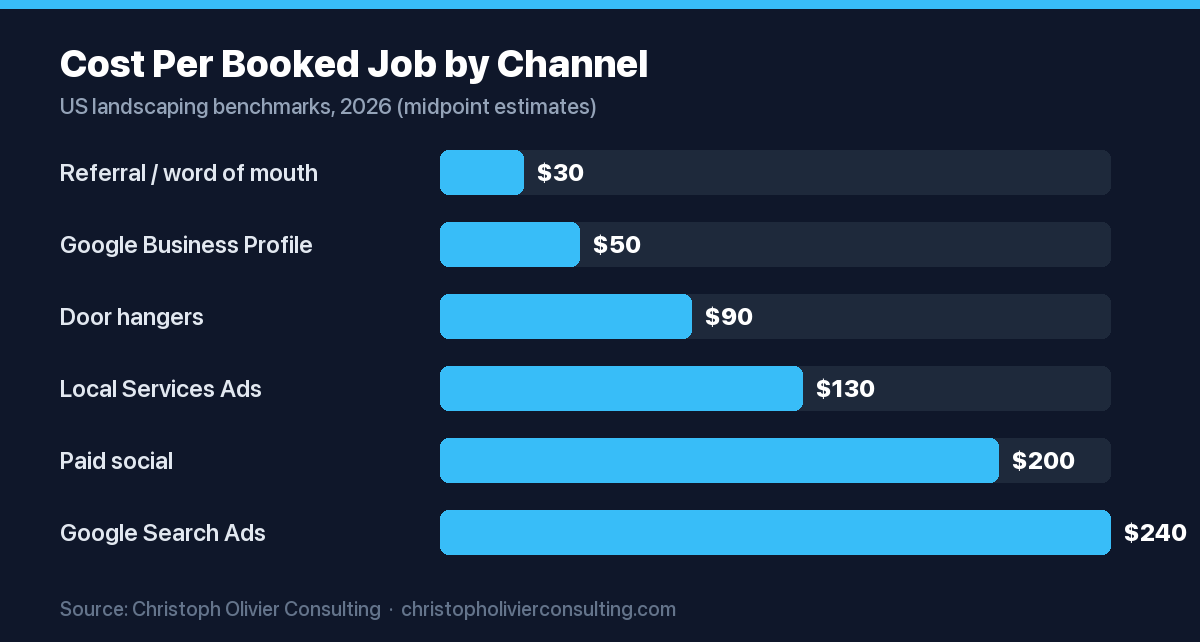
The table below turns lead costs and typical close rates into a cost per booked job you can compare directly. Figures are US midpoints for 2026 and vary by market, season, and job type.
| Channel | Typical cost per booked job | Close rate | Time to results |
|---|---|---|---|
| Referral / word of mouth | $20 to $40 | 75 to 85% | Immediate (needs a base) |
| Google Business Profile (organic map) | $30 to $70 | 40 to 60% | 1 to 3 months |
| Door hangers (route density) | $60 to $120 | 1 to 2% response | Days |
| Local Services Ads | $110 to $160 | 30 to 45% | 1 to 2 weeks |
| Paid social (Facebook / Instagram) | $150 to $250 | 10 to 20% | 2 to 4 weeks |
| Google Search Ads | $180 to $300 | 30 to 50% | Days |
Read this as a sequence, not a menu. Earn the cheap booked jobs first, then buy the expensive ones to fill gaps in your schedule.
What landscaping marketing costs to run
Plan to spend 7 to 10 percent of gross revenue on marketing if you are holding steady, and 10 to 12 percent if you are pushing for growth. In dollar terms, most small landscaping crews land between $1,500 and $5,000 per month across channels once paid ads are live. A solo operator can start well under that by working only the free local plays.
Set the number as a percentage of revenue so the budget scales with the business. For a full method on splitting that spend across channels, pair this with our guide-driven approach to small business lead generation.
Local SEO and Google Business Profile
The Google Local Pack, the map and three listings above organic results, is the single highest-value placement for a landscaping company because it is free and reaches buyers who have already decided to hire someone nearby. A complete profile with the right primary category, service list, service area, photos of finished work, and a steady flow of reviews is what earns those three spots.
Local SEO compounds. Cost per booked job falls over 6 to 12 months as your profile and website earn trust, which is why it belongs at the base of the plan. The mechanics carry across trades, and our local SEO for professional services hub covers the full playbook.
Local Services Ads and paid search
Local Services Ads let you buy calls from Google-screened searchers and pay per lead, which in 2026 averages about $45 to $50 per charged lead for landscaping contractors, with a typical band of $39 to $60. Standard Google Search Ads cost more per lead, roughly $85 to $105 on a full-year average, because you pay per click and filter intent yourself.
Turn these on when you need booked jobs fast or when your schedule has open capacity. They are the fastest channels to start and the easiest to overspend on, so cap daily budgets and watch cost per booked job weekly, not just cost per click.
Cost Per Lead by Season (Google Ads)
Landscaping ad costs swing hard by season. Cost per lead drops to roughly $40 to $50 during the late-April-to-May demand peak, settles into the mid $80s through summer, and expands past $150 to $200 in the winter off-season when demand thins. Planning spend around this curve is one of the biggest levers on your blended cost per job.
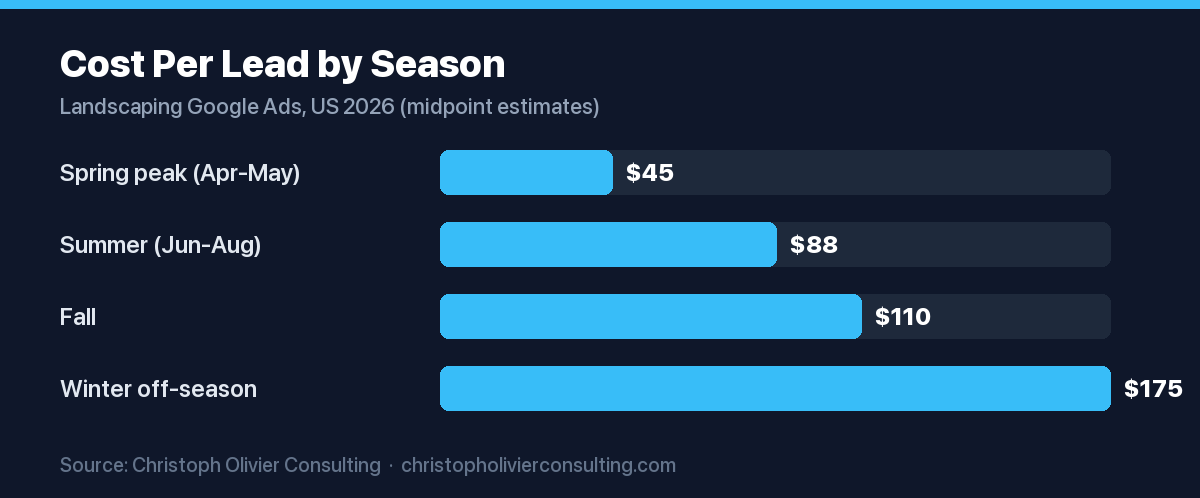
The chart shows the pattern. Push paid budget into spring and early summer when leads are cheapest, and lean on organic and retention through winter instead of paying peak prices for cold clicks.
Neighborhood targeting: door hangers and yard signs
Door hangers convert at 1 to 2 percent when you drop them on the ten closest homes right after finishing a job and lead with a real offer. Yard signs on the property you just serviced turn one job into neighborhood proof. Both work because route density lowers your drive time and your cost to serve, which makes each new job on the same street more profitable.
Treat print as a route tool, not a mass mailing. Ten targeted hangers after a completed job beat a thousand dropped at random, and the response you do get sits inside a tight service area.
Reviews and referrals
Referrals are the cheapest booked jobs you will get: they close at 75 to 85 percent versus 30 to 50 percent for paid Google leads, and referred customers churn less and are worth 16 to 25 percent more over their lifetime. A formal referral offer plus a review request after every job turns satisfied customers into a repeatable channel rather than a lucky accident.
Ask at the moment of highest satisfaction, which is the walk-through when the work is done. Reviews then feed the map pack, so a strong review habit lifts your organic performance at the same time.
Social media and content for landscaping
Before-and-after photos are the strongest social content a landscaping business owns, because the transformation sells the service without a word of copy. Instagram and Facebook carry that work to local buyers, and a simple posting habit keeps your name in the feed of past customers who drive referrals. Social rarely books jobs cheaply on its own, but it multiplies your other channels.
Keep it visual and consistent rather than clever. For a channel-by-channel method, see our guide to social media lead generation.
Recurring maintenance and retention
Recurring maintenance contracts are where landscaping profit actually lives, because you pay the acquisition cost once and collect revenue across a full season or longer. A booked job that becomes a weekly or biweekly account can be worth ten to thirty times its first invoice, which changes what you can afford to pay to win it in the first place.
Design offers that move one-time customers onto recurring plans, then protect those accounts with reliable service and light seasonal touchpoints. Retention is a marketing channel, not an afterthought.
How to build your landscaping marketing plan
Build in order of cost per booked job, cheapest first, so every dollar of paid spend rides on a base of free demand. The steps below are the sequence I use with service businesses that want a full schedule without overpaying for cold leads.
- Fully optimize your Google Business Profile: correct category, services, service area, and photos of finished work.
- Set a review habit: ask every customer at the completed-work walk-through.
- Add route-based door hangers and a yard sign on each job you complete.
- Launch a formal referral offer for existing customers.
- Turn on Local Services Ads to buy screened leads at the lowest paid cost per job.
- Add Google Search Ads to fill open capacity, weighted toward the spring peak.
- Publish before-and-after social content to support referrals and repeat work.
- Convert one-time customers to recurring maintenance and track cost per booked job monthly.
Set the budget at 7 to 12 percent of revenue, review cost per booked job by channel every month, and shift spend toward whatever produces jobs cheapest in your market.
Frequently asked questions
How much should a landscaping business spend on marketing?
Plan to spend 7 to 10 percent of gross revenue if you are holding steady and 10 to 12 percent if you are growing. In practice most small crews spend between $1,500 and $5,000 per month once paid ads are running. A solo operator can start far below that by working only the free local plays first, then adding paid channels as capacity allows.
What is the best marketing channel for a landscaping company?
For most landscaping companies the Google Business Profile and the local map pack deliver the lowest cost per booked job because they are free and reach buyers ready to hire nearby. Referrals close even higher. Paid search and Local Services Ads book jobs fastest but cost more per job, so use them to fill gaps rather than as your foundation.
How much does a landscaping lead cost in 2026?
Local Services Ads average about $45 to $50 per charged lead for landscaping contractors, with a typical band of $39 to $60. Standard Google Search Ads run higher, roughly $85 to $105 per lead on a full-year average. Both compress to $40 to $50 during the spring demand peak and expand past $150 in the winter off-season.
Do door hangers still work for landscaping?
Yes, when you target them. Door hangers convert at 1 to 2 percent if you drop them on the ten closest homes right after finishing a job and lead with a clear offer. The point is route density, not volume: ten targeted hangers plus a yard sign on the property you just serviced beat a thousand dropped at random.
How long does SEO take for a landscaping business?
Local SEO usually starts producing calls within 1 to 3 months for a well-built Google Business Profile, while broader organic gains build over 6 to 12 months. Cost per booked job falls as your profile and reviews earn trust. It is a compounding channel, so start it early and keep the review habit steady to speed results.
Is Google Local Services Ads worth it for landscapers?
For most landscapers, yes. Local Services Ads produce screened leads at a lower cost per lead than standard search, around $45 to $50 in 2026, and you pay per lead rather than per click. Book them once your Google Business Profile is complete, cap the daily budget, and track cost per booked job weekly to keep them profitable.
More marketing guides for rank on ai: get cited by ai search
- Martial Arts School Marketing: A Playbook to Fill Mats and Keep Students
- Pressure Washing Marketing: The Channels That Book Jobs in 2026
- Tree Service Marketing: Cost and ROI by Channel (2026)
- Barbershop Marketing: The 2026 Playbook to Fill Every Chair
- Google Ads Budget for Small Business: How Much to Spend and How to Split It
- Handyman Marketing: The Channel Plan That Books More Jobs
- Rank on AI: Get Cited by AI Search