
Last reviewed: September 2026
Tree service marketing works when you rank channels by cost per booked job, not by cost per lead. A cheap lead that closes at 15 percent is more expensive than a pricey lead that closes at 70 percent. This guide prices every major channel the way an owner should read it: what one paying job actually costs after close rates, plus the storm-demand and higher-ticket economics that make tree work different from other home services.
Tree Service Marketing at a Glance
Tree service marketing is the mix of local SEO, Google Business Profile, paid search, Local Services Ads, referrals, and reviews that turns high-intent searchers into booked jobs. With an average job value near $2,500 and close rates that swing from about 15 percent to 85 percent by source, the channel you pick matters more than the budget you spend. The goal is steady lead flow from three or four sources, not a single tap you cannot turn off.
- Average job value: roughly $2,200 to $3,200, midpoint near $2,500.
- Cost per booked job ranges from about $45 (organic) to $210 (shared lead platforms).
- Mature operators pull 60 to 70 percent of work from organic search, referrals, and repeat clients.
- Peak demand runs May through October; storm events spike emergency, high-margin work.
What a Tree Service Lead Is Actually Worth
A tree service lead is worth its expected revenue times its close rate, minus the cost to acquire it. At a $2,500 average job and a 50 percent close rate, one high-intent lead carries about $1,250 of expected revenue, so paying $85 to $110 for that lead is sound math. The mistake is judging channels on the sticker price of a lead instead of the price of a job that actually gets signed.
Two numbers drive everything: what a lead costs, and how often it closes. High-intent search leads close at roughly 50 to 70 percent. Shared lead platforms, where the same lead is sold to several companies, close at only about 12 to 22 percent. Referrals sit highest at 75 to 85 percent because trust is transferred before the phone rings. Multiply cost per lead by the inverse of the close rate and the true ranking changes hard.
Cost Per Booked Job by Channel
Cost per booked job is your cost per lead divided by that channel’s close rate, and it is the only number worth comparing across channels. On 2026 US benchmarks, organic search and Google Business Profile deliver booked jobs for roughly $45 to $55, referrals near $80, Local Services Ads near $90, Google Ads near $190, and shared lead platforms near $210 once their low close rate is priced in. The table below shows the full math.
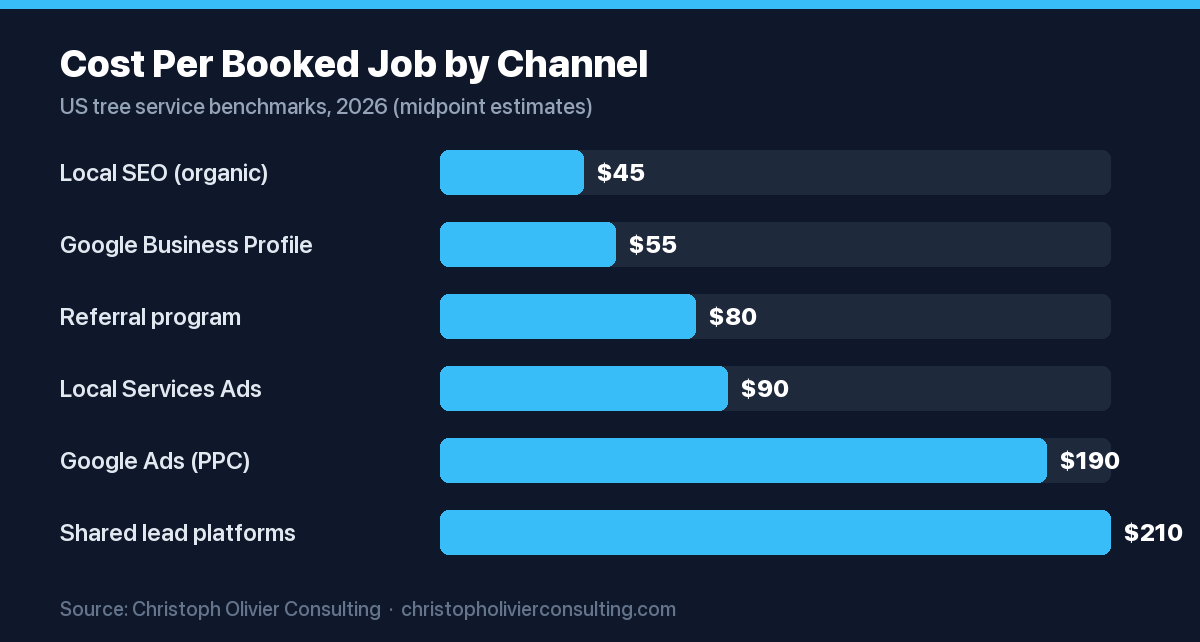
| Channel | Cost per lead | Typical close rate | Cost per booked job | Best for |
|---|---|---|---|---|
| Local SEO (organic) | Low, mostly time or retainer | 50-70% | ~$45 | Compounding base demand |
| Google Business Profile | Free to manage | 50-70% | ~$55 | Near-me and map calls |
| Referral program | $50-100 credit per closed job | 75-85% | ~$80 | Highest-trust growth |
| Local Services Ads | $42-83 per lead | 50-65% | ~$90 | Fast, verified calls |
| Google Ads (PPC) | $85-110 per lead | 45-55% | ~$190 | Removal and emergency intent |
| Shared lead platforms | $25-40 per lead | 12-22% | ~$210 | Filling a slow week only |
Read the table right to left. Shared platforms show the cheapest lead and the most expensive job, because you buy the same lead five other crews are calling. Organic and Google Business Profile look free at the top and win at the bottom, which is why they anchor a serious plan even though results build over months rather than days. See more on ranking for these searches in our SEO for professional services guide.
Close Rate by Lead Source
Close rate is the multiplier that decides whether a channel is cheap or expensive. Referrals close highest at about 80 percent because a neighbor already vouched for you. Exclusive high-intent search leads close near 55 to 60 percent. Google Ads leads close around 50 percent. Shared lead platforms sit near 17 percent, since the buyer is comparing several quotes at once. Protecting close rate through fast callbacks and clear on-site estimates is often cheaper than buying more leads.
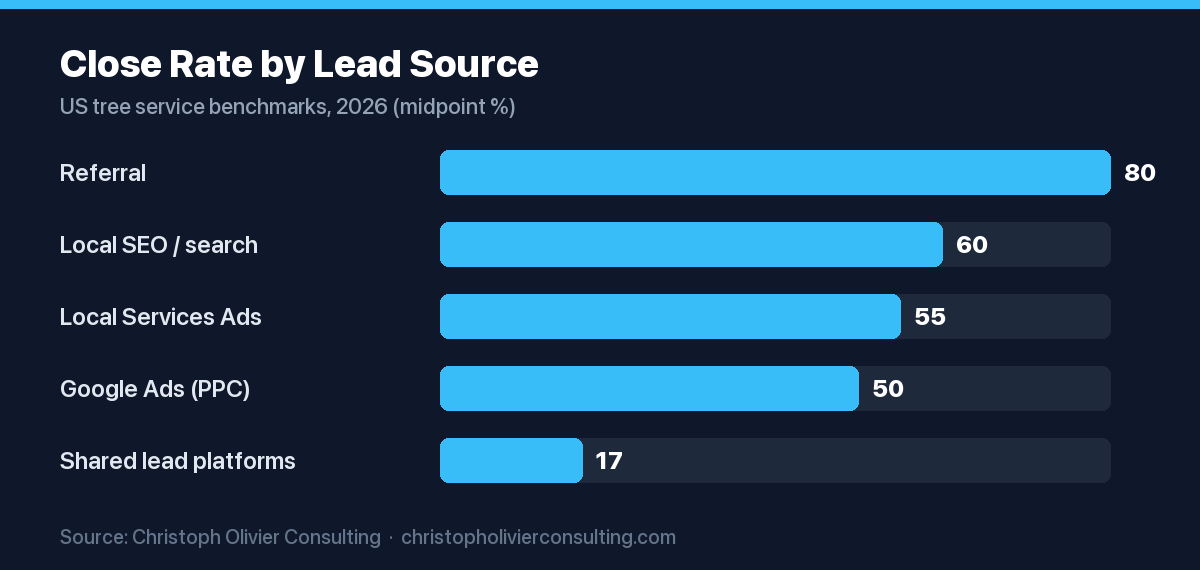
| Lead source | Close rate | Why it moves |
|---|---|---|
| Referral | ~80% | Trust transferred before contact |
| Local SEO / high-intent search | ~60% | Searcher has a specific need now |
| Local Services Ads | ~55% | Verified, phone-first, Google-backed |
| Google Ads (PPC) | ~50% | Click intent, some comparison shopping |
| Shared lead platforms | ~17% | Same lead sold to many crews |
Local SEO and Google Business Profile: The Compounding Base
Local SEO and a well-run Google Business Profile form the lowest cost-per-job channel because you pay once to build ranking and then earn calls for free. A mature local presence can produce 30 to 60 organic leads a month at near-zero ongoing cost. The build takes months, so start it first and treat paid channels as the accelerant while it matures.
Build service and service-area pages
Create one page per service (tree removal, trimming, stump grinding, emergency work) and one page per city or neighborhood you cover. This matches how people search and gives Google specific pages to rank for specific queries. Thin, single-page sites lose to competitors who answer each search directly, so depth on your core services pays back for years.
Win the map pack with reviews and proximity
Google Business Profile visibility is driven mainly by proximity, relevance, and review volume. Ask every satisfied customer for a review the day the job finishes, respond to each one, and post seasonal updates. Reviews are the single strongest trust signal in home services, and they lift both map ranking and close rate at the same time. Pair this with our small business lead generation playbook for the intake side.
Local Services Ads and Google Ads: Buying Demand
Paid search buys demand you have not earned organically yet, and both Google formats have a place. Local Services Ads charge per verified lead (about $42 to $83 each in 2026) and put a Google Guaranteed badge on phone-first calls. Google Ads charge per click, with competitive tree keywords running $8 to $20-plus per click and leads landing near $85 to $110. Run Local Services Ads first for the badge and the lower cost per job, then layer Google Ads for removal and emergency intent.
- Turn on Local Services Ads and complete the Google Guaranteed verification.
- Set your service area tightly so you pay for calls you can reach same-day.
- Launch a small Google Ads Search campaign on high-intent terms like “emergency tree removal” and “tree removal near me”.
- Add negative keywords (jobs, DIY, free) to stop wasted clicks.
- Route every call to a person, not voicemail, since answered calls decide the cost per job.
Avoid shared lead platforms as your main source. They look cheap per lead and price out as your most expensive booked job once the 12 to 22 percent close rate is counted. Use them only to fill a genuinely slow week.
Referrals and Reviews: The Highest-Converting Channel
Referrals convert better than any paid channel, closing at roughly 75 to 85 percent, because the recommendation does the selling for you. A structured program that pays $50 to $100 per qualified referral turns one job into two or three at a cost per booked job near $80. Reviews are the public version of the same trust, so treat both as a system rather than an accident.
Ask for the referral at the moment of highest goodwill, right after the crew cleans up and the customer sees the finished yard. Hand out cards, send a follow-up text with your review link, and credit the referrer promptly so the loop keeps running. Social proof also carries paid campaigns, which is why review-rich profiles lower ad costs too. Our social media lead generation guide covers turning finished jobs into shareable before-and-after content.
Storm Response and Seasonal Demand
Tree service demand is seasonal and storm-driven, and this shapes budget timing more than any other trade. Demand peaks May through October and drops 35 to 40 percent in winter, but competitors cut their marketing 60 to 70 percent in the off-season, so ad costs fall and visibility gets cheaper. Storms create surge windows where the first crews to answer within about 4 to 6 hours capture the highest-ticket emergency work.
Plan spend against the calendar. Pre-book preventative pruning with direct mail and Google Business Profile posts in early spring and late autumn, keep an always-on emergency campaign that can scale the moment a storm hits, and defend your organic ranking through winter when clicks are cheap. Higher-ticket storm and removal jobs justify a higher cost per lead than routine trimming, so segment budgets by job type rather than spending one flat rate.
A 90-Day Tree Service Marketing Plan
A workable plan sequences the compounding base first, then adds paid demand, then systematizes referrals. This order gets cash flowing from paid channels while the free channels mature, so you are not paying premium lead prices forever. Here is a 90-day build for a single-market operator.
- Days 1-15: Claim and complete Google Business Profile, add service and service-area pages, set up a review-request text after every job.
- Days 16-30: Turn on Local Services Ads with Google Guaranteed verification and a tight service radius.
- Days 31-45: Launch a small Google Ads Search campaign on emergency and removal terms with negative keywords.
- Days 46-60: Publish before-and-after content and start posting weekly to Google Business Profile and social.
- Days 61-75: Roll out a $50-100 referral credit and ask every closed customer in person.
- Days 76-90: Review cost per booked job by channel, cut the worst performer, and reinvest in the best.
How to Judge Value vs Price
Judge every marketing dollar by cost per booked job and payback against your average ticket, not by the price of a lead or a monthly retainer. At a $2,500 average job, a channel that books work at $90 returns better than 25 to 1, so the right question is which channels can scale at that ratio, not which quote is lowest. Track the number for 90 days, then move budget toward whatever books jobs cheapest.
If you want the strategy built and run for you, review our consulting services to map channels, budgets, and expected cost per job for your market before you spend.
Frequently asked questions
How much does tree service marketing cost per booked job?
On 2026 US benchmarks, cost per booked job runs about $45 to $55 for local SEO and Google Business Profile, near $80 for referrals, about $90 for Local Services Ads, near $190 for Google Ads, and about $210 for shared lead platforms. The figure is cost per lead divided by close rate, which is why cheap shared leads end up the most expensive jobs.
What is the best marketing channel for a tree service?
Local SEO plus Google Business Profile is the best long-term channel because it books jobs at the lowest cost once ranking is built, and it compounds over time. Referrals close highest at roughly 75 to 85 percent. Most successful operators run three or four channels at once so no single source can stall the whole pipeline.
How much should a tree service spend on Google Ads?
Expect $85 to $110 per lead and roughly $8 to $20-plus per click on competitive tree keywords in 2026. Start with a small Search budget on high-intent terms like emergency and removal, add negative keywords, and answer every call live. Run Local Services Ads alongside it, since they usually book jobs at a lower cost than click-based ads.
Are shared tree service leads worth buying?
Rarely as a primary source. Shared platforms sell the same lead to several crews, so close rates fall to about 12 to 22 percent and the true cost per booked job climbs near $210, higher than any other channel. Use them only to fill a genuinely slow week, and prioritize exclusive search leads and referrals instead.
When is the best time to market a tree service?
Demand peaks May through October and drops 35 to 40 percent in winter, but competitors cut spend 60 to 70 percent in the off-season, so winter clicks are cheaper. Pre-book pruning with spring and autumn campaigns, keep an always-on emergency campaign ready for storms, and defend organic ranking year-round.
How do referrals compare to paid ads for tree services?
Referrals convert far better, closing at roughly 75 to 85 percent versus about 50 percent for Google Ads, because trust is transferred before contact. A program paying $50 to $100 per closed referral books jobs near $80 each. Ask at the moment the crew finishes and the customer sees the result, then credit the referrer quickly.
More marketing guides for rank on ai: get cited by ai search
- Barbershop Marketing: The 2026 Playbook to Fill Every Chair
- Google Ads Budget for Small Business: How Much to Spend and How to Split It
- Handyman Marketing: The Channel Plan That Books More Jobs
- How Much Does Digital Marketing Cost?
- How Much Does SEO Cost in 2026?
- Junk Removal Marketing: A Channel-by-Channel Booking System
- Rank on AI: Get Cited by AI Search