
Lead generation for a barbershop comes down to four things: a booking app whose marketplace sends you new clients, a Google Business Profile with a Book button, a steady flow of honest reviews, and a rebook at checkout so each new client turns into a regular. Marketplace fees are published, so you can price a new client before you pay for one: on a $40 cut, a first visit booked through Booksy Boost or StyleSeat costs you $12, through the Fresha marketplace $8, and through theCut’s free plan $10. Below are each vendor’s US prices, the chair math that tells you how many new clients you actually need, and a 90-day plan with weekly targets.
How many new clients does one barber chair need?
Start with the target, not the channel. One chair can only hold so many appointments, and how often your regulars come back decides how many of them it takes to fill it. Work it out like this:
- Weekly slots: appointments one barber can take in a week. The example below assumes 40 (8 a day, 5 days).
- Active clients needed: weekly slots × the average gap between visits, in weeks.
- New clients needed each month: active clients × the share who lapse each month. The example assumes 5% a month. Measure your own: count the clients who had a visit 3 months ago and have no visit or booking since.
| Average gap between visits | Active clients to fill 40 slots a week | New clients a month to replace 5% lapse | Marketplace cost at $12 per new client |
|---|---|---|---|
| 2 weeks | 80 | 4 | $48 |
| 3 weeks | 120 | 6 | $72 |
| 4 weeks | 160 | 8 | $96 |
| 6 weeks | 240 | 12 | $144 |
All figures are our arithmetic from the stated assumptions. The $12 is the Booksy Boost or StyleSeat fee on a $40 first visit (see the next section). Two things fall out of this table. A barber whose clients come every 3 weeks needs half the book of one whose clients come every 6 weeks. And a chair that is already full needs only a handful of new clients a month, so the real lead generation job is keeping the gap short and the lapse rate low, then filling empty chairs or a new barber’s book.
If you want the same “leads needed × affordable cost per lead” logic laid out for a wider range of service businesses, our small business lead generation plan walks through it with a budget template.
Booking apps that send you new clients, and what each one charges
For most barbers the biggest new-client source is the marketplace inside the booking app, where clients search by neighborhood and style. Three vendors charge a one-time fee only when their marketplace brings you a brand-new client; the other three do not publish one. Prices below come from each vendor’s own US pricing page, read on 1 November 2026 (Fresha and Vagaro from US snapshots dated 21 and 22 October 2026, because their pages show other currencies outside the US).
| Platform | Subscription (USD) | New-client marketplace fee | Fee on a $40 first visit | Fee on a $60 cut and beard |
|---|---|---|---|---|
| Booksy | $29.99/mo plus tax, plus $20/mo per extra user | Boost: free to turn on, one-time 30% of the client’s first visit, up to $100 | $12 | $18 |
| StyleSeat | $35/mo | New Client Connection: 30% of the first appointment, max $50 | $12 | $18 |
| Fresha | Independent $19.95/mo; Team $14.95 per bookable team member/mo | 20% one-time commission, minimum $6 per client | $8 | $12 |
| theCut | Free $0; Pro $25/mo (owner accounts free) | Client Discovery: $10 per client on Free, included on Pro | $10 (Free) or $0 (Pro) | $10 (Free) or $0 (Pro) |
| Squire | Independent $30/mo; Pro $50/mo; Executive $150/mo per shop; Titan $250/mo per shop | None published. The page says your clients “won’t be sold or shown to other businesses” | Not published | Not published |
| Vagaro | $30/mo for one calendar ($23.99/mo for the first 6 months); each added bookable calendar $10/mo, up to seven | None listed; “Free listing on the Vagaro Marketplace” is included | None listed | None listed |
Details that change the math:
- The fee only applies to marketplace clients. Booksy’s FAQ tells you to share your own profile link so clients you bring yourself are not charged as Boost clients. StyleSeat states that “clients you bring to StyleSeat yourself are not New Client Connections.” Fresha says no fee ever applies to returning clients.
- StyleSeat charges the client too. Clients pay a $2.35 booking fee per appointment. StyleSeat’s optional Smart Pricing takes 5.5% of the service price, up to $16.50.
- Processing is separate. Booksy: 2.69% + $0.30 for mobile and keyed payments, 2.49% + $0.10 on its card reader. Fresha: 2.29% + $0.20 in person, 2.79% + $0.20 online. StyleSeat: 2.5% + $0.30 tap to pay. theCut: 2.75%.
- Texts are not always free. Booksy says appointment confirmations and reminders are always free, and Squire includes free, unlimited email and text reminders. Fresha includes 100 automated texts a month, then $0.02 per text, and charges $0.08 per marketing text.
What a 4-chair shop pays a month in subscriptions
| Platform | How it is billed | 4 barbers, per month (before tax and processing) |
|---|---|---|
| Squire Pro | Flat per shop, multiple barber accounts | $50 (Executive, with unlimited email and SMS marketing and a Google reviews tool: $150) |
| Fresha Team | $14.95 per bookable team member | $59.80 |
| Vagaro | $30 base plus $10 per added calendar | $60 |
| Booksy | $29.99 plus $20 per extra user | $89.99 |
| theCut | Owner account free; each barber chooses Free or Pro | $0 to $100 |
| StyleSeat | $35 per professional | $140 |
Monthly totals are our arithmetic from the published prices. Subscription cost is only half the decision. If your shop needs 8 new clients a month and you would get them through a marketplace, add $64 to $96 a month in first-visit fees on $40 cuts. If your chairs are full, a platform with no marketplace fee and strong rebooking tools may cost less overall. When you compare these against the CRMs and portals other service businesses use, our review of client management apps shows why a barbershop is better served by a booking platform that doubles as its client list.
Google Business Profile for barbershops: category, services and the Book button
Your profile is where “barber near me” searchers decide. Google’s own help pages set the rules, and three of them matter most for a shop.
- Pick the most specific category. Google says to “select a specific category from the list” and gives the example of choosing “Nail salon” instead of “Salon”. You cannot create your own. For a barbershop, type “barber” in the Primary category box and choose the barber category from the list rather than a general salon category. Google’s own Places data treats barber_shop as its own place type, separate from hair_salon. Add a few additional categories only for real departments, not one per service. Editing a category can trigger re-verification, per Google’s category help page.
- List every service and price. Google’s profile guidelines name barbers specifically: a service menu should list the complete set of services available at the business. Use the names clients search: skin fade, taper, beard trim, hot towel shave, kids cut.
- Connect a booking provider. The category page says health and beauty businesses “can add a booking button to their profiles.” In the profile, select Bookings, then Get started, then your provider; Google says providers appear on your profile within a week, and warns that “when you book through Google, your provider might charge you” (Google help). You can also add your own booking link instead.
Which apps connect? On the Reserve with Google partner list we checked on 1 November 2026, Booksy, Fresha, Squire, Square Appointments, Setmore, MINDBODY and Booker appear. Vagaro, StyleSeat and theCut did not appear on that list, so with those apps you would add your own booking link. Check the list yourself before switching, because it changes.
Reviews: what Google and the FTC allow a barbershop to do
Reviews decide which shop gets the click in the map results, and barbershops break the rules in very specific ways: free line-ups for five stars, review cards that name the barber, or asking only the clients who look happy. Here is what the rules actually say.
| Common shop practice | Allowed? | Rule |
|---|---|---|
| Discount or free service for leaving a review | No | Google bars incentives “such as payment, discounts, free goods and/or services” for posting a review (Google Maps content policy) |
| Reward only for a 5-star or positive review | No | FTC rule bans compensation conditioned on a review “expressing a particular sentiment, whether positive or negative” (16 CFR 465.4) |
| Ask only clients who seem happy | No | Google: merchants may not “selectively solicit positive reviews” |
| Ask clients to mention a barber by name | No | Google lists staff soliciting reviews “that include specific content, including content that identifies a staff member” |
| Review quotas for each barber | No | Google lists “merchants requesting that staff solicit a certain number of reviews” |
| Hand the client a tablet and wait while they review | No | Google: do not “require or pressure users to leave ratings or write reviews while on the premises” |
| Owner or manager posts a review of the shop | Only with a clear disclosure | 16 CFR 465.5 requires disclosure of an officer’s or manager’s relationship |
| Ask every client, with no reward, by text after the visit | Yes | Google allows merchants to “solicit or encourage” reviews of genuine experiences without incentives |
The safe system: send every client the same review link a few hours after the appointment, with no reward attached, and keep any referral credit completely separate from reviews. If your app offers a review prompt (Fresha sells a Google Rating Boost add-on at $14.95 per location a month; Squire Executive includes a Google reviews tool), set it to ask every completed appointment rather than only clients who rated you highly inside the app.
Copy-ready text, sent by the app 2 to 4 hours after the cut:
“Thanks for coming in to [Shop] today. If you have a minute, we’d appreciate an honest Google review of your visit: [short link]. Your next opening with [barber] is [day]; book it here: [booking link].”
Notice what it leaves out: no reward, no star request, no barber name for the review. The barber name is only in the rebooking line. More templates and the full policy walk-through are in how to get more Google reviews.
Rebooking math: what a regular is worth
A new client is only worth the acquisition fee if they come back. The chart and table assume a $40 cut and show annual revenue by visit gap (52 weeks divided by the gap).
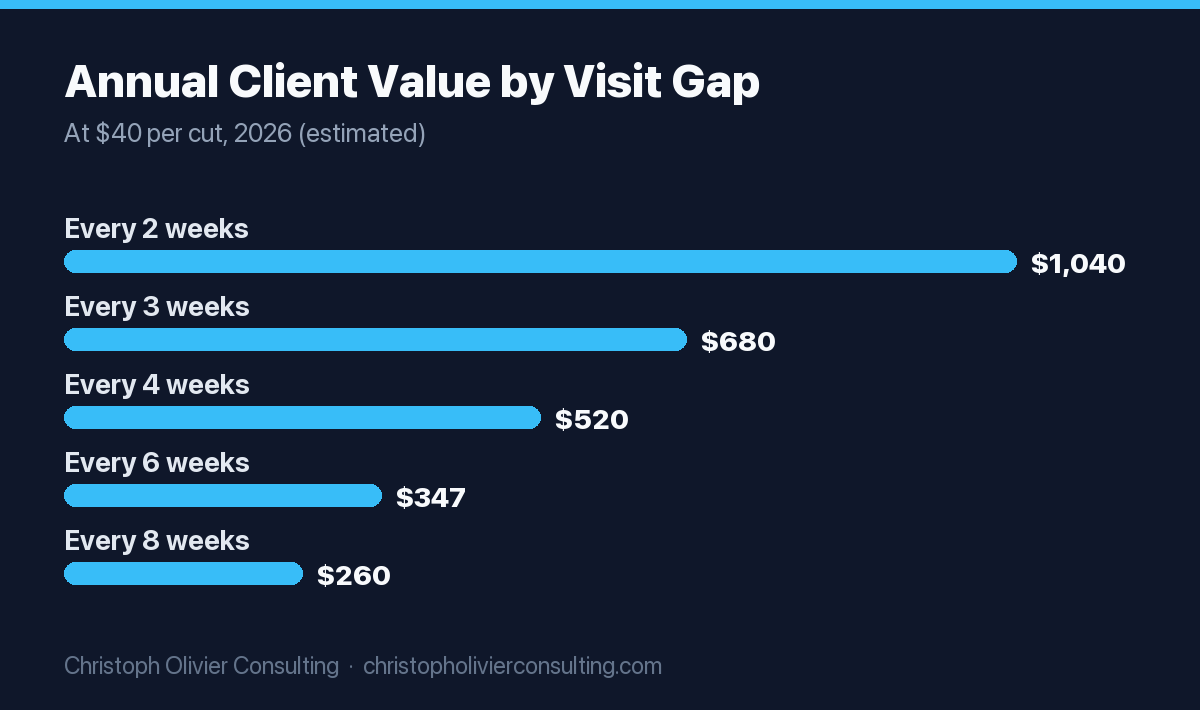
| Visit gap | Visits a year | Revenue a year at $40 | Revenue over 2 years |
|---|---|---|---|
| Every 2 weeks | 26 | $1,040 | $2,080 |
| Every 3 weeks | 17.3 | $693 | $1,387 |
| Every 4 weeks | 13 | $520 | $1,040 |
| Every 6 weeks | 8.7 | $347 | $693 |
| Every 8 weeks | 6.5 | $260 | $520 |
Assumptions: $40 average ticket, no tips or product sales, and a client who stays 2 years. Swap in your own average ticket and the average tenure from your booking app’s client report.
Worked example: a client on a 4-week gap brings $520 a year. Paying a $12 marketplace fee for that client is 2.3% of the first year’s revenue. The same client moved from a 6-week to a 4-week gap is worth $173 more a year, which is why the rebook question at checkout (“Same time in four weeks?”) is the highest-return sentence in the shop. Turn on the app’s rebooking prompt, and track one number weekly: the share of completed appointments that leave with the next one booked.
Text reminders and promo texts without a TCPA problem
Your booking app’s reminder texts and your promotional blasts are treated differently. Reminders about an appointment the client booked are informational. A “20% off this Tuesday” blast is marketing, and under the federal rule a marketing text sent with an autodialer needs the client’s prior express written consent. That consent must tell the client they are not required to agree as a condition of buying anything.
Copy-ready opt-in checkbox for your booking form (unticked by default):
“Text me offers and openings from [Shop] at this number. Consent is not required to book. Msg frequency varies. Msg and data rates may apply. Reply STOP to opt out.”
| Rule or fee | What it means for a shop | Status |
|---|---|---|
| Opt-out words | “Stop,” “quit,” “end,” “revoke,” “opt out,” “cancel” or “unsubscribe” count as revoking consent; other wording counts if a reasonable person would read it as opting out | In force (47 CFR 64.1200(a)(10)) |
| Honor opt-outs | Within a reasonable time, no more than ten business days | In force |
| New revocation rule | Senders may treat a revocation as applying only to the category of informational messages it was aimed at, and may designate an exclusive means to revoke | Published Oct 26, 2026; effective Nov 25, 2026 (91 FR 67214) |
| Calling hours | No telephone solicitation before 8 a.m. or after 9 p.m., client’s local time | In force (64.1200(c)(1)) |
| Damages | $500 per violation, up to three times that if willful or knowing | In force (47 U.S.C. 227(b)(3)) |
| 10DLC brand registration | $4.50 one-time; Standard brand vetting $41.50 one-time (brands above 6,000 segments a day) | Current (Twilio brand docs) |
| 10DLC campaign fees | $15 one-time campaign vetting; $1.50 to $10 per campaign per month ($2 for sole proprietors) | Current (Twilio 10DLC overview) |
10DLC fees only hit you if you text from your own business number through a provider like Twilio. If you send through Booksy, Squire or Fresha, the platform handles the sending. The full timeline, including the one-to-one consent rule that was vacated in 2025, is in our SMS marketing statistics. None of this is legal advice; have counsel review your opt-in wording.
Paid ads for a barbershop: Google Search and a Meta local radius
Ads make sense when you have empty slots to sell: a new barber, a new location, or slow weekdays. The closest categories in the 2026 LocaliQ and WordStream Search Advertising Benchmarks (US medians, April 2025 to March 2026) are:
| Category | Avg CPC | Click-through rate | Conversion rate | Cost per lead |
|---|---|---|---|---|
| Beauty & Personal Care | $4.62 | 6.75% | 10.35% | $39.25 |
| Personal Services | $7.17 | 7.16% | 12.34% | $54.60 |
| All industries | $5.42 | 6.64% | 8.18% | $66.69 |
Barbershops are not broken out on their own, so treat these as a range. Beauty and Personal Care CPC fell 18.95% from the prior edition, per WordStream’s 2026 report. Budget math at the Beauty and Personal Care median: $300 a month ÷ $39.25 cost per lead ≈ 7.6 leads. LocaliQ counts a lead as a click that contacts you by phone, chat, form fill or email, so not every lead becomes a booked chair. Compare that $39.25 with the $8 to $12 a marketplace charges on a $40 first visit, and ads only win when the marketplace cannot fill the slots. Category-by-category detail is in our Google Ads CPC by industry breakdown.
Meta (Facebook and Instagram) local radius, set up correctly. Meta’s help page on location targeting (read via an archived copy from 11 October 2026) gives the settings that matter for a shop:
- In Ads Manager, at the Ad set level, open Audience, then Locations.
- Use Drop pin on the shop’s address and drag the radius slider. Meta says the radius minimum and maximum vary by location type, and a radius is not possible on ZIP codes, states or countries.
- If you target a city, Meta may tick “Reach more people likely to respond to your ads” by default. Untick it if you only want people near the shop.
- Run a before and after reel with one offer for a slow day, and send clicks straight to your booking link.
The barbershop market in numbers
These figures explain why barber lead generation looks so different from salon or spa marketing: the typical barbershop is one person.
| Measure | Figure | Source |
|---|---|---|
| Barbers on payrolls, May 2025 | 15,000 | BLS OEWS, occupation 39-5011 (excludes the self-employed) |
| Median wage, payroll barbers | $18.37 an hour; $38,210 a year | BLS OEWS, May 2025 |
| Barber shops with employees (NAICS 812111), 2023 | 7,789 establishments; 29,017 employees; $977 million annual payroll | Census County Business Patterns (2023 is the latest year) |
| Share of those with fewer than 5 employees | 75.5% (5,884) | CBP 2023; share is our arithmetic |
| Barber shops with no employees, 2024 | 154,456, with $5.07 billion in receipts | Census Nonemployer Statistics |
| Average receipts per nonemployer shop | About $32,800 | Our arithmetic from Nonemployer Statistics 2024 |
There are roughly 20 one-person barber businesses for every barbershop with a payroll. That is why so many barbers market themselves, not the shop: each booth renter needs a personal booking link, a profile on the marketplace, and their own regulars. If you own the shop, give each barber their own booking link and track new clients per chair. If you are a vendor reading this to sell to barbershops, the same numbers say your buyer is usually a solo operator on a phone, not an office manager.
For the salon side of the same playbook, with color and chemical services that change the rebooking math, see our salon marketing guide.
90-day barbershop lead generation plan with weekly targets
Set the numbers from the chair math table first: your active-client target and the new clients you need each month. Then work the plan in order. Each week has one task and one number to check.
| Week | Task | Target to check that week |
|---|---|---|
| 1 | Pull a client report from your booking app: active clients, average visit gap, lapsed clients | 3 baseline numbers written down |
| 2 | Fix the Google profile: specific barber category, full service menu with prices, hours, 10 or more cut photos | Every service on the menu has a price |
| 3 | Connect the booking provider or add your booking link to the profile | Book button or link live on the profile |
| 4 | Turn on the post-visit review text for every completed appointment, no reward | 100% of appointments get the text |
| 5 | Train the rebook question at checkout and turn on the app’s rebook prompt | Share of clients leaving with a booking, measured daily |
| 6 | Decide on the marketplace: turn on Boost, New Client Connection or Fresha marketplace, or Client Discovery, only for barbers with open slots | New marketplace clients per chair, and fees paid |
| 7 | Add the SMS opt-in checkbox to the booking form | Opt-in rate on new bookings |
| 8 | Text lapsed clients who opted in: one “we have openings” message with a booking link | Rebookings from the lapsed list |
| 9 | Start a referral credit for both people, paid after the friend’s first paid visit, kept separate from reviews | Referred first visits |
| 10 | Post 3 short before and after clips with the booking link pinned | Bookings from the link in bio |
| 11 | If slots are still empty, test Google Search or a Meta radius ad on your slowest day | Cost per booked first visit vs the marketplace fee |
| 12 | Review each channel’s cost per new client and cut the most expensive | One channel kept, one dropped |
| 13 | Rerun the week 1 report and compare | Active clients, average gap and lapse rate vs baseline |
The order matters. Reviews, the Book button and the rebook habit cost nothing and make every paid channel convert better, so they come before the marketplace fee or the ad budget. In my view, most shops that say they need more leads actually need a shorter visit gap. If you would like a second pair of eyes on your numbers, you can book a consultation.
Frequently asked questions
What is the best lead generation for a barbershop?
For most shops it is the booking app's marketplace plus a complete Google Business Profile with a Book button, honest reviews requested from every client, and a rebook at checkout. Marketplace fees are published: on a $40 first visit Booksy Boost and StyleSeat charge $12, Fresha $8 and theCut's free plan $10. Paid ads come after those, to fill empty slots.
How much does Booksy charge for new clients?
Booksy costs $29.99 a month plus tax, plus $20 a month per extra user. Its Boost feature is free to turn on and charges a one-time fee of 30% of a Boost client's first visit, up to $100. Clients who book through your own Booksy profile link are not charged as Boost clients, per Booksy's US pricing page.
How many clients does a barber need to fill a chair?
Multiply weekly appointment slots by the average gap between visits in weeks. A barber with 40 slots a week needs about 120 active clients if regulars come every 3 weeks, and about 240 if they come every 6 weeks. Shortening the visit gap is often a faster way to fill the chair than finding more new clients.
Can a barbershop give a discount for a Google review?
No. Google's Maps content policy bars incentives such as payment, discounts or free services for posting a review, and the FTC rule at 16 CFR 465.4 bans rewards conditioned on positive or negative reviews. Google also bars asking only happy clients and asking for reviews that name a barber. Ask every client, with no reward attached.
Do barbershops need consent to text clients?
Appointment reminders for a booking the client made are informational. Promotional texts sent with an autodialer need prior express written consent, and the consent form must say agreeing is not a condition of buying. Clients can opt out with words like stop or cancel, and opt-outs must be honored within ten business days under 47 CFR 64.1200.
Are Google Ads worth it for a barbershop?
Only when you have empty slots a marketplace cannot fill. The 2026 LocaliQ and WordStream benchmarks put Beauty and Personal Care at a $4.62 median cost per click and $39.25 per lead, against $8 to $12 for a marketplace first visit on a $40 cut. Test ads on your slowest day and compare cost per booked first visit.
More Growth, Strategy & Sales guides
- Google Ads Budget for Small Business: How Much to Spend and How to Split It
- Handyman Marketing: The Channel Plan That Books More Jobs
- How Much Does Digital Marketing Cost?
- How Much Does SEO Cost in 2026?
- Junk Removal Marketing: A Channel-by-Channel Booking System
- Landscaping Marketing in 2026: Cost Per Booked Job by Channel
- Salon Marketing: The 2026 Playbook for Bookings and Rebooks
- All Growth, Strategy & Sales guides →