
Last reviewed: October 2026

Salon marketing is the system that gets new clients to book, gets them back in the chair on schedule, and keeps your book full on slow days. In 2026 the work that pays most often sits in five places: a fast online booking flow, a complete Google Business Profile, a steady flow of fresh reviews, consented before-and-after content, and a rebooking habit at checkout. Ads and promotions help most once those five are working.
This playbook is written for salon owners and managers who want a plan rather than another list of 50 ideas. Every benchmark below links to the report it came from. Where good data does not exist, I say so instead of quoting a number nobody can trace.
What salon marketing means in 2026 (and where to start)
Salon marketing in 2026 is less about posting more and more about removing friction between interest and a booked appointment. Start with the booking flow and your Google profile, because those capture people already looking. Then build retention, because a client who rebooks costs far less than a new one you have to find.
The context matters. The Bureau of Labor Statistics counts 595,000 hairdresser, hairstylist and cosmetologist jobs in 2025 and projects 8% growth from 2025 to 2035. It also reports that 48% of hairdressers, hairstylists and cosmetologists are self-employed. Many of your competitors are booth renters and suite owners. Your edge as a salon is the system: one brand, one booking path, one review profile, and a team that rebooks every client.
Use this order of operations:
- Capture: booking flow, Google Business Profile, reviews.
- Keep: rebooking at checkout, reminders, memberships.
- Grow: content, referrals, partnerships, gift cards, then paid ads.
Here is how the main tactics compare on cost and speed.
| Tactic | Main job | Cash cost | Typical time to see impact | KPI to watch |
|---|---|---|---|---|
| Online booking + Reserve with Google | Convert people already looking | Software fee, possible per-booking fees | Days to weeks | Online booking rate |
| Google Business Profile | Show up in Maps and local search | Free | Weeks | Calls, booking clicks, direction requests |
| Review requests | Win the comparison | Free | Weeks | New reviews per month, average rating |
| Rebooking at checkout | Keep clients on schedule | Free (training time) | Immediate | Rebook rate |
| SMS and email | Reminders, slow-day fills, win-backs | Low | Immediate | No-shows, fill rate of last-minute gaps |
| Instagram and TikTok | Show the work, build demand | Time | Months | Profile booking clicks |
| Referrals, gift cards, partnerships | Turn clients into a channel | Reward cost | One to three months | New clients by source |
| Paid social and search ads | Add volume on demand | Ad spend | Days | Cost per first booking |
Fix the booking flow first: online booking and Reserve with Google
The fastest salon marketing win is usually a shorter path to “booked.” Clients should be able to pick a service, a stylist and a time from your Google listing, Instagram profile and website in under a minute, without calling. Every extra step or phone-only service loses some people who were ready to book.
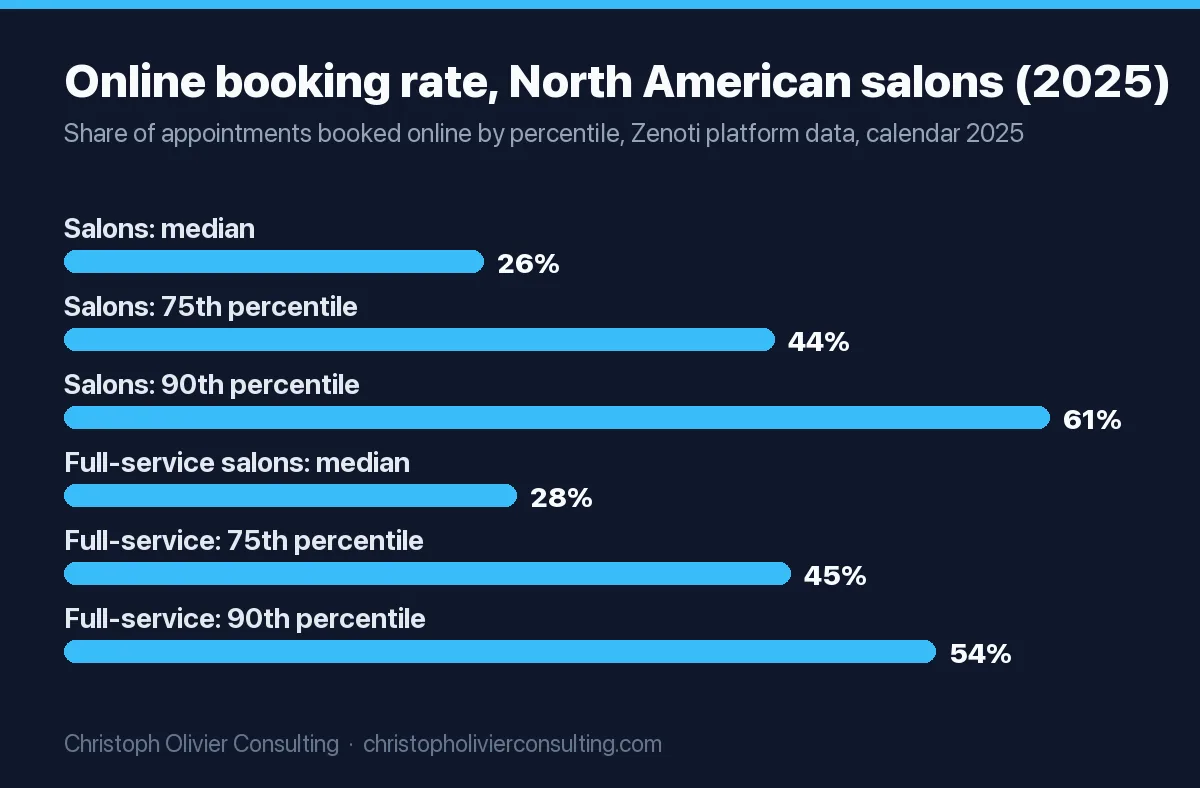
How far the best salons have taken this shows up in Zenoti’s 2026 Beauty and Wellness Benchmark Report (Salon Edition), which aggregates calendar-year 2025 data from North American businesses on its platform. The median salon took 26% of appointments online, while salons at the 90th percentile took 61%. For full-service salons the spread was 28% at the median and 54% at the 90th percentile. Zenoti calls these directional, but the gap is wide enough to act on.
Booking flow checklist
- Every service on your menu is bookable online, including consultations for color corrections and extensions.
- Service names match what clients search (“balayage,” “silk press,” “brow lamination”), not internal codes.
- Deposits or card-on-file policies are stated before checkout, not sprung at the end.
- The same booking link sits on your Google profile, Instagram bio, website header and confirmation texts.
How to turn on booking from Google
Google’s Business Profile help page on bookings describes the setup. You open your Business Profile, go to the Bookings section, choose “Get started,” select a supported provider and confirm. Google says the provider appears on your profile within a week. It also notes that your provider may charge you for bookings made through Google, and that you can add your own booking link instead if your software is not a partner. Check your salon software’s integration page before you assume it is supported.
Google Business Profile and local SEO for salons
Your Google Business Profile is often the first thing a new client sees, before your website or Instagram. Choose the most specific primary category, list every service with prices or “from” prices, add real photos of your space and team, keep hours current, and post updates monthly. A complete, active profile gives Google and clients more reasons to choose you.
Local search also rewards consistency: the same name, address and phone everywhere, and one website page per core service with the neighborhood named naturally. If you serve several areas or have more than one location, the structure in our local SEO playbook for service businesses applies to salons almost line for line.
Clients choose stylists on visual proof, so upload finished work regularly (with consent, covered below) plus exterior and interior shots.
Reviews: how many you need and how to ask
Reviews decide most salon comparisons. A steady stream of recent, specific reviews, each answered by the owner, often matters more than a perfect average. Ask every happy client at checkout with a direct link or QR code, reply to every review within a week, and never offer a discount or freebie in exchange for one.
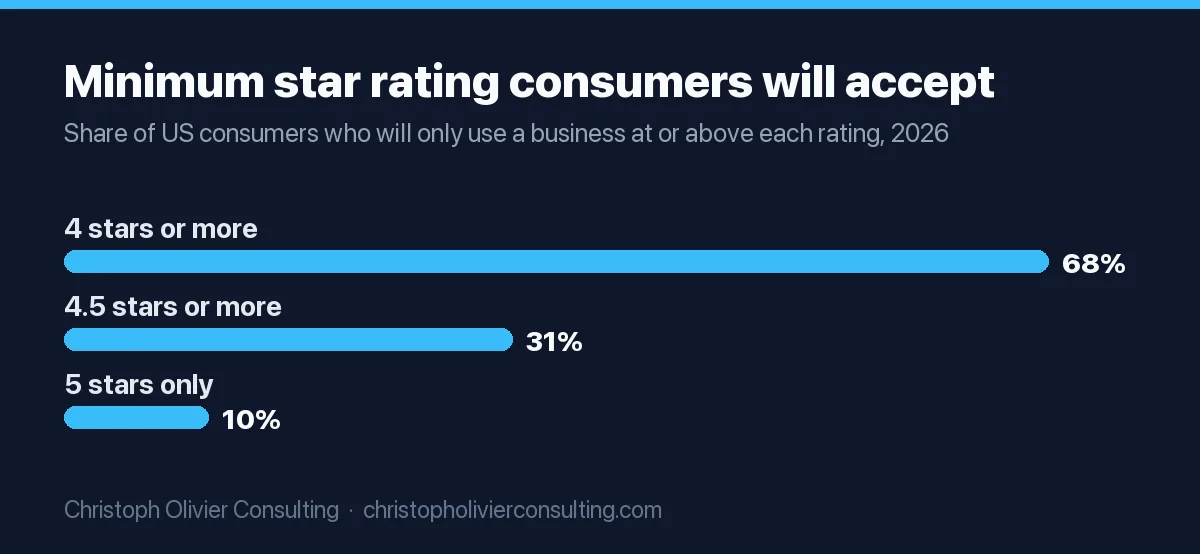
The demand side is clear in BrightLocal’s Local Consumer Review Survey 2026, a panel of 1,002 US adults. It found that 97% of consumers read reviews online and 41% “always” read them when browsing for businesses. Recency and volume both count: 74% look for reviews written in the last three months, and 47% will not use a business with fewer than 20 reviews. The same survey found 89% of consumers expect owners to respond to reviews, and 83% of people who were asked to leave a review went on to leave one. Asking works.
One shift worth noting: BrightLocal reports Google’s share of consumers’ review sources dipped from 83% in 2025 to 71% in 2026, while AI tools such as ChatGPT rose from 6% to 45%. Specific reviews on several platforms give those tools more to quote.
The rules you have to follow
- Google: its review tips page says offering incentives such as free or discounted goods or services in exchange for reviews is strictly prohibited. That is stricter than federal law, so “10% off for a review” is out on Google.
- FTC: the FTC’s final rule on fake reviews and testimonials bans fake reviews, incentives conditioned on review sentiment, and review suppression through threats or intimidation. Staff and family should not post reviews of your salon.
Template: the checkout review ask
At the desk: “I’m so glad you love it. Would you mind sharing a quick review on Google? It really helps new clients find [stylist name]. I’ll text you the link now.”
Follow-up text (same day): “Thanks for coming in today, [first name]. If you have a minute, your honest review helps us a lot: [review link]. Reply STOP to opt out.”
Owner reply to a 5-star review: “Thank you, [name]. [Stylist] loved working on your [specific service]. See you in [rebook interval].”
Instagram and TikTok: before-and-after content with consent
Social media works for salons when it shows real transformations and makes booking one tap away. Post short videos of the process and the reveal, tag the location, name the service in the caption, and put your booking link in the profile. Get written permission before you post any client’s face or hair, every time.
Formats that tend to work for salons:
- Transformation reels: before, the process in a few cuts, the reveal in natural light.
- Stylist spotlights: who does what, so clients can book the right person.
- Education: short answers to questions clients already ask, such as what a toner does.
- Slot fills: stories that say “two openings Thursday afternoon” with the booking link.
Our roundup of successful Instagram campaigns shows principles that scale down to a single chair: one clear idea, a strong first second, and an obvious next step.
Checklist: photo and video consent
- A written or digital consent form signed before any photo or video is taken, stored with the client record.
- Separate tick boxes for: social media, website, paid ads, and showing the face versus hair only.
- Clear language that the client can withdraw consent later, and a process to remove posts when they do.
- No content of minors without a parent or guardian’s consent.
- Credit the stylist and avoid editing that misrepresents the result, since misleading before-and-after images can create consumer protection risk.
Rebooking and retention: the salon marketing strategy with the best math
Rebooking at checkout is the cheapest salon marketing strategy you have. A client who leaves with the next appointment already booked is far more likely to return on schedule than one who “will call.” Train every stylist to recommend the next visit by service interval, and track rebook rate per stylist every week.
Benchmarks vary by market and by how platforms define the metric. Zenoti’s 2026 European salon data puts the median salon rebooking rate at 24%, the 75th percentile at 33% and the 90th percentile at 41%. Its North American salon report adds a warning: it found a 72% cancellation rate on first-time rebooked appointments, against 4% for guests rebooked two or more times. The first rebook is fragile; the habit sticks once a client has rebooked a couple of times, so reminders and easy rescheduling matter.
Worked example: what a higher rebook rate is worth
This is illustrative arithmetic, not a forecast. Assume a salon with 300 client visits a month and an average ticket of $77, the median salon ticket in Zenoti’s 2026 North American report.
- Moving the rebook rate from 24% to 33% (median to 75th percentile in Zenoti’s European data) adds 9 rebooked visits per 100 visits, or 27 a month.
- Assume only half of those are truly incremental, since some clients would have booked anyway and some first rebooks get cancelled. That leaves about 13 or 14 extra visits a month.
- At $77 a visit, that is roughly $1,000 to $1,080 a month, or about $12,000 to $13,000 a year, with no ad spend.
Your numbers will differ, but a nine-point move in a free, trainable behavior can be worth more than a modest ad budget.
Memberships
Memberships (a monthly fee for a set service, such as a blowout or gloss, plus perks) lock in visit frequency. In Zenoti’s 2026 North American salon report, salons with memberships grew sales 8% versus 2% for salons without, and existing guest visits 12% versus 3%. That is a correlation, not proof that memberships caused the growth, but it supports testing one simple membership tied to a high-frequency service.
SMS and email: reminders, slow-day fills and TCPA consent
Text messages are the salon’s best tool for reminders, last-minute openings and win-backs, and email suits newsletters and longer offers. The catch is consent. Marketing texts need clear, written opt-in under federal rules, separate from appointment reminders, and every opt-out must be honored quickly. Build consent into booking from day one.
Under the FCC’s rule at 47 CFR 64.1200, “prior express written consent” is a signed agreement (electronic signatures count) that clearly authorizes the business to send advertisements or telemarketing messages using an autodialer or prerecorded voice to a specific phone number. The same rule says revocation requests made in any reasonable manner must be honored within a reasonable time not exceeding ten business days, and it bars calls to residential subscribers before 8 a.m. or after 9 p.m. local time. States can add rules, so have counsel review your opt-in language (this is not legal advice).
Template: SMS opt-in language at booking
“[ ] Yes, send me appointment reminders by text.” (transactional)
“[ ] Yes, [Salon legal name] may send me marketing texts, including openings and offers, at the number above using automated technology. Consent is not a condition of purchase. Msg and data rates may apply. Reply STOP to opt out, HELP for help.”
Keep both boxes unchecked by default. Then use the channel in four ways:
- Reminders: a confirmation at booking and a reminder before the visit, with a one-tap reschedule link.
- Slow-day fills: a short text to opted-in clients who are due, naming the stylist and the open slot.
- Win-backs: a personal message to clients who are past their normal interval.
If you are choosing software, our comparison of SMS marketing platforms covers consent capture, segmentation and pricing models to check before you sign.
Hair salon marketing ideas that fill the book: referrals, gift cards and partnerships
The best hair salon marketing ideas turn existing clients and neighbors into a channel. A two-sided referral reward, gift cards promoted before key holidays, and partnerships with nearby businesses that share your clients can all bring in people who arrive already trusting you. Track each with its own code so you know what works.
- Referral program: reward both people, for example a credit for the referrer and a first-visit perk for the friend, issued after the friend’s first paid visit. Keep the referral reward separate from reviews so it never looks like a payment for a rating.
- Gift cards: sell them online and at the desk ahead of gifting seasons. Each one introduces you to a new recipient. Check your state’s rules on expiration dates and fees.
- Local partnerships: wedding planners and bridal shops, photographers, gyms and yoga studios, boutiques. Offer a tracked perk to their clients and a reciprocal one to yours.
- Slow-day offers: target quiet slots only, and prefer a value add (a free treatment on Tuesdays) over a discount.
If you run a barbershop alongside a salon, the walk-in and loyalty mechanics differ, and our barbershop marketing guide covers them. For salons adding injectables or advanced skin services, the compliance bar rises, and the med spa marketing guide is the better starting point.
Pricing and service menu design as marketing
Your service menu is a marketing asset. Clear names, clear “from” prices, and packaged services make booking easier and raise the average ticket without pushing. Tiered stylist levels (new talent, senior, master) let price-sensitive clients find a fit and give senior stylists room to raise prices as their books fill.
- Name services the way clients search: “Balayage with toner and blowout,” not “Color Svc 3.”
- Bundle the add-on: a treatment packaged with color is easier to accept than an upsell at the bowl.
- Price by level: promote stylists on rebook rate and utilization, not tenure alone.
Average ticket benchmarks help you sanity-check pricing. In Zenoti’s 2026 North American data, the median salon ticket was $77, with $90 at the 75th percentile and $142 at the 90th. Full-service salons ran $114 at the median and $169 at the 90th percentile.
Beauty salon marketing metrics to track
Track a short list of metrics weekly, by stylist where possible: rebook rate, online booking rate, utilization, new clients by source, and reviews per month. These tell you whether marketing is filling chairs profitably. Follower counts and likes are useful signals at best, and they are not the scoreboard.
| Metric | How to calculate | Published reference point | Source |
|---|---|---|---|
| Rebook rate | Clients leaving with a future booking / clients served | Median 24%, 75th pct 33%, 90th pct 41% (European salons, 2025) | Zenoti |
| Online booking rate | Online bookings / all bookings | Median 26%, 90th pct 61% (North American salons, 2025) | Zenoti |
| Staff utilization | Booked hours / available hours | Median 47%, 75th pct 65%, 90th pct 79% (salons) | Zenoti |
| Average ticket | Service + retail revenue / visits | Median $77, 90th pct $142 (salons) | Zenoti |
| Reviews per month | New Google reviews in the month | 74% of consumers look for reviews from the last 3 months | BrightLocal |
| New clients by source | First visits tagged by channel or code | No reliable public benchmark; track your own trend | Your booking software |
| Cost per first booking | Channel spend / first visits from that channel | No reliable public benchmark; compare against first-visit ticket | Your ad accounts |
Zenoti does not publish metric definitions on these pages, so treat the reference points as direction and watch your own trend.
A 90-day salon marketing plan
A realistic 90-day plan fixes capture in month one, builds retention in month two, and adds growth channels in month three. Each step builds on the one before, so ads and promotions land on a profile with fresh reviews and a booking flow that converts. Measure the same five metrics at the start and end.
- Days 1 to 14: baseline and booking. Pull current rebook rate, online booking rate, utilization and reviews per month. Make every service bookable online. Connect booking to Google and add the link to Instagram.
- Days 15 to 30: Google profile and reviews. Complete every profile field, list services with prices, upload 20 or more real photos. Start the checkout review ask with a QR code at the desk. Reply to every review.
- Days 31 to 45: rebooking. Set service intervals for each service. Script the rebook recommendation, role-play it with the team, and post rebook rate by stylist weekly.
- Days 46 to 60: consent and messaging. Add photo consent and SMS opt-in to intake. Turn on confirmation and reminder texts. Build a win-back message for clients past their interval.
- Days 61 to 75: content and referrals. Commit to a realistic cadence of transformation reels. Launch a two-sided referral reward with tracked codes.
- Days 76 to 90: partnerships and paid tests. Approach three local partners. Run a small, tightly targeted ad test to your highest-margin service, measured by cost per first booking. Compare all five metrics to day one.
Most salons need the right few tactics done every week, not more tactics. If you want an outside view of which of these will move your numbers first, you can book a consultation and we can look at your data together.
Frequently asked questions
What is the best marketing strategy for a hair salon?
For most salons the best strategy starts with capture and retention rather than ads: make every service bookable online, complete your Google Business Profile, ask every happy client for a review, and rebook clients before they leave. Once those are working, add consented before-and-after content, referrals and partnerships, then test paid ads against cost per first booking.
How much should a salon spend on marketing?
There is no reliable public benchmark specific to salons, so set the budget from your own numbers. Work out what a new client is worth over a year from your average ticket and visit frequency, then decide what you can afford to pay for a first booking. Free channels such as your Google profile, reviews and rebooking usually deserve attention before paid spend.
How do I get more Google reviews for my salon?
Ask at checkout when the client is happiest, then text a direct review link or show a QR code the same day. BrightLocal's 2026 survey found 83% of people asked to leave a review went on to leave one. Reply to every review. Do not offer discounts or freebies in exchange, since Google prohibits review incentives.
What is a good rebooking rate for a salon?
It depends on the market and how your software defines it. Zenoti's 2026 European salon data shows a median rebooking rate of 24%, a 75th percentile of 33% and a 90th percentile of 41%. Track your own rate by stylist weekly and focus on improving the trend, since definitions differ between booking platforms.
Can I post client before-and-after photos on Instagram?
Only with the client's permission. Use a signed written or digital consent form before taking photos, with separate options for social media, website and paid ads, and for showing the face or hair only. Let clients withdraw consent later and remove posts when they do. Avoid edits that misrepresent the result.
Do I need consent to send salon marketing texts?
Yes. FCC rules require prior express written consent for marketing messages sent with automated technology to a phone number, and opt-outs made in any reasonable way must be honored within ten business days. Keep reminder consent and marketing consent as separate, unchecked boxes at booking, and have counsel review your language.
More Growth Consulting guides
- Med Spa Marketing: How to Attract and Keep Clients in 2026
- Barbershop Marketing: The 2026 Playbook to Fill Every Chair
- How to Start Digital Marketing: A Beginner’s First-90-Days Sequence
- 12 Marketing Strategy Frameworks Compared
- Push Notification Marketing: A Playbook for Web and App Push
- How to Create a Marketing Plan (Step by Step, With Template and Example)
- All Growth Consulting guides →