
Last reviewed: October 2026
Successful Instagram campaigns share three traits: one simple thing for people to do or see, creative built for the vertical feed, and a result measured against a baseline or control. The clearest documented examples include TOMS #WithoutShoes (296,243 pairs of shoes given from more than 338,280 tagged photos), LANEIGE’s creator partnership ads (a 28-point ad recall lift) and H&M’s creator-led summer campaign (4.8x higher brand consideration lift).
This page lists 15 campaigns whose results were published by the brand, Meta, an awards body or trade press. Each entry gives the year, format, mechanic, documented result and a reusable lesson, followed by a comparison table, the patterns behind the wins and a planning process.
What makes an Instagram campaign successful?
An Instagram campaign is successful when it hits a goal you set before launch and you can show the lift against a baseline. Likes and follower counts are signals, not proof. The strongest case studies report a measured change: more purchases, lower cost per lead, higher ad recall or consideration in a controlled test.
Most campaigns below do one of four jobs:
- Participation: get people to post something that spreads the brand for you.
- Creator reach: borrow creators’ trust and audience, often through partnership ads.
- Brand lift: move ad recall, awareness or consideration.
- Direct response: drive purchases or leads at a lower cost.
Successful Instagram campaigns built on user-generated content
User-generated content campaigns ask customers to post a photo with a hashtag, then reward participation with a donation, a feature or a prize. They work when the action is easy, the reward is meaningful and the brand promises something concrete per post. TOMS, Aerie, Marc Jacobs, Starbucks and Apple all used versions of this mechanic.
1. TOMS #WithoutShoes (2015, UGC hashtag)
From May 5 to May 21, 2015, TOMS asked people to post a photo of their bare feet on Instagram with #withoutshoes. Each unique photo meant a new pair of shoes for a child in need. According to the Shorty Awards case entry, more than 338,280 barefoot photos were tagged, 296,243 children received shoes and people in over 30 countries took part. The lesson: a one-for-one promise turns a hashtag into a reason to post.
2. Aerie #AerieREAL (2014 onward, UGC plus cause)
Aerie stopped retouching its models in 2014, then built an annual hashtag drive around it. In 2018, Aerie said it would donate $1, up to $25,000, to the National Eating Disorders Association for every unretouched swim photo shared with #AerieREAL, per AEO’s 2018 announcement. By 2021 the cap was $100,000 per year for Instagram posts, and Aerie said it had donated nearly $1.5 million through the partnership, according to Aerie’s 2021 partnership post. The lesson: a value-led campaign can repeat for years.
3. Marc by Marc Jacobs #CastMeMarc (2014, open casting)
Marc by Marc Jacobs invited any Instagram user to audition for its Fall 2014 ad campaign by posting a photo with #CastMeMarc. Nylon reported that over 70,000 people entered. The team shortlisted 50, flew 30 to New York and cast nine. The lesson: being in the ad was the prize.
4. Starbucks #WhiteCupContest (2014, design contest)
Customers decorated a plain white Starbucks cup and posted a photo with #WhiteCupContest. Starbucks picked a winning design from more than 4,000 entries and sold it as a reusable tumbler, as reported by Fast Casual. Brandwatch notes the idea came from customers themselves. The lesson: formalize something customers already do.
5. Apple Shot on iPhone Macro Challenge (2022, photo challenge)
From January 25 to February 16, 2022, Apple invited iPhone 13 Pro owners to share macro photos on Instagram and Twitter with #ShotoniPhone and #iPhonemacrochallenge, as iMore reported. Apple picked 10 winners from tens of thousands of entries and featured them on Apple.com, Apple’s Instagram and billboards in select cities, per iMore’s winners coverage. The lesson: the entries prove the feature.
Instagram campaign examples built on creators and partnership ads
Creator campaigns partner with Instagram creators, then often run that content as partnership ads from the creator’s handle. Meta’s published case studies show the biggest gains came from a diverse mix of creators rather than one niche. H&M, LANEIGE, LG and LOMOJI each documented lift in a Meta measurement study.
If you are building a creator program from scratch, our influencer marketing strategy guide covers selection, contracts and briefs.
6. H&M “Find your beach” (2024, creator video plus CGI)
From June 1 to August 31, 2024, H&M in the US ran creator-produced video and computer-generated imagery through partnership ads and Advantage+ shopping campaigns across Instagram Stories, Reels, Explore and Feed. In Meta’s H&M case study, the creator campaigns delivered 4.8x higher brand consideration lift, 94% lower cost per lift for consideration and 2x higher incremental return on ad spend online and in store compared with conventional campaigns. The lesson: creator content can do brand and sales work at once.
7. LANEIGE JuicePop launch (2026, partnership ads)
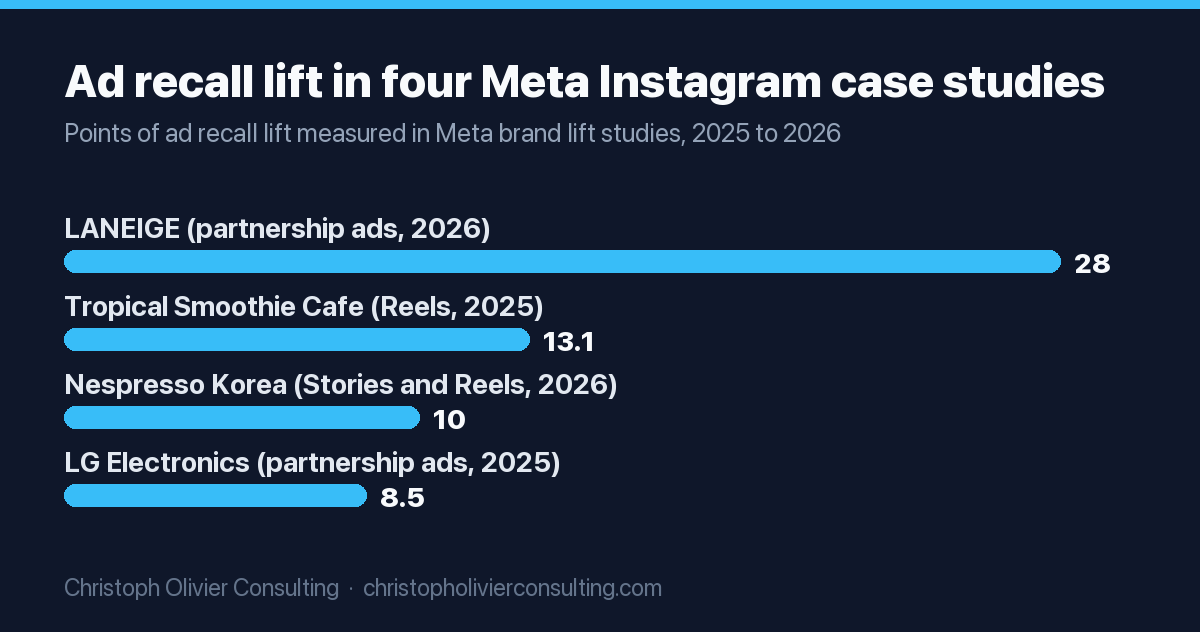
From January 27 to March 31, 2026, LANEIGE promoted its JuicePop lip tint in the US with partnership ads featuring influencers and celebrities, plus photo and video ads with a “Shop now” button to Sephora. It targeted women aged 18 to 44 across Reels, Feed and Stories. Meta’s LANEIGE case study reports a 28-point lift in ad recall, a 22-point lift in awareness and a 7-point lift in consideration. The lesson: familiar faces help launches.
8. LG Electronics xboom speakers (2025, diverse creators)
From April 14 to May 25, 2025, LG ran partnership ads with DJs, artists, beauty creators, dancers and lifestyle creators, across Feed, Stories and Reels. Meta’s LG case study reports an 8.5-point lift in ad recall, a 5.5-point lift in purchase consideration and an 18% increase in content views. The lesson: show many real use cases, not one hero shot.
9. LOMOJI creator mix test (2025, A/B test)
Taiwanese wellness brand LOMOJI ran two Advantage+ sales campaigns from October 29 to November 12, 2025. One used only wellness creators. The other used a mix of lifestyle, beauty, fitness and parenting creators. Per Meta’s LOMOJI case study, the diverse mix produced a 42% lower cost per purchase and 74.6% more purchases. The lesson: your obvious niche may be the least efficient option.
Reels and Stories campaigns that moved brand metrics
Reels and Stories campaigns use full-screen 9:16 video with sound. Meta’s Reels ads guidance says campaigns with 9:16 video, sound and key messages inside the safe zone saw 2x higher delivery to Reels placements. Tropical Smoothie Cafe, Nespresso Korea and Opel Türkiye show the format working for awareness and for leads.
Scale is the reason brands keep testing here: Meta said at the 2025 IAB NewFronts that Reels see 4.5 billion reshares a day. The Meta Reels ads page also cites a survey in which 79% of people reported buying a product or service after seeing it in a Reel. For more creative references in the Stories format, see these Instagram Story ads examples.
10. Tropical Smoothie Cafe “Mermaid Style” (2025, Reels trending ads)
From November 9 to 23, 2025, Tropical Smoothie Cafe promoted a limited-time item with Reels trending ads, which run after top-trending creator Reels. The creative was full-screen vertical video with music and text overlays. Meta’s case study reports a 13.1-point lift in ad recall, a 4.1-point lift in unaided awareness, a 5.7-point lift in consideration and 22% higher three-second video plays than usual campaigns. The lesson: a two-week burst can move brand metrics.
11. Nespresso Korea Vertuo Up launch (2026, Stories sequencing)
From mid-April to late May 2026, Nespresso Korea combined three campaign types across Instagram Feed, Stories and Reels: a short burst, a Story Builder campaign with ad sequencing and target frequency, and Reels trending ads in food, drink and music. Meta’s Nespresso Korea case study reports a 10-point lift in ad recall and a 5.8-point lift in purchase intent. The lesson: sequence the story instead of repeating one ad.
12. Opel Türkiye creative volume test (2026, Reels lead gen)
From March 18 to April 1, 2026, Opel Türkiye tested ad sets with one or two creative assets against ad sets with two to four varied 9:16 videos built for Reels, using instant forms with a “Get offer” button. Per Meta’s Opel Türkiye case study, the higher-volume, diversified creative produced 17% more leads at a 15% lower cost per lead. The lesson: give delivery more creative to work with.
Recent innovative marketing campaigns that spread through participation
The most innovative recent campaigns give people a personal artifact or challenge worth posting. Spotify Wrapped hands users a shareable year in review, Gymshark66 gives them a 66-day pledge, and Addict Aide built a fake influencer to make a point. None of these depends on a big ad budget for its reach.
13. Spotify Wrapped 2025 (shareable data cards)
Wrapped turns each user’s listening data into cards built for social channels such as Instagram Stories. In 2025 Spotify added Listening Age, Wrapped Party and Clubs, per the Spotify newsroom. TechCrunch reported over 200 million engaged users in the first 24 hours, up 19% on 2024, and more than 500 million shares, up 41%. Shares include screenshots and downloads across all apps, not Instagram alone. The lesson: make the customer the subject.
14. Gymshark66 (annual habit challenge)
Every January, Gymshark asks people to pick daily habits across mind, movement and nutrition, track them for 66 days in the Gymshark Training app and share progress with #Gymshark66. Entrants can compete to become a Gymshark athlete. Gymshark says the challenge has helped hundreds of thousands of people build healthier habits,. The lesson: a recurring challenge becomes a ritual.
15. Addict Aide “Like My Addiction” (2016, fictional influencer)
On August 1, 2016, Paris agency BETC launched a fictional Instagram profile that looked like an ordinary lifestyle influencer’s feed. The reveal: it was an alcohol addiction awareness campaign for Addict Aide. Brandwatch reports the account passed 65,000 followers and 50,000 likes by September. The lesson: the format of Instagram itself can be the message.
Successful Instagram campaigns compared: format and result
The table puts all 15 campaigns side by side. Participation campaigns report volume (posts, entries, shares), while the paid campaigns from Meta case studies report lift in a controlled study. Those are different kinds of evidence, so compare within each group, not across groups, and read results as directional.
| # | Brand and campaign | Year | Format | Documented result |
|---|---|---|---|---|
| 1 | TOMS #WithoutShoes | 2015 | UGC hashtag | 338,280+ photos, 296,243 pairs given |
| 2 | Aerie #AerieREAL | 2014 onward | UGC plus cause | Nearly $1.5M donated by 2021 |
| 3 | Marc by Marc Jacobs #CastMeMarc | 2014 | Open casting | 70,000+ entries, 9 cast |
| 4 | Starbucks #WhiteCupContest | 2014 | Design contest | 4,000+ entries |
| 5 | Apple Shot on iPhone Macro Challenge | 2022 | Photo challenge | Tens of thousands of entries, 10 winners |
| 6 | H&M “Find your beach” | 2024 | Creator video, partnership ads | 4.8x consideration lift, 2x incremental ROAS |
| 7 | LANEIGE JuicePop | 2026 | Partnership ads | +28 pts ad recall, +22 pts awareness |
| 8 | LG xboom | 2025 | Partnership ads | +8.5 pts ad recall, +5.5 pts consideration |
| 9 | LOMOJI | 2025 | Creator A/B test | 42% lower cost per purchase |
| 10 | Tropical Smoothie Cafe | 2025 | Reels trending ads | +13.1 pts ad recall |
| 11 | Nespresso Korea | 2026 | Stories sequencing, Reels | +10 pts ad recall, +5.8 pts purchase intent |
| 12 | Opel Türkiye | 2026 | Reels lead ads | 17% more leads, 15% lower CPL |
| 13 | Spotify Wrapped | 2025 | Shareable cards | 200M+ users in 24 hours, 500M+ shares |
| 14 | Gymshark66 | Annual | Habit challenge | “Hundreds of thousands” (brand claim) |
| 15 | Addict Aide “Like My Addiction” | 2016 | Fictional influencer | 65,000+ followers (Brandwatch) |
7 patterns behind successful Instagram campaigns
Across these 15 campaigns, seven patterns repeat: one clear action, a reward tied to the brand, creative made for vertical video, real people over polished models, creator variety, more than one creative asset, and a measurement plan set before launch. You do not need all seven, but the documented winners usually used at least three.
- One action in one line. Post your bare feet. Decorate a cup. If the mechanic needs a paragraph, participation drops.
- A reward that belongs to the brand. A shoe donation, a spot in the ad, a product made from your design.
- Vertical, sound-on creative. The Reels and Stories winners built for 9:16 full screen rather than cropping a TV spot.
- Real people in the frame. Unretouched customers, open casting calls and creators, not models.
- Creator variety beats creator fit. LG and LOMOJI did better with a wider mix of creator types.
- More creative, not just more budget. Opel Türkiye’s gain came from two to four assets per ad set.
- Measurement designed up front. Every Meta case here used a lift study or A/B test, which is why it can report lift instead of reach.
How to plan your own successful Instagram campaign
Plan an Instagram campaign in eight steps: set one goal and metric, pick the campaign type, define the action, choose the face of the campaign, build vertical creative in variants, design the test, launch in a fixed window and review against your baseline. Most small and mid-size brands can run this cycle in four to eight weeks.
If your account foundations are not in place yet, start with our Instagram marketing guide for 2026.
- Set one goal and one metric. Ad recall lift, consideration lift, cost per lead or cost per purchase. Write down the current baseline.
- Pick the campaign type. Participation, creator partnership, Reels or Stories brand ads, or lead and sales ads.
- Define the single action. Post, enter, tap “Get offer” or buy. One sentence.
- Choose the face. Customers, employees or creators. If creators, recruit across categories.
- Build three to five creative variants. 9:16, sound on, key text inside the safe zone. Our guide on how to create Instagram Stories ads covers specs.
- Design the test before launch. Brand lift for awareness, conversion lift or A/B tests for sales, geographic holdouts at higher volume.
- Launch in a fixed window. The cases above ran from two weeks to three months.
- Review, then decide. Keep the winning creative and creators, cut the rest before the next flight.
Worked example: an Instagram campaign plan for a service business
Here is a template for a 7-figure service business, such as a regional accounting firm or home-services company, running its first structured Instagram campaign. The numbers are planning inputs you would replace with your own, not benchmarks or promised results. The structure borrows from the LOMOJI and Opel Türkiye tests.
- Goal: booked consultations, measured by cost per qualified lead.
- Baseline: your last 90 days of cost per lead and lead-to-booking rate.
- Window: six weeks, no creative changes in the first two.
- Face: two staff members and, with written consent, one or two real clients describing their problem. No outcome claims.
- Creative: four 9:16 videos of 15 to 30 seconds: a common mistake, a process walkthrough, a staff introduction, a client story.
- Test: ad set A with one video, ad set B with all four, same audience and budget.
- Offer: a short instant form with a “Book a call” button and three qualifying questions.
- Decision rule: keep the ad set with the lower cost per qualified lead and a booking rate at or above baseline.
In my experience, the qualifying questions matter as much as the creative for service firms. A cheap lead that never books is not a success.
How to measure Instagram campaign success
Measure Instagram campaign success with the metric that matches your goal and a method that isolates the campaign’s effect. Brand lift studies measure ad recall and consideration. Conversion lift and A/B tests measure purchases and leads. Geographic holdout tests compare regions with and without ads. Raw likes and reach alone cannot prove a campaign worked.
| Campaign goal | Primary metric | Measurement method | Example from this list |
|---|---|---|---|
| Awareness | Ad recall lift, unaided awareness lift | Meta brand lift study | Tropical Smoothie Cafe, LANEIGE |
| Consideration | Consideration or purchase intent lift | Meta brand lift study | H&M, LG, Nespresso Korea |
| Sales | Cost per purchase, incremental ROAS | Conversion lift or A/B test | LOMOJI, H&M |
| Leads | Cost per lead, lead-to-booking rate | A/B test of ad sets | Opel Türkiye |
| New customers | Incremental new customers | GeoLift (geographic holdout) | AJIO |
| Participation | Entries, tagged posts, shares | Hashtag and entry counts | TOMS, Starbucks, Spotify |
Indian fashion retailer AJIO shows the GeoLift method: from April 16 to May 20, 2026, it compared regions exposed to Facebook and Instagram ads with control regions. Meta’s AJIO case study reports a 3.9% lift in new customers and a 4.7% lift in engaged view sessions. For the reporting side see our Instagram ads performance playbook.
Honest caveats before you copy any campaign
Treat every published case study as a selected winner. Meta, agencies and brands publish the campaigns that worked, not the ones that failed, and many famous examples ran under conditions that no longer exist. Use these campaigns for mechanics and test ideas, not as a forecast of your own numbers.
- Survivorship bias. Meta’s success stories are real studies, but you never see the campaigns that showed no lift.
- Different markets and budgets. A global beauty brand’s 28-point recall lift says little about a local firm’s likely result.
- Older UGC campaigns had less competition. The 2014 and 2015 hashtag contests ran when organic reach was easier to earn.
- Not every “Instagram” campaign lived on Instagram. Dove’s award-winning #TurnYourBack, often listed beside Instagram examples, centered on TikTok, where it gained 54 million video views from 68 influencer partners, per WPP’s case study.
My view: the safest thing to copy is the test design, not the creative. If you want a second opinion on which mechanic fits your firm and how to measure it, you can book a consultation and we will map it to your goals and budget.
Frequently asked questions
What makes an Instagram campaign successful?
A successful Instagram campaign hits a goal set before launch and shows measurable lift against a baseline or control group. The best documented examples combine one simple action, creative built for vertical video, real people or creators on camera, and a test design such as a brand lift study or A/B test. Likes and reach alone are signals, not proof of success.
What are some examples of successful Instagram campaigns?
Well-documented examples include TOMS #WithoutShoes, which turned more than 338,280 tagged photos into 296,243 pairs of donated shoes in 2015; Marc by Marc Jacobs #CastMeMarc, with over 70,000 entries; H&M's 2024 creator campaign, with 4.8x higher consideration lift; and LANEIGE's 2026 partnership ads, which lifted ad recall by 28 points in a Meta study.
What is the 5-3-1 rule for Instagram?
The 5-3-1 rule is an informal content-mix guideline, not an Instagram policy. It is usually described as five posts that inform or entertain, three that engage or feature your community, and one that promotes your offer. Treat it as a starting ratio for organic posting and adjust it based on what your own audience responds to.
What is the 80/20 rule on Instagram?
The 80/20 rule on Instagram is a rule of thumb that about 80% of your posts should give value, such as tips, stories or entertainment, and about 20% should promote your products or services. It is a planning heuristic, not a platform rule, and campaigns with a fixed launch window often run a heavier promotional mix for a short period.
How long should an Instagram campaign run?
Most documented campaigns ran between two weeks and three months. Tropical Smoothie Cafe ran Reels trending ads for two weeks, LANEIGE ran about nine weeks and H&M ran three months. Choose a fixed window long enough for your test to collect enough results, and avoid changing creative in the first week or two so the comparison stays clean.
How do you measure the success of an Instagram campaign?
Match the measurement method to the goal. Use a Meta brand lift study for ad recall, awareness and consideration, a conversion lift study or A/B test for purchases and leads, and a geographic holdout test such as GeoLift for incremental new customers. Track cost per result against your pre-campaign baseline, and treat raw likes and reach as supporting signals only.
More Content Marketing guides
- Influencer Marketing Strategy: A Step-by-Step Playbook
- Brand Equity: What It Is, How to Measure It, and How to Build It
- Email Marketing Platforms 2026 Guide
- Shopify Email Marketing for DTC Brands
- Brand Strategy for Small Business: Positioning, Messaging, and Visual Identity on a Budget
- Webinar Promotion: Triple Your Registrations
- All Content Marketing guides →