

B2B sales channels are the routes a contract takes from you to a business buyer: field sales, inside sales, outbound prospecting, self-serve or product-led sign-up, B2B ecommerce portals, resellers and referral partners, distributors, cloud marketplaces such as AWS, and events. Which ones you should run depends mostly on your average contract value (ACV). At 2026 benchmark pay and quota, a rep-led sale costs roughly 30 to 36 cents per dollar booked, a partner commission about 23.5 cents, and a cloud marketplace private offer 3 cents on top of the sales effort you still need.
Below: the full channel map, a comparison table, the cost-of-sale math on a $40,000 deal, a decision tree by ACV, and a 90-day test plan for adding channels to increase B2B sales.
The 9 B2B sales channels compared
Every B2B channel is either direct (your people or your website close the deal) or indirect (another business sits between you and the buyer and takes a cut). The table compares them on the four things that decide fit. The ACV bands are my rules of thumb, derived from the cost math further down; the cost figures are sourced.
| Channel | Type | Deal size fit (ACV) | Cost of sale reference | Cycle | Control of customer |
|---|---|---|---|---|---|
| Field sales (in-person AE) | Direct | $100,000+ | Loaded AE cost / quota: about 30% of new bookings at median, plus travel | Longest | Full |
| Inside sales (remote AE) | Direct | $10,000 to $100,000 | Same AE math, no travel | Medium | Full |
| Outbound (SDR prospecting) | Direct, pipeline source | $25,000+ | Adds about 5 points: one SDR per 2.4 AEs | Adds a prospecting stage | Full |
| Self-serve / product-led | Direct, digital | Under $10,000, or an entry offer | Marketing and payment costs only, no rep | Shortest | Full |
| B2B ecommerce portal | Direct, digital | Repeat orders at any size | Platform and integration costs | Short for reorders | Full |
| Resellers and referral partners | Indirect | Segments or regions you cannot staff | Commission: 23.5% average among top PartnerStack vendors (2023) | Medium, slow to ramp | Shared |
| Distributors and wholesalers | Indirect | Physical goods, many small buyers | Distributor discount off list price | Short per order, long to get listed | Low |
| Cloud marketplaces (AWS, Microsoft, Google Cloud) | Indirect checkout | Software sold to buyers with cloud commitments | 3% standard; 2% or 1.5% on large private offers; 1.5% on many renewals | Can shorten procurement | High |
| Events and trade shows | Direct, meeting source | $50,000+ or concentrated industries | Booth, travel and staff time per event | Medium | Full |
The cost column tells you how much of a dollar each channel keeps. The type column tells you who owns the customer relationship at renewal time, which matters as much as the first sale.
Direct field sales
Account executives meet buying groups in person, run discovery and negotiate. It is the most expensive channel per rep, so it only pays where one rep can close a quota’s worth of revenue in ten or fewer deals a year. Bridge Group’s 2026 AE study of 158 B2B companies puts median AE on-target earnings (OTE) at $200,000, median quota at $960,000 and average ramp at 6.2 months. Only 48% of AEs were at quota.
Inside sales
The same AE role, selling by video, phone and email. It covers more accounts per rep because nobody travels, which is why it is the default for mid-market deals. The cost math matches field sales minus travel and expenses. Bridge Group does not publish separate field and inside figures, so treat the $200,000 OTE as the benchmark for both.
Outbound prospecting
Sales development reps (SDRs) or founders contact accounts that have not raised their hand. Bridge Group’s 2025 SDR report (351 companies, published February 2025) gives the unit economics: median SDR OTE $80,000, a median quota of 10 held meetings a month, 6 converted to an opportunity, $3.78 million of pipeline per SDR per year, one SDR for every 2.4 AEs, and 40% annual attrition. Outbound fails when it is generic: Gartner found 73% of B2B buyers actively avoid suppliers who send irrelevant outreach. Our outbound lead generation playbook covers list building and sequences.
Self-serve and product-led growth
The buyer signs up, starts a trial or books and pays without talking to a rep. For software this is product-led growth: free plan or trial, in-app upgrade, sales only for expansion. For a service firm it is published price ranges, a scoping form and a self-booking calendar. This is the channel 67% of buyers say they want: Gartner’s survey of 646 buyers in August and September 2025 found 67% prefer a rep-free experience, and 45% used AI during a recent purchase.
B2B ecommerce portals
A logged-in catalog with customer-specific prices, quick reorder, purchase order checkout and often EDI. This is where most B2B digital revenue already sits. The U.S. Census Bureau’s E-Stats report found e-commerce was 67.8% of all manufacturing shipments and 33.3% of merchant wholesaler sales in 2019 (the last year Census published as a written report; later years are released as a data visualization). Census counts EDI and other electronic orders as e-commerce, so that figure is mostly system-to-system reordering, not shopping carts. If your buyers reorder the same items, a portal frees reps from order-taking.
Partners and resellers
Resellers, value-added resellers (VARs), agencies and referral partners sell to customers they already serve, for a commission or margin. PartnerStack reports that its top 25 vendors paid an average commission of 23.5% in 2023, with 20%, 25% and 30% the most common offers. Referral partners in professional services often work on reciprocity instead of fees. Partners need a partner relationship management (PRM) system such as Impartner or PartnerStack and account mapping such as Crossbeam to stay aligned across regions, deals and handoffs. Tier design, deal registration rules and PRM prices are in our channel sales program template.
Distributors and wholesalers
A distributor buys your product at a discount, holds inventory and resells to many smaller business buyers, usually with its own sales force and credit terms. You gain reach and lose the customer data: the distributor owns the end-buyer relationship. It fits physical goods with many small buyers (industrial supplies, components, building products). It rarely fits services or software.
Cloud marketplaces: AWS, Microsoft and Google Cloud
For software, a marketplace listing lets the buyer purchase through their existing cloud bill and, in many cases, count the spend against a committed cloud budget. The fees are published:
| Marketplace | Public / standard offer | Private offer by total contract value | Renewals and extras |
|---|---|---|---|
| AWS Marketplace (since January 5, 2024) | SaaS 3%; server products 20% | Under $1M: 3%; $1M to under $10M: 2%; $10M+: 1.5% | All renewals 1.5%; channel partner private offers add 0.5% |
| Microsoft Marketplace | 3% store service fee | 3% | 50% fee discount on qualifying private offer renewals |
| Google Cloud Marketplace (announced May 2025) | 3% | Under $1M: 3%; $1M to under $10M: 2%; $10M+: 1.5% | Channel shifts, migrations and native renewals: 1.5% |
The catch: a marketplace is a checkout, not a demand source. Your rep still finds and works the deal. The fee is an added cost unless it shortens procurement or opens budget the buyer could not otherwise spend.
Events and trade shows
Conferences, trade shows and your own roundtables compress weeks of trust-building into one meeting. They are lumpy and costly, so they pay when you book meetings with named target accounts before the event, not when you wait for foot traffic. Marketers are leaning in: in CMI and MarketingProfs research for 2026, 33% of B2B marketers plan to increase investment in events and experiential marketing.
How buyers move between channels, and what it means for your mix
No single channel carries a B2B deal from first touch to signature. Buyers prefer a rep-free start, then want a person for fit questions. Gartner’s survey of 632 buyers (August to September 2024) found they prefer to complete an average of 3.0 buying activities both online and with reps, 2.3 with reps only and 1.8 through self-service.
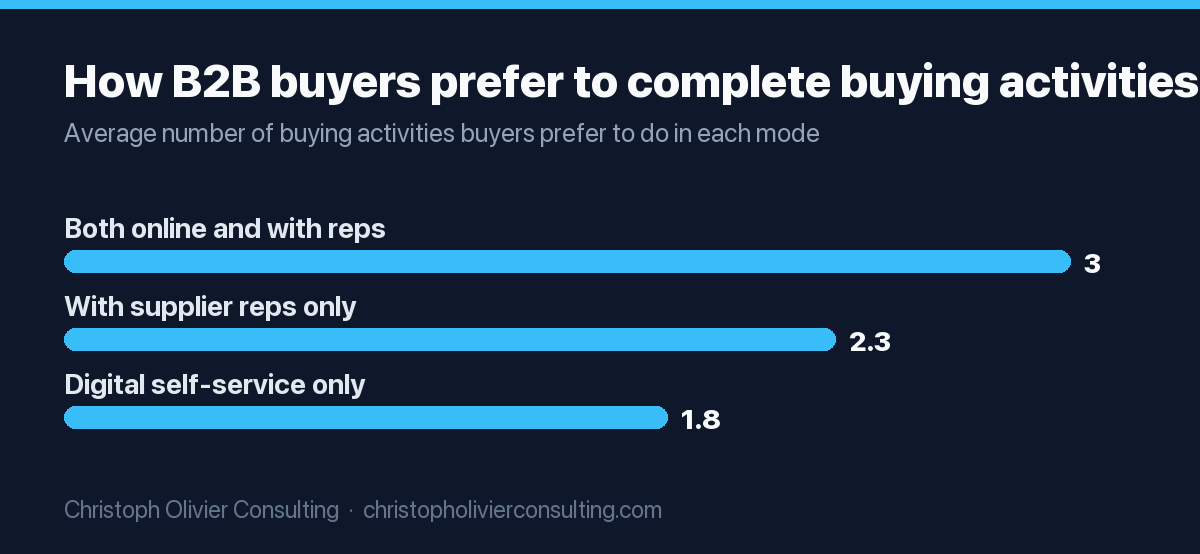
Three numbers set the constraints:
- 17% of buying time goes to meeting all potential suppliers combined, per a Gartner survey of 750 buyers shown in Gartner’s 2021 webinar deck (the rest is independent research online 27%, offline 18%, buying-group meetings 22%, other 16%). With three suppliers in the running, that is about 5 to 6% each. Your website and partners do most of the selling.
- 69% of buyers see inconsistencies between a supplier’s website and what its sellers say (Gartner, June 2025). Adding channels multiplies that risk.
- 39% of buyers would spend over $500,000 per order through self-service or remote rep channels, up from 28% two years earlier, in McKinsey’s ninth B2B Pulse survey of 3,942 decision makers, as reported by Digital Commerce 360. Inside sales and digital are not just for small deals.
The rest of the buyer data, with fieldwork dates for every figure, is in our B2B sales statistics. The practical rule: every channel mix needs one self-serve path and one human path, telling the same story.
Cost of sale per channel: a worked example on a $40,000 deal
Cost of sale is what you spend to win a dollar of new contract value. Here it is for one $40,000 first-year contract, built from published benchmarks. The arithmetic is mine; the inputs are sourced.
Inputs. AE OTE $200,000 and quota $960,000 (Bridge Group 2026). SDR OTE $80,000 and 1 SDR per 2.4 AEs (Bridge Group 2025). Loading for benefits and payroll taxes: wages are 68.5% of total compensation cost for full-time private industry workers, per the BLS Employer Costs for Employee Compensation release for June 2026, so fully loaded cost is OTE divided by 0.685.
| Channel | Calculation | Cost per $1 booked | Cost on a $40,000 deal |
|---|---|---|---|
| AE only (inside or field, before travel) | $200,000 / 0.685 = $291,970 loaded, / $960,000 quota | $0.30 | $12,165 |
| AE plus SDR outbound | AE $291,970 + SDR ($80,000 / 0.685 / 2.4 = $48,662) = $340,632, / $960,000 | $0.35 | $14,193 |
| Reseller or referral partner | 23.5% commission (PartnerStack top-vendor average) | $0.235 | $9,400 |
| AE plus AWS Marketplace private offer | AE $0.30 + 3% listing fee | $0.33 | $13,365 |
| AWS Marketplace renewal (year 2) | 1.5% renewal fee, assuming no AE commission on the renewal | $0.015 | $600 |
Three things the table shows that a generic channel list does not:
- Rep-led cost assumes the rep hits quota. At 75% average attainment, the AE line becomes $291,970 / $720,000 = $0.41 per dollar, or $16,220 on the same deal. With only 48% of AEs at quota in 2026, budget for this, not the median.
- Partners look cheaper than they are. The 23.5% excludes the channel manager, enablement and co-marketing you fund to get partners selling. One $150,000 loaded channel manager supporting $1 million of partner bookings adds 15 cents per dollar, pushing the partner channel to about $0.385 (illustrative figures).
- Marketplaces win on renewals, not new logos. On the first deal the marketplace adds 3 points of cost. It pays back when it removes a procurement stall or when renewals flow through at 1.5%.
Swap in your own OTE, quota and attainment. If your number is above your first-year gross margin, the channel loses money until renewals come in. Our customer acquisition cost guide covers payback and the marketing side of CAC.
Channel selection decision tree by ACV
Start from one number: how many deals one AE must close a year to cover a median quota. Divide $960,000 by your ACV. At $5,000 ACV it is 192 deals (16 a month). At $40,000 it is 24. At $250,000 it is about 4. That ratio decides which channels are even possible.
- Is your ACV under $5,000? Go self-serve or product-led first, with an ecommerce portal if buyers reorder. A loaded AE costing $291,970 would need 58 contracts a year just to cover their own cost. Add inside sales only for expansion accounts. Add a cloud marketplace public listing if you sell software to AWS, Azure or Google Cloud customers.
- Is your ACV $5,000 to $25,000? Lead with inside sales behind a self-serve trial or a published-price page. Add referral partners or resellers, because a 20% to 25% commission is easier to absorb than a rep cost that only works at 3 to 5 closes a month. Skip field sales.
- Is your ACV $25,000 to $100,000? Inside sales plus outbound (SDRs or founder-led) to named accounts. Add one or two events a year where your buyers concentrate. For software, offer marketplace private offers when the buyer has a cloud commitment.
- Is your ACV over $100,000? Field sales with account-based outbound and events. At this size, marketplace private offers are worth building: on AWS and Google Cloud the fee drops to 2% once total contract value reaches $1 million.
- Do you sell physical goods to many small business buyers? Distributors for reach, a B2B ecommerce portal for reorders, and a small direct team for your top accounts.
- Do other firms already sell to your exact buyer? At any ACV, test a referral or reseller partnership before hiring. It is the only channel where someone else has already earned the trust.
For named-account programs above $100,000, our account-based marketing strategy guide sets up the target list and plays.
Which channels fit B2B launches?
For a new product or market launch, use the channels that produce learning in weeks: founder-led outbound to 100 to 200 named accounts, your existing customers and referral partners, and a self-serve page with pricing guidance so rep-free buyers can qualify themselves. Hold off on resellers, distributors and trade shows until you have three or more referenceable customers. Partners resell what is already proven, and a booth without case studies converts poorly.
When telesales and digital costs keep rising and conversions drop
If cost per meeting is rising and win rates are falling, the channel is usually not the root problem. Work through this in order before you switch:
- Compute cost per held meeting. A fully loaded SDR costs about $9,730 a month ($80,000 / 0.685 / 12). At Bridge Group’s median quota of 10 held meetings, that is about $973 per meeting. If yours is two or three times that, the problem is list quality or message relevance, not the channel.
- Check relevance. With 73% of buyers avoiding suppliers that send irrelevant outreach, more dials make it worse. Cut volume, tighten the account list and give every message a “why you, why now” reason.
- Check consistency. Compare your website pricing, scope and proof with what reps say on calls. The 69% inconsistency finding means many lost deals die in the gap.
- Then shift budget. Move spend toward channels where trust already exists (referral partners, customer expansion) or where buyers serve themselves (a better self-serve path). These usually have lower cost per opportunity than cold telesales.
Channels to increase B2B sales: a prioritized 90-day test plan
Test one new channel at a time, in this order: cheapest and fastest feedback first. Each test gets an owner, a fixed budget and a pass line set before it starts. The pass lines are my suggested thresholds, anchored to the benchmarks above.
| Priority | Test | Days 1 to 14: set up | Days 15 to 75: run | Pass line at day 90 |
|---|---|---|---|---|
| 1 | Self-serve path | Publish price ranges, a scoping form, a self-booking link and two case studies on the service pages | Route every site lead to a same-day reply | Booked calls per 1,000 service-page visits up at least 25% on the prior 90 days |
| 2 | Referral partners | Pick 5 firms serving the same buyer; agree terms (fee or reciprocity) and a one-page referral brief | Monthly check-in; send them referrals first | At least 3 qualified introductions in total |
| 3 | Targeted outbound | Build a list of 200 accounts with a trigger (funding, hire, regulation); write 3 messages | One person, 4 to 6 touches per account | At least 5 held meetings a month per full-time person (half the Bridge Group median quota) with cost per meeting under your current channel |
| 4 | Cloud marketplace private offer (software only) | List on the marketplace your top prospects use; train reps on private offers | Offer it on every deal stuck in procurement | One deal closed through the marketplace, or a measurably shorter procurement stage |
| 5 | One event | Choose an event where 20+ target accounts attend; book meetings 4 weeks before | Hold meetings; follow up within 48 hours | Cost per held target-account meeting at or below your outbound cost per meeting |
At day 90, scale what passed, fix what came close and cut the rest. Then start the next test. Record both first source and meeting source in your CRM, or every channel will claim the same deal.
B2B sales channels vs B2B marketing channels
Marketing channels (SEO, LinkedIn, email, paid search, webinars) create demand. Sales channels turn that demand into contracts. Events, LinkedIn and outbound do both, which is why they appear on both lists. When marketers rate channels, they rate reach, not closing. In the CMI and MarketingProfs research for 2026 (1,015 B2B marketers surveyed June to August 2025), 76% named LinkedIn as one of the most effective channels for publishing thought leadership.
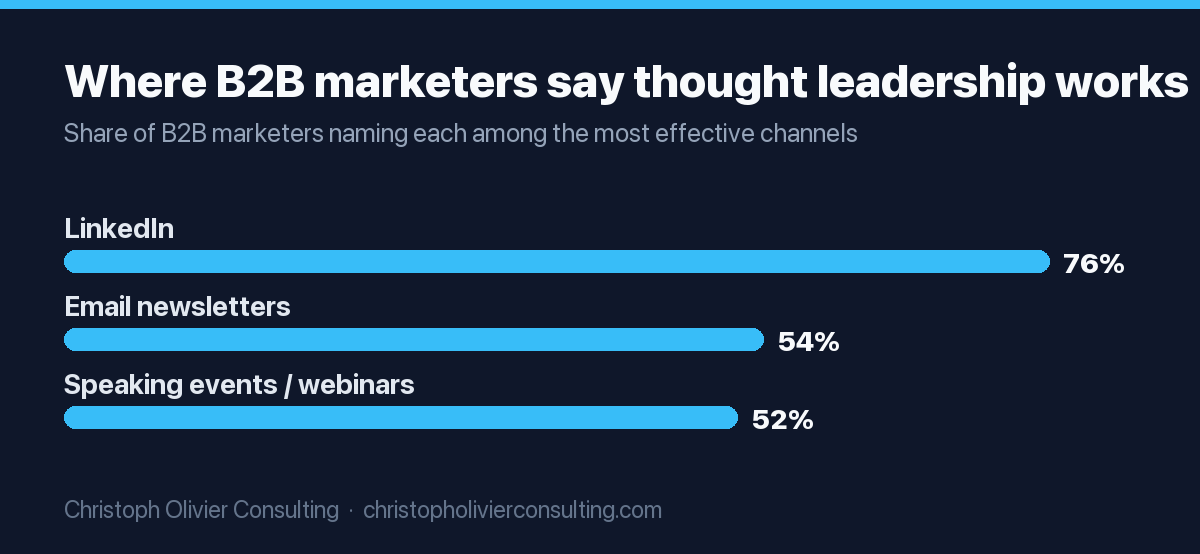
Choose sales channels first by ACV and cost of sale, then pick the marketing channels that feed them. How positioning, budget and the marketing channel mix fit together for a small or midsize firm is covered in our business-to-business marketing strategy guide.
Running multiple B2B sales channels without conflict
Most firms that sell through several channels lose margin to overlap, not to bad channels. Four rules prevent it:
- One price list. Partners and marketplaces get a discount or a fee, never a different list price. Buyers compare.
- Registered deals win. The first channel to register an account with documented activity owns it for a fixed window, such as 90 days.
- One owner per channel. A named person accountable for pipeline, win rate and cost of sale.
- Same scorecard. Judge every channel on pipeline created, win rate, cycle length, average deal size and cost per dollar booked.
In my view, most firms under $10 million in revenue should run two channels well before adding a third. If you want a second opinion on which two, you can book a consultation.
Frequently asked questions
What are the main B2B sales channels?
The main B2B sales channels are field sales, inside sales, outbound prospecting, self-serve or product-led sign-up, B2B ecommerce portals, resellers and referral partners, distributors, cloud marketplaces such as AWS, Microsoft and Google Cloud, and events. The first five are direct, meaning your people or website close the deal. Partners, distributors and marketplaces are indirect and take a commission, discount or fee.
What are the best channels to increase B2B sales?
Start with the cheapest tests that give fast feedback: fix your self-serve path with price ranges and a booking link, then add referral partners who already serve your buyer, then run a targeted outbound test to about 200 named accounts. Add marketplace private offers if you sell software, and events only once you can pre-book meetings with target accounts. Test one channel at a time for 90 days.
What is the difference between B2B sales channels and B2B marketing channels?
Marketing channels such as SEO, LinkedIn, email, paid search and webinars create demand and leads. Sales channels are the routes that turn demand into signed contracts: reps, your website checkout, partners, distributors and marketplaces. Events, LinkedIn and outbound do both jobs. Pick sales channels first by deal size and cost of sale, then choose the marketing channels that feed them.
What are B2B distribution channels?
B2B distribution channels are the indirect routes that carry your product to business buyers: distributors and wholesalers that buy and resell, value-added resellers that bundle services, agencies and referral partners, and online marketplaces. They trade margin and customer control for reach. Distributors suit physical goods sold to many small buyers; resellers and marketplaces suit software and services.
How much do AWS, Microsoft and Google Cloud marketplaces charge?
AWS Marketplace charges 3% on SaaS public offers and 20% on server products. AWS and Google Cloud private offers cost 3% under $1 million total contract value, 2% from $1 million to under $10 million, and 1.5% at $10 million or more, with 1.5% on renewals. Microsoft charges a 3% store service fee, with a 50% discount on qualifying private offer renewals.
Which channels fit B2B launches?
For a launch, use channels that produce learning in weeks: founder-led outbound to 100 to 200 named accounts, existing customers and referral partners, and a self-serve page with pricing guidance so rep-free buyers can qualify themselves. Wait on resellers, distributors and trade shows until you have at least three referenceable customers, because partners resell proven offers and booths convert poorly without case studies.
Which sales tools help channel partners and resellers stay aligned across regions and deals?
Three tool types do most of the work. A partner relationship management (PRM) platform such as Impartner or PartnerStack handles deal registration, partner onboarding and commission payouts. Account-mapping tools such as Crossbeam show which accounts you and a partner share. Your CRM must record the registered partner on every opportunity so handoffs and quota credit are clear.
More Sales Process & CRM guides
- B2B Sales Process: First Touch to Close
- Challenger Sale Method: Still Relevant in 2026?
- What Is B2B Sales? Modern Definition
- Sales Forecasting Methods & Models
- Sales Approach: The 4 Core Styles and How to Pick Yours
- Sales Forms Every Service Business Needs (And What Goes in Each)
- All Sales Process & CRM guides →