
An influencer marketing strategy is a documented plan for partnering with creators to reach a defined audience, tied to a specific business goal and a measurement model, not a one-off sponsored post. A strong strategy starts with the outcome you want (awareness, leads, or sales), picks creator tiers that fit that outcome, and builds disclosure and tracking in from day one so results are provable and compliant.
Last reviewed: October 2026

Most programs stall because they buy reach first and think about goals later. This playbook runs the order in reverse: goal, audience, tier, creator, brief, disclosure, amplification, then measurement. It is written for founders and marketing leads who need a program that ties to pipeline, and it draws on how we build these at Christoph Olivier Consulting.
What is an influencer marketing strategy?
An influencer marketing strategy is a plan that matches creators to a business goal, defines the deliverables and disclosure rules, and sets the metrics that prove return. It differs from a single campaign because it treats creator relationships as a repeatable channel, with a briefing process, an approval checklist, and a tracking system that connects content to leads or revenue.
Treat it as a channel that sits alongside your other social work, not a novelty. It pairs naturally with organic social media lead generation because the creator supplies trust and reach while your owned assets capture the demand. The industry is large, estimated around $22 billion and growing, which means creator rates, disclosure enforcement, and platform rules all matter to your margin.
How do you set goals and pick the right KPIs?
Pick one primary goal per campaign and map two or three KPIs to it before you contact a single creator. Awareness campaigns track reach, impressions, and engagement rate. Consideration campaigns track saves, shares, click-through, and landing-page traffic. Conversion campaigns track tracked-link clicks, promo-code redemptions, sign-ups, and cost per acquisition.
A vague goal like “grow the brand” produces content nobody can score. Write the goal as a sentence with a number and a date, for example “drive 300 trial sign-ups from creator content in Q4.” That single line decides your tier mix, your brief, and your tracking. Feed the outcome back into your wider sales and marketing strategy so creator spend competes fairly against your other channels.
What are the creator tiers and which should you pick?
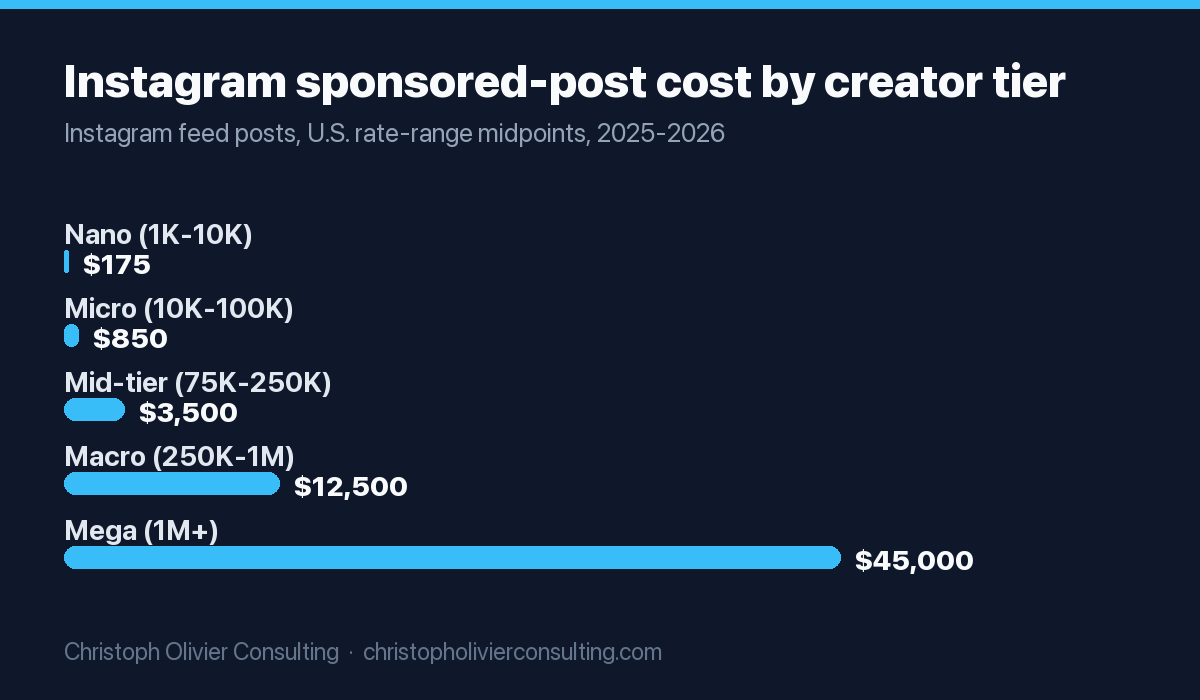
Creators fall into five tiers by follower count, and engagement moves inversely to size: smaller creators post higher engagement, larger creators buy broader reach. Nano and micro creators tend to win on trust, conversion, and cost efficiency. Macro and mega creators win on scale and speed. The strongest programs blend tiers rather than betting everything on one.
| Tier | Follower range | Typical engagement | Best for | Relative cost |
|---|---|---|---|---|
| Nano | 1,000 to 10,000 | 4 to 8 percent | Trust, local niche, conversion, low budget | Lowest (often gifting or low flat fee) |
| Micro | 10,000 to 100,000 | 2 to 4 percent | Best all-round ROI and conversion efficiency | Low to moderate |
| Mid-tier | 100,000 to 500,000 | 1 to 3 percent | Balanced reach and credibility | Moderate |
| Macro | 500,000 to 1 million | 1 to 2 percent | Reach, launch moments, awareness | High |
| Mega | 1 million and up | Under 1 percent | Mass awareness, cultural reach | Highest |
Engagement figures are benchmarks and vary by platform and niche; TikTok medians often run higher than Instagram. For a lead or sales goal on a limited budget, a cluster of 8 to 15 micro and nano creators usually beats one macro deal at the same spend, because you get more posts, more tests, and higher engagement per dollar.
How do you find and vet the right creators?
Find creators through platform search, hashtag and competitor audits, creator marketplaces, and your own customer base, then vet each one on audience fit, authenticity, and brand safety before you offer a deal. Fit beats follower count: a 12,000-follower creator whose audience matches your buyer is worth more than a 400,000-follower generalist.
Vet every candidate against a short checklist so you do not pay for fake reach:
- Audience match: location, age, and interest overlap with your buyer, visible in the creator’s media kit or platform analytics.
- Real engagement: comments that read like humans, a like-to-comment ratio in a normal range, and no sudden follower spikes that suggest bought audience.
- Content quality and cadence: consistent posting and a style that fits your brand without heavy editing.
- Brand safety: past posts, prior sponsorships, and tone that will not create a reputational problem.
- Disclosure history: creators who already label paid posts clearly are lower risk under FTC rules.
How do you brief creators and structure deliverables?
A creator brief gives direction and guardrails without scripting the creator into stiffness. It states the goal, the audience, the key message, the required disclosure, the deliverables and formats, the tracking link or code, usage rights, timeline, and the few must-say and must-avoid points. Let the creator own the voice; audiences follow them for it.
Run each campaign through a repeatable process so nothing gets missed:
- Define the goal and KPIs and write them as one measurable sentence.
- Build the shortlist of vetted creators and confirm tier mix against budget.
- Negotiate scope and rate including deliverables, exclusivity window, usage rights, and payment terms.
- Sign a contract that names FTC-compliant disclosure as a material term and a breach if missed.
- Send the brief with tracking links or unique promo codes for each creator.
- Approve drafts against a checklist that includes a disclosure check before any post goes live.
- Publish and amplify the best-performing posts through paid promotion.
- Measure against KPIs and log cost per result to inform the next round.
Give creators unique tracking links (UTM-tagged) or one promo code each so you can attribute results per creator, not just per campaign. Point that traffic to a landing page you control and can convert, the same way you would for any content marketing asset.
How do you stay FTC compliant with disclosure?
US creators and the brands that pay them must disclose any material connection clearly and conspicuously, in language the audience sees without searching. A material connection is any financial or business relationship: payment, free product, affiliate commission, or free service, no matter how small. The safest disclosure is plain in-caption text such as “#ad” or “Sponsored by [Brand]” placed near the top, above the fold.
Follow these rules to keep both sides protected:
- Use clear terms: “#ad,” “Advertisement,” or “Paid partnership with [Brand].” Vague tags like “#collab,” “#partner,” or “#sp” do not meet the standard.
- Do not rely on platform tags alone: the FTC has stated that a built-in “paid partnership” label by itself is not enough; include in-caption disclosure too.
- Match the format: in video, say and show the disclosure; in a story, put it on-screen long enough to read; in audio, state it aloud.
- Put it in the contract: require compliant disclosure as a material term so non-disclosure is a breach.
- Check every draft: add disclosure to the approval checklist and return non-compliant drafts before they post.
Liability is shared. The FTC can name the brand in an enforcement action even when the creator made the posting decision, and per-violation penalties run into the tens of thousands of dollars (recently in the $51,000 to $53,000 range per violation). Building disclosure into the contract and the approval step is cheap insurance against that exposure. This is general information, not legal advice; consult counsel for your specific situation and jurisdiction.
What is whitelisting and paid amplification?
Whitelisting (also called creator licensing or partnership ads) is when a creator grants your brand permission to run paid ads from their handle. Paid amplification is putting media spend behind organic creator posts. Both extend a winning post beyond the creator’s own followers and let you target by audience, which is where influencer content often earns its best return.
The workflow is straightforward: identify posts that already perform organically, secure usage rights in the contract, then boost them or run them as partnership ads through the platform ads manager. Because the ad runs from the creator’s trusted handle rather than the brand handle, it usually holds higher engagement and lower cost per result than standard brand creative. Always confirm the disclosure carries through to the paid version.
How do you measure ROI and prove pipeline?
Measure influencer ROI by tying tracked results (clicks, sign-ups, code redemptions, and revenue) back to cost per creator, then judging the program on cost per acquisition and payback, not vanity reach. Awareness metrics like impressions matter for top-funnel goals, but a program aimed at pipeline is scored on tracked conversions and the revenue they produce.
| Metric | What it tells you | Funnel stage |
|---|---|---|
| Reach and impressions | How many people saw the content | Awareness |
| Engagement rate | Whether the audience responded to it | Awareness / consideration |
| Click-through and traffic | Whether it moved people to your site | Consideration |
| Sign-ups and code redemptions | Whether it produced tracked action | Conversion |
| Cost per acquisition and revenue | Whether the program pays back | Conversion / retention |
Keep a simple per-creator ledger: spend, deliverables, tracked results, and cost per result. After two or three rounds you will see which tiers and creators repay investment, and you can shift budget toward them. That evidence turns influencer marketing from a gamble into a channel you can plan and scale.
Ready to build a program that ties creator spend to pipeline? See how we approach it in our fractional CMO services.
Frequently asked questions
How much does influencer marketing cost?
Cost depends on tier, platform, and deliverables. Nano creators often work for free product or a low flat fee, micro creators typically run from low hundreds to low thousands per post, and macro or mega creators can reach five or six figures. For a fixed budget, a cluster of micro and nano creators usually returns more tracked action than one large deal at the same spend.
Which influencer tier delivers the best ROI?
Micro creators (10,000 to 100,000 followers) tend to deliver the best all-round ROI, combining 2 to 4 percent engagement with moderate cost and strong conversion. Nano creators win on trust and price for local or niche goals. Macro and mega creators buy reach for awareness moments. Most high-performing programs blend tiers rather than relying on one.
Do I legally need an FTC disclosure?
Yes. In the US, any material connection between a brand and a creator (payment, free product, affiliate commission, or free service) must be disclosed clearly and conspicuously. Use plain in-caption language like “#ad” or “Sponsored by [Brand]” near the top of the post. Platform tags alone do not satisfy the requirement, and both brand and creator can be held liable.
What is influencer whitelisting?
Whitelisting, also called creator licensing or partnership ads, is when a creator grants a brand permission to run paid ads from the creator’s own handle. It lets the brand target new audiences while keeping the credibility of the creator’s account, which often produces higher engagement and lower cost per result than ads from the brand handle. Secure the rights in the contract first.
How do you measure the ROI of influencer marketing?
Give each creator a unique tracked link or promo code, then connect the clicks, sign-ups, redemptions, and revenue back to what you paid them. Judge the program on cost per acquisition and payback rather than reach alone. Keep a per-creator ledger of spend and tracked results so you can shift budget toward the tiers and creators that repay investment.
How long does it take to see results from influencer marketing?
Awareness and engagement signals appear within days of posting, but conversion and pipeline results usually take two to three campaign rounds to read clearly, because you need enough data to compare creators and tiers. Treat the first round as a test, log cost per result, and expect the program to sharpen as you concentrate spend on proven creators.
More Content Marketing guides
- Social Media Campaigns: How to Plan One, Plus 13 Real Examples
- Successful Instagram Campaigns: 15 Real Examples With Results
- LinkedIn Marketing for B2B: The Full Playbook
- Podcast Marketing Strategy: A Pipeline-First Playbook
- Product Marketing Strategy: How to Build One That Drives Pipeline
- Webinar Marketing Strategy: Fill Seats and Convert Pipeline
- How to Build an Account Based Marketing Strategy
- Content Marketing for Startups: What to Build First With No Team or Budget