
Last reviewed: September 2026
Instagram Stories ads are full-screen vertical placements you build inside Meta Ads Manager and target to the Stories slot specifically. This guide walks the exact build: campaign objective, ad set targeting and budget, the Stories placement, the creative specs that keep your message inside the safe zone, and the launch checks that stop wasted spend. It is the tutorial for the placement, not a broad strategy overview.
How to create Instagram Stories ads: the fast answer
To create Instagram Stories ads, open Meta Ads Manager, click Create, pick a campaign objective, set your audience and budget at the ad set level, choose Manual placements and select only Instagram Stories, then upload a 1080×1920 (9:16) image or video, add your caption, link and call-to-action button, and publish. The whole build takes about 15 to 20 minutes once your creative is ready.
This article assumes you already have a Meta Business account, a connected Instagram account and a payment method on file. If your account strategy is still forming, start with our Instagram marketing guide for 2026 before you spend a dollar on ads.
Before you start: what you need
Three things need to be ready before you open Ads Manager: a Meta Business Manager account with billing set up, an Instagram account connected to that Business account, and a vertical creative asset sized at 1080×1920 pixels. Missing any of these stalls the build partway through, so confirm them first.
- A Meta Business Manager account with an active payment method.
- An Instagram professional account connected under Accounts in Business settings.
- A 9:16 image (JPG or PNG) or vertical video (MP4 or MOV) ready to upload.
- A destination URL and a clear single call-to-action.
Step by step: build the Stories ad in Meta Ads Manager
The build follows the standard three-level structure: campaign (objective), ad set (audience, budget, placement) and ad (creative). Isolating Instagram Stories happens at the ad set level under placements, and the creative sizing happens at the ad level. Follow the order below.
- Open Ads Manager and click Create. Go to the Campaigns tab and select the Create button to start a new campaign.
- Choose a campaign objective. Pick the objective that matches your goal, such as Awareness, Traffic, Engagement, Leads or Sales. The objective tells Meta who to optimize delivery toward.
- Name the campaign and continue to the ad set. Use a naming convention you can filter later, for example “Stories-Traffic-Q4”.
- Set your budget. Choose a daily or lifetime budget at the ad set (or campaign) level. Meta accepts as little as $1 per day for impression goals and about $5 per day for click or conversion goals.
- Define your audience. Set location, age, gender and detailed targeting, or load a custom or lookalike audience. Narrower, more competitive segments cost more per result.
- Switch to Manual placements. Placements default to Advantage+ (automatic). Select Manual placements to control where the ad runs.
- Select only Instagram Stories. Under Instagram, tick Stories and clear the other boxes if you want a Stories-only test. This is the step that isolates the placement.
- Move to the ad level and pick a format. Choose Single image or video for a clean Stories build. Carousel and collection also run in Stories but single-asset is the simplest first test.
- Upload your 9:16 creative. Add your 1080×1920 image or vertical video and confirm the preview fills the screen without awkward cropping.
- Write the caption and add the link plus call-to-action. Enter your primary text, destination URL and a CTA button such as Learn More or Shop Now.
- Review the Stories preview and publish. Check the right-hand preview on the Stories placement, confirm text sits inside the safe zone, then click Publish.
Instagram Stories ad specs you have to hit
Stories ads render full-screen vertical, so the non-negotiable is a 9:16 aspect ratio at 1080×1920 pixels. Video runs from 1 second up to 60 seconds per card, and interface elements overlay the top and bottom, which is why safe-zone margins matter as much as the pixel dimensions.
| Spec | Requirement |
|---|---|
| Aspect ratio | 9:16 (vertical, full screen) |
| Resolution | 1080 x 1920 pixels |
| Image formats | JPG or PNG, up to 30 MB |
| Video formats | MP4 or MOV, H.264, up to 4 GB |
| Video length | 1 to 60 seconds per Story card |
| Recommended hook | First 2 to 3 seconds; 6 to 15 seconds total performs well |
| Top safe margin | Leave about 250 px clear of text and logos |
| Bottom safe margin | Leave about 340 px clear for the CTA and profile row |
The safe-zone margins exist because the profile name sits at the top and the CTA button plus swipe area sit at the bottom. Keep headlines and logos in the middle band so nothing important gets covered.
Creative that earns the swipe
Stories are skippable in a tap, so the creative has to hook in the first 2 to 3 seconds and stay legible on mute. Design for sound-off with captions or on-screen text, keep one message per card, and make the call-to-action visually obvious above the fold of attention rather than saved for the end.
- Open with the payoff, not a slow logo intro.
- Shoot or design natively vertical, never a letterboxed horizontal crop.
- Add captions so the ad works with sound off.
- Keep one idea and one CTA per Story card.
Targeting and budget for a first Stories test
Meta accepts a daily budget from about $1 per day for impressions and roughly $5 per day once you optimize for clicks or conversions, but the practical floor is higher. Meta needs about 50 optimization events per ad set per week to exit the learning phase and deliver stably, so a real test usually runs $5 or more per day for at least six days.
For targeting, start broader than instinct suggests and let Meta’s delivery find the pocket, then narrow using performance data. Tight, high-competition segments raise your cost per result. Many businesses budget $300 to $500 per month as a starting range for a meaningful read. Once results come in, the work shifts to optimization and scaling, which we cover in the Instagram ads performance playbook.
What Instagram Stories ads cost right now
Stories is typically the cheapest Instagram placement on a cost-per-click basis. Reported 2026 benchmarks for Stories CPC range from about $0.70 (Emplifi Q2 2026 median) to roughly $1.83 (blended 2026 average), with Stories running around 20 to 45 percent cheaper per click than Feed. Treat these as directional; your real numbers depend on geography, industry, audience and creative quality.
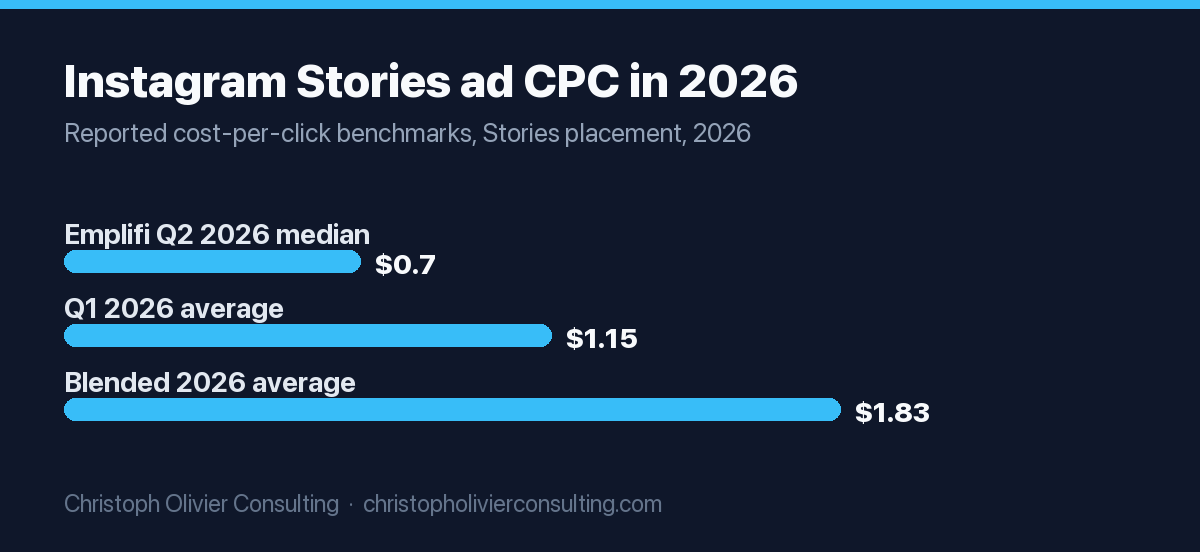
| Metric | Reported 2026 range (Stories) |
|---|---|
| CPC (cost per click) | $0.70 to $1.83 |
| CPM (cost per 1,000 impressions) | $4.50 to $7.94 |
| Relative to Feed | Roughly 20 to 45 percent cheaper per click |
The spread across sources is real, not noise. Use the low end for planning best-case reach and the high end for conservative budgeting.
Launch checklist
Before you publish, run a final pass so a fixable error does not eat your first day of spend. Confirm the placement is Stories only, the creative is 9:16 with text inside the safe zone, the link works, and the CTA matches the objective.
- Placement shows Instagram Stories selected and Feed cleared (if Stories-only).
- Creative previews full-screen 9:16 with no cropping.
- Text and logo sit clear of the top 250 px and bottom 340 px.
- Destination URL loads correctly on mobile.
- CTA button matches the campaign objective.
- Budget and schedule are set as intended.
If you would rather have this built and managed for you, see how we run paid social inside our fractional CMO services, and if AI-search visibility is also on your list, our rank on AI guide covers that side.
Frequently asked questions
How do I make an ad show only in Instagram Stories?
At the ad set level in Meta Ads Manager, switch from Advantage+ (automatic) placements to Manual placements. Then under the Instagram section, tick Stories and clear every other box. This isolates delivery to the Stories slot only, which is useful when you want a clean read on how the placement performs before mixing it with Feed and Reels.
What size should an Instagram Stories ad be?
Instagram Stories ads use a 9:16 vertical aspect ratio at 1080×1920 pixels for both images and video. Images can be JPG or PNG up to 30 MB, and video can be MP4 or MOV up to 4 GB. Leave roughly 250 px clear at the top and 340 px at the bottom so interface elements do not cover your text or logo.
How long can an Instagram Stories video ad be?
A single Instagram Stories video ad card can run from 1 second up to 60 seconds. In practice, shorter performs better: put your hook in the first 2 to 3 seconds and aim for roughly 6 to 15 seconds total, because viewers tap past Stories quickly and rarely watch a slow build to completion.
What is the minimum budget for Instagram Stories ads?
Meta accepts daily budgets from about $1 per day for impression goals and around $5 per day for click or conversion goals. The practical minimum is higher because Meta needs roughly 50 optimization events per ad set per week to exit the learning phase, so plan for at least $5 per day over six or more days for a usable test.
Are Instagram Stories ads cheaper than Feed ads?
Usually, yes. Reported 2026 benchmarks put Stories among the cheapest Instagram placements on a cost-per-click basis, often running about 20 to 45 percent less per click than Feed. Stories CPC ranges from roughly $0.70 to $1.83 depending on the source, industry and audience, but your actual cost depends on competition and creative quality.
Do I need a video to run a Stories ad?
No. Instagram Stories ads run as single images, single videos, carousels or collections. A single vertical 1080×1920 image with a strong headline and clear call-to-action is a valid and fast first test. Video often earns more attention because it moves, but a well-designed static image is enough to launch and learn from.
More marketing guides for rank on ai: get cited by ai search
- How to Rank Higher on Google: A Prioritized 2026 Playbook
- The Best HubSpot Alternatives in 2026 (by Use Case)
- 20 Personal Brand Statement Examples (and How to Write Yours)
- Sales Representative Job Description (Template + Skills)
- What Does an Advertising Manager Do? Role, Skills, Salary
- AI Marketing Agents: What They Are and How to Use Them
- Rank on AI: Get Cited by AI Search