
Last reviewed: September 2026
HubSpot is a strong platform, but it is not the right platform for everyone. The most common reason teams look at HubSpot alternatives is cost: contact-based pricing and the jump from the free tools to the Professional tier can multiply a bill fast as a database grows. This roundup sorts the best HubSpot alternatives in 2026 by use case, with honest strengths, limits, and real entry pricing, so you match the tool to the job instead of buying the biggest suite by default.
These are practitioner picks from years of building marketing stacks for growing companies, not affiliate rankings. Every tool below earns its place for a specific buyer. If you want help designing the wider stack these tools sit inside, see our work on the marketing technology stack.
Why teams look for HubSpot alternatives
Most teams leave HubSpot for one of three reasons: price escalation as contacts grow, paying for modules they never use, or wanting a tool that is sharper at one job. Contact-based pricing is the churn trigger cited most often by small and mid-market switchers, because the bill climbs with the database rather than with the value delivered.
HubSpot’s free and Starter tools are genuinely good. The pressure point is the step up to Professional, where advanced automation, reporting, and higher contact tiers live. For a five to twenty person team, that step can feel like a large fixed cost for features a leaner tool covers at a fraction of the price. The fix is to define the one or two jobs the platform must do well, then pick the category leader for those jobs.
The best HubSpot alternatives by use case
The right alternative depends on whether you need an all-in-one suite, a sales-first CRM, a marketing-first automation engine, the cheapest workable option, or enterprise depth. The table below maps the leading tools to each use case with their lowest paid entry price, so you can shortlist in a minute.
| Use case | Best pick | Lowest paid tier | Best for |
|---|---|---|---|
| All-in-one suite | EngageBay | ~$14/user/mo | SMBs wanting CRM, marketing, and support in one bill |
| All-in-one, scalable | Zoho CRM | $14/user/mo | Teams already using or open to the Zoho ecosystem |
| CRM-first (sales) | Pipedrive | $16/seat/mo | Reps who want pipeline focus, not marketing bloat |
| CRM-first, low cost | Freshsales | $9/user/mo | Small sales teams wanting built-in phone and AI |
| Work-management CRM | monday CRM | $12/user/mo | Teams that run projects and deals in one board |
| Marketing-first | ActiveCampaign | ~$15/mo | Advanced email and lifecycle automation |
| Budget / free | Zoho, EngageBay, Bitrix24 | $0 (free tier) | Early-stage teams with no software budget |
| Enterprise | Salesforce | $25/user/mo | Complex orgs needing deep customization |
All-in-one alternatives
If you want CRM, email marketing, and support under one login and one invoice, EngageBay and Zoho are the two to test. Both bundle the pieces HubSpot spreads across separate Hubs, at a per-user price that stays predictable as contacts grow. This is the closest like-for-like swap for a HubSpot Professional buyer.
EngageBay pairs marketing, sales, and service in a single suite with all-in-one paid plans starting around $14 per user per month, which makes it a direct answer to HubSpot’s price for a similar feature set. Its limit is polish and third-party integration depth: it does most jobs well rather than any one job at a category-leader level. Zoho CRM starts at $14 per user per month for Standard and climbs to $40 for Enterprise, and its strength is the surrounding Zoho ecosystem you can bolt on. The trade-off is that a full Zoho stack can get sprawling, and the interface has a learning curve.
CRM-first (sales) alternatives
When the job is closing deals and HubSpot feels too marketing-centric, a sales-first CRM wins. Pipedrive, Freshsales, and monday CRM keep the rep’s daily workflow front and center: pipelines, activities, and deal movement, without the marketing modules you would not use.
Pipedrive starts at $16 per seat per month for its Lite plan and is built around visual pipeline management, which reps adopt quickly. Its limit is marketing: email and automation are lighter than HubSpot’s, so marketing-heavy teams outgrow it. Freshsales starts at $9 per user per month and includes built-in phone and AI assistance, which is rare at that price, though the total cost can rise once you add higher-tier features. monday CRM starts at $12 per user per month and suits teams that already run projects on monday and want deals in the same workspace, with the caveat that some advanced features sit behind higher tiers.
Marketing-first alternatives
If the reason you bought HubSpot was email and lifecycle automation, a marketing-first tool does that job deeper and cheaper. ActiveCampaign and Brevo lead here, with automation logic that rivals or beats HubSpot Marketing Hub for a lower entry cost.
ActiveCampaign starts at roughly $15 per month and is known for advanced, branching email automation without HubSpot’s pricing complexity; adding CRM features moves you to a higher plan, so budget for that if sales tooling matters. Brevo uses a send-based and tiered model rather than pure contact-based pricing, which helps teams with large lists that email infrequently. Both are marketing engines first and CRMs second, so pair them with a dedicated sales tool if your reps need a real pipeline. For how these connect to the buyer journey, see our guide to the customer engagement platform.
Budget and free alternatives
For early-stage teams with no software budget, several tools offer real free tiers, not just trials. Zoho CRM Free supports up to three users, EngageBay has a free plan, and Bitrix24 bundles a free sales suite. These cover contact management and basic pipelines well enough to run a young business.
The honest limit of free tiers is ceilings: contact caps, feature gates, and branding that push you to paid plans as you grow. Treat free as a runway to prove the workflow, then budget for the paid tier you will reach within a year. Zoho and EngageBay both upgrade cleanly from free to paid, which avoids a painful migration later.
Enterprise alternatives
For complex organizations that need deep customization, territory management, and heavy integration, Salesforce is the default enterprise answer. Its small-business Starter package begins at $25 per user per month, and it scales to the most demanding configurations most vendors cannot match.
The trade-off is well known: Salesforce is powerful but complex, and it usually needs training and a dedicated administrator to run well. Zoho at its Enterprise tier and monday CRM both offer enterprise-grade power with a lower administrative burden, and are worth a look if you want capability without a full Salesforce implementation. Match the depth to what you will actually configure, not to the brand.
How to choose the right HubSpot alternative
Pick the tool that is best at your one or two must-do jobs, then confirm the total cost at the contact and user count you expect in twelve months. Do not buy for the demo; buy for the bill you will pay after you grow. This short process keeps the decision honest.
- Name the one or two jobs the platform must do well (sales pipeline, email automation, all-in-one, or support).
- Shortlist the two category leaders for those jobs from the table above.
- Project your contact count and seat count twelve months out, then price each shortlisted tool at that scale, not today’s scale.
- Check migration support: CSV or direct import from HubSpot, field mapping for contacts, deals, and companies, and onboarding help.
- Run a two-week trial with your real data and one real workflow before you commit.
If you would rather have the shortlist and total-cost model built for your specific funnel, that is the kind of decision we handle inside our fractional-CMO services. We also help teams make their content and tooling visible to AI search engines; see rank on AI.
HubSpot alternatives entry pricing compared
Entry price is the fastest way to sanity-check a shortlist, though it is only the starting point. The figures below are each tool’s lowest paid per-user or per-seat CRM tier as advertised in 2026. Flat-rate marketing tools like ActiveCampaign and send-based tools like Brevo use a different pricing model, so they are described in the text rather than forced onto a per-user axis, and quote-only enterprise add-ons are not shown here.
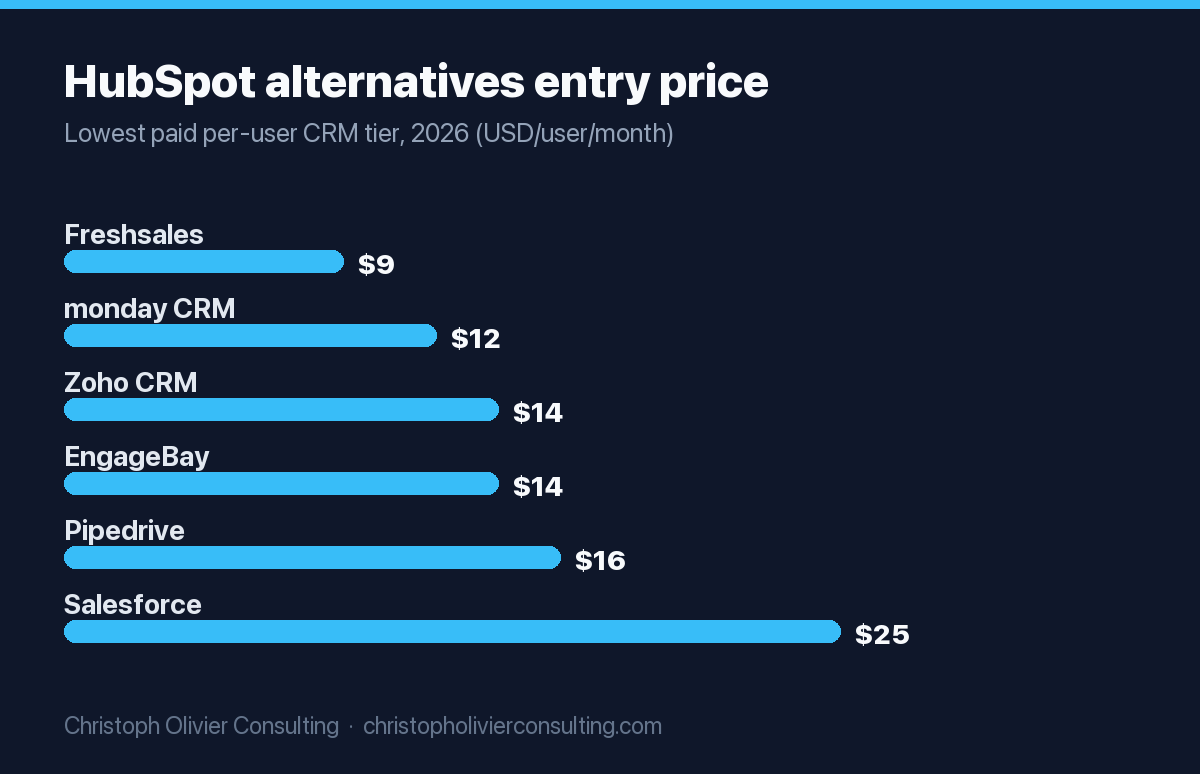
The pattern is clear: sales-first and all-in-one tools cluster between $9 and $16 per user per month, while enterprise depth from Salesforce starts around $25. That range sits well below HubSpot’s Professional tier for comparable capability, which is the core reason these alternatives keep winning switchers.
Frequently asked questions
What is the best alternative to HubSpot?
There is no single best alternative; it depends on the job. For an all-in-one suite, EngageBay and Zoho are the closest swaps. For a sales-first CRM, Pipedrive or Freshsales win. For marketing automation, ActiveCampaign leads. For enterprise depth, Salesforce is the default. Match the tool to your one or two must-do jobs rather than buying the largest suite.
Why is HubSpot so expensive?
HubSpot uses contact-based pricing, so your bill grows with the size of your database, and many features live only in the Professional tier. The free and Starter tools are strong, but the jump to Professional is a large fixed cost. Teams that outgrow the free tools but do not need every module often find the price hard to justify against a focused alternative.
Is there a free HubSpot alternative?
Yes. Zoho CRM Free supports up to three users, EngageBay offers a free plan, and Bitrix24 includes a free sales suite. These handle contact management and basic pipelines for early-stage teams. The limit is ceilings on contacts and features, so treat a free tier as a runway to prove the workflow, then plan to move to a paid tier as you grow.
What is the cheapest HubSpot alternative?
Among paid CRM tools, Freshsales is one of the lowest at around $9 per user per month, followed by monday CRM near $12 and Zoho CRM at $14. EngageBay’s all-in-one paid plan starts near $14 per user per month. Free tiers from Zoho, EngageBay, and Bitrix24 cost nothing at the entry level, with feature and contact caps that push you to paid as you scale.
What is the best HubSpot alternative for a small sales team?
For a small team focused on closing deals, Pipedrive and Freshsales are the strongest picks. Pipedrive centers on visual pipeline management that reps adopt quickly, starting at $16 per seat per month. Freshsales starts at $9 per user per month and adds built-in phone and AI. Both avoid the marketing modules a sales-only team would not use, which keeps the tool simple and the cost low.
How do I migrate from HubSpot to another CRM?
Most modern alternatives offer CSV or direct import from HubSpot, plus guided wizards that map contacts, deals, companies, and custom fields. Start by exporting a clean copy of your data, confirm the new tool maps your key fields, and run a test import before the full move. Then rebuild one core workflow, verify it, and use onboarding support to configure pipelines, automation, and reporting.
More marketing guides for rank on ai: get cited by ai search
- 20 Personal Brand Statement Examples (and How to Write Yours)
- Sales Representative Job Description (Template + Skills)
- What Does an Advertising Manager Do? Role, Skills, Salary
- AI Marketing Agents: What They Are and How to Use Them
- Client Database Software: How to Store and Segment Client Records
- The Best Client Management Apps for Service Businesses (2026)
- Rank on AI: Get Cited by AI Search