
Client database software is the record layer of your business: the single place where every client’s contact fields, tags, custom fields, and history live so you can find, filter, and segment people in seconds. This roundup covers tools built for storing and organizing client records, not project boards or team messaging apps. If you need task tracking or client communication workflows, that is a different category.
Last reviewed: September 2026
What client database software actually does (and what it is not)
Client database software captures, stores, and organizes structured client records: names, emails, phone numbers, addresses, tags, and custom fields, all searchable and filterable. It is the contact-record layer beneath your sales and marketing work. It is not a project manager, a team chat tool, or a post-sale success platform, though many CRMs bolt those features on top.
Keep the distinction clear when you shop. A client management app organizes projects, tasks, and client communication. A client database organizes the records themselves. Customer success software manages renewals and health scores after the sale. You can run all three, but you should pick your record system first, because every other tool reads from it.
For most small teams the record layer and a lightweight CRM are the same product. The buying question is simple: can it store the fields you care about, tag and segment cleanly, and let you import and export without lock-in? Everything else is secondary. Our CRM strategy guide covers how the record layer fits the wider system.
The client record fields that matter
A usable client record needs three kinds of data: standard contact fields, tags for grouping, and custom fields for structured detail. Standard fields cover name, email, phone, and company. Tags label records for fast filtering, such as VIP or Newsletter. Custom fields store typed values like renewal date, plan tier, or account owner. Getting these three right is what makes segmentation possible later.
Tags and custom fields are not interchangeable. A tag is a flexible label you attach or remove in a click, good for behavior and interests. A custom field is a defined slot with a type: text, number, date, or dropdown, holding one value per record. Use tags for loose grouping and custom fields for data you will sort, report on, or filter by range.
- Standard fields: name, email, phone, company, address, source.
- Tags: VIP, active, churned, event attendee, interest categories.
- Custom fields: renewal date, contract value, plan tier, account owner, region.
- Import/export: CSV in and out so you are never locked to one vendor.
Best client database software for storing and segmenting records
The strongest client database tools for small and mid-size teams are Bigin by Zoho, Zoho CRM, HubSpot CRM, Pipedrive, and Airtable, with Notion suiting solo operators. Each stores structured records with custom fields and tags, and each supports CSV import and export. They differ mainly in how deep the custom fields go, how flexible segmentation is, and where the free tier stops.
| Tool | Best record-management fit | Custom fields | Tags / segments | Import / export | Free tier |
|---|---|---|---|---|---|
| HubSpot CRM | Teams wanting a free, scalable record base | Yes | Lists and filtered views | CSV both ways | Yes, unlimited users |
| Zoho CRM | Deep customization at low per-user cost | Yes, extensive | Tags and saved filters | CSV both ways | Up to 3 users |
| Bigin by Zoho | Solo and micro teams leaving spreadsheets | Yes | Tags and pipelines | CSV both ways | Yes, single user |
| Pipedrive | Sales-led teams tracking records by pipeline | Yes | Filters and labels | CSV both ways | No, trial only |
| Airtable | Custom record structures beyond a spreadsheet | Yes, typed columns | Views and grouping | CSV both ways | Yes, limited rows |
| Notion | Solo operators with light record needs | Yes, database properties | Filtered views | CSV both ways | Yes, personal use |
Match the tool to how you will actually filter records. If you segment by many typed attributes, Zoho CRM and Airtable give the most field depth. If you want a free starting base that grows, HubSpot CRM is the safest first move. If you are one person leaving a spreadsheet, Bigin or Notion keep things light. For a fuller picture of how AI search surfaces these tools, see our note on ranking on AI.
Client database software pricing: honest entry prices
Paid entry prices for client database tools cluster between $7 and $20 per user per month on annual billing in 2026. Bigin by Zoho starts lowest at $7, Zoho CRM and Pipedrive both start at $14, and HubSpot’s Starter and Airtable’s Team plans both start at $20. HubSpot and several rivals also keep a genuinely free tier for smaller record sets.
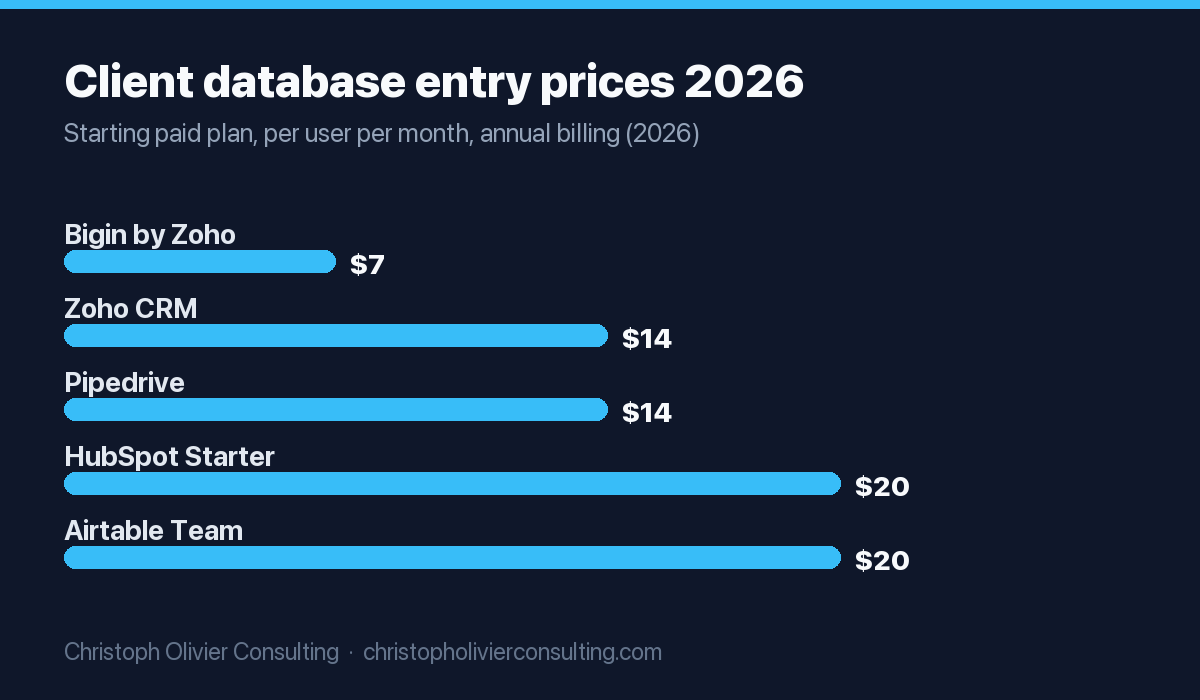
Read the starting price as a floor, not the real bill. HubSpot layers on optional onboarding fees and contact overage charges, contact-based pricing can climb as your database grows, and per-user costs multiply with headcount. Confirm your record count and seat count before you commit, and check that export is free so switching later stays cheap.
| Tool | Entry paid plan | Starting price (per user / mo, annual) | Free tier |
|---|---|---|---|
| Bigin by Zoho | Express | $7 | Yes |
| Zoho CRM | Standard | $14 | Up to 3 users |
| Pipedrive | Essential | $14 | No |
| HubSpot CRM | Starter | $20 | Yes |
| Airtable | Team | $20 | Yes |
How to segment client records step by step
Segmentation turns a flat list of contacts into groups you can act on. The process is the same across every tool: standardize your fields, tag consistently, build a filter, then save it as a reusable segment. Do this once with a clear naming convention and every future campaign, review, or export becomes a two-click job instead of a manual hunt.
- Clean your standard fields so name, email, and company are consistent and deduplicated.
- Decide which attributes are tags (loose labels) and which are custom fields (typed, filterable values).
- Apply tags and fill custom fields consistently, using one naming convention across the team.
- Build a filter that combines fields and tags, for example plan tier equals Pro and region equals West.
- Save the filter as a named segment so it updates as records change.
- Export or sync each segment to the campaign, review call, or report that needs it.
Consistency is the whole game. A tag spelled two ways splits a segment in half, and a custom field left blank drops a record out of every filter that uses it. For the strategy behind grouping clients by value and behavior, read our customer segmentation guide.
Data protection basics for client records
A client database holds personal data, so basic protection is not optional. At minimum, choose a vendor that lets you export and delete records on request, restricts who can see fields, and states that it does not sell your data. Several tools built on Zoho’s infrastructure carry ISO 27001, GDPR, SOC 2, and HIPAA certifications, which is a reasonable bar to look for.
Practical steps matter as much as certifications. Limit record access by role so not everyone sees every field, keep an export of your data in case you switch vendors, and record consent for marketing contact where your jurisdiction requires it. This is general guidance, not legal advice; confirm your specific obligations with a qualified adviser before you rely on any single control.
Spreadsheet vs client database: when to switch
A spreadsheet works until your client list grows past a few hundred records or more than one person edits it. Databases keep data integrity through defined field types, link related records, log changes, and handle far more rows without slowing down. If you are deduplicating by hand, fighting over versions, or cannot filter cleanly, you have outgrown the sheet.
The switch is low risk because every tool here imports a CSV. Export your spreadsheet, map columns to standard and custom fields, import, then rebuild your key segments as saved filters. Start on a free tier to test the fit before paying. If you want help choosing and setting up the record layer for your business, see our services.
Frequently asked questions
What is client database software?
Client database software is a tool that stores structured client records in one searchable place: contact fields, tags, and custom fields for every person or company you work with. It is the record layer your sales and marketing tools read from. Most small teams use a lightweight CRM for this, storing, filtering, and segmenting records rather than managing projects or messaging.
Is client database software the same as a CRM?
They overlap heavily. A CRM includes a client database plus sales features like pipelines and reporting. If you only need to store and segment records, the database layer of a CRM is enough, and a lighter tool works fine. As your needs grow into deal tracking and automation, a fuller CRM becomes the natural home for the same records.
What is the difference between tags and custom fields?
A tag is a flexible label you attach or remove in one click, good for loose grouping like VIP or churned. A custom field is a defined slot with a type: text, number, date, or dropdown, holding one value per record. Use tags for behavior and interests, and custom fields for data you will sort, filter by range, or report on.
How much does client database software cost?
Paid entry plans in 2026 run roughly $7 to $20 per user per month on annual billing. Bigin by Zoho starts around $7, Zoho CRM and Pipedrive near $14, and HubSpot Starter and Airtable Team near $20. Several tools, including HubSpot, keep a free tier. Watch for contact overage charges and onboarding fees that push the real bill above the headline price.
Can I use a spreadsheet instead of client database software?
Yes, until it breaks down. Spreadsheets are fine for a few hundred records and a single editor. Once you pass that, or more than one person edits, databases win on data integrity, change logs, linked records, and clean filtering. Because every tool imports a CSV, moving off a spreadsheet is straightforward when you outgrow it.
How do I segment my client database?
Standardize your fields, decide which attributes are tags and which are custom fields, apply them consistently, then build a filter that combines them and save it as a named segment. For example, filter plan tier equals Pro and region equals West, then reuse that segment for every campaign or export. Consistent naming is what keeps segments accurate over time.
Does client database software keep client data secure?
Reputable tools offer role-based access, encryption, and data export or deletion on request, and several built on Zoho’s infrastructure hold ISO 27001, GDPR, SOC 2, and HIPAA certifications. Certifications help, but your own controls matter too: limit field access by role, keep exports, and record marketing consent where required. Confirm your specific legal obligations with a qualified adviser.
More marketing guides for rank on ai: get cited by ai search
- The Best Client Management Apps for Service Businesses (2026)
- Customer Relationships: Stages, Strategy, and How to Build Them
- How to Create Instagram Stories Ads: A Step-by-Step Guide
- How to Rank Higher on Google: A Prioritized 2026 Playbook
- The Best HubSpot Alternatives in 2026 (by Use Case)
- 20 Personal Brand Statement Examples (and How to Write Yours)
- Rank on AI: Get Cited by AI Search