
Last reviewed: September 2026
Ranking higher on Google in 2026 comes down to a short list of factors you can actually influence: matching search intent, publishing genuinely useful content, clean on-page structure, internal links, working technical foundations, and earned authority. This playbook puts those in priority order so you fix the things that move rankings before the things that do not. It covers Google organic search only. Getting cited inside AI answer engines is a separate discipline, which we cover in how to rank on AI.
What actually decides where you rank on Google
Google decides ranking on three broad questions: does the page match what the searcher wants, is the content trustworthy and useful, and is the site technically sound enough to serve it well. Everything below rolls up into one of those. Chasing 200 individual signals wastes time; the fundamentals carry most of the weight.
The factors you can influence, roughly in order of impact for most small and mid-size sites, are intent match, content quality, on-page optimization, internal linking, technical health, and off-site authority. A page that misreads intent will not rank no matter how many backlinks it has, which is why intent sits first.
Why your ranking position still decides your traffic
Position still governs how much traffic a page earns, even as AI Overviews compress clicks. The top organic result captures a large share of clicks, and the drop-off after position three is steep. Moving from page two to the top three is usually worth more than any single on-page tweak.
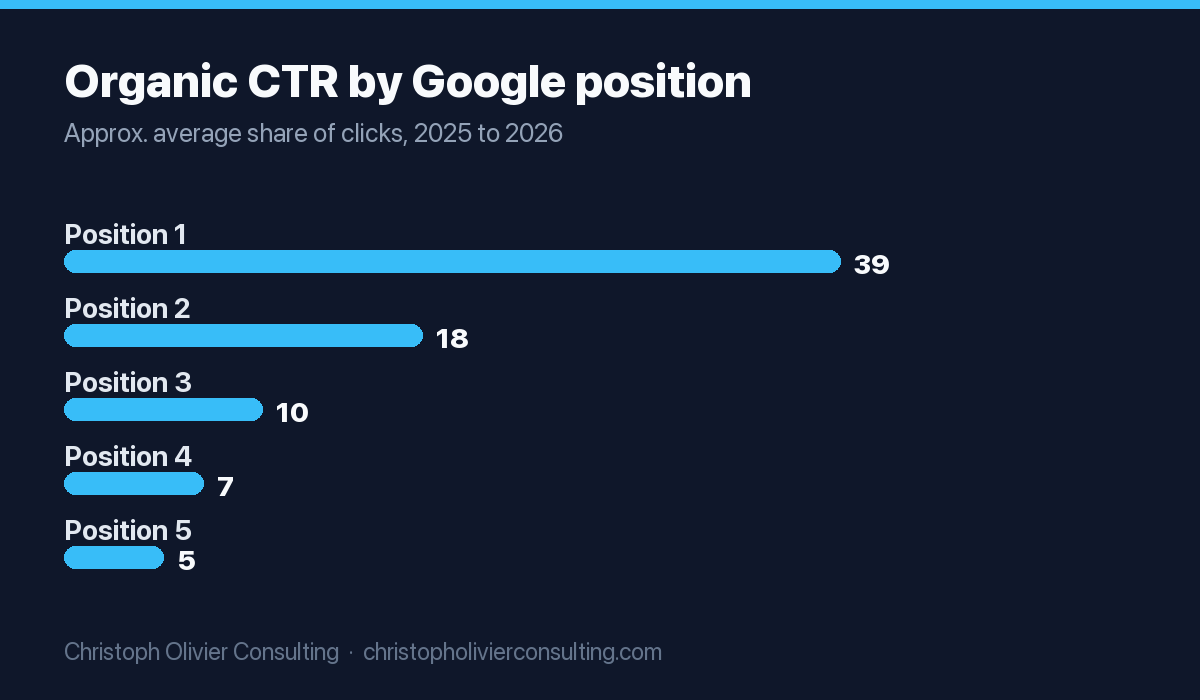
The figures below are approximate industry averages and shift with query type and whether an AI Overview appears. Treat them as direction, not a promise. They explain why the goal is the top three, not merely “page one.”
| Organic position | Approx. average CTR | What it means |
|---|---|---|
| Position 1 | ~39% | Captures the majority of clicks for the query |
| Position 2 | ~18% | Roughly half of position one |
| Position 3 | ~10% | Last position with strong volume |
| Position 4 | ~7% | Meaningful decline begins |
| Position 5 | ~5% | Diminishing returns |
Averages vary by source and by the presence of AI Overviews, which several 2025 to 2026 studies link to lower click-through on top pages. The pattern holds regardless: rank three or better or accept a fraction of the available traffic.
Match search intent before you optimize anything
Intent match is the highest-impact factor because Google will not rank a page format that does not fit the query. Search your target keyword, read the top five results, and note the dominant format: a how-to guide, a comparison, a product page, or a list. If they are all guides and you built a sales page, the page type is wrong.
Group your keywords by the job the searcher is doing: learning something, comparing options, or ready to buy. Build the page format that already wins for that job, then make it clearer and more complete than what ranks now.
Publish content that fully answers the query
Content quality is the strongest on-page factor in 2026, and Google now rewards pages written by people who have done the thing. Cover the whole question, add specifics competitors leave out, and make the answer easy to extract. Depth and originality beat length for its own sake.
Demonstrate first-hand experience: real numbers, named tools, examples from actual work, and a clear author with relevant credentials. This is the practical side of E-E-A-T (experience, expertise, authoritativeness, trustworthiness), which functions as Google’s content-quality lens rather than a single switch you flip.
Get on-page SEO right
On-page optimization tells Google what a page is about and makes it easy to read. Put the primary keyword in the title tag, the H1, the URL, and the first sentence, then use it naturally in a couple of subheadings. Write a title that earns the click, not just one that contains the term.
Structure the page with descriptive H2s, short paragraphs, and tables or lists where they help. Add a meta description that includes the keyword and describes the value. Give images descriptive alt text and compress them so they do not slow the page.
Use internal links to move authority
Internal links pass ranking signals between your own pages and tell Google which are most important. Link from strong, related pages to the page you want to rank, using descriptive anchor text that names the topic. This is one of the fastest on-site levers because you control it entirely.
Build topic clusters: a main page on a subject links to supporting pages, and each supporting page links back. For a consultancy that often means connecting a service to the problems it solves, for example our work on SEO for lead generation tied back to the relevant service pages. Fix orphaned pages that no internal link points to.
Fix the technical foundations
Technical SEO does not usually create rankings, but broken foundations cap them. If Google cannot crawl, index, or load your pages quickly, none of the content work pays off. Handle this as a checklist and keep it maintained rather than treating it as a one-time project.
- Submit an XML sitemap in Google Search Console and confirm your key pages are indexed.
- Fix crawl errors, broken links, and redirect chains.
- Improve page speed and Core Web Vitals, including INP, on mobile first.
- Ensure the site is mobile-friendly and renders without layout shift.
- Use HTTPS and a logical, readable URL structure.
- Add relevant structured data so eligible pages can earn rich results.
Earn authority with relevant links and mentions
Off-site authority is judged on trust and relevance, not volume. A handful of links from respected, topically related sites outweighs hundreds of low-quality ones. Earn them with content worth citing, original data, expert commentary, and genuine relationships in your field.
Authority compounds slowly, so treat it as a steady program rather than a sprint. Consistent publishing, digital PR, and being quoted where your audience already reads all feed the same signal.
The prioritized action plan
Work this list in order. Earlier steps unblock later ones, so do not build links to a page that misreads intent or sits on a site Google cannot crawl.
- Confirm search intent for each target keyword and match the page format to the winning results.
- Fix crawling and indexing so your priority pages are actually in Google’s index.
- Upgrade the content to fully answer the query with first-hand specifics and a credible author.
- Tighten on-page basics: title tag, H1, URL, first sentence, headings, and meta description.
- Add internal links from strong related pages using descriptive anchor text.
- Improve page speed and Core Web Vitals, prioritizing mobile.
- Earn relevant links and mentions from trusted sites in your niche.
- Measure in Search Console, then revisit pages stuck on page two and improve the weakest factor.
How long ranking takes and what to expect
Most meaningful ranking gains land in a 4 to 12 month window, and Google has said as much. New sites often take 3 to 6 months to start ranking; competitive terms can take 6 to 12 months or longer. Low-competition pages sometimes move in a few weeks. No one can honestly guarantee a position or a date.
Budget and scope shape the timeline as much as patience does. If you are weighing what to spend, see our breakdown of how much SEO costs, and if you want this run for you, look at our services.
Frequently asked questions
How do I rank higher on Google fast?
There is no guaranteed shortcut, but the fastest honest wins are usually on pages already sitting on page two. Match the page to search intent, tighten the title tag and on-page basics, add internal links from strong related pages, and improve the weakest content section. These on-site changes can move rankings within weeks, while authority building takes longer.
What is the most important Google ranking factor in 2026?
Search intent match and content quality carry the most weight. Google will not rank a page whose format does not fit what searchers want, and among pages that do fit, it favors the one that most fully and credibly answers the query. E-E-A-T, meaning demonstrated experience and expertise, is how Google judges that quality.
How long does it take to rank higher on Google?
Most meaningful gains appear in a 4 to 12 month range. New sites typically take 3 to 6 months to begin ranking, and competitive keywords can take 6 to 12 months or longer. Low-competition pages sometimes rank in a few weeks. Timelines depend on competition, site authority, and how well the page matches intent.
Do backlinks still matter for ranking on Google?
Yes, but quality and relevance decide their value, not quantity. A few links from respected, topically related sites outweigh hundreds of low-quality ones. Earn them with content worth citing, original data, and expert commentary. Backlinks are one factor among several, so they will not rescue a page that misreads intent.
Is ranking on Google the same as ranking on AI search?
No. Google organic ranking is about appearing in the classic list of blue links, driven by intent, content, on-page, links, and technical health. Getting cited inside AI answer engines like ChatGPT, Perplexity, and AI Overviews is a related but distinct discipline. We cover that separately in our guide on how to rank on AI.
Does page speed affect Google rankings?
Page speed and Core Web Vitals are ranking factors, and they matter most on mobile. Slow pages rarely rank well and lose users regardless of ranking. That said, speed is a foundation rather than a growth lever: fix it so it stops holding you back, then invest the larger effort in intent match and content quality.
More marketing guides for rank on ai: get cited by ai search
- The Best HubSpot Alternatives in 2026 (by Use Case)
- 20 Personal Brand Statement Examples (and How to Write Yours)
- Sales Representative Job Description (Template + Skills)
- What Does an Advertising Manager Do? Role, Skills, Salary
- AI Marketing Agents: What They Are and How to Use Them
- Client Database Software: How to Store and Segment Client Records
- Rank on AI: Get Cited by AI Search