
Last reviewed: October 2026
A marketing automation consultant is a specialist who audits, designs, builds and documents the systems that move a lead from first touch to closed deal without manual work: forms, CRM sync, email nurture, lead scoring, routing and reporting. Most engagements run as a fixed-scope audit plus a build, and published 2026 market ranges put freelance automation experts anywhere from $20 to $225 per hour depending on seniority.
This guide is for owners, partners and marketing leads at service businesses who are deciding whether to hire one. It covers what the work actually includes, how it compares with doing it yourself, an agency or an in-house hire, what it costs, what the first 90 days should look like, and the questions and red flags that separate a good consultant from an expensive one.
What a marketing automation consultant does
A marketing automation consultant turns your sales and marketing process into tested, documented rules inside your software. The job covers six areas: auditing what you have, choosing or rationalizing platforms, integrating the CRM, building workflows, setting up lead scoring and routing, and creating reporting you can trust. Strategy comes first; the clicks come second.
In practice, the work breaks down like this:
- Audit. Map every lead source, form, list, field, workflow and integration. Find duplicates, broken triggers, dead fields and leads that fall through the cracks.
- Platform selection. Decide whether your current tools can do the job or whether you need a different stack. A good consultant is tool-agnostic and explains the tradeoffs in plain language. If you are still comparing options, our breakdown of marketing automation platforms is a useful starting point.
- CRM integration. Define which system is the source of truth for each field, how records sync, and what happens when two systems disagree.
- Workflow build. Speed-to-lead alerts, nurture sequences, appointment reminders, re-engagement, onboarding and review requests.
- Lead scoring and routing. Rules that decide who is sales-ready and who gets the lead, with a written service level for follow-up.
- Reporting. Dashboards that tie campaigns to pipeline and revenue, not just opens and clicks.
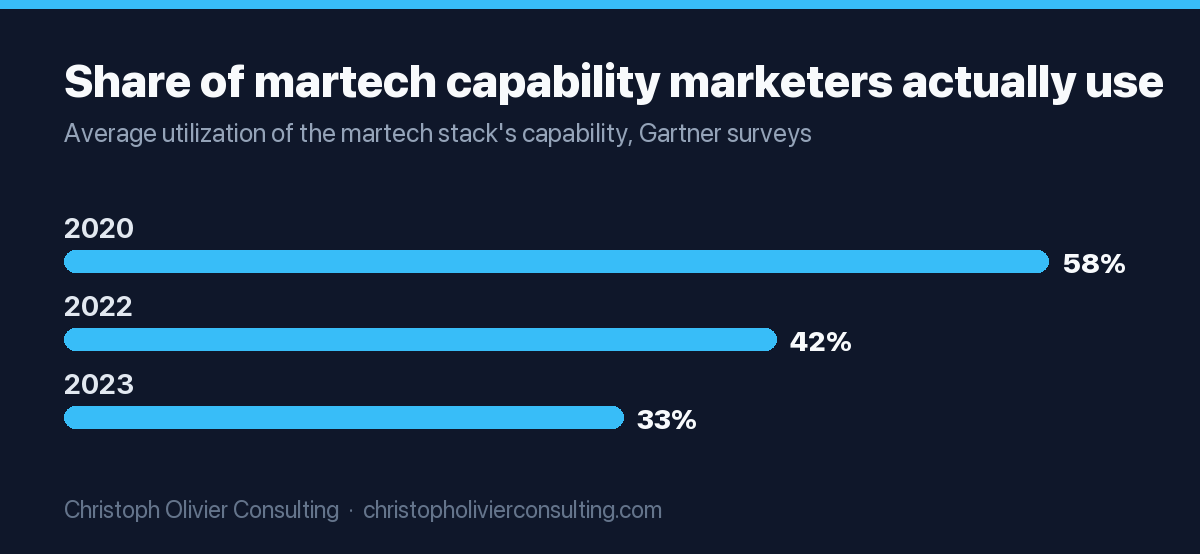
The reason this role exists is simple: most companies own far more software capability than they use. A Gartner survey of 405 marketing leaders conducted in May and June 2023 found that organizations used only 33% of their martech stack’s capability on average, down from 42% in 2022 and 58% in 2020, while technology took 25.4% of the marketing budget. A consultant’s first job is often to make the tools you already pay for earn their keep.
Marketing automation consulting deliverables: the checklist
Good marketing automation consulting ends with assets you own, not just workflows that run. At minimum you should receive an audit report, a system map, a prioritized roadmap, built and tested workflows, a field and naming dictionary, a reporting dashboard, written runbooks and a training session. If a deliverable is not written down, assume you will not get it.
Use this checklist when you review a proposal:
- Current-state audit with findings ranked by revenue impact and effort
- System diagram showing every tool, integration and data flow
- Lifecycle stage definitions agreed by marketing and sales (lead, MQL, SQL, opportunity, client)
- Field dictionary: every custom field, its purpose, its owner and its source of truth
- Workflow specifications: trigger, conditions, actions, exit rules and re-enrollment logic
- Test plan and test results, including negative cases (what should not happen)
- Email authentication and deliverability setup (SPF, DKIM, DMARC, unsubscribe handling)
- Dashboard tied to pipeline, with definitions for each metric
- Runbooks for common changes, plus a recorded training session
- Admin access and ownership of every account transferred to you
The deliverability line matters more than it used to. Google’s email sender guidelines require anyone sending more than 5,000 messages a day to Gmail accounts to set up SPF, DKIM and DMARC, support one-click unsubscribe on marketing messages, and keep spam rates reported in Postmaster Tools below 0.3%. A consultant who skips this can build perfect workflows that land in spam.
Consultant vs DIY vs agency vs in-house hire
Hire a marketing automation consultant when the problem is design: lifecycle rules, data flow, scoring and integration. Do it yourself when the need is one simple sequence. Use an agency when you also need ongoing content and campaigns produced. Hire in-house when automation is daily, continuous work that justifies a full salary and benefits.
| Option | Best when | Typical cost basis | Main risk |
|---|---|---|---|
| DIY (owner or marketer) | One or two simple workflows on a tool you already know | Your time plus software | Fragile builds nobody documented; hidden opportunity cost |
| Marketing automation consultant | You need architecture, cleanup, integration or a rebuild | Hourly, fixed project fee or short retainer | Weak handoff leaves you dependent on one person |
| Agency | You need automation plus ongoing content, ads and campaign production | Monthly retainer | Automation becomes a side service; strategy may be generic |
| In-house marketing ops hire | Daily changes, many campaigns, several tools to maintain | Salary plus benefits and tools | One person carries all the knowledge; a hire before the system is designed often inherits a mess |
| Fractional CMO with automation scope | You need strategy, positioning and systems tied together | Monthly retainer | Make sure hands-on build capacity is included, not just advice |
For reference on the in-house option, the US Bureau of Labor Statistics reports a median annual wage of $166,790 for marketing managers in May 2025, and $78,760 for market research analysts. Neither figure includes benefits or software. For many 7-figure service firms, a consultant to design the system followed by a trained part-time operator costs less than a senior full-time hire and leaves better documentation behind.
If you are not sure you are ready for any of these, our guide on when you actually need marketing automation walks through the readiness signals.
How much does a marketing automation consultant cost in 2026?
Published 2026 market ranges put freelance marketing automation experts between $20 and $225 per hour, with senior specialists usually in the $80 to $140 band. Broader marketing consultant data shows $100 to $300 per hour and $3,000 to $15,000 monthly retainers. Treat these as market ranges, not quotes; scope drives the final number.
| Source and basis | Tier or model | Published range |
|---|---|---|
| goLance rate guide, freelance marketing automation experts worldwide, updated September 2026 | Junior (0 to 2 years) | $20 to $40 per hour |
| Mid-level (2 to 5 years) | $40 to $80 per hour | |
| Senior (5 to 10 years) | $80 to $140 per hour | |
| Expert (10+ years) | $140 to $225 per hour | |
| MarketerHire, marketing consultants generally, 30,000+ marketplace matches, June 2026 | Hourly | $100 to $300 per hour |
| Monthly retainer | $3,000 to $15,000 per month | |
| Project | $5,000 to $50,000 per project | |
| OuterBox cost guide, marketing consultants generally, September 2026 | Independent consultants | $75 to $250 per hour |
| Senior specialists | $150 to $500 per hour |
Three things explain most of the spread:
- Strategy vs implementation. Someone who only configures workflows you specify charges less than someone who designs the lifecycle, the data model and the reporting.
- Platform depth. Enterprise platforms and complex CRM integrations command higher rates than single-tool email setups.
- Location and marketplace. The goLance guide notes that location, scope and specialization move individual rates up or down, and its own platform median is far below the US senior band.
Also budget for the software itself. Platform subscriptions, onboarding fees and contact-tier pricing change often, so check the vendor’s current pricing page before you sign anything. Our comparison of CRM and marketing automation software explains how those tools fit together.
When to hire a marketing automation consultant
Hire a marketing automation consultant when leads are slipping between systems, nobody trusts the reports, you pay for features nobody uses, or a planned platform migration is coming. The common thread is that the problem is structural. Adding one more email sequence will not fix a broken lifecycle or a CRM that disagrees with your marketing tool.
Specific signals worth acting on:
- Leads from web forms, calls or ads arrive in different places, and some never get a follow-up.
- Sales and marketing disagree on what counts as a qualified lead.
- You have duplicate contacts, conflicting fields and lists nobody can explain.
- Your dashboard reports email opens, but you cannot say which channel produced last quarter’s clients.
- You are moving platforms and want the migration to fix problems rather than copy them.
- The person who built your automations left, and nothing is documented.
If none of these apply and you need a single welcome sequence, you probably do not need a consultant yet.
What the first 90 days of an engagement look like
A well-run marketing automation engagement moves through audit, roadmap, pilot and scale. The first two weeks are discovery and audit, weeks three and four produce the roadmap, the middle month builds and tests a small set of high-impact workflows, and the final month expands, documents and trains. Each phase should end with a deliverable you approve.
- Weeks 1 to 2: discovery and audit. Interviews with sales, marketing and operations. Admin access review. Inventory of every tool, form, list, field and workflow. Baseline metrics captured so progress can be measured later.
- Weeks 3 to 4: roadmap and definitions. Agreed lifecycle stages, lead scoring criteria, routing rules and follow-up service levels. A ranked backlog of workflows by impact and effort. A decision on platforms.
- Weeks 5 to 8: pilot build. Clean the data that the pilot depends on. Build two or three priority workflows, typically speed-to-lead, a nurture track and an appointment or onboarding sequence. Test every path, including the ones that should not fire.
- Weeks 9 to 10: reporting. Connect the CRM and marketing platform to a dashboard that tracks leads by source, conversion by stage and time to first response.
- Weeks 11 to 12: scale, document and hand off. Extend what worked, write runbooks and the field dictionary, train your team, and transfer ownership of every account.
Not sure which workflows belong in the pilot? Our list of the marketing automation workflows to build first ranks them by impact for service businesses.
Worked example: scoping a marketing automation project
Here is an illustrative scope for a 12-person professional-service firm with a website, a CRM nobody fully trusts, and leads arriving from forms and phone calls. The numbers are arithmetic based on the published rate bands above, not a quote or a real client result. Use it as a template for reading proposals.
| Phase | Work included | Estimated hours |
|---|---|---|
| Audit and discovery | Stakeholder interviews, tool and field inventory, baseline metrics | 12 |
| Roadmap and definitions | Lifecycle stages, scoring, routing rules, ranked backlog | 8 |
| Data cleanup | Deduplication, field consolidation, list rebuild | 10 |
| Workflow build | Speed-to-lead alert, 6-email nurture, consultation reminders | 20 |
| QA and deliverability | Test cases, SPF/DKIM/DMARC check, unsubscribe test | 6 |
| Reporting | Pipeline dashboard with source and stage conversion | 8 |
| Documentation and training | Runbooks, field dictionary, recorded session | 6 |
| Total | 70 |
At $80 per hour, the bottom of the published senior band, 70 hours comes to $5,600. At $140 per hour, the top of that band, it comes to $9,800. A strategy-led consultant at $200 per hour would land at $14,000. The scope, not the hourly rate, is what you should compare across proposals: a cheaper quote that drops QA, reporting or documentation usually costs more later.
Questions to ask before you hire a marketing automation consultant
Ask questions that reveal how a consultant thinks, not just which tools they know. The best ones expose their approach to discovery, data ownership, testing, compliance and handoff. A strong candidate answers with specifics and examples of process; a weak one answers with software features and promises about results.
- How do you tell a process problem from a platform problem?
- Which system will be the source of truth for each key field, and how do you handle conflicts?
- How do you prevent duplicate records and unwanted re-enrollment in workflows?
- What does your test plan include, and do you test the paths that should not fire?
- How do you handle unsubscribes, suppression lists and email authentication?
- What will you not automate, and why?
- What documentation and training do I get, and who owns the accounts at the end?
- How will we measure whether this worked, and what is the baseline?
- Can I see a sample audit report or workflow spec with client details removed?
Compliance deserves its own question. The FTC’s CAN-SPAM compliance guide says you must honor opt-out requests within 10 business days, each violating email can carry penalties of up to $53,088, and you cannot contract away your legal responsibility by hiring another company to send your email. Your consultant should build for that, but the liability stays with you.
Red flags in marketing automation services
The biggest red flags are guaranteed results, skipping discovery, building inside accounts you do not own, and no written documentation. Others include pushing one platform regardless of fit, recommending more automation than your volume needs, and quoting a fixed price before seeing your systems. Any of these suggests you are buying activity, not a working system.
- Guaranteed lead or revenue lifts. Results depend on your offer, market and follow-up. Honest consultants talk about measurement, not promises.
- No audit. Building before mapping the current state usually copies existing problems into a new tool.
- Accounts in their name. You should own every platform, domain and integration. Grant them a user seat, not ownership.
- Platform loyalty over fit. A partner badge is fine; a recommendation that ignores your size, budget and team is not.
- No documentation in the scope. If runbooks and a field dictionary are not listed as deliverables, plan on paying someone to reverse engineer the build later.
- Vanity reporting. Dashboards built on opens and clicks with no link to pipeline or revenue.
- Excessive access requests. Asking for full admin rights to systems outside the scope, such as billing or unrelated tools.
How to keep the value after the consultant leaves
The value of marketing automation consulting lasts only if someone owns the system afterward. Name an internal owner before the engagement starts, have them attend the build sessions, require runbooks and a change log, and schedule a quarterly review of workflows, fields and reports. Without an owner, even good builds decay within months.
A simple ownership routine:
- Weekly: check that new leads were assigned and followed up within your service level.
- Monthly: review bounce and spam complaint rates, failed syncs and workflow errors.
- Quarterly: retire unused workflows and fields, review scoring against actual closed deals, and confirm reports still match how sales works.
- Before any new tool: update the system map and ask whether an existing platform already does the job.
Automation also extends beyond marketing. Intake, onboarding, proposals and reporting often run on the same data, which is why many firms pair this work with broader business automation across sales and operations. In my experience, the firms that get the most from a consultant treat the engagement as building an operating system for growth, not buying a set of emails.
If you want a second opinion on your current setup or a scope before you hire anyone, you can book a consultation and we will walk through it together.
Frequently asked questions
What does a marketing automation consultant do?
A marketing automation consultant audits your current tools and data, decides which platforms you need, integrates your CRM, builds and tests workflows such as speed-to-lead alerts and nurture sequences, sets up lead scoring and routing, and creates reporting tied to pipeline. A good one also documents the system and trains your team so you can run it after the engagement ends.
How much does a marketing automation consultant cost?
Published 2026 market ranges put freelance marketing automation experts between $20 and $225 per hour, with senior specialists commonly at $80 to $140 per hour per goLance's rate guide. Broader marketing consultant data from MarketerHire shows $100 to $300 per hour and $3,000 to $15,000 monthly retainers. Your scope, platform complexity and the consultant's seniority drive the final price.
Should I hire a marketing automation consultant or an agency?
Hire a consultant when the core problem is design: lifecycle stages, data flow, CRM integration, scoring and reporting. Choose an agency when you also need ongoing content, ads and campaign production every month. Many service firms use a consultant to design and build the system, then have an internal person or agency run campaigns on top of it.
How long does a marketing automation consulting engagement take?
A focused engagement often runs about 90 days: two weeks of discovery and audit, two weeks of roadmap and definitions, about a month building and testing a pilot set of workflows, then a final month on reporting, scaling, documentation and training. Larger migrations or multi-platform integrations can take longer, so ask for a phased plan with approved deliverables at each stage.
What should I ask before I hire a marketing automation consultant?
Ask how they separate process problems from platform problems, which system will be the source of truth for key fields, how they prevent duplicates and unwanted re-enrollment, what their test plan includes, how they handle unsubscribes and email authentication, what they will not automate, and what documentation, training and account ownership you receive at the end.
Do I need marketing automation services if I already have a CRM?
Often, yes, if leads still slip between systems or reports are not trusted. Owning software is not the same as using it: a Gartner survey found marketers used only 33% of their martech stack's capability in 2023. A consultant can connect the CRM to your marketing tools, define lifecycle rules and build the workflows your current subscription already supports.
More Business Automation guides
- Marketing Automation Platforms: How to Choose One for a Growing Business
- 10 Marketing Automation Workflows to Build First
- CRM and Marketing Automation Software: A Practical Guide for SMB Lead Management
- Marketing Automation: When You Need It
- No-Code Automation in 2026: Tools & Limits
- Marketing Automation Strategy: Tools to Workflows
- All Business Automation guides →