
Last reviewed: October 2026
An SEO starter package is a fixed, entry-level scope of search work: a technical audit, Google Business Profile setup, on-page fixes for your core pages, tracking, and a few pieces of content. In the largest public pricing survey, Ahrefs found the most common SEO retainer was $501 to $1,000 a month and the most common project fee was $2,501 to $5,000. A good starter package fixes the foundations in 60 to 90 days. It does not promise rankings.
This guide covers what belongs in a starter package, what it costs, what months one to three look like, which offers to walk away from, and how to compare quotes side by side. It is written for owners and partners at professional-service firms and established service businesses who want a clear buying standard before they sign anything.
What is an SEO starter package?
An SEO starter package is a defined bundle of foundational SEO work sold at a fixed price, usually as a one-time project or a short retainer of three months or so. Its job is to make your site crawlable, accurately described to Google, measurable, and ready for ongoing content. It is a setup phase, not a growth engine.
Most providers sell SEO in three formats: hourly, per project, and monthly retainer. A starter package usually sits between project and retainer. You get a scoped list of deliverables, a deadline, and a handoff. The best ones end with a written plan for what comes next, so you can decide whether to continue, hire in house, or stop.
You will also see the same thing sold as a “basic SEO package,” a “small business SEO package,” or a “bronze” tier on an agency’s SEO packages page. The label matters less than the deliverables list. Two packages with the same name can contain very different work.
What a good SEO starter package should include
A good SEO starter package covers five foundations: a technical audit with fixes, Google Business Profile setup if you serve a local market, on-page optimization of your core service pages, analytics and Search Console tracking, and two to four pieces of content aimed at real buyer questions. Anything less is usually an audit, not a package.
1. Technical audit and priority fixes
The audit should check indexing, crawl errors, page speed, mobile rendering, broken links, redirects, duplicate pages, and structured data. The deliverable is not a 90-page PDF. It is a ranked list of problems with the fixes actually made, or clearly assigned to your web developer. Our 26-point SEO audit checklist shows what a complete technical pass looks like in practice.
2. Google Business Profile setup and cleanup
If clients find you by city or region, your Business Profile is often the first thing they see. Google says local results are ranked mainly on relevance, distance and prominence, and that “there’s no way to request or pay for a better local ranking.” A starter package should verify the profile, fix categories, services, hours and description, add photos, and set up a review request process.
Reviews deserve real attention. In BrightLocal’s Local Consumer Review Survey 2026 of 1,002 US adults, 41% said they always read reviews when browsing for a business, 31% will only use a business rated 4.5 stars or higher, and 74% look for reviews written in the last three months.
3. On-page optimization of core pages
This means your homepage, your main service pages, your about page and your contact page. For each one: a unique title tag, a clear meta description, a logical heading structure, internal links, and copy that matches what buyers search for. Google’s own SEO Starter Guide says a good title is “unique to the page, clear and concise, and accurately describes the contents.” A starter scope is usually five to fifteen pages.
4. Keyword research tied to revenue
Keyword research in a starter package should be short and commercial. You want a map of which search terms belong to which page, focused on service and location terms that bring in paying clients. A spreadsheet of 2,000 keywords with no page assignments is not useful at this stage.
5. Tracking and reporting setup
Before any work starts, the provider should set up Google Search Console, connect analytics, and define what counts as a conversion: calls, form fills, consultation bookings. Search Console’s Performance report shows clicks, impressions, click-through rate and average position, which gives you a baseline to judge the package against.
6. Two to four pieces of content
A starter package should include a small amount of new content: a missing service page, a location page, or an article that answers a question your buyers ask before they call. The goal is to fill obvious gaps, not to launch a publishing program.
What a starter package usually leaves out
- Ongoing link building or digital PR campaigns
- A full content calendar with weekly publishing
- Site redesigns or platform migrations
- Paid search management
- Conversion rate testing beyond basic fixes
How much does an SEO starter package cost in 2026?
Most SEO starter packages in the US fall between roughly $500 and $5,000, depending on whether they are sold monthly or as a one-time project. Ahrefs surveyed 439 SEO providers and found the most common monthly retainer was $501 to $1,000, and the most common project fee was $2,501 to $5,000.
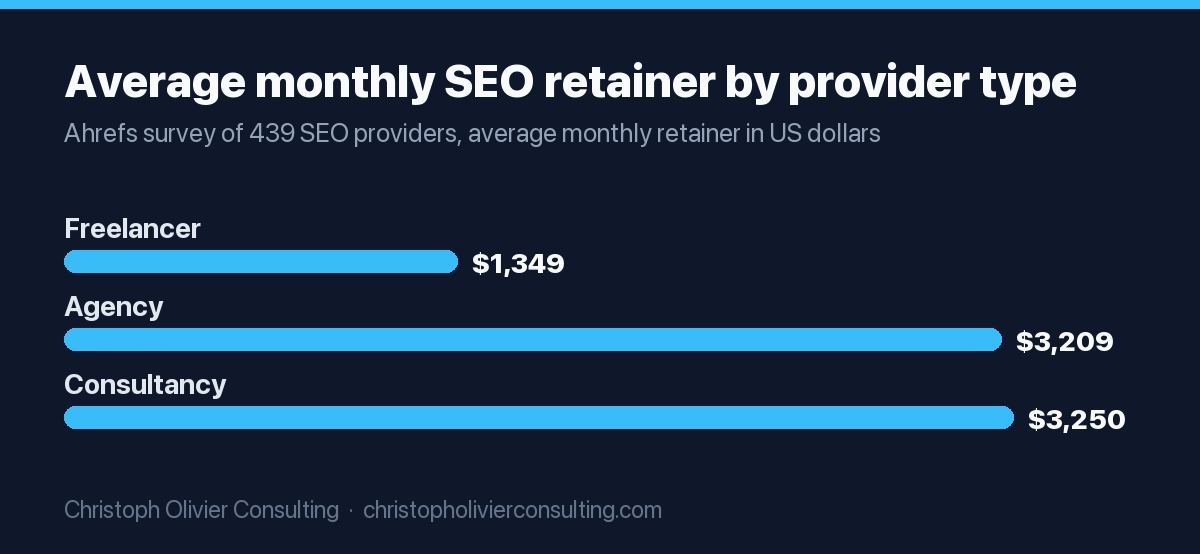
The Ahrefs SEO pricing survey (updated August 2024) is still the most useful public benchmark because the team manually checked that each respondent actually sold SEO services. Here is what it found.
| Pricing model | Most common band (Ahrefs survey) | Share of respondents | What it usually buys in a starter scope |
|---|---|---|---|
| Hourly | $75 to $100 per hour | 24% | Audits, consulting calls, fixes done by your own team |
| Monthly retainer | $501 to $1,000 per month | 20.4% | Light ongoing fixes, a few pages, basic reporting |
| Per project | $2,501 to $5,000 | 21.2% | A defined setup project: audit, fixes, core pages, tracking |
Who you hire changes the price. In the same survey, freelancers averaged $1,348.63 a month on retainer, agencies $3,209, and consultancies $3,250. Experience mattered too: providers with two years or less averaged $1,540.52 a month, while those with five to ten years averaged $3,648.28.
Public price lists show the same spread. One 2026 roundup of SEO starter packages lists offers from $199 a month up to $1,499.99 a month, with some sold as one-time fees around $400 to $550. Those cheaper offers are usually narrower: a profile setup or a single audit, not the full set of foundations above. For a deeper breakdown by business size and channel, see our guide on how much SEO costs in 2026.
A quick way to sanity check a quote
Divide the package price by the hours the provider says it includes. If a $499 package claims to cover an audit, 15 optimized pages, profile setup and four articles, the implied hourly rate is far below the $75 to $100 market norm. Either the work is thinner than it sounds or it is heavily automated.
Basic SEO package vs. small business SEO package vs. full retainer
A basic SEO package usually means a one-time audit and fixes. A small business SEO package often adds local SEO and a little content on a short retainer. A full retainer adds ongoing content, links and strategy. The right choice depends on whether your site’s foundations are already sound, not on the label.
| Feature | Basic SEO package | Small business SEO package | Full monthly retainer |
|---|---|---|---|
| Typical format | One-time project | 3 to 6 month retainer | Ongoing, 6 to 12+ months |
| Technical audit | Yes, with fixes | Yes, with fixes | Yes, plus ongoing monitoring |
| Google Business Profile | Sometimes | Yes | Yes, with review program |
| Core page optimization | 5 to 10 pages | 10 to 15 pages | Full site |
| New content | Rarely | 2 to 4 pieces | Regular publishing |
| Link acquisition | No | Citations only | Earned links, PR |
| Reporting | Baseline report | Monthly | Monthly plus strategy reviews |
| Best for | Sites with clear technical issues | Local and regional service firms | Competitive markets, growth goals |
Package names are not standardized, so treat this table as a guide to scope, not a definition. Always compare the actual deliverables list.
What to expect in months one to three
In the first 90 days of an SEO starter package, expect setup, fixes and early signals rather than new revenue. Google says some changes can take effect in hours while others take several months. Month one is diagnosis, month two is implementation, and month three is measurement and a plan for what comes next.
- Weeks 1 to 2: access and baseline. The provider gets read access to Search Console and analytics, records current traffic, rankings and conversions, and confirms goals. Google advises granting only read access to Search Console during an audit, not write access.
- Weeks 2 to 4: technical audit and keyword map. You receive a ranked list of technical problems and a map of target terms by page.
- Weeks 4 to 8: implementation. Technical fixes go live, core pages are rewritten or optimized, and the Business Profile is cleaned up.
- Weeks 6 to 10: content. The two to four new pages or articles are written, reviewed by you, and published.
- Weeks 10 to 13: measurement and next steps. You get a report comparing the baseline to current data and a written recommendation for the next six months.
Be realistic about results. Google’s SEO Starter Guide says “some changes might take effect in a few hours, others could take several months,” and suggests waiting a few weeks before judging the impact of a change. Early wins usually show up as more impressions and better indexing before they show up as calls.
Red flags in cheap SEO packages
The biggest red flags in an SEO package are guaranteed rankings, bulk link packages, secrecy about what was changed, and requests for full control of your accounts. Google states plainly that “no one can guarantee a #1 ranking on Google,” so any package built on that promise is selling something it cannot deliver.
Google’s own guide, Do you need an SEO?, lists warning signs worth checking against any offer:
- Guaranteed rankings or “priority submit” claims. Google says no one can guarantee a #1 ranking and warns against SEOs who claim a special relationship with Google.
- Cheap link packages. “200 backlinks for $99” offers fall under Google’s link spam policy, which covers “exchanging money for links, or posts that contain links.” Paid links are only acceptable when marked with
rel="nofollow"orrel="sponsored", which removes their ranking value. - Secrecy. If a provider will not explain what they changed on your site and why, you cannot judge the work or undo it.
- Unsolicited outreach. Cold emails promising page one results are a pattern Google specifically warns about.
- Owning your assets. Your domain, Business Profile, analytics and Search Console should stay in your name. Grant access, never ownership.
- Vague reporting. Rankings for obscure keywords nobody searches are easy to show and mean little. Ask for traffic and leads from search.
How to compare SEO packages: a scoring checklist
To compare SEO packages fairly, score each quote on the same criteria: deliverables, who does the work, timeline, reporting, ownership and exit terms. Price only makes sense once scope is equal. A $1,500 package with fixes made is often better value than a $700 package that delivers recommendations only.
Use this table when you have two or three quotes in hand. Score each line from 0 (missing) to 2 (clear and specific).
| Criterion | What a 2 looks like | Quote A | Quote B | Quote C |
|---|---|---|---|---|
| Technical audit | Named checks, fixes implemented, not just listed | |||
| Core pages | Specific number of pages and what changes on each | |||
| Business Profile | Verification, categories, services, review process | |||
| Content | Number of pieces, length, topics agreed with you | |||
| Tracking | Search Console, analytics and conversions set up in week one | |||
| Who does the work | Named person, in house or disclosed subcontractor | |||
| Timeline | Dated milestones over 60 to 90 days | |||
| Reporting | Baseline vs. current for traffic, leads and visibility | |||
| Ownership | All accounts and content stay in your name | |||
| Exit terms | No long lock-in, clear handoff document |
A package scoring 16 or more out of 20 is usually worth a serious conversation. Below 10, the scope is too vague to judge. Then ask Google’s own suggested questions, including “What kind of results do you expect to see, and in what timeframe? How do you measure your success?” Our framework for how to choose an SEO company goes further on interviewing providers and checking references.
Worked example: a starter scope for a three-partner accounting firm
Here is an illustrative 90-day starter scope for a hypothetical three-partner accounting firm serving one metro area. It shows how the foundations translate into hours and cost. It is a planning template, not a client case, and the hours are estimates you should adjust to your own site.
| Workstream | Deliverable | Estimated hours |
|---|---|---|
| Baseline and tracking | Search Console, analytics, call and form conversions, baseline report | 6 |
| Technical audit and fixes | Indexing, speed, redirects, duplicates, schema | 12 |
| Keyword map | Service and city terms assigned to 10 pages | 5 |
| Core page optimization | Homepage, 6 service pages, about, contact, team | 15 |
| Business Profile | Categories, services, photos, review request process | 5 |
| New content | 1 missing service page, 2 articles on common client questions | 12 |
| Wrap-up | 90-day report and six month recommendation | 5 |
| Total | 60 |
At the most common hourly band in the Ahrefs survey, $75 to $100, 60 hours works out to $4,500 to $6,000. That sits just above the most common project band of $2,501 to $5,000. If a quote for similar scope comes in far below that, ask which items are automated, templated or left out.
Notice what the example does not include: link building, a publishing calendar, or a redesign. Those belong in a later phase, once the foundations are working and you have baseline data to justify the spend.
When an SEO starter package is the wrong buy
An SEO starter package is the wrong buy when your problem is not foundations. If your site is already technically sound, your pages are already optimized, or your market is so competitive that setup alone will not move you, a starter package pays for work you do not need and delays the work you do.
Skip the starter package, or change the scope, in these situations:
- Your site is about to be rebuilt. Optimizing pages that will be replaced in three months wastes budget. Fold SEO into the rebuild instead.
- Foundations are already done. If a recent audit came back clean, you need content and authority, which means a retainer or a content program.
- You need leads this month. SEO is slow. Paid search or referral work may be the better short-term buy.
- Your offer or positioning is unclear. SEO amplifies a clear message. It rarely fixes a confusing one.
- You have no one to approve changes. Packages stall when nobody on your side reviews pages or grants access.
In my experience the most common mistake is buying a package before deciding what a good lead looks like. Define that first and every other decision gets easier.
What happens after the starter package ends
After a starter package, you should have three things: a fixed technical foundation, a baseline of search data, and a written plan. From there you can move to an ongoing retainer, bring the work in house, or pause. A good provider makes all three options workable by handing over documentation and access.
The handoff document should list every change made, the keyword map, the reporting setup, open issues, and recommended next steps with rough budgets. If you plan to continue with outside help, our SEO services buyer’s guide explains how to scope a longer engagement and what ongoing work should include.
For firms that want this run as part of a wider marketing plan rather than as a standalone project, our SEO services start with the same foundations and connect them to positioning, content and lead tracking. If you want a second opinion on a quote you have received, you can book a consultation and we can walk through the scope together.
Frequently asked questions
What is included in an SEO starter package?
A solid SEO starter package includes a technical audit with fixes, Google Business Profile setup for local firms, on-page optimization of five to fifteen core pages, a keyword map, Search Console and analytics tracking with conversions defined, and two to four new pieces of content. It should end with a written report and a plan for the next six months.
How much does an SEO starter package cost?
Most US starter packages fall between roughly $500 and $5,000. In Ahrefs' survey of 439 SEO providers, the most common monthly retainer was $501 to $1,000 and the most common project fee was $2,501 to $5,000. Freelancers averaged $1,348.63 a month on retainer, agencies $3,209 and consultancies $3,250.
How long before an SEO starter package shows results?
Expect setup and early signals in the first 90 days, not a jump in revenue. Google says some changes take effect in a few hours while others can take several months. Early progress usually shows up as better indexing and more impressions in Search Console before it shows up as more calls or form fills.
Is a cheap SEO package worth it?
It can be, if the scope is narrow and honest, such as a one-time Business Profile setup or a single audit. Be wary of low-priced packages that promise full audits, many optimized pages, content and backlinks at once. The implied hourly rate is often far below the $75 to $100 market norm, which usually means thin or automated work.
Can an SEO company guarantee first page rankings?
No. Google states that no one can guarantee a #1 ranking on Google, and it warns against providers who claim a special relationship with Google or priority submission. Treat any package built on guaranteed rankings as a red flag. Look instead for clear deliverables, transparent reporting, and realistic expectations about timing.
What is the difference between a basic SEO package and a monthly retainer?
A basic SEO package is usually a one-time project that fixes foundations: audit, core pages, tracking. A monthly retainer is ongoing work that adds regular content, link earning, monitoring and strategy reviews. Many firms start with a basic package to build a baseline, then decide whether a retainer is justified by the data.