
Last reviewed: October 2026
Here is how to build a social media marketing team: start with one strategist who can also execute, tie the team to one or two business goals, then add specialists in the order your bottlenecks appear: content creation first, then community management, paid social and analytics. Most firms under 50 people run well on one to three people plus freelancers. Specialist roles only pay off once social has a clear revenue job.
This guide covers the roles, the team structure that fits each stage of growth, what each role costs using 2025 Bureau of Labor Statistics pay data, how to choose between in-house, agency, freelance and fractional help, and the approval workflows and KPIs that stop a new team from stalling. It is written for owners and marketing leads at professional-service firms and service businesses, not for global consumer brands.
What does a social media marketing team actually do?
A social media marketing team does six jobs: sets strategy tied to business goals, produces content, publishes on a calendar, manages community and inbound messages, runs paid social, and measures results. In a small firm one person covers most of these. As you grow, you split them into roles. Knowing the six jobs tells you what you are hiring for.
- Strategy: which audiences, which channels, what each channel is for, and how it connects to pipeline.
- Content production: copy, graphics, carousels, short-form video, and repurposed long-form content.
- Publishing and operations: the calendar, scheduling, approvals and the asset library.
- Community and social care: comments, DMs, reviews, mentions and escalations.
- Paid social: targeting, creative testing, budgets and lead forms.
- Measurement: reporting, attribution and social listening.
Responsiveness is not optional. In the 2025 Sprout Social Index, 73% of consumers said they would buy from a competitor if a brand does not respond on social. That is why community management shows up early in the hiring order below, even for small teams.
Social media team roles and responsibilities
The core social media team roles are social media manager, content creator, video producer, community manager, paid social specialist and social analyst, with a head of social above them once the team grows. Each role owns a distinct output. The table shows what each owns, when to add it, and the closest government pay benchmark.
The US Bureau of Labor Statistics has no occupation code called “social media manager,” so the pay column uses the closest match. The BLS profile for public relations specialists explicitly says they are “usually in charge of monitoring and responding to social media questions and concerns,” which makes it the most defensible proxy for a manager or community role.
| Role | Owns | Add it when | Closest BLS benchmark (median pay, May 2025) |
|---|---|---|---|
| Social media manager / strategist | Strategy, calendar, approvals, reporting to leadership | First hire | Public relations specialists: $74,750 |
| Content creator / designer | Copy, graphics, carousels, templates | The manager spends more time producing than planning | Graphic designers: $62,960; Writers and authors: $76,910 |
| Video producer / editor | Short-form video, editing, captions | Video becomes your main format on your main channel | Film and video editors: $75,420 |
| Community manager / social care | Replies, DMs, reviews, moderation, escalations | Inbound messages start going unanswered or slow | Public relations specialists: $74,750 |
| Paid social specialist | Campaign setup, targeting, creative testing, budget pacing | Paid spend becomes a meaningful share of the budget | No direct BLS code; often contracted |
| Social analyst | Dashboards, attribution, listening, competitor tracking | Leadership asks for revenue impact you cannot prove | Market research analysts: $78,760 |
| Head of social / marketing manager | Ties social to business goals, budget, hiring | Team reaches roughly five or more people | Marketing managers: $166,790 |
Sources: BLS Occupational Outlook Handbook profiles for graphic designers, writers and authors, film and video editors, market research analysts and marketing managers.
Specialist roles larger teams add
Bigger teams split further. Sprout Social’s guide to building a social media team highlights social SEO strategists, social customer care leads, influencer marketing strategists and social intelligence analysts. Members of SocialMedia.org also describe brand engagement leads and social listening leads. For a professional-service firm, these are rarely full-time jobs. Treat them as responsibilities you assign, not headcount you add.
Social media team structure by company stage
The right social media team structure depends on stage, not ambition. A solo generalist suits firms finding their channel, a two to three person core suits firms with a working channel, and a specialized team of four to six suits firms where social drives measurable pipeline. Above that, a hub-and-spoke model links social to sales, service and product.
| Stage | Typical team | Who does what | Outside help that fits |
|---|---|---|---|
| 1. Solo (often part-time) | 1 generalist manager | Strategy, posting, replies and a simple monthly report on one or two channels | Freelance designer or editor on demand; fractional strategy |
| 2. Core team (2 to 3) | Manager + content creator, sometimes a part-time community manager | Manager plans, approves and reports; creator produces; replies are split with a clear owner | Paid social contractor or agency for ad campaigns |
| 3. Specialized (4 to 6) | Manager, designer, video producer, community manager, paid specialist | Each output has one owner; the manager becomes a strategist and editor | Analytics support, production agencies for big campaigns |
| 4. Scaled (7+) | Head of social, channel or platform leads, care team, paid, analyst, creative pod | Central team sets standards; other departments contribute content and expertise | Agency of record for paid or creative, influencer partners |
Three structure models
- Centralized: one team owns every account and every post. Fast and consistent, but it bottlenecks when other departments need social support.
- Hub and spoke: a central team owns strategy, standards and paid, and works with service, sales and product teams. GoDaddy’s guide recommends it for teams that want coordination without centralizing everything.
- Center of excellence or committee: a cross-department group sets rules and shares resources. In the SocialMedia.org guide, Vanguard’s head of social describes a social media committee with members from HR, product, brand and marketing, and Lenovo describes platform-dedicated roles inside a center of excellence.
For most firms with fewer than 100 people, centralized is right. The structure question matters less than having one person clearly accountable for results.
How to build a social media marketing team in 7 steps
To build a social media marketing team, define the business goal, audit what you already have, pick channels, choose a structure and sourcing model, hire in bottleneck order, build the operating system, then measure and adjust every quarter. Skipping the first two steps is the most common reason new teams produce activity without results.
- Write down the business goal. Pick one or two: qualified leads, recruiting, referral-partner visibility, or client retention. SocialMedia.org members stress a documented social strategy with KPIs agreed by senior leadership, reviewed with stakeholders at the start of the year.
- Audit what exists. List every account, who has logins, what is already being posted, and which partners or employees post about the firm. Inventory people and spend too; Lenovo’s governance lead describes this as a way to find duplication before adding roles.
- Choose channels on purpose. Start with the one or two platforms where your buyers and referral sources spend time. For most B2B professional services that means LinkedIn first. Each extra channel adds production load, so add channels only after the first one runs on schedule.
- Pick a structure and sourcing model. Use the stage table above, then decide what stays in-house and what goes to an agency, freelancers or a fractional leader (compared in the next section).
- Hire in bottleneck order. Hire the strategist who can execute first. Write the role carefully; a clear scope, reporting line and KPIs, like those in this marketing manager job description template, prevent hiring a poster when you needed a planner. Then add whichever job is slowing output: usually content, then community, then paid.
- Build the operating system. Set up a shared calendar, a brand and voice guide, an approval matrix, response-time targets and an asset library. A working content calendar is the backbone that lets a small team publish consistently.
- Measure, review and re-evaluate. Report monthly against the goals from step 1 and review the plan each quarter. SocialMedia.org members advise re-evaluating structure more often than other business units, and fully re-assessing roles every three to five years.
In-house vs agency vs freelancers vs fractional
In-house teams give the most control and brand knowledge, agencies give breadth and speed, freelancers fill specific production gaps, and a fractional leader supplies strategy and hiring judgment without a full-time executive salary. Most growing firms use a blend: strategy and community in-house or fractional, specialist production and paid execution outside.
| Factor | In-house hire | Agency | Freelancers | Fractional leader |
|---|---|---|---|---|
| Best for | Daily posting, community, brand voice | Paid social, campaigns, multi-channel production | Design, video editing, copy overflow | Strategy, team design, hiring, vendor management |
| Cost structure | Salary plus benefits and tools | Monthly retainer or project fee | Hourly or per deliverable | Monthly retainer for part-time senior time |
| Time to start | Slowest: recruiting and onboarding | Weeks | Days | Weeks |
| Brand and client knowledge | Deepest over time | Depends on account team stability | Limited to the brief | Strong at strategy level |
| Control | Highest | Shared | Per task | High on direction, low on daily execution |
| Main risk | One-person dependency and burnout | Generic content, account turnover | Inconsistency, management overhead | Still needs someone to execute |
Burnout is a real constraint on the in-house column. In the 2025 Sprout Social Index, 94% of social practitioners said they feel they have to be “chronically online” to do their jobs, and over a third reported more creative fatigue than the prior year. A single in-house hire with no backup for replies and approvals is the setup most likely to break.
If you do not yet have a senior marketer who can design the team and manage vendors, fractional CMO services are one way to get the strategy, hiring plan and agency oversight in place before committing to full-time senior headcount.
What do social media roles cost in 2026?
Using the latest BLS data (May 2025), median pay for the occupations closest to social media roles ranges from $62,960 for graphic designers to $78,760 for market research analysts, with marketing managers at $166,790. Add roughly 43% on top of salary for benefits and employer costs when you budget a full-time hire.
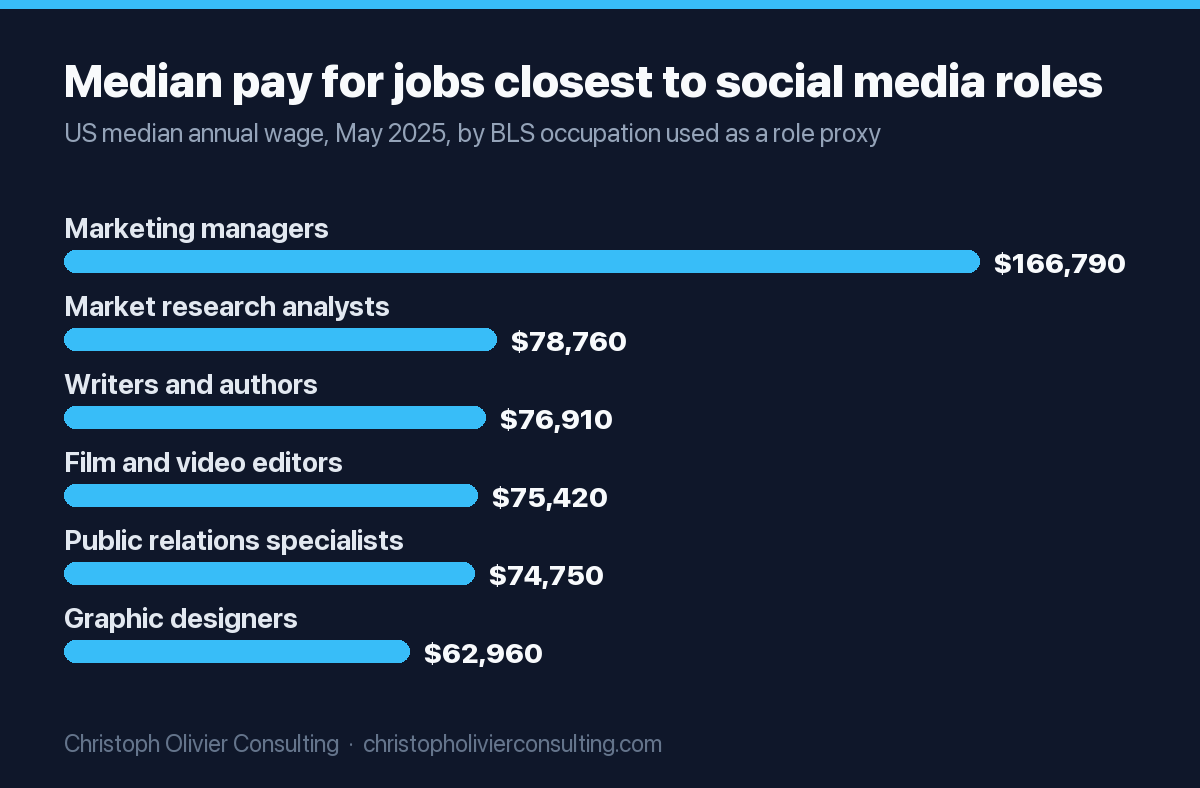
The 43% figure comes from the BLS Employer Costs for Employee Compensation release: for private industry in June 2026, wages and salaries were 70.0% of employer compensation costs and benefits the other 30.0%. Dividing a salary by 0.70 gives an estimate of fully loaded cost. Your actual figure will vary by benefits package, location and seniority, and medians are national, so major metros often pay more.
| Role (BLS proxy) | Median salary, May 2025 | Estimated loaded cost (salary / 0.70) |
|---|---|---|
| Social media manager or community manager (public relations specialists) | $74,750 | About $106,800 |
| Designer (graphic designers) | $62,960 | About $89,900 |
| Copywriter (writers and authors) | $76,910 | About $109,900 |
| Video editor (film and video editors) | $75,420 | About $107,700 |
| Social analyst (market research analysts) | $78,760 | About $112,500 |
| Head of marketing (marketing managers) | $166,790 | About $238,300 |
The math explains why the specialized stage is a real budget decision. A four-person in-house team built from these medians can run past $400,000 a year in loaded cost before tools and ad spend. That is why many firms keep design, video and paid execution on contract until volume justifies a hire.
Workflows and approvals that keep a social team fast
A social team stays fast when approvals are tiered by risk: routine replies and reshares need no sign-off, planned posts need one approver, and anything with claims, testimonials, client references or regulatory exposure goes to compliance. Write the tiers down so the team never waits on a meeting to answer a comment.
- Tier 1, pre-approved: replies from a response library, thank-you comments, reshares of your own published content.
- Tier 2, single approver: calendar posts, carousels and videos. The social manager or a named marketing lead approves within an agreed window.
- Tier 3, compliance or partner review: performance claims, client names or results, testimonials, pricing, legal or tax opinions, and any crisis response.
Regulated firms need this written into policy. For broker-dealers, FINRA’s social media guidance separates static content, which generally needs principal pre-approval, from interactive real-time communications, which can be supervised like correspondence instead, and requires retaining business communications for at least three years. Law, accounting and advisory firms have their own professional advertising rules, so confirm the tiers with your compliance or ethics counsel.
Employee advocacy needs a rule too. The FTC’s Endorsement Guides FAQ says employees who mention their company’s products on social media should disclose the relationship, and that companies need reasonable programs to train and monitor the people posting for them.
Trust from leadership is what makes Tier 2 work. In the 2025 Sprout Social Index, 41% of practitioners feared leadership would not trust their content judgment. A written approval matrix replaces case-by-case permission with agreed rules.
Tools a social media marketing team needs
A social media marketing team needs six tool categories: a scheduling and publishing platform, a shared inbox for comments and DMs, design and video editing tools, an analytics or reporting tool, an approval and asset library, and social listening once the team is larger. Small teams can cover most of this with one management platform plus a design tool.
- Publishing and calendar: one place to plan, schedule and approve posts across channels.
- Unified inbox: so replies have an owner and nothing sits unanswered.
- Design and video: templates the whole team can use without breaking brand rules.
- Analytics: channel data plus UTM-tagged links feeding your CRM.
- Asset library and approvals: current logos, headshots, disclaimers and approved copy.
- Listening: brand, competitor and topic monitoring for scaled teams.
Pick tools after you choose the structure, not before; the right stack for a solo manager differs from a six-person team with a care function. This roundup of social media marketing tools compares options by team size and job.
KPIs to hold a social media team accountable
Hold the team to one business KPI tied to the goal (leads, pipeline, applicants or retention), supported by role-level metrics: output and on-time publishing for creators, response time for community, cost per lead for paid, and report accuracy for analysts. Engagement is a leading indicator, not the goal.
Most teams measure too narrowly. Sprout Social’s 2025 Impact of Social research, a survey of 1,200 marketing leaders reported in a GlobeNewswire release, found 68% of teams measure success by engagement and 65% by conversions, only 44% of leaders rate their teams as expert at measuring social’s business impact, and fewer than half integrate social data into their CRM. The same survey found 75% of leaders planned to grow social team headcount, so the pressure to prove value is rising with the investment.
| Role | Primary KPI | Supporting metrics |
|---|---|---|
| Social media manager | Qualified leads or pipeline attributed to social | Calendar adherence, share of voice, follower quality |
| Content creator | On-time output against the calendar | Saves, shares, comments per post |
| Community manager | Median first-response time | Resolution rate, escalations handled, review response rate |
| Paid social specialist | Cost per qualified lead | Click-through rate, conversion rate, frequency |
| Social analyst | Reports delivered and decisions they changed | CRM match rate, attribution coverage |
For benchmarks to set realistic targets, see these social media marketing statistics for 2026.
Worked example: building a team at a 40-person professional-service firm
Here is how the framework applies to a hypothetical 40-person accounting or law firm whose goal is more qualified consultations from LinkedIn. It is an illustration of the method, not a client case. The firm starts with one in-house manager, adds contract production, and only considers a second hire after six months of data.
- Goal: qualified consultation requests from business owners, tracked in the CRM with a “LinkedIn” source field.
- Audit: finds two dormant pages, eight partners posting inconsistently, and no approval rules for client mentions.
- Channels: the LinkedIn company page plus partner profiles. Other platforms wait.
- First hire: a social media manager budgeted near the BLS public relations specialist median of $74,750, about $106,800 loaded. The manager owns the calendar, partner ghostwriting, replies and monthly reporting.
- Contract support: a freelance designer for templates and a video editor for short partner clips, paid per deliverable.
- Operating system: three-tier approvals with a partner as Tier 3 reviewer, a response library, and a two-week rolling calendar.
- Review at month six: if production is the bottleneck, hire a content creator; if replies and DMs are slipping, add part-time community support; if leads are steady and the firm wants scale, test a paid social contractor.
The design choice that matters most here is keeping replies and partner content in-house. Those depend on knowing the firm’s clients and voice, which a vendor learns slowly.
Common mistakes when building a social media team
The most common mistakes are hiring a junior poster as the only social hire, adding channels before the first one works, measuring engagement instead of the business goal, leaving approvals undefined, and having no backup for the one person who answers messages. Each is cheap to prevent and expensive to fix later.
- Hiring for execution without strategy. A junior hire with no strategic owner tends to produce volume without direction.
- Spreading across every platform. Three half-run channels usually perform worse than one run well.
- No owner for replies. Unanswered DMs cost more than missed posts.
- Approval by committee. Unwritten rules turn every post into a meeting.
- No link to the CRM. Without UTM tags and source fields, you cannot show leadership what social produces.
- Single point of failure. Document logins, voice guides and response libraries so vacations and departures do not stop the program.
In my experience the teams that work are small, clearly owned and tied to one number the partners care about. If you want a second set of eyes on your team design or hiring order, you can book a consultation and we can map it to your firm’s goals.
Frequently asked questions
How should a social media team be structured?
Structure it by stage. A solo generalist suits firms still finding their channel, a two to three person core (manager plus content creator) suits firms with one working channel, and a four to six person specialized team suits firms where social drives pipeline. Most firms under 100 people do best with a centralized team and one clearly accountable owner.
What roles does a social media marketing team need?
The core roles are social media manager or strategist, content creator or designer, video producer, community manager, paid social specialist and social analyst. Larger teams add a head of social and specialists such as social care, influencer and social listening leads. Small firms usually assign these as responsibilities rather than separate hires.
Who should be the first hire on a social media team?
Hire a strategist who can also execute: someone who can set goals, plan the calendar, write and publish, answer messages and report results. A junior poster without a strategic owner tends to produce volume without direction. Add the next role based on whichever job is slowing output, usually content, then community, then paid.
How many people does a small business need on its social media team?
Many small and mid-size service businesses run well with one to three people plus freelancers. One person can manage one or two channels if design and video are partly contracted. A second hire usually makes sense once production or inbound messages consistently fall behind, or when paid social becomes a meaningful share of the budget.
How much does a social media manager cost?
BLS has no social media manager code, but the closest proxy, public relations specialists, had a median salary of $74,750 in May 2025. BLS employer cost data shows wages are about 70% of total compensation in private industry, so a fully loaded cost near $106,800 is a reasonable planning estimate before tools and ad spend.
Should I hire an agency or build an in-house social media team?
It depends on what you need. In-house gives the most control and brand knowledge for daily posting and community. Agencies suit paid social and campaign production. Freelancers fill design and video gaps. A fractional marketing leader can set strategy and manage vendors. Many growing firms use a blend of these rather than one model.
More Content Marketing guides
- Social Media Marketing Tools: A Buyer’s Guide for Small Business
- How to Build a Content Calendar You Actually Keep
- YouTube Marketing for B2B & Service Businesses
- How to Brand Yourself: A Step-by-Step Playbook for 2026
- AI Content Writing Workflows That Work
- LinkedIn Marketing for Founders and Advisors
- All Content Marketing guides →