
Last reviewed: October 2026
What is a content roadmap? It is a time-based plan that shows which content you will create, in what order, for which audience and which business goal, usually over the next 6 to 12 months. It sits between your content strategy, which explains why you publish, and your content calendar, which fixes exact dates. In practice, it is a prioritized, quarter-by-quarter backlog that leadership can approve and your team can execute.
This guide gives you a working definition, a side-by-side comparison of roadmap, calendar and strategy, a 9-step process for building a 12-month content roadmap from business goals, a scoring model to rank ideas, a fill-in content roadmap template, and an illustrative example for a professional-service firm.
What is a content roadmap?
A content roadmap is a plan that sequences content work against business goals over a set period, usually two to four quarters. It lists themes, priority assets, owners, effort and target windows rather than exact publish dates. Its job is to decide what gets made next and why, so your team stops re-debating topics every week.
The idea comes from product management, where a roadmap shows which features ship in which order. Definitions vary by altitude. CoSchedule describes a content roadmap as something that “breaks down a campaign or initiative into step-by-step timelines”. Brightspot frames a content strategy roadmap as “a high-level plan that connects business goals with the content, people, processes, technology and distribution channels required to achieve them”. One is a campaign view, the other an enterprise view.
For most service firms, the useful version sits in the middle: a 12-month plan, detailed for the next quarter, directional for the rest, that fits on one spreadsheet tab.
Content roadmap vs content calendar vs content strategy
A content strategy defines why you create content and for whom. A content roadmap decides what you will build, and in what order, over the next year. A content calendar schedules who publishes which piece on which date. Each answers a different question, and each depends on the one above it being settled first.
| Content strategy | Content roadmap | Content calendar | |
|---|---|---|---|
| Core question | Why publish, for whom, to what end? | What do we build next, and in what order? | What goes live on which date, and who ships it? |
| Time horizon | 1 to 3 years | 6 to 12 months, by quarter | 2 to 12 weeks, by day |
| Level of detail | Audiences, positioning, goals, channels | Themes, priority assets, effort, owners, target windows | Titles, briefs, deadlines, publish dates, channels |
| Typical owner | CMO, partner or founder | Head of content or fractional CMO | Editor or content coordinator |
| Update cadence | Yearly, or when the business changes | Quarterly re-score, monthly status check | Weekly |
| Usual format | Short written document | Spreadsheet or timeline board | Calendar view or task board |
| Failure if missing | Content with no point of view | Random acts of content, nothing compounds | Good plans that never ship |
People who search for a “content strategy roadmap” usually mean the same thing as a content roadmap, with a one-page strategy summary at the front. That is a sensible format. If you are still at the strategy layer, start with the basics in what content marketing is and how the modern playbook works. If your roadmap is done and the problem is shipping, the next layer is a content calendar you actually keep.
What goes into a content roadmap
A useful content roadmap contains six things: the business goals it serves, the audiences and buying stages it targets, three to five themes, a ranked list of assets, the effort and owner for each asset, and the quarter each one lands in. Anything else is optional. Missing any of the six usually makes the roadmap hard to defend.
- Business goals and KPIs. Two or three outcomes with numbers, such as qualified consultations, proposal win rate or pipeline from a new service line.
- Audiences and buying stages. Who each asset is for and where they are: problem-aware, comparing options, or ready to talk to someone.
- Themes. Three to five topic areas you want to own. Each theme usually maps to a hub page and its supporting articles, the structure covered in our guide to pillar page strategy and the hub-and-spoke model.
- Asset backlog. Every candidate piece as one row, labeled new, refresh, consolidate or retire.
- Effort and ownership. Estimated hours or days, plus one named owner. Shared ownership tends to mean no ownership.
- Target window. A quarter or month, not a date. Dates belong in the calendar.
- Dependencies. Interviews with partners, data you need from finance, design work, legal or compliance review.
- Measurement. The one or two metrics each theme will be judged on, set before you publish.
Why a content roadmap matters in 2026
Almost every B2B team says it has a content strategy, yet few rate it highly. In a 2024 Content Marketing Institute survey, 95% of B2B marketers had a strategy but only 29% called it extremely or very effective. The most cited reason for underperformance was a lack of clear goals. A roadmap forces goals, sequence and ownership onto one page.
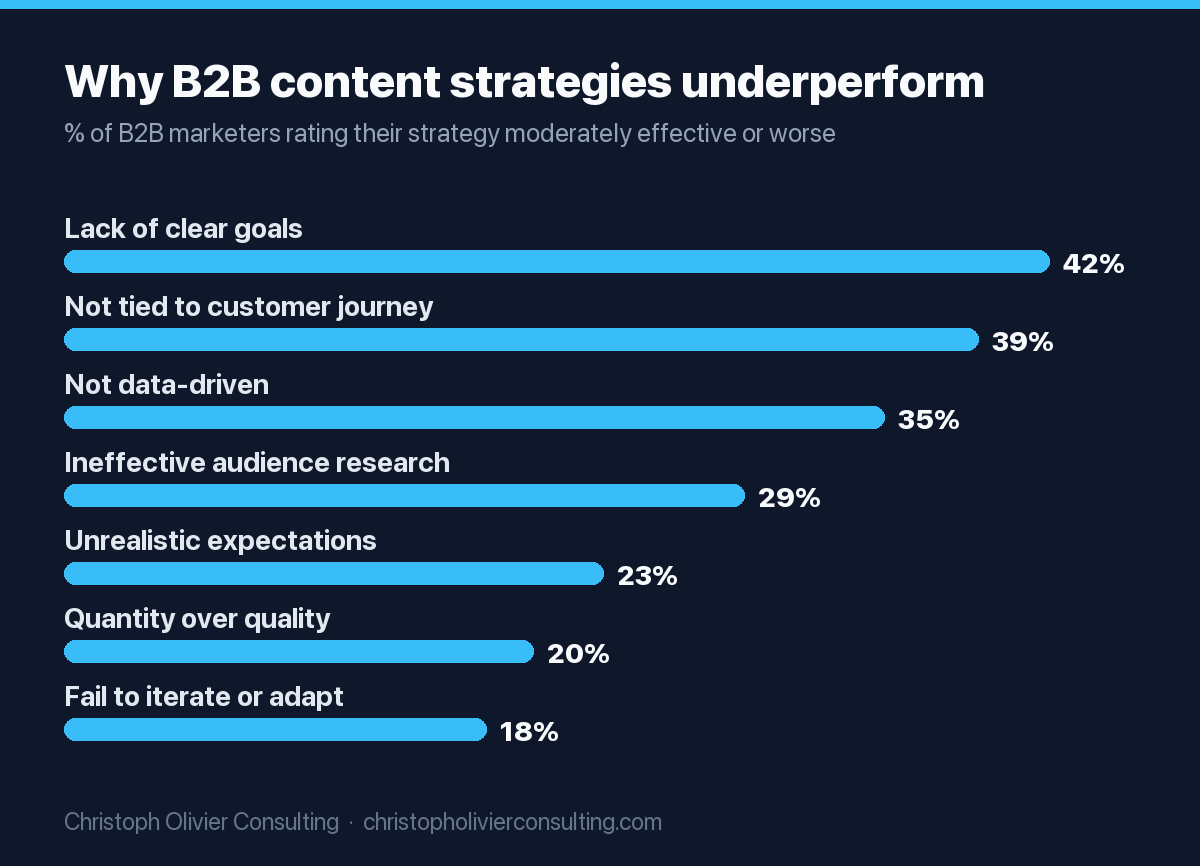
Those figures come from CMI and MarketingProfs’ B2B Content Marketing Benchmarks, Budgets, and Trends: Outlook for 2025, based on 980 respondents surveyed between June and August 2024. Among marketers who rated their strategy moderately effective or worse, 42% cited a lack of clear goals, 39% said it was not tied to the customer journey, 35% said it was not data-driven, and 18% said they failed to iterate or adapt.
The follow-up study points the same way. In B2B Content and Marketing Trends: Insights for 2026, which surveyed 1,015 B2B marketers in mid-2025, 97% said they have a content strategy and 61% reported that its effectiveness improved. Among the drivers of that improvement, 74% pointed to strategy refinement, ahead of new technology at 51%. The top challenges were creating content that prompts a desired action (40%), resource constraints (39%) and measuring content effectiveness (33%).
AI raises the stakes. CMI’s press release on the 2026 research notes that “9 in 10 marketers already use AI to churn out content” while “fewer than 4 in 10 say it has actually improved performance.” When drafting is cheap, the scarce skill is choosing what to make and in what order. That choice is the roadmap.
How to build a 12-month content roadmap from business goals
Build a 12-month content roadmap by working backward from two or three business goals: define audiences, audit what you already have, research demand, group ideas into themes, score every idea, fit the ranked list to real capacity, then assign owners and quarters. Plan the next quarter in detail and keep later quarters directional.
- Write down two or three business goals with numbers. “More brand awareness” is not a goal. “Twenty more qualified consultations a quarter for the new trust administration service” is. Then translate each goal into a content job, such as answering the five questions prospects ask before booking.
- Define the audiences and buying stages. List who signs the check, who influences the decision, and what each needs to know at the problem, comparison and decision stages. Use sales calls and intake notes.
- Audit what you already have. Export every URL with its traffic, rankings, leads and last-updated date. Label each one keep, refresh, consolidate or retire. In many established sites, the fastest wins sit in the refresh column, not the new-content column.
- Research demand. Pull keyword data, People Also Ask questions, sales FAQs and questions buyers ask AI assistants. Assign each target query to one page so pages do not compete with each other, using a process like keyword mapping.
- Group ideas into three to five themes. Themes should match services you sell. If a theme does not lead to a service, question why it is on the roadmap.
- Build one backlog. Every idea becomes one row: working title, theme, buyer stage, target query, type (new, refresh, consolidate) and a rough effort estimate.
- Score and rank the backlog. Use the scoring model in the next section so priorities are argued with numbers, not volume of opinion.
- Fit the ranked list to capacity. Count realistic hours per month, including partner review time. Fill each quarter from the top of the ranked list until hours run out. Whatever does not fit waits.
- Assign owners, windows and KPIs, then get sign-off. Put one owner and one target month on every asset in the next quarter. Get leadership to approve the roadmap once, then hand the next quarter to the calendar and the SEO content plan that turns keywords into dated briefs.
How far ahead should a content roadmap go?
Twelve months is the practical default. Detail the next 90 days down to the asset and owner. Keep quarters two and three at the theme and priority-asset level. Treat quarter four as a placeholder. Fine detail a year out usually goes stale by the second quarterly review.
How to prioritize content roadmap ideas: a scoring model
The simplest reliable way to prioritize a content roadmap is to score every idea on reach, impact, confidence and effort, then rank by the result. This is the RICE model, adapted from product management. It turns “I think we should write about X” into a number that anyone on the team can challenge and re-score.
RICE was published by Sean McBride on the Intercom blog in 2018. The formula is (Reach × Impact × Confidence) ÷ Effort. Intercom scores impact as 3 for massive, 2 for high, 1 for medium, 0.5 for low and 0.25 for minimal, and confidence as 100% for high, 80% for medium and 50% for low. Intercom measures effort in person-months. For content, I find person-days more practical, since most assets take days, not months.
| Factor | Question to ask | Content scale | Example |
|---|---|---|---|
| Reach | How many target buyers could this reach in a quarter? | 1 to 5 (estimated search demand, list size or sales-call frequency) | 4: asked on most intake calls and searched regularly |
| Impact | How much does it move the business goal for each person reached? | 3, 2, 1, 0.5, 0.25 (Intercom scale) | 2: decision-stage page next to a booking link |
| Confidence | How sure are you about reach and impact? | 100%, 80%, 50% | 80%: demand data plus sales feedback agree |
| Effort | How many person-days to research, write, review and publish? | Person-days, including partner and compliance review | 3 days |
| Score | Reach × Impact × Confidence ÷ Effort | Rank highest first | 4 × 2 × 0.8 ÷ 3 = 2.13 |
If the full formula feels heavy, a two-axis impact/effort sort gets you most of the way:
- High impact, low effort: do these first. Refreshes of pages that already rank on page two often land here.
- High impact, high effort: schedule one or two per quarter as the anchor projects, such as a pillar page or an original data piece.
- Low impact, low effort: use as fillers when an anchor slips.
- Low impact, high effort: cut them, even if someone senior likes the idea.
Scores are estimates, so re-score each quarter with real data. And do not let reach dominate: a low-volume, decision-stage page for a service you sell often beats a high-volume informational topic on business value.
How to plan quarterly content themes
Quarterly themes give a roadmap rhythm. Assign one primary theme per quarter, sometimes two, and concentrate effort so a full topic cluster ships together instead of scattering single posts across many topics. A quarter is long enough to finish a cluster and short enough to correct course at the next review.
A default sequence for many service firms looks like this. Adjust it for seasonality: a tax practice cannot run a major push during filing season.
Quarter 1: foundations
Fix and refresh the pages closest to revenue: service pages, the main pillar page for your strongest service, and any existing article that already ranks on page two.
Quarter 2: depth on the core theme
Build out the supporting articles for that pillar: costs, process, comparisons and the questions prospects ask before they book.
Quarter 3: second theme or new service
Repeat the cluster pattern for the next service line or a launch.
Quarter 4: proof and refresh
Publish evidence assets, such as original data, process explainers or detailed methodology pages, and refresh everything from quarter one that has slipped or gone stale.
Content roadmap template
A content roadmap template is one table where each row is an asset and each column answers a planning question: which quarter, which theme, which goal, what type, which buyer stage, what score, how much effort and who owns it. Copy the structure below into a spreadsheet and fill one row per idea.
| Quarter | Theme | Goal / KPI | Asset (working title) | Type | Buyer stage | Target query or question | Score | Effort (days) | Owner | Status |
|---|---|---|---|---|---|---|---|---|---|---|
| Q1 | [Theme 1] | [e.g. consultations from organic] | [Pillar page title] | New | Comparison | [Primary keyword] | [ ] | [ ] | [Name] | Not started |
| Q1 | [Theme 1] | [Same KPI] | [Existing page to update] | Refresh | Decision | [Keyword it ranks for] | [ ] | [ ] | [Name] | In progress |
| Q2 | [Theme 1] | [Same KPI] | [Supporting article] | New | Problem | [Question from sales calls] | [ ] | [ ] | [Name] | Backlog |
| Q2 | [Theme 2] | [Second KPI] | [Two overlapping posts] | Consolidate | Comparison | [Shared keyword] | [ ] | [ ] | [Name] | Backlog |
Add a short header above the table:
- North-star goal: the one outcome this roadmap serves this year.
- Themes: three to five, each linked to a service.
- Capacity: realistic person-days per month, including review time.
- Review dates: monthly status check and quarterly re-score, already on the calendar.
Worked example: a content roadmap for a professional-service firm
Here is an illustrative 12-month roadmap for a hypothetical estate planning law firm with one marketing coordinator and partners who review every page. It is a planning example, not a client case: the firm, scores and capacity are invented to show the method, and no results are implied.
Starting point. The firm wants more consultations for trust administration, a newer service, while keeping its core estate planning work steady. Capacity is about eight person-days of content work a month, of which two go to partner review. The audit finds a dated “living trust vs will” article ranking on page two, two thin posts that overlap on probate costs, and no page about trust administration at all.
| Quarter | Theme | Priority assets | Why this order |
|---|---|---|---|
| Q1 | Estate planning foundations | Refresh the trust vs will article; merge the two probate cost posts into one; tighten the estate planning service page | Low effort, closest to revenue, uses pages that already have some visibility |
| Q2 | Trust administration (new service) | Trust administration pillar page; successor trustee duties; timeline; cost guide | Highest-impact gap; one cluster shipped together |
| Q3 | Trust administration depth | Common trustee mistakes; working with a CPA on trust returns; FAQ page built from intake questions | Supports the Q2 pillar once early data shows which subtopics pull interest |
| Q4 | Proof and refresh | Process explainer showing how the firm handles an administration; refresh all Q1 pages | Builds trust at the decision stage and keeps Q1 work current |
Scoring shows why the order falls this way. The trust vs will refresh scores roughly 4 × 2 × 0.8 ÷ 2 = 3.2, because the page already exists and reaches people comparing options. The trust administration pillar scores lower on confidence at first, about 3 × 3 × 0.5 ÷ 6 = 0.75, which is why it waits a quarter while the firm collects intake questions to raise confidence. Your own scores will differ, and that is the point of writing them down.
How to keep your content roadmap updated
Keep a content roadmap current with three rhythms: a monthly status check on the current quarter, a quarterly re-score and re-plan using real performance data, and an annual reset tied to business planning. Between reviews, change the roadmap only when a real trigger appears, not when a new idea feels exciting.
- Monthly (30 minutes): mark what shipped, what slipped and why. Move slipped items rather than deleting them.
- Quarterly (half a day): pull traffic, rankings, leads and sales feedback for everything published. Re-score the backlog. Lock the next quarter in detail.
- Annually: revisit goals and themes with leadership, retire themes that no longer map to a service, and restart the audit.
Treat refreshes as real roadmap work: updated facts, examples and sources. Google’s guidance on creating helpful, reliable, people-first content asks site owners directly: “Are you changing the date of pages to make them seem fresh when the content has not substantially changed?” The same guidance flags “producing lots of content on many different topics in hopes that some of it might perform well.” A focused roadmap is the practical answer to both.
Common content roadmap mistakes
Most content roadmaps fail for planning reasons, not writing reasons. The common errors are dates without priorities, too many themes, no capacity math, no refresh lane, no named owners and no link to the services the firm sells. Each one is cheap to fix at the planning stage and expensive to fix after a year of publishing.
- A keyword list posing as a roadmap. Keywords are an input. Without goals, themes and effort, the list is a backlog, not a plan.
- Too many themes. Five themes with three posts each rarely build authority. Two connected clusters often do.
- No capacity math. If the roadmap needs twenty person-days a month and you have eight, it is a wish list.
- Only new content. Ignoring refreshes and consolidation leaves overlapping, aging pages competing with each other.
- No measurement agreed up front. If you decide what success looks like after publishing, every result can be read as success.
Start small: one goal, two themes, one quarter planned in detail, and a review date on the calendar. That is enough to make the next twelve months of content add up. If you want a second pair of eyes on your goals, backlog and scoring, you can book a consultation and we can work through it together.
Frequently asked questions
What is the difference between a content roadmap and a content calendar?
A content roadmap decides what you will build and in what order over the next 6 to 12 months, organized by quarter, theme and priority. A content calendar schedules individual pieces on specific dates with owners and deadlines. The roadmap feeds the calendar: once a quarter is approved, its top-ranked assets move into the calendar for dated production.
How far ahead should a content roadmap go?
Twelve months is a practical default. Plan the next quarter in detail, down to each asset, owner and target month. Keep the second and third quarters at the theme and priority-asset level, and treat the fourth quarter as a placeholder. Re-score and re-plan every quarter, because priorities usually shift as real performance data and sales feedback come in.
What should a content roadmap template include?
At minimum: quarter, theme, business goal or KPI, asset working title, type (new, refresh, consolidate or retire), buyer stage, target query or question, priority score, effort in person-days, owner and status. Add a short header with the north-star goal, themes, monthly capacity, review dates and the metric each theme will be judged on.
Who should own the content roadmap?
One person should own it, usually the head of content, marketing lead or a fractional CMO. Leadership approves the goals and themes, sales contributes the questions prospects ask, and subject-matter experts review accuracy. Each asset on the roadmap also needs one named owner, because shared ownership tends to mean nobody moves the work forward.
How do you prioritize content on a roadmap?
Score each idea on reach, impact, confidence and effort, then rank by (Reach x Impact x Confidence) divided by Effort. This RICE model was published by Intercom for product teams and adapts well to content if you measure effort in person-days. A simpler impact versus effort sort also works: do high-impact, low-effort items first and cut low-impact, high-effort ones.
Can ChatGPT create a content roadmap?
An AI assistant can draft a roadmap structure, brainstorm topics and suggest themes quickly. It does not know your business goals, capacity, existing page performance or what prospects ask on sales calls, so its output is a starting draft, not a plan. Feed it your audit and goals, then score and sequence the results yourself and verify any data it cites.
How often should you update a content roadmap?
Check status monthly, re-score and re-plan quarterly, and reset goals and themes annually alongside business planning. Between reviews, change the roadmap only for a real trigger: a new service, a regulatory change that dates existing pages, a page that suddenly starts ranking, or a recurring sales question that no page answers.
More Content Marketing guides
- How to Build a Content Calendar You Actually Keep
- What Is Content Marketing? Modern Playbook
- TikTok Marketing: How Businesses Turn Views Into Leads
- Brand Equity: What It Is, How to Measure It, and How to Build It
- Content Marketing for Startups: What to Build First With No Team or Budget
- Ecommerce Content Optimization: A Playbook for Copy That Ranks and Sells
- All Content Marketing guides →