
Last reviewed: October 2026

A marketing plan for senior living community growth is a written 12-month playbook that sets an occupancy goal, names your two buyers (the older adult and the adult child), gives each lead source a budget and a conversion target, and defines how every inquiry is followed up until move-in. The best plans are built backward from move-ins, not forward from tactics.
This guide gives you the 2026 market context, verified funnel benchmarks by care type and lead source, the fair housing rules that limit senior living ads, a fill-in plan template, and a checklist for hiring outside help. Every number below links to the source it came from, and where no reliable number exists, the guide says so.
Want a specialist to build this for your business? See how CO Consulting’s marketing services work, starting with a diagnostic and audit.
What a marketing plan for senior living community teams should include
Your plan needs seven parts: an occupancy goal per care level, profiles for residents and adult children, a lead-source mix with a budget per source, funnel targets from inquiry to move-in, a follow-up and CRM process, a content and reputation program, and a compliance check. Anything less is a tactics list, not a plan.
- Occupancy goal: occupied units by care level and date.
- Audiences: what the senior and the adult child each need to hear.
- Lead-source mix: web and search, paid media, directories, referral agencies, professional referrals, events.
- Funnel targets: inquiries, tours and move-ins per month, by source.
- Follow-up system: response standard, CRM rules, nurture sequences.
- Content and reputation: pricing and care explainers, video tours, reviews.
- Compliance and budget: fair housing review of every ad, budget built from cost per move-in.
Most ranking templates stop at goals, personas and budget categories. Plans usually fail on what they skip: conversion math by lead source, referral agency costs and fair housing rules.
Senior living marketing in 2026: occupancy, competition and budgets
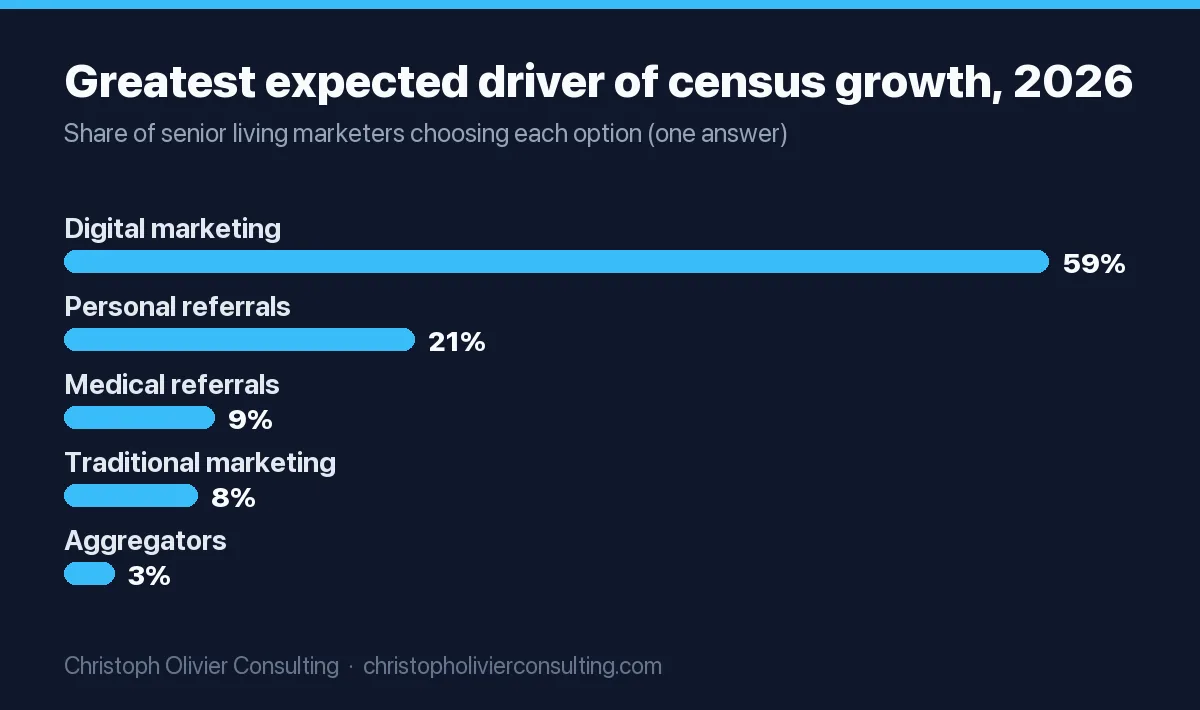
Demand is strong, but competition is still the top worry. NIC MAP data put average occupancy across 31 primary markets at 90.4% in the third quarter of 2026, yet marketers rank the competitive environment as their biggest challenge. High averages hide wide gaps between markets, buildings and care levels.
According to Senior Housing News coverage of NIC MAP third-quarter 2026 data, independent living averaged 91.7% and assisted living 89.1%. Sixteen of the 31 primary markets were at or above 90%, while Miami (86.5%), Atlanta (87.2%) and Houston (87.3%) sat lowest. Inventory grew just 0.4% year over year, with 16,159 units in development. NIC’s own second-quarter 2026 release reported 89.9% occupancy, the figure later shown as 89.8% in the third-quarter comparison.
With little new supply, your competition is mostly existing buildings nearby, so positioning is the main job. In the Senior Living Marketing in 2026 survey by Senior Housing News and Unlock Health (86 marketing professionals, fielded December 30, 2025 to February 2, 2026), 23% named the competitive environment as their biggest challenge, 17% the changing set of marketing tools and 15% budget. Half expected marketing spend to rise in the next 12 months. And 67% said their new-resident messaging focuses on differentiating from local competitors’ amenities rather than aging in place.
If your market averages 90% and your building sits at 82%, marketing alone may not close the gap. Check price, product, staffing and tour quality before buying more leads.
Know your two buyers: adult children and the senior
Most senior living marketing speaks to two people at once: the older adult who will live there and the adult child who often researches, compares options and worries about cost and safety. Your plan should give each a separate message, channel and proof point, then bring them together at the tour.
Operators already lean toward the family. When the 2026 SHN survey asked how much marketing effort targets adult-child decision makers versus residents on a 1 to 10 scale, the most common answer was 7. Seventy percent called messaging to different decision makers somewhat challenging and 13% very challenging.
| Audience | Main worries | Where they look | Proof that helps |
|---|---|---|---|
| Adult child (often the researcher) | Safety, care quality, total monthly cost, guilt, time | Search, AI answers, review sites, directories, your website on mobile | Clear pricing ranges, care level explainers, staff tenure, inspection history, reviews from other families |
| Prospective resident | Losing independence, leaving home, making friends, food, routine | Tours, events, word of mouth, print, friends already living there | A day-in-the-life video, a lunch visit, residents who choose to share their own stories |
| Professional referrers | Safe discharge, fit for care needs, responsiveness | Direct relationships, past outcomes, how fast you call back | Admission criteria sheet, response time, a named contact |
Professional referrers include discharge planners, physicians, elder law attorneys and home care agencies. If you also run home care, those relationships overlap heavily with home care marketing, so plan them together.
Senior living marketing strategies by lead source
Every lead source has its own cost structure and conversion profile. In Aline’s benchmark, web inquiries convert to tours at the highest rate, call-ins close behind, and paid directory and aggregator leads convert lower. Set a separate target for each source instead of managing one blended cost-per-lead number.
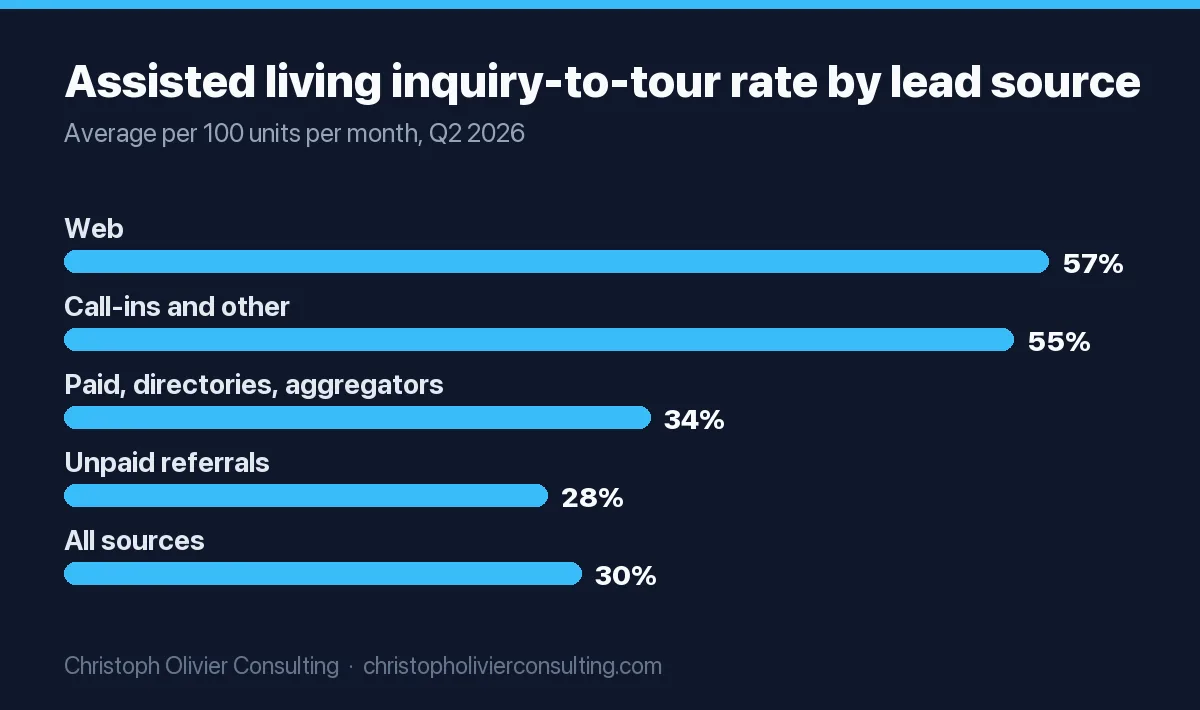
The figures below come from the Aline Sales and Marketing Benchmark Snapshot, Q2 2026, which reports averages per 100 units per month. It is a vendor benchmark that does not publish its sample or method, so treat it as a reference point, not an industry census.
| Lead source | How you pay | AL inquiry-to-tour, Q2 2026 | AL share of inquiries, Q2 2026 | Watch-outs |
|---|---|---|---|---|
| Web (site forms, chat, organic and direct) | Website, content, SEO, paid traffic that lands on your site | 57% | 51% | Form follow-up speed; tracking which campaign drove the form |
| Call-ins and other | Brand, signage, word of mouth, call tracking | 55% | 13% | Missed calls after hours; untrained front desk |
| Paid, online directories, lead aggregators | Per lead, per click, or per move-in, by contract | 34% | 26% | Shared leads, families contacted by several communities at once |
| Unpaid referrals | Staff time for relationships | 28% | 11% | Slow to build; depends on one or two people |
Referral placement agencies
Placement services are a lead source with a cost per move-in. A Place for Mom states on its advisor page that it is paid by participating communities if a family moves in, that its service is free to families, and that its network covers over 15,000 senior living communities and home care agencies. Fee amounts are set by contract and are not published, so get yours in writing and compare it with your other sources.
The model has drawn scrutiny. In 2024 the chairman of the US Senate Special Committee on Aging sent the company a letter that, as Senior Housing News reported, alleged providers raise rates to cover commissions and that nearly 40% of referred families paid above their assisted living budget (55% for memory care). These are allegations, not findings. Track referral move-ins, fees and length of stay separately so you judge the channel on facts.
Sales velocity: from inquiry to tour to move-in
Marketing produces inquiries; sales turns them into move-ins, and your plan has to cover both. In Aline’s Q2 2026 benchmark, assisted living communities averaged 36 inquiries, 10 tours and 4 move-ins per 100 units per month, with 30% of inquiries touring and 46% of tours moving in.
| Care type (Q2 2026) | Inquiries per 100 units per month | Tours | Move-ins | Inquiry-to-tour (all sources) | Tour-to-move-in |
|---|---|---|---|---|---|
| Independent living | 28 | 7 | 3 | 32% | 42% |
| Assisted living | 36 | 10 | 4 | 30% | 46% |
| Memory care | 34 | 14 | 9 | 36% | 52% |
| Life plan residential | 28 | 6 | 2 | 27% | 29% |
Source: Aline Q2 2026 Benchmark Snapshot. Your own 12-month history beats any benchmark.
Worked example: reverse-engineer your funnel
- Set the target. A hypothetical 120-unit assisted living building at 85% has 102 occupied units. The goal is 108 (90%) in six months, which is one net move-in per month.
- Add move-outs. Use your own trailing 12-month move-out count. For this example, assume 3 per month. You now need 4 move-ins a month.
- Convert to tours. At a 46% tour-to-move-in rate, 4 move-ins need about 9 tours.
- Convert to inquiries. At a 30% inquiry-to-tour rate, 9 tours need about 29 inquiries.
- Split by source and price it. Apply your current inquiry mix and cost per inquiry for each source, then check the total against revenue from 4 move-ins.
Scaled to 120 units, the Aline assisted living average is roughly 43 inquiries and 12 tours a month. So if this community already receives 40 inquiries and still misses, the leak is follow-up or tour quality, not lead volume. Response time is a common leak, and the research gathered in these speed-to-lead statistics shows why the first contact window deserves a written standard.
CRM, follow-up and lead nurturing
A senior living move often takes months, so most inquiries are not ready on day one. Your plan needs a CRM that records every inquiry and its source, a written first-response standard, defined follow-up steps through tour and deposit, and a long-term nurture track for families who are still deciding.
Tools are not the bottleneck. In the 2026 SHN survey, 84% of respondents used analytics dashboards, 73% a CRM, 57% call tracking and call scoring, and 43% chat. Yet reporting ranked last in time spent, behind planning and executing. One operator executive quoted in the report said her team would be “far more disciplined about tracking cost per lead and cost per move in by source.”
- Response standard: who answers forms and calls, how fast, including evenings and weekends.
- Source capture: every inquiry tagged to a source, with call tracking per channel.
- Tour follow-up: a personal note within a day and a clear next step.
- Nurture track: monthly, useful emails for families who are months away.
- Re-engagement: a quarterly check-in before an inquiry is marked lost.
For sequence structure, adapt these email drip campaign examples to a family deciding about care: fewer sales messages, more answers, and an easy way to talk to a person.
Assisted living marketing ideas: content, video tours, events and reviews
The content that moves senior living buyers answers their real questions: what care costs, what a normal day looks like, how staff respond to a fall at night, and how the move works. Pair that with video tours, events that bring families on site, and a steady flow of honest reviews.
Content and search
Families now research in AI search tools as well as Google. A marketing director quoted in the 2026 SHN report said prospects and their adult children are “turning to AI-powered search experiences” to research care and compare communities. Plain answers to specific questions are what those tools quote.
- A pricing page with real monthly ranges and what is included.
- Care level explainers: independent living vs assisted living vs memory care, in plain language.
- A move-in guide: timeline, what to bring, the first week.
- Staff profile videos, especially nursing and dining leads.
Video tours
A walk-through video lets an out-of-state adult child see the building before the parent visits. Keep it unscripted, show real apartments, add captions, and use it on your site, your Google Business Profile and in follow-up emails.
Events
Events get seniors on site without the pressure of a sales tour: lunch-and-learns on Medicare or downsizing, caregiver support groups, holiday open houses. Treat each one as a campaign with a goal, invite list and follow-up, using a simple event marketing plan.
Reviews and reputation
Ask families for reviews at natural moments and respond to every review. Follow each platform’s policies, and never confirm residency or mention care details in a public reply. Google’s walkthrough below covers Business Profile reviews.
Fair housing rules for senior living advertising
Senior living ads are housing ads, so fair housing law applies. HUD’s rule at 24 CFR 100.75 bars ads that indicate a preference or limitation based on race, color, religion, sex, handicap, familial status or national origin, and it also covers how you choose the media and locations where ads run.
Its examples in 24 CFR 100.75 include choosing media or locations that deny particular segments of the housing market information, so document why each channel was chosen.
Communities that operate as 55-and-older housing rely on an exemption. Under 24 CFR 100.304, familial status rules do not apply to housing intended and operated for persons 55 or older that meets the related requirements. Section 100.306 lists the factors that show that intent, including how the community is described to prospective residents and the advertising it uses. It names “adult living” and “adult community” as phrases inconsistent with an intent to provide 55-and-older housing, so say “55 and older community” or “senior living” instead.
Ad platforms add their own limits. Meta’s special ad category documentation says housing ads have age generally fixed at 18 to 65+, no gender selection, no ZIP code targeting, a minimum 15-mile radius around locations in the US, no lookalike audiences, and no demographic or behavior targeting. In practice your creative and landing pages do the targeting that audience settings cannot.
Describe the community and its care, not the ideal resident, show a range of people in photos, and have counsel review your ad language and 55-plus policies. This section is general information, not legal advice.
How to set a senior living marketing budget
There is no reliable public benchmark for what a senior living community should spend on marketing, so build the budget from the bottom up. Start with move-ins needed, multiply by your cost per move-in for each source, add fixed costs like your website, CRM and content, then test the total against revenue per move-in.
Some agency guides quote a percentage of revenue, but the ones reviewed here cited no data behind it. Your own cost per move-in by source is a better anchor.
- Pull 12 months of move-ins by source from your CRM.
- Pull spend by source for the same period, including referral fees and staff time for outreach.
- Divide spend by move-ins to get cost per move-in for each source.
- Multiply next year’s move-in target by the source mix you plan to use.
- Add fixed costs: website, CRM, call tracking, photography and video, content.
- Hold back a test budget for one new channel, with a stop rule.
Comparing your options for getting the work done
| Option | How you typically pay | Best when | Risks |
|---|---|---|---|
| In-house marketing and sales team | Salaries and tools | Multiple communities, steady volume, strong leadership | Skill gaps in paid media, SEO or analytics |
| Senior living specialist agency | Monthly retainer or project fee; ask for written quotes | You need execution depth in digital channels | Reporting on leads instead of move-ins |
| Referral placement service | Paid by the community when a referred family moves in | You need volume fast or lack local search presence | Dependence, shared leads, fee cost per move-in |
| Fractional CMO or consultant | Part-time monthly retainer | You need a plan, measurement and vendor oversight, not a full-time hire | Needs internal or agency capacity to execute |
When survey respondents chose what they value most in an agency partner, digital marketing expertise led at 34%, followed by senior living experience (26%), integrated marketing (24%) and brand building (16%), per the 2026 SHN report. Senior living also shares the trust and privacy demands of healthcare marketing, so check that any partner understands both.
Senior living marketing plan template
Use the template below as your one-page plan. Fill each row with a number, an owner and a date. A row without a number is a hope, not a plan. Review it monthly against actual inquiries, tours and move-ins by source, and rewrite it every quarter as the data comes in.
| Plan section | What to write | KPI to track |
|---|---|---|
| Occupancy goal | Occupied units by care level and date | Occupancy %, net move-ins |
| Audiences | Adult child, senior, professional referrers: worries and proof for each | Inquiries by audience type |
| Positioning | Why choose you over the two or three nearest competitors | Tour feedback, lost-to-competitor reasons |
| Lead-source mix | Target inquiries and budget per source | Cost per inquiry, cost per move-in by source |
| Funnel targets | Inquiry-to-tour and tour-to-move-in per source | Conversion rates by source |
| Response standard | Who responds, how fast, after hours coverage | Median response time |
| Nurture | Sequences for not-ready families | Re-engaged inquiries, tours from nurture |
| Content and video | Pricing page, care explainers, video tour, monthly topics | Organic inquiries, page conversions |
| Events and reviews | Quarterly events; when you ask for reviews and who responds | Tours booked from events, new reviews per month |
| Compliance | Fair housing review step for every ad | Ads reviewed before launch |
| Budget and reporting | Monthly spend by source, monthly review meeting | Spend vs plan, move-ins vs plan |
90-day launch checklist
- Days 1 to 30, audit: clean CRM source data, add call tracking, mystery-shop your own phone line and web form, list referral contracts and fees.
- Days 31 to 60, fix the leaks: set the response standard, write tour follow-up steps, publish the pricing and care level pages, start review requests.
- Days 61 to 90, grow: launch one paid channel with a cost-per-move-in target, run one event, start the nurture sequence, hold the first monthly source review.
Hiring help: checklist, questions to ask and red flags
If you bring in an agency, consultant or fractional CMO, judge them on move-ins, not impressions. Ask how they will measure cost per move-in by source, who does the work, how they handle fair housing rules, and what happens in the first 90 days. Walk away from anyone who promises a specific occupancy number.
Questions to ask:
- How will you connect your work to move-ins in our CRM, by source?
- What will you audit first, and what do we get in the first 90 days?
- How do you review ads for fair housing and the Meta housing ad category?
- Who on your team will do the work, and how much of it is outsourced?
- Can we keep the ad accounts, website, content and data if we part ways?
Red flags:
- Guaranteed occupancy, lead counts or rankings.
- Reports built on clicks and impressions with no move-in data.
- Ad accounts or tracking numbers owned by the vendor.
- Audience targeting by age or family status in housing ads.
- Long contracts with no performance review points.
I work audit first: we review your funnel and lead sources, then build a 90-day plan you can run in-house or hand to an agency I help you find and vet. My background is content systems that have drawn more than 200 million organic views and managing millions in ad spend, and no one can guarantee occupancy, including me. If a second opinion on your plan would help, you can book a consultation.
Work with CO Consulting
Want this done for your business?
- A diagnostic call and an audit of your current marketing and numbers
- A prioritized 90-day plan built for your market
- Execution across SEO and AI search, paid ads, content, funnels and automation
- Weekly check-ins and monthly reporting, led by a fractional CMO
Frequently asked questions
What should a marketing plan for a senior living community include?
It should include an occupancy goal by care level, profiles for the adult child and the prospective resident, a lead-source mix with a budget per source, funnel targets from inquiry to tour to move-in, a CRM and follow-up standard, a content and review program, and a fair housing review step for every ad. Each section needs a number, an owner and a date.
Who makes the decision to move into senior living?
Usually it is a shared decision between the older adult and one or more adult children, with input from doctors or discharge planners. In the 2026 Senior Housing News and Unlock Health survey, the most common answer for how much marketing effort targets adult children versus residents was 7 on a 1 to 10 scale, so most operators lean toward the family.
What is a good inquiry-to-move-in conversion rate for assisted living?
Aline's Q2 2026 benchmark shows assisted living communities converting about 30% of inquiries to tours and 46% of tours to move-ins, or roughly 4 move-ins per 36 inquiries per 100 units each month. Rates vary by lead source, with web inquiries touring far more often than paid directory and aggregator leads. Compare against your own 12-month history first.
How do referral agencies like A Place for Mom get paid?
A Place for Mom says it is paid by participating senior living communities if a referred family moves in, and that its service is free to families. Fee amounts are set by contract and are not published. Track each placement service's move-ins, fees and resident length of stay so you can compare its true cost per move-in with your other sources.
How much should a senior living community spend on marketing?
There is no reliable public benchmark, and percentage-of-revenue figures in agency guides are usually unsourced. Build the budget bottom up: move-ins needed, times your cost per move-in by source, plus fixed costs like the website, CRM and content. In the 2026 SHN and Unlock Health survey, half of marketers expected spend to rise and 43% expected it to stay flat.
Can senior living Facebook ads target people by age?
Not in the usual way. Meta treats senior living ads as housing ads, and its special ad category documentation says age is generally fixed at 18 to 65+, gender cannot be chosen, ZIP code targeting is unavailable, locations need at least a 15-mile radius in the US, and lookalike audiences are not allowed. Your creative and landing pages have to do the targeting.
What words should senior living ads avoid under fair housing rules?
Avoid language that signals a preference based on race, color, religion, sex, disability, familial status or national origin. For 55-and-older communities, HUD's rule at 24 CFR 100.306 names "adult living" and "adult community" as phrases inconsistent with 55-plus intent, so use "55 and older community" or "senior living." Have counsel review your ad language.
More Growth Consulting guides
- Healthcare Marketing: How Practices Attract and Keep Patients
- What a Marketing Consultant for Startups Does (and When to Hire One)
- Moving Company Marketing: A Cost-Per-Booked-Move Playbook
- Electrician Marketing: Cost Per Booked Job by Channel
- Performance Max: How Google’s All-Inventory Campaign Works (2026 Guide)
- Dental Marketing: What Works and What It Costs Per Patient
- All Growth Consulting guides →