
Last reviewed: October 2026
Email drip campaign examples are only useful when you can see the whole sequence: the trigger, the number of emails, the gap between them, the subject line and the one job each email does. The 12 examples below give you all five, covering lead capture, sales follow-up, client onboarding, re-engagement and ecommerce. In most cases a working drip is 3 to 6 emails, spaced a day to a week apart, and it stops the moment the reader takes the action you wanted.
These are templates, not brand case studies. Benchmarks link to the platform reports they came from, and every delay is a starting point to test. If you run a professional-service firm, pay closest attention to examples 4 through 9: the consultation, proposal and client drips that most roundups skip.
What is an email drip campaign?
An email drip campaign is a set of pre-written emails sent automatically on a schedule after someone does something: subscribes, books a call, downloads a guide, buys or goes quiet. Each email is timed relative to that trigger, not to a calendar date, so every recipient gets the same sequence at the moment it is relevant to them.
That timing is the difference between a drip and the email you probably send today:
- Newsletter or broadcast: one email to the whole list on the same day.
- Drip campaign: the same sequence for each person, starting at their own trigger.
- Nurture campaign: a longer drip, often with branches, built to move a lead toward a sales conversation over weeks or months. Our lead nurturing guide covers how to design the branching logic.
Every drip has four parts. A trigger starts it. Delays space the emails. Content answers one question per email. An exit rule removes the person once they convert, reply or unsubscribe. Most broken drips fail on the exit rule.
Do drip campaigns work? What the benchmarks show
Yes, in the datasets platforms publish, triggered sequences beat one-off broadcasts on clicks. GetResponse’s benchmark, built on more than 4.4 billion messages sent in 2023, found autoresponder emails averaged a 5.59% click-through rate against 3.84% for newsletters, and welcome emails averaged 16.6%. Relevance and timing do most of that work.
| Email type | Average open rate | Average click-through rate |
|---|---|---|
| Newsletter (broadcast) | 40.08% | 3.84% |
| Triggered | 45.38% | 5.02% |
| Autoresponder (drip) | 51.05% | 5.59% |
| Welcome email | 83.63% | 16.6% |
Source: GetResponse Email Marketing Benchmarks (messages sent in 2023 by active senders with at least 500 contacts).
Ecommerce data points the same way. In the Omnisend 2025 Ecommerce Marketing Report, which analyzed close to 24 billion emails sent in 2024, automated messages were 2% of email volume but drove 37% of email-driven sales. One in three people who clicked an automated message bought, compared with one in 18 for scheduled messages.
Two caveats before you set targets. First, open rates are inflated: Mailchimp’s benchmark page warns that Apple Mail Privacy Protection affects open-rate accuracy, so judge a drip on clicks, replies and bookings. Second, platforms measure differently. Mailchimp reports a 35.63% open rate and 2.62% click rate across all users (data last updated December 2023), while MailerLite’s 2025 benchmarks report 43.46% and 2.09% across 3.6 million campaigns. Compare yourself to your own platform’s numbers, and see our email marketing benchmarks breakdown for more context.
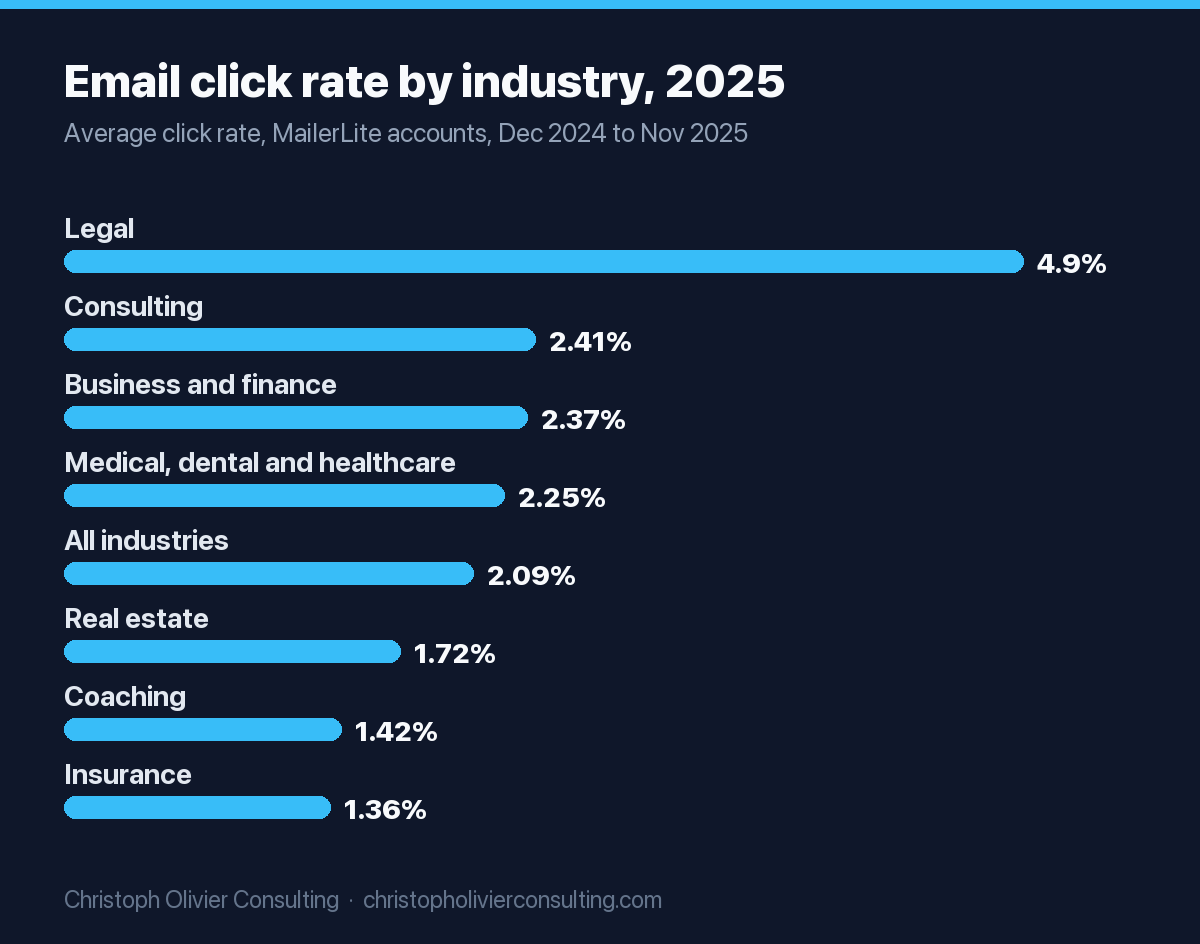
For professional services, MailerLite’s 2025 industry data is a useful baseline to beat with a drip: legal emails averaged a 4.90% click rate, consulting 2.41% and business and finance 2.37%, against 2.09% across all industries. Those are campaign averages, a baseline a targeted drip should aim to beat.
12 email drip campaign examples at a glance
The 12 drip campaign examples below cover the full customer lifecycle. Use the table to pick the sequence that matches your biggest leak: leads who never book, consultations that never close, new clients who feel ignored, or a list that has gone quiet. Then copy the full sequence from the section that follows.
| # | Drip campaign | Trigger | Emails | Runs over | Exit when |
|---|---|---|---|---|---|
| 1 | Welcome series | Newsletter signup | 4 | 10 days | Replies or clicks a core page |
| 2 | Lead magnet nurture | Guide or checklist download | 6 | 4 weeks | Books a consultation |
| 3 | Webinar sequence | Registration | 5 | Signup to 3 days after | Attends or watches replay |
| 4 | Consultation booked | Call scheduled | 3 | Booking to call time | Call held |
| 5 | Post-consultation follow-up | Call held, no decision | 4 | 14 days | Requests proposal or declines |
| 6 | Proposal follow-up | Proposal sent | 4 | 15 days | Signs or says no |
| 7 | Client onboarding | Contract signed | 5 | 30 days | Kickoff complete |
| 8 | Review and referral | Milestone reached | 3 | 10 days | Leaves review or makes intro |
| 9 | Seasonal deadline | Date before a deadline | 3 | 6 weeks | Books appointment |
| 10 | Re-engagement | No clicks in 90+ days | 3 | 10 days | Clicks, or is suppressed |
| 11 | Abandoned cart | Cart left at checkout | 3 | 3 days | Purchases |
| 12 | Post-purchase | Order shipped | 4 | 30 days | Reviews or reorders |
Lead capture drip campaign examples
Lead capture drips turn a new subscriber or registrant into someone who knows what you do and why it matters to them. The three examples here, a welcome series, a lead magnet nurture and a webinar sequence, share one rule: deliver what was promised in the first email, then earn the next click with something useful.
1. Welcome series (4 emails, 10 days)
Trigger: newsletter signup. Goal: a reply or a click to a core service page. Our welcome email sequence guide goes deeper on structure.
- Email 1, immediately. Subject: “Your [resource] is inside, plus what to expect.” Deliver the promise and say how often you will write.
- Email 2, day 2. Subject: “The mistake most [audience] make with [topic].” One useful idea, one link.
- Email 3, day 5. Subject: “How we approach [problem], in 3 steps.” Your point of view and method.
- Email 4, day 10. Subject: “Quick question: what is your biggest [topic] challenge?” Ask for a reply and tag the answer for segmentation.
2. Lead magnet nurture (6 emails, 4 weeks)
Trigger: a guide, checklist or calculator download. Goal: a booked consultation.
- Email 1, immediately. Subject: “[Guide name]: your download link.” Deliver it, point to the most useful page.
- Email 2, day 3. Subject: “A 10-minute win from page [x].” One quick action they can take today.
- Email 3, day 7. Subject: “What [problem] costs a firm like yours.” Help them size the cost of doing nothing, using their own numbers.
- Email 4, day 12. Subject: “A worked example: [scenario].” A clearly labeled hypothetical walkthrough, not an invented client story.
- Email 5, day 19. Subject: “3 questions to ask before you hire a [service].” Buying criteria, written honestly.
- Email 6, day 26. Subject: “Want a second pair of eyes on [topic]?” A soft invitation to book.
3. Webinar sequence (5 emails, registration to 3 days after)
Trigger: registration. Goal: attendance, then a next step. This drip branches after the event.
- Confirmation, immediately. Subject: “You’re in: [title] on [date].” Calendar link and the one thing they will learn.
- Reminder, 1 day before. Subject: “Tomorrow: bring this one question.”
- Reminder, 1 hour before. Subject: “Starting in 1 hour, your link is inside.”
- Follow-up, 1 day after. Attendees get “Slides and the 2 next steps.” No-shows get “You missed it, here is the replay.”
- Close, 3 days after. Subject: “Your questions from the session, answered.” End with one call to action.
Sales drip email examples for service firms
Sales drips cover the gap between first conversation and signed engagement, where deals often stall from silence rather than a firm no. These three drip email examples handle the booked call, the call that ended without a decision, and the proposal nobody has answered. Send them from a named person, in plain text.
4. Consultation booked (3 emails, booking to call)
- Email 1, immediately. Subject: “Confirmed: [day, time] with [name].” Calendar file and video link.
- Email 2, 24 hours before. Subject: “3 things to have ready for tomorrow.”
- Email 3, 1 hour before. Subject: “See you at [time], here is the link.” Short. Mobile-friendly.
5. Post-consultation follow-up (4 emails, 14 days)
Trigger: call held, no decision. Goal: a proposal request or a clear no. The full text is in the worked example below.
- Email 1, same day. Subject: “Recap of today’s call and the next step.”
- Email 2, day 3. Subject: “The [resource] I mentioned.”
- Email 3, day 7. Subject: “What the first 90 days would look like.”
- Email 4, day 14. Subject: “Should I close your file?”
6. Proposal follow-up (4 emails, 15 days)
- Email 1, day 0. Subject: “Your proposal for [project].” A three-line summary above the attachment, with options if you offer tiers.
- Email 2, day 3. Subject: “Any questions on scope or timing?” Invite objections early.
- Email 3, day 8. Subject: “An option if the timing is not right.” Offer a smaller first phase or a later start.
- Email 4, day 15. Subject: “Close the loop on [project]?” Ask for a yes, a no or a date.
Client drip campaign examples: onboarding, reviews and deadlines
Client drips protect revenue you already won. An onboarding sequence sets expectations in the first 30 days, a review and referral sequence asks when satisfaction is likely highest, and a deadline drip brings existing clients back before a date that matters to them. All three can run with little extra staff time.
7. Client onboarding (5 emails, 30 days)
- Day 0. Subject: “Welcome aboard: your first 30 days.” Timeline, who does what, how to reach you.
- Day 1. Subject: “What we need from you (checklist).” Documents, access, approvals.
- Day 3. Subject: “Meet your team.” Names, roles, response times.
- Day 10. Subject: “Progress check: done, in progress, next.”
- Day 30. Subject: “30 days in: how are we doing?” One question, reply-based.
8. Review and referral (3 emails, 10 days)
Trigger this on a milestone, such as a project delivered or a positive check-in score, not on a calendar date. Check your profession’s advertising rules before requesting testimonials, since some regulated fields restrict how they can be used.
- Day 0. Subject: “A quick favor? (60 seconds).” Direct review link.
- Day 4. Subject: “Here is the direct link again.” One line, no pressure.
- Day 10. Subject: “Know someone who would find this useful?” A simple, forwardable introduction.
9. Seasonal deadline drip (3 emails, 6 weeks)
Useful for tax filing, insurance renewals, benefits enrollment or year-end planning. The trigger is a date, so build it once and reuse it every year.
- 6 weeks before. Subject: “[Deadline] is [date]: here is what to send us.”
- 3 weeks before. Subject: “Book your slot before [date].”
- 1 week before. Subject: “Last week to [action] before [deadline].”
Re-engagement and win-back drip campaign examples
A re-engagement drip goes to subscribers who have stopped clicking, often defined as 90 days or more without a click, and asks them to confirm interest or leave. A win-back drip targets lapsed customers or clients with a reason to return. Both protect deliverability, because mailbox providers track how recipients treat your mail.
10. Re-engagement (3 emails, 10 days)
- Day 0. Subject: “Still want these emails?” One button to stay subscribed.
- Day 4. Subject: “Our 3 most useful pieces this year.” Value before the final ask.
- Day 10. Subject: “Last email unless you click below.” Then suppress anyone who did not click.
Use clicks, not opens, to define “inactive,” because privacy features can register opens that never happened. For lapsed buyers or former clients, the win-back campaign guide covers offers, timing and when to stop.
Ecommerce drip email examples: abandoned cart and post-purchase
Ecommerce drips respond to buying behavior. In Omnisend’s 2025 report, welcome, abandoned cart and browse abandonment emails together produced 87% of automated orders, so these are the flows to build first if you sell products online. The timing below is a common starting point, not a rule.
11. Abandoned cart (3 emails, 3 days)
- 1 hour after. Subject: “Did something go wrong at checkout?” Cart contents and a direct link back.
- 24 hours after. Subject: “Still thinking about [product]?” Reviews, returns policy, shipping answers.
- 72 hours after. Subject: “Your cart is saved until [date].” Add an incentive only if margins allow, since routine discounts can train buyers to wait.
Our abandoned cart email guide breaks down subject line and incentive tests in more detail.
12. Post-purchase (4 emails, 30 days)
- At shipping. Subject: “Your order is on the way, plus how to get the most from it.”
- 3 days after delivery. Subject: “How to use [product] in 5 minutes.”
- 14 days after delivery. Subject: “How is [product] working out?” Review request.
- 30 days after delivery. Subject: “Pairs well with [product].” A relevant cross-sell, not the whole catalog.
Worked example: a post-consultation drip, written out
Here is example 5 written out in full, because in my experience it is the sequence service firms most often lack. It assumes a 30-minute consultation ended without a decision. Replace the bracketed fields, send it from the person who ran the call, and stop the sequence the moment the prospect replies.
Email 1, same day. Subject: Recap of today’s call and the next step
Hi [First name], thanks for walking me through [situation] today. Here is what I heard: your goal is [goal in their words], the main obstacle is [obstacle], and the constraint is [budget, timing or approval]. The next step we discussed is [proposal, second call or data access]. If that still makes sense, reply “yes” and I will have it to you by [day]. [Name]
Email 2, day 3. Subject: The [resource] I mentioned
Hi [First name], I said I would send [resource], so here it is: [link]. The section on [topic] is the part most relevant to [their obstacle]. No reply needed. [Name]
Email 3, day 7. Subject: What the first 90 days would look like
Hi [First name], in case it helps you decide, here is how I would sequence the work. Month 1: [diagnose]. Month 2: [fix the biggest leak]. Month 3: [scale what works]. I can adjust this for [constraint]. Want me to turn it into a proposal? [Name]
Email 4, day 14. Subject: Should I close your file?
Hi [First name], I have not heard back, which often means the timing is not right. That is fine. Reply with 1, 2 or 3 so I know where things stand. 1: send the proposal. 2: check back in [month]. 3: not a fit, close the file. Thanks either way. [Name]
Why this works: email 1 proves you listened, email 2 keeps a promise, email 3 makes the decision concrete, and email 4 gives the prospect an easy way to say no.
How to build a drip campaign in 8 steps
To build a drip campaign, pick one trigger and one goal, list the questions a person has between the two, write one email per question, set delays that match your sales cycle, add exit rules, then measure clicks and conversions rather than opens.
- Choose one trigger and one goal. “Downloaded the pricing guide” to “booked a call.”
- List the questions in between. Pull them from sales calls and proposal objections. Each question becomes an email.
- Keep it to 3 to 6 emails to start.
- Front-load the timing. Send the first email immediately, the next within 1 to 3 days, then widen the gaps. Match total length to how long buyers take to decide.
- Write subject lines that say what is inside. For service firms, plain-text emails from a named person usually fit better than designed templates.
- Set exit and overlap rules. Remove people who book, buy, reply or unsubscribe. Stop any marketing drip when someone becomes a client. Prevent one contact from receiving two drips at once.
- Authenticate and comply before launch. Domain authentication, a working unsubscribe and a postal address, covered in the next section.
- Measure and test one variable at a time. Subject line, delay or call to action, not all three. Review after enough sends to see a pattern.
What to measure in a drip campaign
| Metric | What it tells you | Watch for |
|---|---|---|
| Click rate per email | Which email earns attention | A sharp drop at one step means that email is the leak |
| Goal conversion rate | Whether the drip does its job (bookings, sales, signatures) | Measure against people who did not get the drip if you can |
| Reply rate | Real engagement for sales and service drips | Replies should pause the sequence automatically |
| Unsubscribe rate | Whether frequency and relevance fit | Spikes after a specific email or delay |
| Spam complaints | Deliverability risk | Gmail’s threshold for all senders is below 0.3% |
| Open rate | Directional only | Inflated by privacy features, so never use it alone |
Drip campaign rules: deliverability and compliance
A drip campaign is still commercial email, so the same rules apply. In the US, CAN-SPAM requires a valid postal address and an opt-out you honor within 10 business days, and Gmail requires bulk senders to authenticate their domain, support one-click unsubscribe and keep spam rates below 0.3%.
- CAN-SPAM basics. The FTC’s compliance guide says each message must include your valid physical postal address, opt-outs must be honored within 10 business days, the opt-out mechanism must work for at least 30 days after you send, and each violating email can carry penalties of up to $53,088.
- Gmail sender requirements. Google’s sender guidelines require all senders to set up SPF or DKIM and keep spam rates below 0.3%. Senders of 5,000 or more messages a day to Gmail must also set up SPF, DKIM and DMARC and support one-click unsubscribe with a visible unsubscribe link.
- Consent. These examples assume an opt-in or an existing relationship. Cold outreach is a separate program.
- Regulated professions. Have templates reviewed against your own advertising and privacy rules, and keep confidential details out of automated emails.
If you want help choosing which of these drips to build first, or mapping them to your sales cycle, you can book a consultation and we will look at it together.
Frequently asked questions
What is an example of a drip campaign?
A common example is a welcome series: someone subscribes, gets the promised resource immediately, then receives a useful tip on day 2, your method on day 5 and a question inviting a reply on day 10. A service-firm example is a post-consultation drip that sends a recap the same day, a resource on day 3, a 90-day plan on day 7 and a close-the-loop email on day 14.
How many emails should a drip campaign have?
Start with 3 to 6 emails. Short, high-intent drips such as abandoned cart or consultation reminders often need only 3. Lead nurture sequences for considered purchases can run 6 or more over several weeks. Add emails only after your data shows where people drop off, and give every email one clear job so none of them exist just to fill the calendar.
How long should you wait between drip emails?
Send the first email immediately after the trigger, the second within 1 to 3 days, then widen the gaps to 4 to 7 days. Match the total length to how long your buyers take to decide: hours to days for a cart, about two weeks for a proposal, several weeks for a lead magnet nurture. Test one delay change at a time.
What is the difference between a drip campaign and a nurture campaign?
A drip campaign is any automated sequence sent on a fixed schedule after a trigger. A nurture campaign is a type of drip aimed at moving a lead toward a sales conversation, usually longer and often branching based on what the person clicks or downloads. Every nurture campaign is a drip, but a cart reminder or onboarding sequence is a drip that is not nurture.
What is a good open rate for a drip campaign?
Open rates are unreliable because privacy features inflate them, so judge drips on clicks, replies and conversions. For context, GetResponse reported autoresponder emails averaged a 51.05% open rate and 5.59% click-through rate on 2023 data, versus 40.08% and 3.84% for newsletters. Compare against your own platform's benchmarks and your own broadcast emails.
Do drip campaigns work for professional service firms?
They often work well, because service sales involve repeatable moments: a guide download, a booked consultation, a sent proposal, a new client. Plain-text drips from a named person can follow up consistently where manual follow-up tends to slip. Regulated firms should have templates reviewed against their advertising and privacy rules, and keep confidential client details out of automated emails.
Can drip campaigns hurt email deliverability?
They can if they keep mailing people who no longer engage, overlap with other sends or trigger spam complaints. Google requires all senders to keep spam rates below 0.3% and bulk senders to authenticate with SPF, DKIM and DMARC and offer one-click unsubscribe. Exit rules, frequency caps and a re-engagement drip that suppresses inactive contacts keep the risk low.
More Funnels & Email guides
- Welcome Email Sequence: The 5-Email Series You Can Copy
- Abandoned Cart Email: The 3-Email Sequence That Recovers Revenue
- Webinar Funnels: Predictable Sales
- Landing Pages That Convert: 11 Patterns
- What Are Funnels? A Plain-English Guide to Marketing, Sales, and Product Funnels
- Funnel Visualization: How to Build and Read a Funnel Chart
- All Funnels & Email guides →