
Last reviewed: October 2026
Digital marketing packages are bundled monthly services, usually some mix of SEO, paid ads management, social media, email, content and reporting, sold at fixed tiers. Published market data puts most single-channel retainers between about $500 and $5,000 a month, with multi-channel “full-service” packages running from roughly $1,000 to $10,000+ a month before ad spend. The right package is the one whose deliverables, contract terms and account ownership you can verify in writing.
This guide breaks down what starter, growth and premium packages typically include, what the market actually charges (sourced, not guessed), how to evaluate an offer line by line, the red flags to walk away from, and when a package is the wrong format altogether. If you want the full budgeting picture across every channel, pair it with our breakdown of how much digital marketing costs in 2026.
What are digital marketing packages?
A digital marketing package is a pre-scoped bundle of marketing services sold for a fixed monthly fee, usually in two to four tiers. Each tier adds channels, volume or senior attention. Packages trade customization for speed and price clarity: you know what you pay, but the scope was designed for an average client, not for you.
Most agencies build packages from the same six building blocks:
- SEO: keyword research, on-page optimization, technical fixes, local listings and content. Google’s own guide to hiring an SEO lists the typical services as content development, keyword research, site structure review, technical advice and optimizing for generative AI.
- PPC management: building and managing Google Ads or Meta campaigns. The management fee is separate from the ad spend you pay the platform.
- Social media management: content calendars, post creation, scheduling and community replies across two to five platforms.
- Email marketing: newsletters, automated sequences and list hygiene.
- Content marketing: blog articles, landing pages, case studies and guides.
- Reporting and strategy: dashboards, monthly calls and a strategist who interprets the numbers.
The differences between packages rarely come from the channel names. They come from volume (how many pages, posts or campaigns), seniority (who does the work) and terms (how long you are locked in and who owns the accounts).
What’s included in digital marketing packages at each tier
Starter packages usually cover one or two channels with fixed monthly volumes and a standard report. Growth packages add a third or fourth channel, more content and a named strategist. Premium packages add custom strategy, conversion work, deeper analytics and senior attention. The jump between tiers is mostly volume and seniority, not new channels.
Starter tier
Built for a business that needs a foundation. Expect basic on-page and local SEO, a Google Business Profile tune-up, a modest posting schedule on one or two social platforms, and a templated monthly report. Some starter tiers are a single channel only, such as an SEO starter package focused on fixing the site and claiming local visibility before anything else.
Growth tier
Built for a business with a working website and a sales process that can absorb more leads. Expect ongoing SEO with monthly content, paid search management, social posting across more platforms, an email newsletter and a monthly strategy call.
Premium tier
Built for firms spending meaningfully on ads or competing in crowded markets. Expect a custom strategy, landing page and conversion rate work, paid search plus paid social, higher content volume, attribution reporting tied to revenue, and access to senior people rather than account coordinators.
The table below lines up typical scope with real, published reference prices. The prices are market reference points from named sources, not a quote and not a promise of what any one provider charges.
| Tier | Typical channels | Typical deliverables | Published reference points |
|---|---|---|---|
| Starter | 1 to 2 (often local SEO plus social, or SEO only) | Site audit, on-page fixes, local listings, 8 to 12 social posts, monthly report | Most common SEO retainer bracket: $501 to $1,000 a month (Ahrefs SEO pricing survey). WebFX lists a PPC Lite plan at $750 a month (WebFX PPC pricing). |
| Growth | 3 to 4 (SEO, PPC, social, email) | Monthly content, ads management, social calendar, newsletter, strategy call | Average agency SEO retainer: $3,209 a month (Ahrefs). WebFX PPC Pro: $975 a month minimum or 15% of ad spend, whichever is higher. |
| Premium | 4 to 6, plus CRO and analytics | Custom strategy, landing pages, paid search and social, attribution reporting, senior team | WebFX custom SEO starts at $2,900 a month (WebFX SEO pricing). WebFX PPC Enterprise: 12% of ad spend with a $4,500 minimum. |
Digital marketing package pricing: what the market charges in 2026
Published ranges put SEO packages at about $500 to $5,000 a month, PPC management at $1,500 to $15,000, social media at $750 to $7,000, content at $2,000 to $20,000, and full-service packages at $1,000 to $10,000+ a month. Ad spend is billed on top. Treat these as wide market ranges, not price lists.
Here is what the better-documented sources actually say:
- By service: WebFX’s digital marketing pricing guide lists SEO at $500 to $5,000 a month, PPC advertising at $1,500 to $15,000, social media marketing at $750 to $7,000, email marketing at $50 to $1,000, content marketing at $2,000 to $20,000, and comprehensive packages at $1,000 to $10,000+. It also gives monthly retainers overall a range of $1,000 to $20,000.
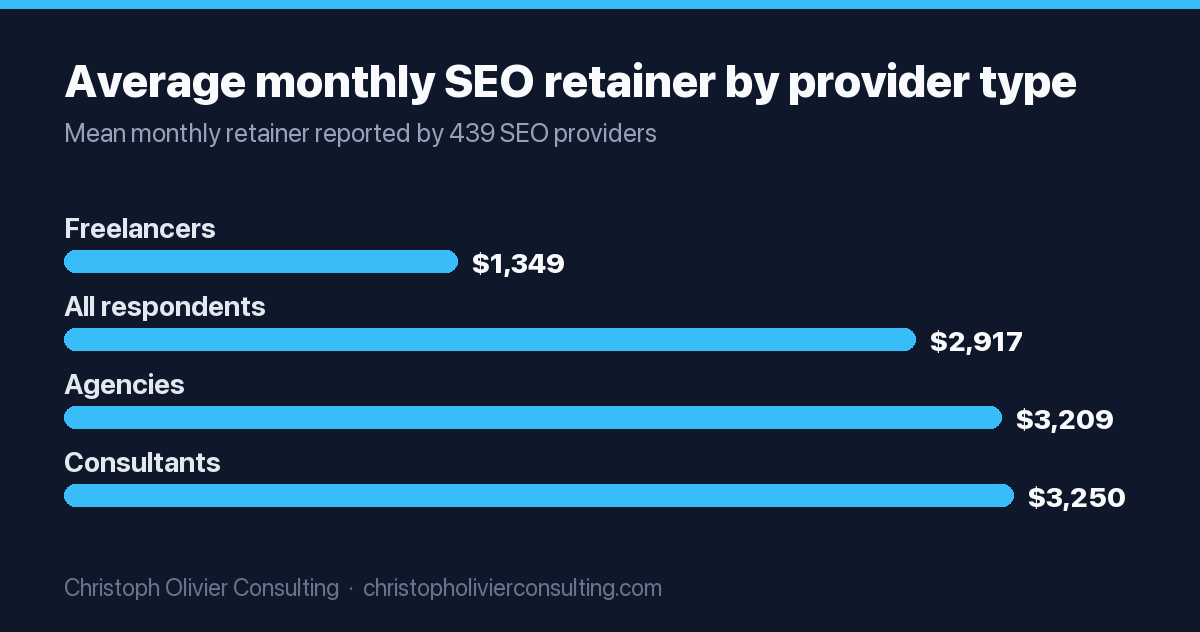
- SEO specifically: The Ahrefs survey of 439 SEO providers (updated August 2024) found $501 to $1,000 a month was the most common retainer bracket, chosen by 20.4% of respondents, while the average retainer was $2,917. US and Canadian providers mostly charged $1,001 or more a month (79.1%).
- Hourly work: Clutch’s digital marketing pricing guide, drawn from over 106,000 listed firms, puts specialized services such as SEO, PPC, content, email and social at $100 to $149 an hour, and the typical reviewed project at $10,000 to $49,999.
- Social media: WebFX’s social media pricing page puts management at $500 to $5,000 a month, with content creation at $40 to $150 per post. For a closer look at what each social tier buys, see our guide to social media management pricing.
The spread inside each range is driven by four things: how many channels, how much monthly volume, how senior the people doing the work are, and how competitive your market is. A local service firm and a national ecommerce brand can buy packages with the same name at five times the price difference.
Provider type matters too. In the Ahrefs data, freelancers averaged far lower SEO retainers than agencies or consultants, which reflects overhead and team depth rather than a quality ranking.
How pricing models work inside a package
Most packages combine a flat monthly fee with one or more add-ons: a first-month setup fee, a percentage of ad spend for paid media, and per-unit charges for extra content. Read the pricing model as carefully as the price, because it decides how your bill moves as you grow.
- Flat monthly retainer. A fixed fee for a fixed scope. Easy to budget. Check what happens when you need more than the scope covers.
- Percentage of ad spend. Common for PPC. WebFX’s PPC pricing page describes a typical agency range of 10% to 20% of ad spend. Your fee rises as you spend more, whether or not the work increases.
- Minimum fee or percentage, whichever is higher. A hybrid that protects the agency on small budgets. WebFX’s Pro tier, for example, is $975 a month or 15% of spend.
- Setup or onboarding fee. Charged once for audits, tracking and account builds. WebFX’s published first-month fees range from $1,200 (Lite) to $5,800 (Enterprise).
- Hourly or project pricing. Used for one-off work like a site migration or a campaign launch rather than ongoing packages.
Always separate three numbers when you compare offers: the management fee, the ad spend, and the tools or software you are expected to pay for. Clutch’s guide makes the same point plainly: digital marketing fees do not include ad costs.
Digital marketing packages for small business: which tier fits
For most small businesses, a focused starter or growth package beats a thin “full-service” bundle. Pick the tier by your bottleneck: if people cannot find you, start with SEO and local visibility; if you need leads this quarter, start with paid search; add channels only when the first one is measured and working.
Use these rules of thumb:
- Your website is weak or outdated: fix the site and the basics first. A package that runs ads to a poor landing page wastes the ad spend.
- You rely on referrals and local search: a starter tier with local SEO, Google Business Profile and reviews is usually the highest-return first step. Our SEO services page explains how that scope is typically structured.
- You need pipeline in 90 days: paid search management with tight conversion tracking, then layer SEO behind it.
- You already run two or more channels in-house: buy a single-channel package for the weakest one, rather than a bundle that duplicates what your team does.
- You can’t name your cost per lead today: no package will fix that on its own. Make tracking and reporting part of the scope.
Keep budget in proportion. Gartner’s 2025 CMO Spend Survey, as reported by Campaign Asia, found average marketing budgets at 7.7% of company revenue, with half of CMOs reporting 6% or less. That sample skews toward large companies, so treat it as a reference point, not a target for a small firm.
How to evaluate a digital marketing package before you sign
Evaluate a package on four things: specific deliverables, how results will be measured, contract terms, and who owns the accounts and assets. A good package names monthly outputs in numbers, ties reporting to leads or revenue, lets you leave on reasonable notice, and keeps every account in your name.
- Turn every line into a number. “Content marketing” means nothing. “Four 1,500-word articles a month, briefed against target keywords” can be checked.
- Separate deliverables from outcomes. Deliverables are what they do. Outcomes are what changes in your business. Ask which outcome metrics they will report on, such as qualified leads, cost per lead and booked consultations, and how they will track them.
- Ask who does the work. Senior strategist on the sales call, junior coordinator on the account is common. Get the names and roles of the people assigned.
- Read the contract length and exit terms. Note the minimum term, the notice period, auto-renewal language and any early-termination fee.
- Confirm account ownership. Your Google Ads, Analytics, Search Console, Business Profile, Meta Business assets, website and domain should be created in your name, with the agency granted access. Google’s manager account documentation notes that users with administrative access to a linked account can unlink it from the agency’s manager account at any time, which is only useful if you hold that access.
- Check what happens to the work if you leave. Content, creative, landing pages and tracking setups you paid for should transfer to you.
- Ask Google’s questions. Google suggests asking any SEO for examples of past work, whether they follow Google Search Essentials, what results to expect and in what timeframe, their experience in your industry, and whether they will share every change made to your site.
Red flags in online marketing packages
The biggest red flags are guaranteed rankings or results, vague deliverables, long lock-in contracts, agency-owned ad accounts and reporting that shows activity instead of leads. Google states plainly that no one can guarantee a #1 ranking, so any package promising one is either misinformed or misleading.
- Guarantees. Google’s SEO hiring guide says “No one can guarantee a #1 ranking on Google” and warns against providers claiming special relationships with Google or “priority submit” services.
- Cold outreach with a cheap bundle. Google also advises being wary of firms that email you out of the blue.
- Secrecy about methods. If they won’t explain what they will do, or talk about link schemes or submitting your site to thousands of search engines, walk away.
- Accounts in the agency’s name. If you can’t log in to your own ad account or analytics, you don’t control your history or your data.
- Vanity reporting. Impressions, followers and “tasks completed” with no line to leads or revenue.
- Every channel for a low price. Six channels for the price of one competent retainer usually means each gets a few hours a month.
- Long minimum terms with no exit. Twelve months with no performance review or termination clause shifts all the risk to you.
Package vs custom retainer vs fractional CMO
A package is best when your needs are standard and you want price certainty. A custom retainer fits when your scope is unusual or spans several channels that must work together. A fractional CMO fits when the gap is strategy and leadership: someone to set the plan, hire and manage vendors, and own the numbers.
| Factor | Digital marketing package | Custom agency retainer | Fractional CMO |
|---|---|---|---|
| What you buy | Fixed deliverables at a set tier | Scope built around your goals | Senior strategy, leadership and vendor management |
| Best for | Standard needs, one or two channels | Multi-channel programs with specific goals | Firms with no marketing leader or several vendors to coordinate |
| Strategy depth | Light, templated | Moderate to deep | Deep, business-level |
| Execution | Included | Included | Usually directs execution by agencies, freelancers or staff |
| Price predictability | High | Medium | High (set monthly fee) |
| Main risk | Paying for work that doesn’t fit | Scope creep | Needs execution capacity to be effective |
In my experience, firms often buy a package when the real gap is someone deciding what to do and holding vendors to it. If that sounds familiar, read how fractional marketing works before you add more channels.
Worked example: scoring two packages side by side
The fastest way to compare packages is a weighted scorecard. List the criteria that matter, weight them, score each offer from 1 to 5, and multiply. It turns sales conversations into a comparison you can defend, and it exposes the cheap package that scores well only on price.
Here is a hypothetical example. A 15-person professional services firm is choosing between two offers. Package A costs $2,000 a month for SEO and social. Package B costs $3,500 a month for SEO, paid search management and email. Both figures are illustrative.
| Criterion | Weight | Package A score | Package B score |
|---|---|---|---|
| Deliverables stated in numbers | 20% | 2 | 4 |
| Reporting tied to leads or revenue | 20% | 2 | 4 |
| Accounts and assets in your name | 20% | 3 | 5 |
| Contract term and exit | 15% | 4 | 3 |
| Fit with your bottleneck | 15% | 3 | 4 |
| Price relative to budget | 10% | 5 | 3 |
| Weighted score | 100% | 2.95 | 3.95 |
In this example, the cheaper package loses because it is vague on deliverables and reporting. Your weights will differ. A firm with a tight budget might weight price at 25%. The point is to decide the weights before you see the proposals, so the shiny pitch doesn’t decide for you.
To use this template:
- Write down your one main bottleneck (visibility, lead volume, lead quality or conversion).
- Set weights for the six criteria above, totaling 100%.
- Request a written scope from each provider with monthly deliverables, reporting metrics, contract terms and an account ownership statement.
- Score each offer independently, then compare totals.
- Negotiate the weakest line of the highest-scoring offer before you sign, for example a shorter initial term or a 90-day review.
How to buy a digital marketing package without overpaying
Buy the smallest package that attacks your real bottleneck, insist on numbered deliverables and lead-based reporting, keep every account in your name, and start with a short term or review point. Then expand only the channel that proves itself. That approach usually costs less than buying a bundle and trimming it later.
A few final practical points:
- Ask for a 90-day review written into the contract, with the right to adjust scope.
- Budget ad spend separately and confirm whether the fee is flat or a percentage.
- Get the onboarding fee itemized so you know what you own afterwards.
- Compare at least two providers on the same written scope.
I’d rather see a firm run one channel well than six channels badly. If you want to see how scopes compare across the work we do, our services page lays them out, and if you’d like a second opinion on a package you’ve been quoted, you can book a consultation and we’ll walk through it together.
Frequently asked questions
What is included in a digital marketing package?
Most packages bundle some mix of SEO, paid ads management, social media management, email marketing, content creation and monthly reporting. Starter tiers usually cover one or two channels at fixed volumes, while growth and premium tiers add channels, content volume, conversion work and more senior strategy. Ad spend is almost always billed separately from the package fee.
How much do digital marketing packages cost?
Published market ranges put SEO packages at about $500 to $5,000 a month and full-service packages at roughly $1,000 to $10,000+ a month, according to WebFX's 2026 pricing guide. The Ahrefs SEO pricing survey found $501 to $1,000 was the most common monthly SEO retainer bracket. Ad spend and software are usually extra.
What is the best digital marketing package for a small business?
The best package is the smallest one that targets your main bottleneck. If people cannot find you, start with local SEO and your Google Business Profile. If you need leads quickly, start with paid search plus conversion tracking. Add channels only once the first one is measured and producing qualified leads.
Is ad spend included in digital marketing package pricing?
Usually not. Management fees and ad spend are separate. Agencies often charge a flat fee, a percentage of ad spend, or a minimum fee or percentage, whichever is higher. WebFX describes a typical agency range of 10% to 20% of ad spend for PPC management. Confirm in writing which costs the package price covers.
How long should a digital marketing contract be?
There is no standard term, but shorter is safer for the buyer. Look for a reasonable notice period, no punitive early-termination fee and a written review point, such as 90 days, where scope can change. Be cautious with 12-month minimums that offer no performance review or exit clause.
Should I own my Google Ads and analytics accounts?
Yes. Your ad accounts, analytics, Search Console, Business Profile, website and domain should be in your name, with the agency granted access. Google notes that admins of a linked Ads account can unlink it from an agency's manager account at any time, which protects your data and history if you change providers.
Is a digital marketing package better than hiring a fractional CMO?
They solve different problems. A package buys execution of a fixed scope. A fractional CMO buys strategy and leadership: setting the plan, choosing and managing vendors, and owning the numbers. Many firms use both, with the fractional CMO directing an agency or package provider.
More Growth Consulting guides
- How Much Does Digital Marketing Cost?
- Home Builder Marketing: A Channel-by-Channel Playbook for a Long Buying Cycle
- How to Write a Positioning Statement (Template + Examples)
- User-Friendly Website Design: The Usability Checklist That Cuts Friction
- Performance Marketing Explained: Scale with ROAS
- How to Write an Elevator Pitch (Structure, Template, and Examples)
- All Growth Consulting guides →