
Last reviewed: October 2026
A white label digital marketing agency is a provider that does marketing work, such as SEO, PPC, social media or web design, which another firm sells to its own clients under its own brand. The reselling firm owns the client relationship, the pricing and the invoice. The white label partner does the fulfillment in the background.
This guide is for agency owners, consultants and fractional CMOs deciding whether to resell white label marketing services. It covers how the model works, what it costs, how to set a margin you can defend, how to vet a provider, who owns the work, and the risks most provider websites leave out.
What is a white label digital marketing agency?
A white label digital marketing agency produces marketing deliverables that carry your brand, not theirs. You sell the service, set the price and manage the client. They execute the work and hand it back unbranded or branded as yours. To the end client, your firm is the agency. The provider is a subcontractor they usually never meet.
Three parties are involved:
- The end client: the business paying for marketing. It signs with you and pays you.
- The reseller: your agency, consultancy or fractional practice. You own strategy, communication and accountability.
- The white label provider: the specialist team that fulfills the work for a wholesale fee.
Unlike a referral or co-branded partnership, only your name appears, so every result, good or bad, is yours to own.
How white label marketing works, step by step
White label marketing works as a relay. You sell and scope the engagement, pass a clear brief to the provider, the provider produces the work, and you review it before it reaches the client. The client sees your reports, your calendar invites and your invoice. The quality of the handoffs decides whether the arrangement holds up.
- Sell and scope. You run discovery, agree goals and define deliverables in your proposal.
- Brief the provider. Send goals, audience, brand voice, access needs, approval rules and deadlines in a standard intake form.
- Grant access the right way. The client grants access to its own accounts. You or the provider receive limited roles, not ownership.
- Fulfillment. The provider executes: audits, campaigns, content, builds or posting.
- Your quality review. You check every client-facing deliverable against the brief before release.
- Reporting. The provider supplies data. You add commentary and next steps in your branded report.
- Billing. The provider invoices you at wholesale. You invoice the client at your price.
Steps 2, 5 and 6 are where resellers add value. Skip the review step and you are just forwarding emails.
Which white label marketing services are most often resold
The services most often sold under white label arrangements are the ones that are repeatable, measurable and skill-heavy: SEO, paid search and paid social, social media management, content production, web design and development, and email marketing. Strategy and client counsel are rarely outsourced, because that is the part clients are actually buying from you.
White label SEO
White label SEO usually covers technical audits, keyword research, on-page optimization, local SEO, content and link acquisition. It is the most common entry point and the riskiest to resell blind, because tactics are hard for clients to see. Google’s own spam policies define link spam as creating links “primarily for the purpose of manipulating search rankings” and say violating sites may “rank lower in results or not appear in results at all.” If your provider buys links, your client carries that risk under your name. Compare any provider’s process with how a transparent engagement should run, as laid out on our SEO services page.
White label PPC
White label PPC covers Google Ads, Microsoft Ads and paid social management. It is easier to audit than SEO because the platforms report spend and results directly. It also comes with platform rules on fee transparency, covered below. Our guide to PPC management explains what good account management looks like, which is the standard you should hold a provider to.
Social, content, web and email
- Social media management: calendars, posting, community replies. High volume, so brand voice drift is the main risk.
- Content marketing: blog posts, case study drafts, newsletters. Expertise is the risk, especially in regulated fields like law, finance or healthcare.
- Web design and development: builds, migrations, maintenance. Ownership of code, design files and hosting matters most here.
- Email marketing: campaign builds and automation. The client should own the email platform account and the list.
White label vs outsourcing vs hiring in-house
White label, standard outsourcing and in-house hiring solve the same capacity problem with different trade-offs. White label hides the provider and keeps your brand in front. Standard outsourcing is visible to the client, who may even contract the specialist directly. Hiring gives you the most control, but it adds fixed cost and takes longest to set up.
| Factor | White label partner | Disclosed subcontractor or referral | In-house hire |
|---|---|---|---|
| Whose brand the client sees | Yours only | Yours plus the specialist, or the specialist only | Yours only |
| Cost structure | Variable, per client or per deliverable | Variable, often billed to the client | Fixed salary plus benefits |
| Speed to launch a new service | Fast, once a provider is vetted | Fast | Slow: recruiting, onboarding, ramp-up |
| Control over quality | Indirect, through briefs and review | Indirect, often less than white label | Direct |
| Your accountability | Full, for work you did not do | Shared | Full |
| Margin potential | Moderate, depends on your markup and review time | Low, often a referral fee | Higher at full utilization, negative when idle |
| Best fit | Repeatable services with steady demand you cannot staff yet | Niche or one-off needs | Core services with enough volume to keep a person busy |
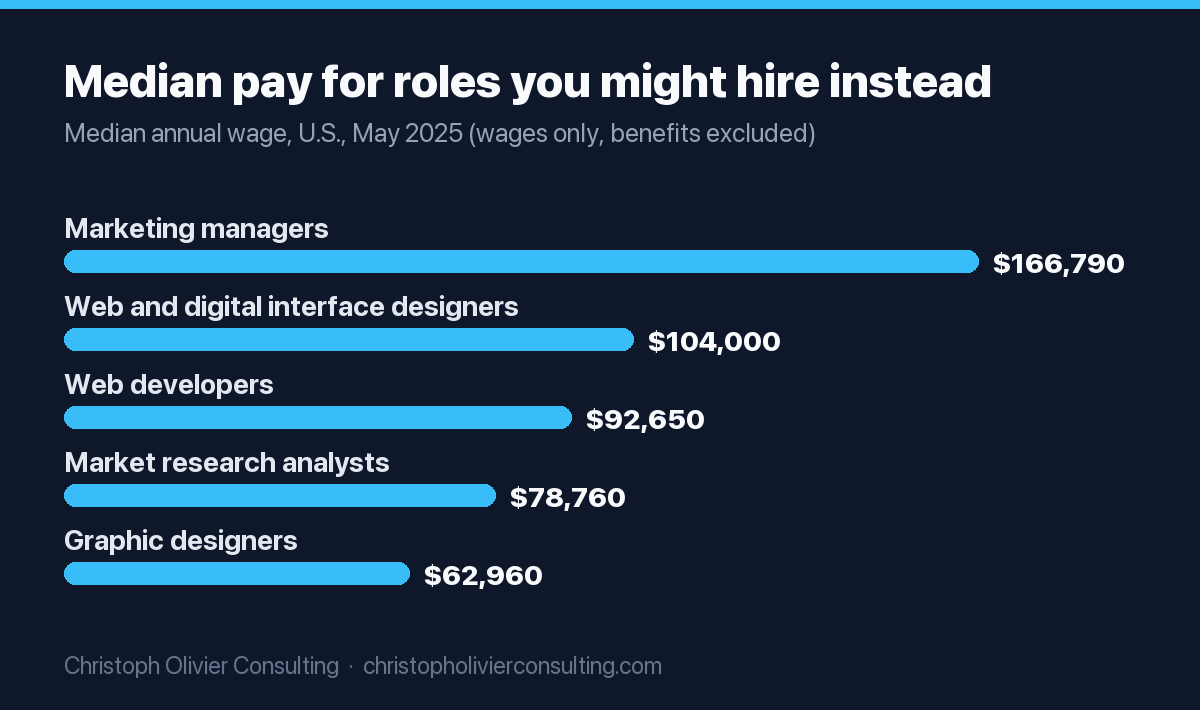
The hiring column deserves real numbers. The U.S. Bureau of Labor Statistics reports a median annual wage of $166,790 for marketing managers, $92,650 for web developers and $62,960 for graphic designers, all as of May 2025. Wages are not the full cost. In the BLS Employer Costs for Employee Compensation release for June 2026, wages were 70.0% of private-industry compensation costs and benefits were 30.0%. If that average ratio held, a $78,760 salary (the May 2025 median for market research analysts) would cost about $112,500 a year in total compensation, before software, training and management time.
That fixed cost is why white label often fits while demand is uneven. Once one service keeps a specialist busy year round, hiring often wins.
White label pricing models and how to set your margin
White label providers usually charge you in one of five ways: a monthly retainer per client, a per-deliverable rate, a percentage of ad spend for paid media, a fixed project fee, or an hourly rate. Your margin is your client price minus your full cost, including your own review time, not just the provider’s invoice.
The five common pricing models
- Monthly retainer per client: common for SEO, social and PPC management. Predictable, but check what is actually included each month.
- Per deliverable: a set price per article, audit, landing page or link. Easy to resell, easy to compare.
- Percentage of ad spend: common for paid media. Costs rise with the client’s budget even if workload does not.
- Project fee: websites, migrations, one-off audits.
- Hourly or block of hours: flexible, but risky to resell at a fixed price.
Published “standard markups” on provider websites vary widely and come from the people selling the service, so treat them as marketing, not benchmarks. Do your own math. For broader context on what clients pay for each channel, see our breakdown of how much digital marketing costs.
Worked example: markup is not margin
The numbers below are illustrative, not market rates. Plug in your own.
| Line item (per client, per month) | Scenario A | Scenario B |
|---|---|---|
| Provider fee (wholesale) | $1,500 | $1,500 |
| Your review and account time (5 hours at $100 internal cost) | $500 | $500 |
| Reporting and project tools allocated to this client | $100 | $100 |
| Total cost to serve | $2,100 | $2,100 |
| Client price | $3,000 (a 100% markup on the provider fee) | $3,500 |
| Gross profit | $900 | $1,400 |
| True gross margin | 30% | 40% |
In Scenario A, doubling the provider fee looks like a 50% margin. Once your own time is counted, it is 30%. Calls, revisions and report rewrites are real cost. Price from the total cost to serve, then add enough margin to cover the risk of owning someone else’s work.
Paid media has a transparency rule
If you manage Google Ads for a client, Google’s transparency requirements for third parties apply. If you charge a management fee separate from ad costs, you must “inform new customers in writing before each first purchase and disclose the fee on all customer invoices.” Where a monthly performance report is required, it must include “costs, clicks, and impressions” at the account level and “the exact amount charged by Google, exclusive of any fees that you charge.” You must also provide customer IDs when requested. In practice, that rules out hiding a markup inside the ad spend line. Price your white label PPC as a clearly stated management fee.
How to vet a white label digital marketing agency
Vet a white label provider the way a cautious client would vet you: ask for proof of process, read their sample deliverables, check how they report, and run a small paid pilot before you put a real client on it. The goal is to find out how they behave when something goes wrong, not how polished their sales deck looks.
Google’s own advice on hiring an SEO is a useful starting point for any channel. It suggests asking for examples of previous work, whether they follow Google Search Essentials, what results they expect and in what timeframe, and “Will you share with me all the changes you make?” It also warns that “No one can guarantee a #1 ranking on Google” and to be cautious of anyone who “won’t clearly explain what they intend to do.”
White label vetting checklist
- Process documentation. Ask for their written process for your service line, from intake to reporting.
- Sample deliverables. Request anonymized real work: an audit, a content piece, a campaign build, a report.
- Tactic disclosure. For SEO, ask exactly how links are acquired. Paid links or networks are a dealbreaker.
- Staffing and industry experience. Who does the work, and have they produced it for your clients’ sectors? Ask whether they re-outsource.
- Communication rules. Response times, named contact, time zone overlap and escalation path.
- Unbranded deliverables. Confirm reports, documents and file metadata can be fully white labeled.
- Access practices. They should work inside client-owned accounts with limited roles, never set up accounts in their own name.
- Contract terms. Non-solicit, confidentiality, IP assignment, termination and data return (see the next section).
- Paid pilot. Run one small, low-stakes project or your own firm’s work first and grade it against the brief.
Contracts, NDAs and who owns the work
Your white label contract should cover confidentiality, a non-solicitation clause so the provider cannot approach your clients, clear assignment of intellectual property, account ownership, data handling, service levels and what happens at termination. Without written terms, ownership of content, designs and code may not automatically pass to you or your client.
Copyright ownership is the clause people most often get wrong. The U.S. Copyright Office’s Circular 30 on works made for hire explains that a commissioned work from an independent contractor is a work made for hire only if it falls into one of nine statutory categories and the parties “expressly agree in a written instrument signed by them.” If any requirement fails, “it is not a work made for hire.” Many marketing deliverables may not fit those categories cleanly, which is why contracts often add a written copyright assignment as well. Ask your attorney to review the chain, because rights need to flow from the provider to you and from you to the client.
Account ownership
The client should own every platform account. You and the provider get access, not ownership.
- Google Analytics: Google’s access documentation describes an Administrator role with “Full control of Analytics,” including managing users, and an Editor role with “Full control of settings at the property level” that “Can’t manage users.” The client keeps Administrator. Providers usually need Editor or less.
- Google Ads: Google’s manager account documentation notes that client account users “can terminate the relationship with the manager account at any time by unlinking their account.” Have the client create its own account and link it to your manager account.
- Everything else: domain registrar, hosting, social pages, email platform and ad accounts should sit in the client’s name with the client’s billing.
Quality control and client communication
Quality control in white label marketing means nothing reaches the client without passing your review against a written standard. Client communication means the client hears from you, on your schedule, in your voice. Both depend on documented checklists, so quality does not rely on whoever is having a good week.
A practical QC workflow
- Write a one-page standard per service: what “done” means, brand voice notes, banned claims and required checks.
- Require the provider to self-check against that standard and note any deviations.
- Review every client-facing item yourself or through one named reviewer. Fact-check claims in regulated industries.
- Track revision rounds per deliverable. A rising count is an early warning.
- Score the provider monthly on on-time delivery, revision rate and results trend.
Communication rules that protect the relationship
- You run all client meetings. If a provider specialist joins, agree how they are introduced, and never misrepresent who someone is.
- Reports go out under your name, with your interpretation and recommended next steps, not a pasted dashboard.
- Set an internal deadline two to three days before every client deadline, so you have time to fix issues.
- Keep a shared log of decisions and changes.
Risks of white label marketing services and how to reduce them
The main risks of white label marketing are quality you cannot fully see, tactics that can harm a client, thin margins once your own time is counted, dependency on one provider, and client churn when results lag. Each risk is manageable with tight contracts, client-owned accounts, a review step and honest expectation setting at the sale.
Churn is the risk that hurts most. In a 2023 survey of more than 500 U.S. small and midsize business owners, inTandem by vcita found that almost 60% had switched outsourced marketing providers in the previous year, and 67% of those switched within six months or less. The top reason was “not enough ROI” (68%). If your provider’s results are slow, your client leaves you, not them.
| Risk | What it looks like | How to reduce it |
|---|---|---|
| Hidden low-quality tactics | Paid links, spun content, auto-generated posts | Written tactic disclosure, change logs, your own spot checks |
| Brand voice drift | Content that sounds generic or off-brand | Voice guide per client, review before publish |
| Margin erosion | Revisions and calls eat your profit | Price from total cost to serve, cap revision rounds |
| Provider dependency | Provider raises prices or closes | Client-owned accounts, documented processes, a vetted backup |
| Client poaching | Provider pitches your client directly | Non-solicit clause, you own all client contact |
| Data and confidentiality | Client data shared too widely | NDA, least-privilege access, removal at termination |
| Overpromising | Sales promises the provider cannot meet | Confirm scope with the provider before the proposal goes out |
When white label makes sense for consultants and fractional CMOs
White label makes sense for a consultant or fractional CMO when clients need execution you do not want to staff, the work is repeatable, and you can review it competently. It does not make sense when you cannot judge quality in that channel, or when the client really needs a specialist with direct access to their team.
In a fractional marketing engagement, the value is senior judgment: strategy, prioritization and accountability. Execution can come from in-house staff, a disclosed agency or a white label team. My own view is that fractional leaders should be open with clients about how execution gets done, even when the deliverables carry one brand, because the trust is the asset being sold. A marketing consultancy faces the same choice.
Good fit
- Several clients need the same service, such as local SEO or monthly paid search management.
- You or a senior team member can review the work line by line.
Poor fit
- You are reselling a channel you do not understand well enough to check.
- The client is in a regulated industry and the provider has no experience there.
- The margin only works if you skip the review step.
A 30-day white label pilot plan
A 30-day pilot tests a white label partner on low-stakes work before any client depends on them. Pick one service, one defined deliverable and one scorecard. At the end, you should know whether their quality, speed and communication meet your standard, and what your true cost to serve looks like.
- Days 1 to 5: Sign the NDA and contract. Share your service standard and intake form. Choose a small pilot project, ideally your own firm’s work.
- Days 6 to 20: Let the provider execute. Track response times, questions asked and whether they follow the brief without chasing.
- Days 21 to 25: Review deliverables against your standard. Log every revision and the hours you spent.
- Days 26 to 30: Score the pilot. Calculate your real cost to serve using the margin table above. Decide: scale, extend the pilot, or walk away.
Rate quality, timeliness, communication and transparency from 1 to 5, and record your own hours. High review hours mean the provider is cheaper on paper than in practice.
White label marketing can be a sound way to offer more services without adding headcount, as long as you treat the provider as part of your delivery team and keep the accountability where your client expects it. If you want a second opinion on whether to build, hire or white label a service line, you can book a consultation and we can work through the numbers together.
Frequently asked questions
What is a white label digital marketing agency?
It is a provider that performs marketing work such as SEO, PPC, social media or web design, which another agency or consultant resells to clients under its own brand. The reseller owns the client relationship, pricing and invoicing. The white label partner does the fulfillment in the background and delivers unbranded work, so the end client only sees the reseller's name.
Is white label marketing legal and ethical?
Reselling services under your own brand is a common, lawful business arrangement in most cases. The ethical line is honesty: do not misrepresent who someone is, do not make claims you cannot support, and follow platform rules. For Google Ads, Google requires third parties to disclose separate management fees in writing and on invoices. Contract questions belong with your attorney.
How much should I mark up white label services?
There is no reliable industry benchmark, and the figures on provider websites come from sellers. Price from your total cost to serve: the provider fee plus your own review, account management and tool costs. A 100% markup on the provider fee can shrink to roughly a 30% true margin once your time is counted, so run the math per client before you quote.
What is white label SEO?
White label SEO is search optimization work, such as audits, keyword research, on-page fixes, local SEO, content and link acquisition, done by a specialist and resold by an agency under its own brand. Ask the provider exactly how links are acquired. Google's spam policies say sites using link schemes may rank lower or not appear in results at all.
Who owns the content and accounts in a white label arrangement?
The client should own every platform account, including analytics, ad accounts, domain and hosting, with you and the provider given limited access roles. Content and design ownership depends on your contracts. The U.S. Copyright Office explains that commissioned work counts as work made for hire only in specific categories with a signed written agreement, so contracts often add a copyright assignment.
White label vs hiring in-house: which is better?
White label usually fits when demand for a service is uneven or you are testing a new service line, because costs scale with clients. Hiring fits when one service has enough steady volume to keep a specialist busy. BLS data shows benefits were about 30% of private-industry compensation costs in June 2026, so salary alone understates the cost of a hire.
How do I keep clients from finding out I use a white label provider?
The better question is how to keep clients happy, because trust matters more than secrecy. Run all meetings yourself, review every deliverable, and send reports under your name with your own analysis. Use a non-solicit clause so the provider cannot contact your clients. If a client asks directly how work is delivered, answer honestly.
More Growth Consulting guides
- What Is a Marketing Consultancy? Services, Fees, and How to Choose
- How Much Does Digital Marketing Cost?
- Business Marketing Management: How to Run Marketing Like a Managed Function
- Ecommerce Marketing Strategy: A Channel-by-Channel Plan Built on LTV:CAC
- Foundation Repair Marketing: The Cost-Per-Booked-Job Playbook
- Integrated Marketing Communications: The Practical Build Guide
- All Growth Consulting guides →