
A marketing consultancy is a firm or independent advisor that diagnoses marketing problems, builds the strategy to fix them, and hands the plan to your team or your delivery partners to run. You are buying senior thinking and direction, not day to day campaign execution. Most work is priced as a fixed project or a monthly advisory retainer.
Last reviewed: September 2026
What is a marketing consultancy?
A marketing consultancy is an outside advisory service that studies your business, market, and current results, then recommends where to spend, what to change, and in what order. The output is usually a written strategy, a set of priorities, and a measurement plan. A consultancy advises and plans; it rarely owns the accounts or produces the creative itself.
The label covers two shapes. A generalist consultancy helps across positioning, channel mix, budget, and hiring. A specialist consultancy goes deep on one area, such as SEO, paid media, lifecycle email, or answer engine visibility. Both sell judgment and a plan you can act on, and both leave the ongoing execution to your team or an agency.
What does a marketing consultancy actually do?
A marketing consultancy turns a vague goal, such as “we need more pipeline,” into a specific plan with owners, budgets, and metrics. The engagement usually moves through a repeatable sequence rather than open ended advice, so you finish with decisions rather than a slide deck that sits unused.
- Audit and diagnosis. Review your funnel, channels, analytics, spend, and competitors to find what is working and what is leaking.
- Positioning and goals. Sharpen the message and set targets tied to revenue, not vanity metrics.
- Channel and budget plan. Decide the mix across search, paid, content, email, and referral, then allocate spend to it. A consultancy often shapes the full sales and marketing strategy here.
- Measurement. Define the dashboard, attribution approach, and the review cadence so results are visible.
- Handover and support. Brief the team or agency who will run the plan, and stay available for check ins.
Modern engagements increasingly cover how a brand shows up in AI answers, not only in classic search. If that is a priority, expect a consultancy to advise on how to rank on AI alongside standard organic and paid work.
Marketing consultancy vs agency vs fractional CMO
The three options solve different problems. A consultancy gives you a plan. An agency gives you execution hands. A fractional CMO gives you part time leadership that owns the plan and steers the team over months. Picking the wrong one is the most common and most expensive mistake buyers make.
| Factor | Marketing consultancy | Marketing agency | Fractional CMO |
|---|---|---|---|
| Core job | Diagnose and plan strategy | Execute campaigns and creative | Own strategy and lead the team |
| Deliverable | Strategy, priorities, roadmap | Live campaigns, assets, reporting | Direction plus accountability for results |
| Ownership | Advisory only | Runs specific channels | Owns the whole marketing function |
| Typical commitment | Project or light retainer | Ongoing monthly retainer | Multi month part time role |
| Best when | You need a decision or plan | You have a plan and need output | You need a leader but not full time |
These lines blur in practice. Some consultancies also place execution partners, and some fractional CMOs start with a consulting style audit. If you want a part time leader rather than a plan, compare the fractional CMO cost for 2026 before you commit to a consultancy retainer.
How much does a marketing consultancy cost?
A marketing consultancy is usually priced one of three ways: by the hour, by the project, or on a monthly retainer. In 2026, US hourly rates commonly run from about $100 to $300, with senior specialists reaching $150 to $500. Projects range from roughly $5,000 for an audit to $50,000 or more for a full go to market plan. Treat every figure as conditional, since scope and seniority move the number a lot.
| Pricing model | Typical 2026 range | Fits when |
|---|---|---|
| Hourly | $100 to $300 per hour | Scope is unclear or you need occasional input |
| Project | $5,000 to $50,000+ | A defined deliverable such as an audit or plan |
| Monthly retainer | $3,000 to $8,000+ for advisory | Ongoing guidance over several months |
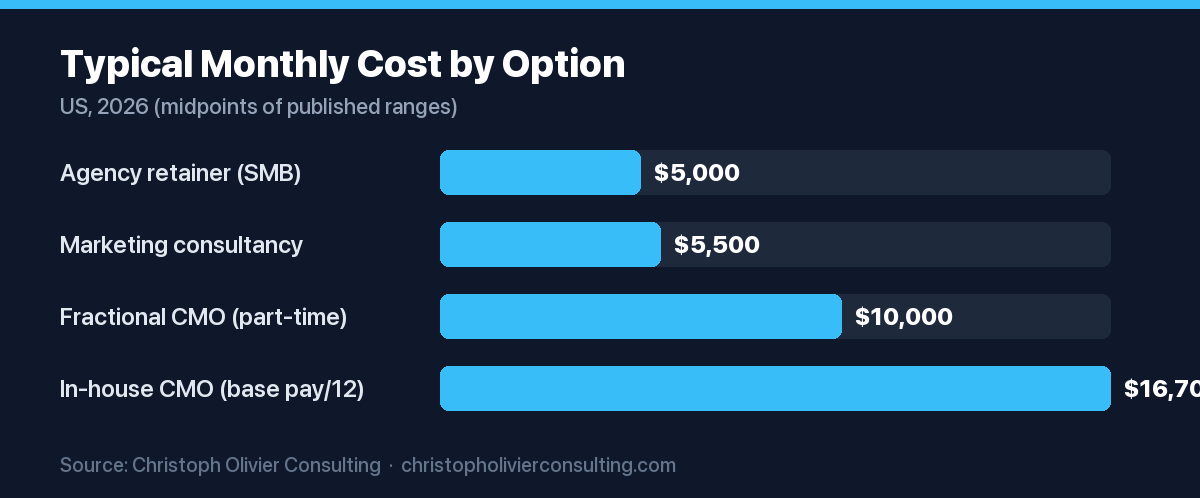
The more useful comparison is monthly cost across your options. Advisory support and an entry agency retainer sit lower, part time leadership sits in the middle, and a full time hire sits highest. The chart below shows midpoints of published 2026 ranges, so read them as a rough ladder rather than a quote.
Ranges overlap heavily, so ask for a written scope and a clear list of deliverables before comparing two proposals on price alone.
How to choose a marketing consultancy
Choose a marketing consultancy by matching the decision you face to the advisor’s proven experience, then testing how they think before you sign. The best signal is not the pitch; it is the quality of the questions they ask about your business. Work through this checklist.
- Name the decision. Write the specific problem, such as “our paid spend is not returning,” so you can judge fit against it.
- Check relevant proof. Ask for examples in your model, business to business or business to consumer, and at your stage.
- Ask for their method. A good consultancy can explain how it moves from audit to plan without hiding behind jargon.
- Confirm the deliverable. Get the exact output, format, and review dates in writing.
- Agree how success is measured. Tie the engagement to metrics you both accept up front.
- Test the handover. Confirm who executes the plan and whether the consultancy supports that team.
If you want to see how one advisory practice scopes this work, review the consulting services and match them against your own checklist rather than the other way around.
When a marketing consultancy is the wrong fit
A marketing consultancy is the wrong choice when your problem is output, not direction. If you already know the plan and simply lack the hands to run campaigns, an agency delivers faster. If the plan keeps stalling because nobody owns it, part time leadership fixes that better than more advice.
Two honest warning signs. First, if you cannot free anyone to act on the recommendations, a strategy document will gather dust and the fee is wasted. Second, if the real gap is consistent execution over many months, a retainer of advice is a costly way to buy something an operator role would deliver. Be clear about whether you need a plan, hands, or a leader, and the right partner becomes obvious.
Frequently asked questions
What is the difference between a marketing consultancy and a marketing agency?
A marketing consultancy diagnoses problems and builds the strategy, then hands the plan over. A marketing agency executes that plan by running campaigns, producing creative, and managing channels. Put simply, a consultancy advises and plans while an agency delivers the output. Many businesses use a consultancy first to set direction, then hire an agency or in house team to run it.
How much does a marketing consultancy cost in 2026?
In 2026, US marketing consultants commonly charge about $100 to $300 per hour, with senior specialists reaching $150 to $500. Projects run from roughly $5,000 for an audit to $50,000 or more for a full go to market plan, and advisory retainers often sit around $3,000 to $8,000 a month. Treat these as conditional ranges, since scope and seniority change the figure significantly.
Do I need a marketing consultancy or a fractional CMO?
Choose a marketing consultancy when you need a plan or a specific decision made well. Choose a fractional CMO when you need someone to own marketing leadership and steer the team over several months, not just advise. If the plan keeps stalling because nobody owns it, part time leadership usually fixes that better than more advice does.
What does a marketing consultant actually deliver?
A marketing consultant typically delivers an audit of your current marketing, a positioning and goals statement, a channel and budget plan, and a measurement framework with a review cadence. The engagement ends with decisions, owners, and metrics rather than open ended suggestions. Some consultants also brief the team or agency who will run the plan and stay available for periodic check ins.
How do I choose a good marketing consultancy?
Start by naming the specific decision or problem you face, then check the consultancy has relevant proof in your business model and stage. Ask them to explain their method from audit to plan, confirm the exact deliverable in writing, and agree how success will be measured up front. The best signal is often the quality of the questions they ask about your business.
Is a marketing consultancy worth it for a small business?
A marketing consultancy can be worth it for a small business at decision points, such as relaunching a site, entering a new market, or fixing paid spend that is not returning. In those cases the cost of a wrong turn can exceed the fee. It is a poor fit when you mainly need ongoing execution, where an agency or part time operator is usually more cost effective.
More marketing guides for rank on ai: get cited by ai search
- The 7 Sales Process Steps (and How to Run Each One)
- Customer Engagement Platform: What It Is and How to Choose
- Customer Success Software: Categories, Features, and Pricing
- What Is Fractional Marketing? Model, Cost, and When to Use It
- 31 Free Marketing Tools Worth Using in 2026
- How to Brand Yourself: A Step-by-Step Playbook for 2026
- Rank on AI: Get Cited by AI Search