
Last reviewed: October 2026
An inbound marketing consultant is a senior specialist who designs and tunes the system that brings buyers to you: positioning, content, SEO and AI search visibility, conversion paths, lead nurturing and the CRM that ties them to revenue. In 2026, published market data puts most at $100 to $300 an hour or $3,000 to $15,000 a month on retainer, and the right one is judged on qualified pipeline, not traffic.
This guide is for owners, partners and marketing leads at professional-service firms and 7-figure service businesses deciding whether to hire one. It compares a consultant with a freelancer, an agency, an in-house hire and a fractional CMO, shows verified market price ranges, and gives you a hiring checklist, the questions to ask, the red flags, and a 90-day plan you can hold someone to.
Need senior marketing leadership without a full-time hire? See CO Consulting’s fractional CMO services.
What does an inbound marketing consultant do?
An inbound marketing consultant builds and improves the system that attracts, converts and nurtures buyers who are already searching for help. The work covers strategy, a repeatable content engine, SEO and answer engine optimization, landing pages and offers, email nurture, and the CRM and reporting that connect marketing activity to booked revenue.
HubSpot, which popularized the term, defines inbound as “a business methodology that attracts customers by creating valuable content and experiences tailored to them,” organized around three stages: attract, engage and delight. If you want the longer version of how that model has changed, read our explainer on what inbound marketing means in 2026.
In practice, a good consultant owns six workstreams:
- Strategy and positioning. Who you serve, what problems they search for, and why you are the obvious choice. Without this, content is noise.
- The content engine. An editorial plan tied to buyer questions, a production workflow, and standards for what “good” looks like. Our content marketing guide covers the mechanics.
- SEO and AEO. Technical health, keyword and topic mapping, internal linking, and making pages easy for Google, ChatGPT and Perplexity to quote.
- Conversion paths. Offers, landing pages, forms, booking flows and calls to action that turn readers into conversations.
- Nurture. Email and retargeting sequences for the majority of buyers who are not ready on their first visit.
- CRM and marketing ops. Lifecycle stages, lead scoring, attribution and dashboards, so you can see which content produced which clients.
The distinction that matters: a consultant decides what to build and why, and often builds the core pieces. Large volumes of execution (dozens of articles a month, ad production, design) usually sit with your team, freelancers or an agency.
Inbound marketing consultant vs agency vs in-house vs fractional CMO
A consultant gives you senior strategy and system design at part-time cost. An agency gives you a production team. An in-house hire gives you full-time ownership and context. A fractional CMO owns the whole marketing function and budget, not only inbound. Many growing firms end up combining two of these.
Here is how the options compare on the factors buyers actually weigh:
| Option | Best for | What you get | Main risk | Typical commitment |
|---|---|---|---|---|
| DIY (owner or generalist staff) | Very early firms testing demand | Low cash cost, full control | Inconsistency; strategy gets skipped when billable work spikes | Ongoing, unpaid time |
| Freelancer | A defined task: articles, a landing page, a HubSpot setup | Specialist execution at a lower rate | No one owns the system; you become the project manager | Per project or hourly |
| Inbound marketing consultant | Firms with some execution capacity that lack senior strategy | Diagnosis, plan, system design, coaching, selective hands-on builds | A great plan that nobody executes | Project or 3 to 12 month retainer |
| Inbound marketing agency | Firms that need volume of production and have budget for it | A team: writers, designers, SEO, ops | Senior people sell, junior people deliver; output over outcomes | Usually 6 to 12 month retainer |
| In-house marketing hire | Firms with steady demand for full-time marketing work | Daily ownership and deep context | One person rarely covers strategy, content, SEO and ops well | Full-time salary plus benefits |
| Fractional CMO | Firms where marketing needs an executive owner across all channels | Leadership, budget, hiring, vendor management, board-level reporting | More than you need if the only gap is inbound execution | Monthly retainer, often 6+ months |
On the specific question of inbound marketing agency vs consultant: choose the agency when your bottleneck is production capacity and the strategy is already sound. Choose the consultant when you are not sure what to produce, why past content has not produced clients, or whether your current agency is pointed at the right target. If inbound is only one part of a broader growth gap, our fractional CMO services page explains when an executive owner is the better fit.
How much does an inbound marketing consultant cost in 2026?
Market rates for experienced marketing consultants in 2026 run about $100 to $300 per hour, $3,000 to $15,000 per month on retainer for 10 to 40 hours of work, and $5,000 to $50,000 or more per project. Inbound-specific programs that include content production often cost more because you are paying for output, not only advice.
These are market ranges from published marketplace and survey data, not a price list. Treat them as a sanity check on any quote you receive.
| Engagement shape | Market range | Source |
|---|---|---|
| Hourly, junior consultant (2 to 5 years) | $100 to $150 per hour | MarketerHire, 2026 |
| Hourly, mid-level (5 to 10 years) | $150 to $225 per hour | MarketerHire, 2026 |
| Hourly, senior (10+ years) | $225 to $300+ per hour | MarketerHire, 2026 |
| Monthly retainer, SEO and organic | $5,000 to $10,000 per month | MarketerHire, 2026 |
| Monthly retainer, fractional CMO or VP Marketing | $10,000 to $20,000 per month | MarketerHire, 2026 |
| Single campaign audit | About $5,000 | MarketerHire, 2026 |
| Full go-to-market strategy project | $5,000 to $50,000+ | MarketerHire, 2026 |
| Content marketing services, monthly | $2,000 to $20,000 per month | WebFX pricing survey |
| Freelancer and consultant hourly, all levels | $25 to $250+ per hour | WebFX pricing survey |
MarketerHire says its figures come from more than 30,000 consultant matches on its marketplace; WebFX says its ranges draw on a survey of more than 250 US marketing and sales professionals. Both are vendors with something to sell, so read them as directional. The pattern is consistent, though: seniority and scope drive price far more than the “inbound” label does.
What drives the price up or down
- Hands-on vs advisory. A consultant who writes, builds pages and configures your CRM costs more per month than one who advises your team.
- Content volume. If production is included, the retainer scales with the number of pieces.
- CRM complexity. Migrations, lead scoring and attribution setups are often scoped as separate projects.
- Your industry. Regulated fields (legal, financial, healthcare) need review steps that add time.
For context on total marketing budgets, Gartner’s 2025 CMO Spend Survey found budgets flat at 7.7% of company revenue, with 59% of CMOs saying they lacked enough budget to execute their strategy. That survey skews to companies above $1 billion in revenue, so smaller firms should treat it as a reference point, not a target.
Consultant vs in-house: a worked cost example
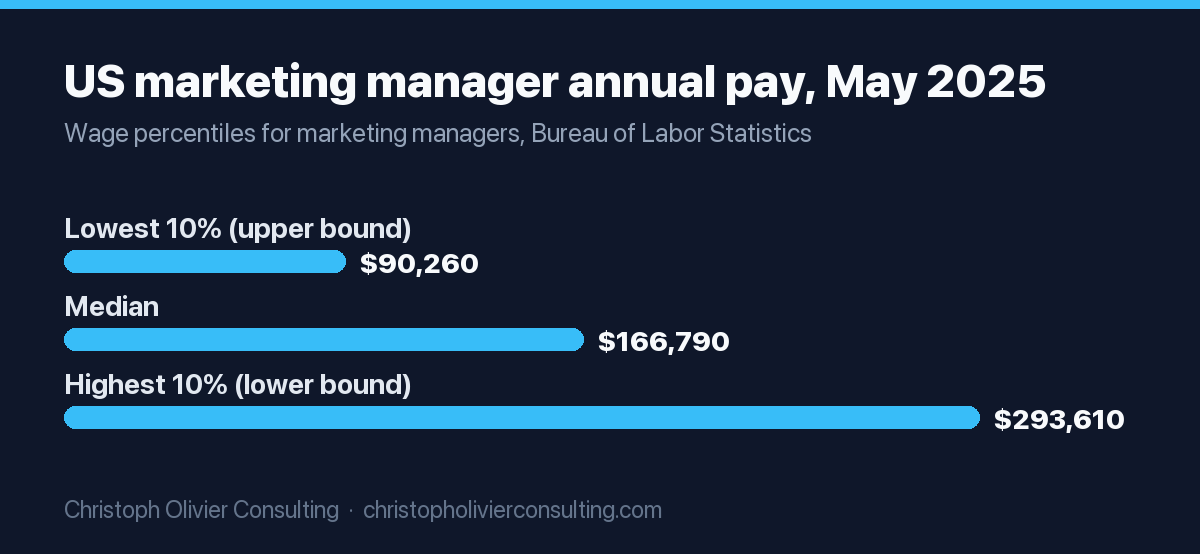
A full-time marketing manager in the US had a median salary of $166,790 in May 2025, and benefits add roughly 30% to employer costs. That puts a median in-house hire near $238,000 a year fully loaded, versus about $36,000 to $180,000 a year for a consultant retainer in the market ranges above.
Here is the math, using only published figures:
- Salary. The Bureau of Labor Statistics reports median pay for marketing managers of $166,790 per year (May 2025). The lowest 10% earned less than $90,260 and the highest 10% more than $293,610.
- Benefits load. The BLS Employer Costs for Employee Compensation release for June 2026 shows benefits at 30.0% of total compensation cost for private industry workers, with wages at 70.0%.
- Fully loaded estimate. If wages are 70% of total cost, $166,790 divided by 0.70 is about $238,000 a year. This is an illustrative estimate: the 30% benefits share is an all-occupation average, and it excludes recruiting, software and management time.
- Consultant comparison. A $3,000 to $15,000 monthly retainer equals $36,000 to $180,000 a year.
| Line item | In-house marketing manager (median) | Inbound consultant retainer |
|---|---|---|
| Annual cash cost | $166,790 salary | $36,000 to $180,000 |
| Benefits and payroll costs | About $71,000 (30% of loaded cost) | None (contractor) |
| Estimated total | About $238,000 | $36,000 to $180,000 |
| Hours of attention | Full-time | Typically 10 to 40 hours per month |
| Seniority you get for the money | One person at one level | Often more senior, but part-time |
The honest read: a consultant is cheaper per year but gives you a fraction of the hours. The comparison favors a consultant when your gap is senior judgment and system design. It favors a hire when the gap is daily execution volume. Many firms use a consultant first to design the system, then hire someone to run it.
When to hire an inbound marketing consultant (and when not to)
Hire an inbound marketing consultant when you already have some marketing activity but it is not producing qualified conversations, when you are about to spend real money on content or an agency and want the plan right first, or when your CRM data cannot tell you where clients come from. Skip it when nobody can execute.
Good signals you are ready:
- You publish content but cannot name a client it produced.
- Referrals are slowing and you need a second source of demand. Our inbound vs outbound comparison helps you decide which to build first.
- You are paying an agency and cannot tell whether the work is pointed at buyers or at vanity metrics.
- Leads arrive but go cold because no one follows up in a structured way.
Signals to wait or choose something else:
- No one on your side can give the consultant 2 to 4 hours a week for interviews, approvals and execution.
- Your offer or pricing is unclear. Inbound amplifies a clear offer; it cannot create one.
- You need leads within weeks. Organic programs usually take months to compound, so paid or outbound may be the right short-term bridge.
How to hire an inbound marketing consultant: step by step
To hire an inbound marketing consultant, define the business outcome first, decide whether you need advice or execution, shortlist three to five people with relevant proof, run a paid diagnostic before any long retainer, and write success metrics into the contract. This order keeps the decision about results, not personality.
- Write the outcome in one sentence. For example: “Ten qualified consultation requests a month from mid-market clients within nine months.” Avoid outcomes like “more traffic.”
- Audit your capacity. List who can write, approve, build pages and manage the CRM today. This decides whether you need an advisor or a builder.
- Pick the engagement shape. Project (audit and roadmap), retainer (ongoing direction and builds), or advisory (monthly sessions with your team).
- Shortlist on proof, not promises. Ask for examples of systems they built, the role they played, and what changed. Look for work in businesses with a similar sales cycle.
- Run a paid diagnostic first. A two to six week audit and plan shows you how they think before you commit to months of retainer.
- Agree on metrics and reporting cadence. Define leading indicators (rankings, conversion rates) and lagging ones (opportunities, revenue) in writing.
- Set a 90-day review point. Build in an explicit decision: continue, change scope or stop.
If you are also weighing broader help, our guide to choosing a marketing consultancy covers the general selection process.
Questions to ask and red flags to watch for
The best questions force a candidate to show how they diagnose problems, how they measure success, and who actually does the work. The biggest red flags are guaranteed rankings or lead counts, reporting built on traffic alone, long lock-in contracts with no diagnostic phase, and vague answers about who owns your content and accounts.
Hiring checklist: copy this into your interview notes
Questions to ask
- Walk me through the first 30 days. What do you need from us?
- Show me an inbound system you designed. What was your role and what did you hand off?
- How do you decide which topics to write about? Where does buyer research come in?
- How do you handle AI search (AI Overviews, ChatGPT, Perplexity) in your content plan?
- Which numbers will you report monthly, and how do they connect to pipeline?
- Who does the work: you, a subcontractor, or a team? Will that change after month one?
- What would make you recommend we stop working together?
Red flags
- Guarantees of page-one rankings, specific lead counts or ROI multiples.
- Reports that stop at sessions, impressions or followers.
- A 12-month contract before any audit or plan.
- They, not you, own the website, CRM, ad accounts or content.
- A one-size playbook with no questions about your sales process.
- Case studies with no context on the starting point or the consultant’s role.
Contract must-haves
- Named deliverables for the first 90 days.
- Your ownership of all accounts, data and content.
- A 30-day exit clause after the initial term.
- Agreed metrics and a monthly reporting date.
What a 90-day inbound marketing consulting engagement looks like
A well-run 90-day inbound marketing consulting engagement starts with an audit, not content. Month one diagnoses positioning, tracking, SEO health and the funnel. Month two builds the priority fixes and the first conversion path. Month three launches the content engine and nurture, then sets the plan and metrics for the next two quarters.
| Phase | Focus | Deliverables you should see |
|---|---|---|
| Days 1 to 30: Diagnose | Positioning, buyer research, analytics and CRM audit, SEO and content audit | Audit report, tracking fixes, ranked list of opportunities, 90-day plan |
| Days 31 to 60: Build | Highest-value pages, offers and conversion paths, CRM lifecycle stages | Rewritten service pages, one lead magnet or consultation path, working attribution |
| Days 61 to 90: Launch | Content engine, nurture sequence, reporting | Editorial calendar, first published pieces, live email nurture, monthly dashboard |
The nurture piece is where many programs leak. Many buyers of professional services are not ready on their first visit, so a structured follow-up sequence matters as much as the content that attracts them. Our lead nurturing guide shows how to build one.
My own approach is audit-first for this reason: a 90-day plan built on a real diagnosis is usually cheaper than six months of content built on guesses.
How to measure an inbound marketing consultant: pipeline, not traffic
Measure an inbound marketing consultant on qualified pipeline: consultation requests, sales-qualified opportunities and revenue you can trace to inbound sources. Traffic, rankings and AI citations are useful leading indicators, but they are not the result. Agree on both layers before work starts, and review them monthly.
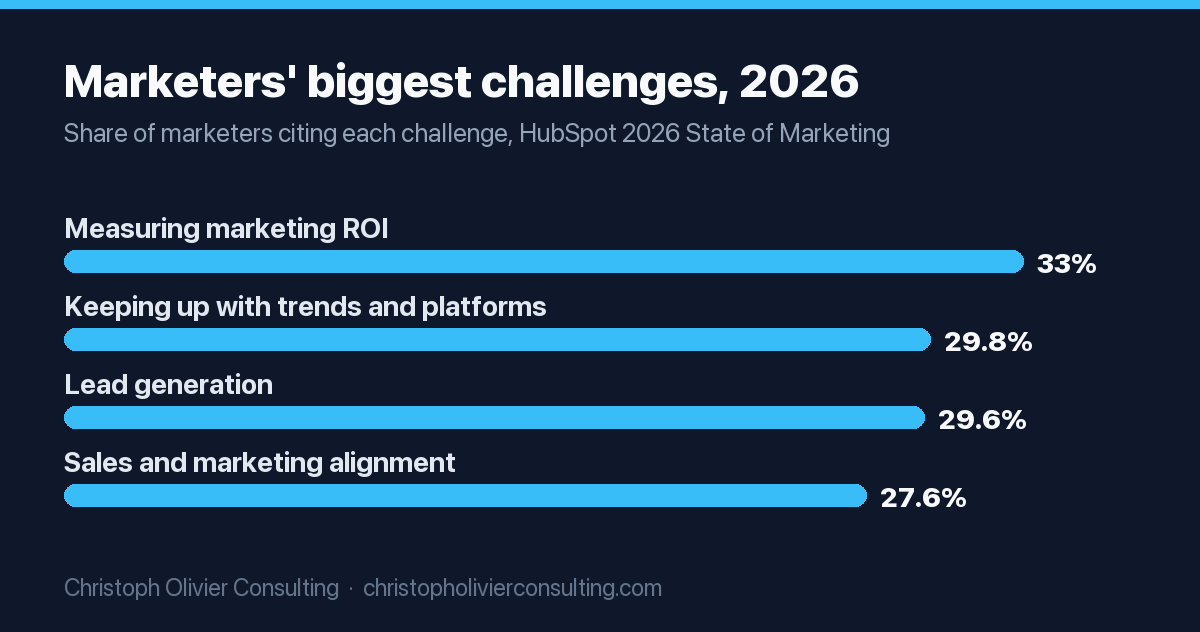
This is the area most marketers struggle with. In HubSpot’s 2026 State of Marketing report, measuring marketing ROI was the most cited challenge, ahead of keeping up with platform changes and lead generation.
A simple scorecard for a professional-service firm:
| Layer | Metric | Why it matters |
|---|---|---|
| Leading | Rankings and AI citations for buyer-intent topics | Shows the content is findable for the right questions |
| Leading | Visit-to-inquiry conversion rate on service pages | Shows whether the pages persuade |
| Middle | Qualified consultation requests per month | The first number that touches revenue |
| Middle | Nurture-to-meeting rate | Shows whether follow-up recovers not-yet-ready buyers |
| Lagging | Opportunities and closed revenue sourced or influenced by inbound | The actual return on the engagement |
Expect the leading metrics to move first. Revenue attribution in long sales cycles can lag by two or more quarters, which is why the CRM setup in month one matters.
How AI search changes inbound marketing consulting in 2026
AI search raises the bar for inbound content but does not replace the fundamentals. Google says there are no special requirements to appear in AI Overviews or AI Mode beyond standard SEO best practices. A good consultant in 2026 builds pages that answer questions directly, stay crawlable and support claims with sources.
Google’s guidance on AI features states that “there are no additional requirements to appear in AI Overviews or AI Mode, nor other special optimizations necessary.” It recommends the same basics: allow crawling, make content findable through internal links, keep important content in text form, and make sure structured data matches visible text.
Marketers are reacting. In the same HubSpot report, 40.60% named updating SEO for search changes as a top trend, and 86.4% said their teams use AI in some area of marketing. In practice, that means a consultant should be able to explain:
- How each priority page opens with a direct, quotable answer.
- How topics are grouped so your expertise is clear across a cluster, not one page.
- How AI tools are used in production, and where human review and subject-matter input come in.
- How they track AI citations alongside classic rankings.
From my own work building content systems that have generated more than 200 million organic views, the pattern I trust is the plain one: answer the buyer’s real question better than anyone else, then make the next step obvious. No consultant can guarantee rankings or AI citations, and you should be wary of anyone who does.
If you would like help scoping the role or being matched with the right shape of support, CO Consulting starts every engagement with an audit-first 90-day plan, backed by experience managing millions in ad spend, and makes no promised outcomes. You can book a consultation to talk it through.
Work with CO Consulting
Senior marketing leadership, without the full-time hire
- One senior owner of strategy, budget, vendors and the weekly scorecard
- Audit first, then a prioritized 90-day plan with measurable milestones
- Weekly team leadership, monthly strategic reviews and quarterly planning
- No guarantees we cannot back up; reporting tied to pipeline
Frequently asked questions
What does an inbound marketing consultant do?
An inbound marketing consultant designs and improves the system that attracts, converts and nurtures buyers who are already looking for help. That includes positioning, a content plan, SEO and AI search visibility, landing pages and offers, email nurture, and the CRM reporting that links marketing activity to revenue. Many also build the core pieces themselves, while high-volume execution usually sits with your team, freelancers or an agency.
How much does an inbound marketing consultant cost?
Published 2026 market data puts experienced marketing consultants at roughly $100 to $300 per hour, $3,000 to $15,000 per month on retainer for 10 to 40 hours of work, and $5,000 to $50,000 or more per strategy project. Programs that include content production usually cost more. Treat these as market ranges, and compare quotes on scope and seniority rather than the inbound label.
Is an inbound marketing agency or a consultant better?
It depends on your bottleneck. An agency fits when the strategy is sound and you need production volume: writers, designers and SEO specialists. A consultant fits when you are unsure what to produce, why past content has not produced clients, or whether an existing agency is aimed at the right buyers. Many firms use a consultant to set the plan, then an agency or freelancers to execute it.
How long before inbound marketing consulting shows results?
Leading indicators such as tracking fixes, conversion rate changes on service pages and early rankings can move within the first 90 days. Organic traffic and qualified pipeline usually take longer to compound, often several months, and revenue attribution in long sales cycles can lag by two or more quarters. Be cautious of anyone who promises fixed timelines or guaranteed lead counts.
What should I ask before I hire an inbound marketing consultant?
Ask how they would spend the first 30 days, what they need from your team, and to see a system they designed along with their exact role in it. Ask which numbers they report monthly and how those connect to pipeline, who actually does the work, how they handle AI search, and what would make them recommend ending the engagement.
Is a fractional CMO the same as an inbound marketing consultant?
No. An inbound marketing consultant focuses on the inbound system: content, SEO, conversion paths, nurture and the CRM behind them. A fractional CMO is a part-time executive who owns the whole marketing function, including budget, hiring, vendor management and channel mix across inbound, outbound and paid. If inbound is your only gap, a consultant is usually enough; if marketing lacks a leader, a fractional CMO fits better.
More Fractional CMO guides
- Fractional CMO Services: The Full Scope of What Gets Delivered
- What Is Fractional Marketing? Model, Cost, and When to Use It
- CMO Salary in 2026: Base, Bonus, and Total Comp by Company Size
- Fractional CMO Guide for 7-Figure Business
- Marketing Director vs Fractional CMO
- Fractional CFO vs CMO: When You Need Each
- All Fractional CMO guides →