
Last reviewed: October 2026
Roofing SEO is the work of getting a roofing company to show up in Google’s map pack and organic results when homeowners in your service area search for roof repair, replacement or an inspection. It rests on four things: a complete, policy-compliant Google Business Profile, one genuinely useful page per service and real market, a steady flow of recent reviews, and tracking that ties searches to booked inspections. Done-for-you roofing SEO is commonly quoted from under $1,000 to several thousand dollars a month, depending mostly on how competitive your metro is.
This guide is written for roofing owners deciding how to get it done: yourself, with a freelancer, with an agency, or with a consultant who sets the plan. It covers what moves rankings according to Google’s own documentation, what to avoid so your profile and site stay safe, how SEO compares with Local Services Ads, verified price ranges, and a hiring checklist you can use on your next sales call.
Would you rather hand SEO to a specialist? CO Consulting’s SEO services start with a month-one audit that decides the plan, and AI search optimization is included.
What roofing SEO is and where you can show up on Google
SEO for roofers means earning unpaid visibility in two places: the local map pack, driven by your Google Business Profile, and the organic results below it, driven by your website. Paid placements sit above both. Knowing which surface you are trying to win keeps your budget and your expectations honest.
A typical “roof repair near me” search can show four distinct surfaces. Each one has a different cost model and a different set of levers.
| Surface | How you pay | What drives position | Best for |
|---|---|---|---|
| Local Services Ads | Per lead (call, message or booking) | Verification, reviews, responsiveness, budget | Fast lead flow while SEO builds |
| Search ads (Google Ads) | Per click | Bid, ad quality, landing page | Specific high-intent terms, storm surges |
| Map pack (Business Profile) | No media cost | Relevance, distance, prominence | “Near me” and city searches |
| Organic results (website) | No media cost | Page relevance, quality, links | Research searches, specific services, materials |
Roofing company SEO covers the bottom two rows. It is slower than paid placements, but the visibility does not switch off the day you stop paying, which is why most established roofers run both.
How Google ranks roofers in the map pack
Google says local results are mainly based on relevance, distance and prominence. Relevance is how well your profile matches the search, distance is how far you are from the searcher, and prominence is how well known you are, including links and reviews. You control relevance and prominence. You cannot control distance.
Those are Google’s words, not an agency’s theory. Its local ranking help page also says that “more reviews and positive ratings can help your business’s local ranking” and that “there’s no way to request or pay for a better local ranking on Google.”
Google Business Profile rules roofers break most often
Start with the basics: choose the most accurate primary category, list each service you actually sell, upload real job photos regularly, keep hours and phone numbers current, and answer every review. The short video below, from a local search agency, walks through profile settings that are easy to miss.
Then check the rules. Most roofers run as service-area businesses, so a few specific rules in Google’s guidelines for representing your business apply directly:
- Hide your address if customers do not come to you. Google says service-area businesses “should hide your business address from customers.”
- Keep your service area realistic. Its boundaries “shouldn’t extend farther than about 2 hours of driving time from where your business is based.”
- No virtual offices. A rented mailing address you do not operate from “isn’t eligible for a Business Profile,” and remote P.O. boxes are not acceptable.
- No keywords in the business name. Adding cities or services such as “Best Roof Repair Dallas” to the name can result in suspension.
Service pages and city pages without doorway spam
Build one strong page for each service you sell, such as roof replacement, repair, inspections, metal roofing and commercial flat roofs, and add city pages only where you genuinely work and can say something specific. Near-identical pages that swap the city name can be treated as doorway abuse under Google’s spam policies.
Google’s spam policies define doorway abuse as pages “created to rank for specific, similar search queries,” and give “having multiple domain names or pages targeted at specific regions or cities that funnel users to one page” as an example. The same document warns against scaled content abuse, which includes mass-producing pages with AI tools mainly to manipulate rankings. Fifty city pages generated from one template is exactly the pattern it describes.
| Element | Doorway-style city page | Useful city page |
|---|---|---|
| Body copy | Same text, city name swapped | Written for that market: common roof types, housing age, weather exposure |
| Proof | Stock photos | Photos and short write-ups of real local jobs |
| Local specifics | None | Permit and HOA notes, typical timelines, neighborhoods served |
| Reviews | Generic widget | Reviews from customers in that area |
| Reason to exist | A keyword | You have crews and a track record there |
A practical rule: if you could not fill a city page with at least three real jobs and one local detail a homeowner would not find elsewhere, cover that town on your main service-area page instead.
Storm, hail and insurance-claim content
Storm content captures demand that spikes after hail and wind events: “hail damage roof inspection,” “roof leak after storm,” “does insurance cover roof replacement.” Publish evergreen guides before storm season, then update the same URLs after an event, rather than spinning up new thin pages every time weather hits your area.
The strongest storm pages answer the homeowner’s real sequence of questions. Write them so they are useful even if the reader never calls you:
- How to tell if a roof has storm damage from the ground, and when not to climb up.
- What to document for the insurer: photos, dates, receipts for emergency tarping.
- How a professional inspection works and what the report includes.
- How the claim, adjuster visit and repair scope typically fit together.
- What a homeowner pays out of pocket and why deductibles vary by policy.
Two cautions. First, do not promise that insurance will pay or that a claim will be approved; you cannot know that, and it erodes trust when it fails. Second, states regulate what contractors may say and do around insurance claims, so have an attorney familiar with your state review any claim-help copy before it goes live.
Reviews: the prominence lever you control most
Reviews feed prominence, influence clicks, and are judged on recency as well as rating. BrightLocal’s 2026 survey of 1,002 US consumers found 74% want reviews from the last three months and 31% will only use a business rated 4.5 stars or higher. A steady weekly flow beats an annual review push.
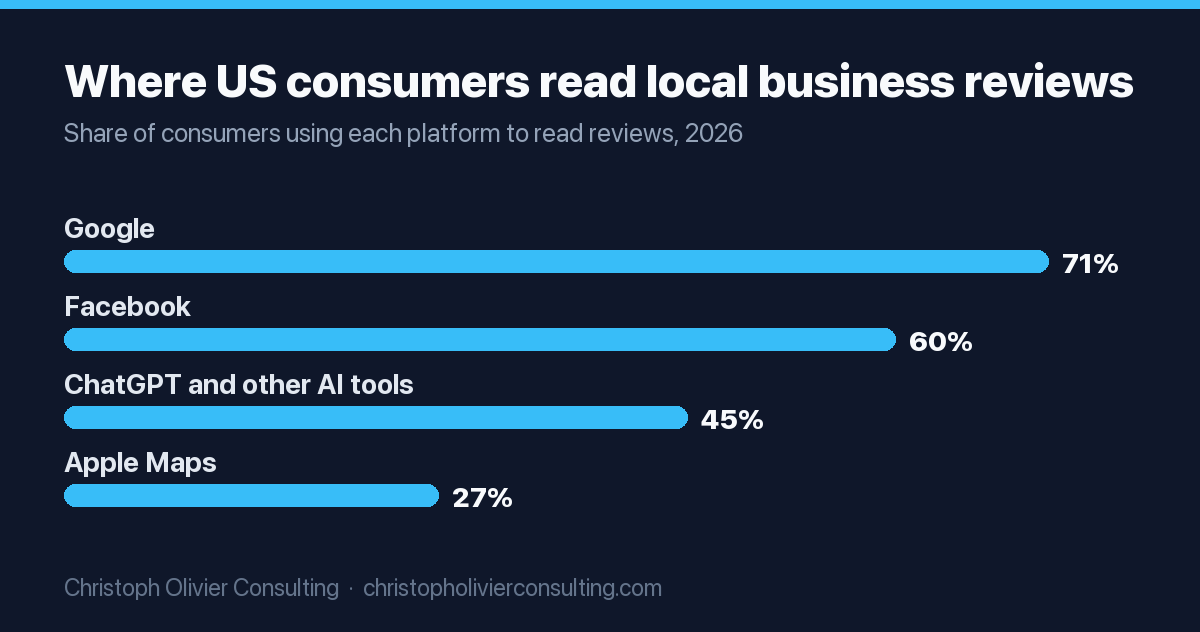
The BrightLocal Local Consumer Review Survey 2026 adds a few numbers worth planning around: 97% of consumers read reviews for local businesses, 80% are more likely to use a business that responds to all of its reviews, and 50% are put off by generic or templated replies. It also shows review reading spreading beyond Google, with AI tools now a meaningful source.
Two sets of rules apply to how you ask. Google’s fake engagement policy prohibits offering “payment, discounts, free goods and/or services” in exchange for reviews, and prohibits trying to “selectively solicit positive reviews from customers,” which is review gating. In the US, the FTC’s final rule on fake reviews, announced August 14, 2024, bans fake reviews and incentives conditioned on a particular sentiment, and lets the agency seek civil penalties against knowing violators.
A compliant review request process for roofers
- Ask every customer, not only the happy ones, at the final walkthrough when the result is visible.
- Send a direct review link by text the same day, from the crew lead or project manager by name.
- Send one reminder after a few days. Stop there.
- Reply to every review in your own words, mentioning the job type and town where it fits naturally.
- Track reviews per month as a KPI, alongside your average rating.
Local links and citations for roofing contractors
Google names links as part of prominence: it looks at “how many websites link to your business.” For roofers, the best links are local and real: suppliers, manufacturer contractor directories you qualify for, trade associations, chambers, sponsorships and local news coverage. Bulk link packages and paid directory networks rarely help and can create risk.
Start with places you already have a relationship with. Roofer SEO link building is mostly business development with a website attached:
- Manufacturer and supplier programs. If you hold a certification, make sure the program’s contractor locator lists and links to you.
- Associations. State and regional roofing or builder associations often have member directories.
- Community. Youth sports sponsorships, charity roof projects and Habitat-style volunteer work often come with a local mention.
- Local media. Offer a factual storm-safety explainer or inspection checklist to local outlets before storm season.
- Core citations. Keep name, phone and website identical across the major directories, BBB and your chamber listing.
Roofing SEO vs Local Services Ads
Local Services Ads charge per lead and can produce calls within weeks; SEO costs time and labor but has no per-lead media cost once it ranks. They are complements, not substitutes. Most roofers use LSA for predictable lead flow and SEO to lower blended cost per job over time.
Google describes LSA simply: you “pay only for leads related to your business and the services you offer.” To run, a business must pass screening and verification that, depending on category and location, can include background, business registration, insurance and license checks plus minimum review requirements.
Two changes matter if you last looked at LSA a while ago. Google has discontinued the Money Back Guarantee tied to the old Google Guarantee badge and moved eligible advertisers to a single Google Verified badge. And Google is moving LSA into Performance Max campaigns with pay-per-lead goals; the first phase began in August 2026 for select US home service advertisers, with roofing named among the initial categories. The pay-per-lead model stays, while manual bidding is no longer supported.
| Factor | Local Services Ads | Roofing SEO |
|---|---|---|
| Cost model | Per lead | Monthly labor or retainer, no media cost |
| Time to first leads | Days to weeks after verification | Usually months |
| Stops when you stop paying | Yes | Rankings decay slowly |
| Main levers | Verification, reviews, response speed, budget | Profile, pages, reviews, links |
| Shared input | Reviews help both, which is one more reason to fix your review process first | |
How long roofing SEO takes and how to measure it
Expect the first month to be setup, early map pack movement in months two and three, and meaningful organic lead growth after four to six months, with larger gains often between months six and twelve. Measure booked inspections and signed jobs by source, not rankings alone. Rankings are a leading indicator, not the result.
That timeline comes from one roofing marketing vendor’s contractor guide, and it matches what Jobber’s roofing SEO guide describes as a typical three-to-six-month window for results. Treat it as a market expectation, not a promise. A brand-new domain in a crowded metro can take longer; an established company with a neglected profile can move faster.
Tracking setup that ties SEO to revenue
- Add UTM parameters to the website link in your Business Profile so profile traffic is separated in analytics.
- Use call tracking on the website so calls are attributed by source.
- Track form submissions and online booking requests as conversions.
- Add a lead source field in your CRM and make it required before an inspection is scheduled.
- Report monthly: leads, booked inspections, signed jobs and revenue by channel, plus map pack and organic visibility for your core terms.
What roofing SEO costs in 2026: DIY, freelancer, agency or consultant
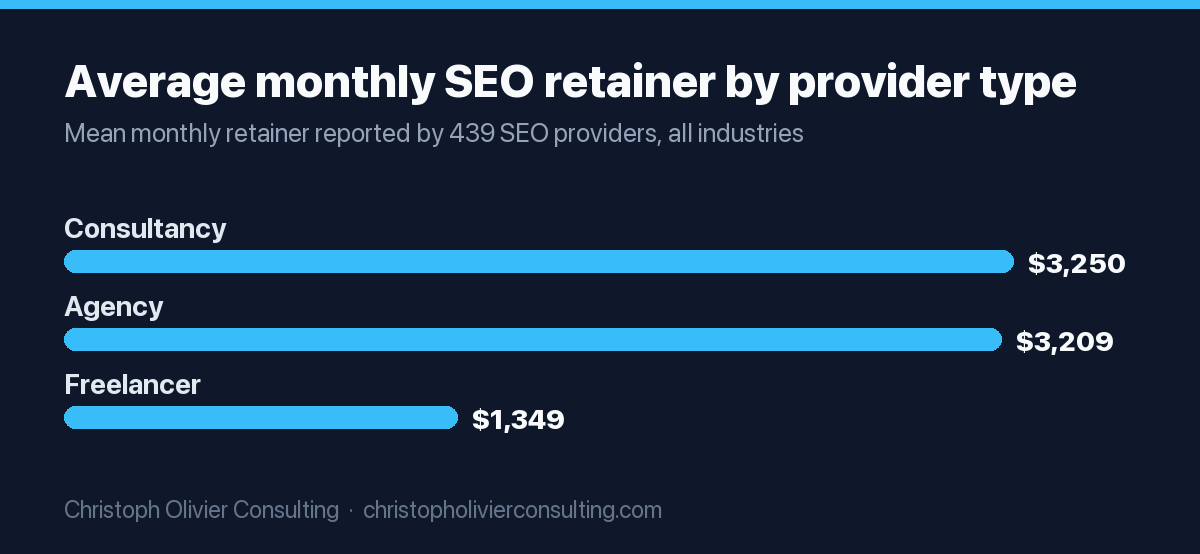
Roofing SEO is commonly quoted between about $750 and $3,500 a month for single-city and mid-sized markets, and $3,500 to $7,500 or more in large competitive metros. Broader survey data puts average SEO retainers near $3,200 a month for agencies and about $1,350 for freelancers. These are market ranges, not quotes.
The roofing-specific ranges come from BizIQ’s guide: $750 to $1,500 a month for single-location, low-density markets, $1,500 to $3,500 for a mid-level campaign across 5 to 15 suburban markets, and $3,500 to $7,500 or more in major metros such as Houston, Phoenix and Chicago. It also advises skepticism toward packages under $500 a month. Another agency, HawkSEM, lists local SEO services at $500 to $1,000 a month and ongoing SEO at $3,000 to $10,000.
For a cross-industry view, the Ahrefs SEO pricing survey of 439 providers (published 2024) found an average local SEO cost of $1,557 a month, and the most common retainer bracket was $501 to $1,000 a month, chosen by 20.4% of respondents. Its averages by provider type are shown in the chart above.
| Option | Typical cost (market range) | Good fit when | Main risk |
|---|---|---|---|
| DIY (owner or office staff) | Your time plus tools | One market, owner enjoys it, reviews already strong | It slips during busy season |
| Freelancer | About $1,150 a month average for local SEO, $1,350 overall (Ahrefs) | Clear plan exists, you need execution | Single point of failure, narrow skills |
| Agency | About $3,200 a month average (Ahrefs); $750 to $7,500+ quoted for roofing (BizIQ) | Several markets, you want content, links and reporting handled | Long contracts, junior staff, templated city pages |
| Consultant or fractional lead | About $3,250 a month average for consultancies (Ahrefs) | You need strategy, vendor selection and accountability | Needs an execution team alongside |
If budget is the constraint, a scoped SEO starter package that fixes the profile, core service pages and tracking first is often a better use of money than a cheap retainer, and the trade-offs are covered in more detail in this guide to affordable SEO services.
How to hire a roofing SEO company: checklist, questions and red flags
Hire on process and proof, not promises. A good roofing SEO provider audits your profile, site and tracking first, explains what they will change in the first 90 days, reports on leads and booked jobs, and never guarantees rankings. Anyone who claims a special arrangement with Google is contradicting Google’s own documentation.
Hiring checklist (copy this into your vendor notes)
- [ ] They audited my Business Profile, site and competitors before quoting.
- [ ] The proposal lists the first 90 days of work, by month.
- [ ] I own the website, domain, Business Profile, analytics and call tracking accounts.
- [ ] Reporting includes leads, booked inspections and jobs by source, not just rankings.
- [ ] City pages are planned only for markets where we have real jobs to show.
- [ ] Their review process is compliant: no incentives, no gating.
- [ ] Contract term and cancellation terms are written down.
- [ ] I have spoken to at least one current home-service client.
Questions to ask on the sales call
- What did you find wrong with my Business Profile and site, specifically?
- Which pages will you create or rewrite in the first three months, and why those?
- How do you build links for a local contractor, and can I see examples?
- How will you attribute a signed roof replacement back to search?
- Who does the work day to day, and what is their roofing or home-service experience?
- What happens to my content and accounts if we part ways?
Red flags
- Guaranteed first-page or number-one rankings.
- Claims of insider access to Google, which its ranking documentation rules out.
- Dozens of near-identical city pages promised in month one.
- Keyword-stuffed business names or virtual-office listings.
- Reports with rankings and traffic but no leads or jobs.
- Bulk link packages, or “review generation” that offers customers discounts.
If you would rather not vet providers yourself, my SEO services start with an audit and a 90-day plan, then match you with the right execution setup, whether that is in-house, a freelancer or an agency. I have built content systems that generated more than 200 million organic views and managed millions in ad spend, and I still will not guarantee rankings, because nobody honestly can.
A 90-day roofing SEO plan: worked example
Here is how a single-location residential roofer serving one metro and a handful of suburbs could sequence the first 90 days. The order matters: fix the profile and tracking before writing content, and fix reviews before buying links. This is a template to adapt, not a client case study.
- Days 1 to 15: audit and tracking. Review the Business Profile against Google’s guidelines, fix name, categories, service area and address visibility. Install call tracking, form conversion tracking and UTM tags. Add a required lead source field in the CRM.
- Days 15 to 30: core service pages. Rewrite or build pages for replacement, repair, inspection and one specialty you actually want more of, each with real job photos, process, warranty details and clear calls to action.
- Days 30 to 45: reviews. Roll out the compliant request process above, with a weekly target per crew lead. Reply to every existing review.
- Days 45 to 60: market pages. Build pages only for the two or three suburbs where you have the most completed jobs, using the useful city page standard.
- Days 60 to 75: storm content and links. Publish one evergreen storm damage guide, then contact suppliers, manufacturer programs and associations to correct or add listings and links.
- Days 75 to 90: review and reallocate. Compare leads and booked inspections by source against the starting baseline, decide where LSA or search ads fill gaps, and set the next quarter’s page and link targets.
The same structure carries over to other home-service trades; the local SEO playbook for service businesses covers the profile and citation work in more depth, and the roofing lead generation guide shows how SEO fits with referrals, ads and canvassing. If you want a second set of eyes on your own plan, you can book a consultation and we will look at your profile and numbers together.
Work with CO Consulting
Want SEO that brings in qualified clients?
- A month-one audit that decides the mix, written into a 90-day plan you can hold us to
- Technical, on-page, local, content and AI search work in one engagement
- Monthly tracking of whether ChatGPT, Perplexity and Google AI Overviews cite your business
- Reporting tied to pipeline, not vanity rankings. No ranking guarantees, ever
Frequently asked questions
What is roofing SEO?
Roofing SEO is the process of getting a roofing company to appear in Google's map pack and organic results when local homeowners search for roof repair, replacement or inspections. It covers your Google Business Profile, service and city pages on your website, reviews, local links, and tracking that connects searches to booked inspections and signed jobs.
How much does SEO for roofers cost?
Market ranges vary by competition. One roofing marketing vendor quotes $750 to $1,500 a month for single-city markets, $1,500 to $3,500 for mid-sized multi-suburb campaigns, and $3,500 to $7,500 or more in major metros. A 2024 Ahrefs survey of 439 providers put average local SEO at $1,557 a month. Treat these as ranges, not quotes.
How long does roofing SEO take to work?
Most guidance points to setup in the first month, early map pack movement in months two and three, and meaningful organic lead growth after about four to six months, with larger gains often between months six and twelve. A new website in a crowded metro can take longer, while an established company with a neglected profile can sometimes move faster.
Is roofing SEO better than Local Services Ads?
Neither is strictly better. Local Services Ads charge per lead and can produce calls soon after verification, but leads stop when spending stops. SEO has no per-lead media cost once you rank but takes months to build. Many roofers run LSA for predictable lead flow while SEO lowers their blended cost per job over time. Reviews help both.
Can I pay Google to rank higher in the map pack?
No. Google states there is no way to request or pay for a better local ranking. Map pack results are mainly based on relevance, distance and prominence. Paid placements such as Local Services Ads and search ads appear separately from the unpaid map results, so any vendor claiming special access to Google rankings should be treated as a red flag.
Should a roofing company create a page for every city it serves?
Only where you genuinely work and can say something specific. Google's spam policies treat near-identical pages targeting different cities as doorway abuse. Build city pages for markets where you have real completed jobs, local photos, reviews and details such as permits or common roof types, and cover the remaining towns on a single service-area page.
Can I offer customers a discount for leaving a Google review?
No. Google's fake engagement policy prohibits offering payment, discounts, free goods or services in exchange for reviews, and also prohibits selectively asking only happy customers. The FTC's 2024 rule on fake reviews separately bans incentives conditioned on a particular sentiment. Ask every customer, send a direct link, and reply to every review.
More SEO guides
- Local SEO Playbook for Service Businesses
- On-Page SEO Services: What You Get, What It Costs, and How to Vet a Provider
- SEO Strategies for Ecommerce Sites: A Site-Architecture Playbook
- How to Rank Higher on Google: A Prioritized 2026 Playbook
- Managing SEO: The Owner’s Guide to Running an SEO Program Without Being an Expert
- llms.txt Explained: Guide for AI Crawling
- All SEO guides →