
Last reviewed: October 2026
A YouTube advertising agency plans, produces and manages paid video campaigns on YouTube through Google Ads: strategy, creative, audience targeting, bidding and measurement. Market rates published in 2026 put ads management at roughly 10% to 25% of ad spend or a flat monthly retainer, with video production and media billed on top. Whether you should hire one depends on your budget, your creative capacity and how much control you want to keep.
This guide is for owners and marketing leads at service businesses who are deciding how to run YouTube ads. It compares the four realistic options (DIY, freelancer, agency, fractional lead), lays out what each layer of cost looks like, and gives you a hiring checklist, a brief template and the red flags that should end a sales call early.
If you would rather have an expert run your ads, see how CO Consulting manages paid advertising for service businesses.
What a YouTube advertising agency actually does
A YouTube advertising agency handles four jobs: deciding who to reach and why, making ads that people watch, building and optimizing the campaigns inside Google Ads, and proving what the spend produced. Some agencies do all four. Many only manage campaigns and expect you to supply the videos, which changes the price and the outcome.
Strategy and audiences
The agency should start with your business goal, not a format. That means picking the job YouTube is doing (awareness, consideration or leads), defining audiences such as your customer lists, website visitors, custom segments built from search terms and in-market audiences, and deciding how YouTube fits next to your search and social spend. If YouTube is one part of a wider media plan, it helps to read how it fits into a full paid advertising program before you scope the agency’s role.
Creative and production
Creative is where most YouTube budgets are won or lost. Google cites research from NCSolutions showing that creative is the number one driver of campaign effectiveness and ROI, in its write-up of the ABCDs of effective creative on YouTube. A strong agency either produces video in-house or directs a production partner, and it plans several cuts per concept (a 6 second bumper, a 15 to 30 second in-stream cut, a vertical Shorts cut) instead of one long video.
Campaign build and management
This is the Google Ads work: campaign types, bidding strategies, placements, frequency, exclusions, conversion tracking and weekly optimization. It is the same discipline as PPC management for search, with a different set of levers.
Measurement
Good YouTube ads management reports on more than views. Expect conversion tracking in Google Ads and GA4, view-through and engaged-view conversions where relevant, and, at larger budgets, a Brand Lift study that surveys exposed and unexposed viewers to measure changes in awareness or consideration.
YouTube ad formats and campaign types in 2026
YouTube ads run in Google Ads as video campaigns or Demand Gen campaigns. The core formats are skippable and non-skippable in-stream ads, in-feed video ads, 6 second bumpers, Shorts ads and the reservation-only Masthead. Each format bills differently, so an agency’s format mix directly shapes what you pay for and what you can measure.
The table below summarizes Google’s own video ad formats documentation. Use it to check whether an agency’s proposal matches the goal it claims to serve.
| Format | Length and skip rules | How you pay | Best used for |
|---|---|---|---|
| Skippable in-stream | Skippable after 5 seconds; under 3 minutes recommended | CPV, target CPM or target CPA; on CPV you pay when a viewer watches 30 seconds (or the whole ad if shorter) | Consideration and leads |
| Non-skippable in-stream | 60 seconds or shorter, no skip | Target CPM | Message delivery and reach |
| In-feed video | Thumbnail plus text; the viewer chooses to click and watch | Charged when someone clicks to watch, or after 10 seconds of autoplay in video view campaigns | Viewers actively choosing content |
| Bumper | Between 5 and 6 seconds, no skip | Target CPM | Reach and frequency, recall |
| Shorts ads | Vertical, under 60 seconds recommended, swipe to skip | CPV, target CPM or engagement-based; a view counts at 10 seconds or the end, whichever comes first | Mobile reach and younger audiences |
| Masthead | Reserved placement; 30 second autoplay on desktop | CPM or cost per hour, reservation only | Large launches |
One change matters if you are reviewing an older account or an older agency deck. Google retired Video Action Campaigns: per its upgrade notice, new ones could no longer be created from April 2025, and the final campaigns were upgraded automatically to Demand Gen by April 2026. Demand Gen runs across YouTube (including in-feed and Shorts), Discover, Gmail, Maps and the Google Display Network, and supports video and image ads in one campaign. Google says advertisers who added image assets alongside video saw 20% more conversions at the same cost per action than video-only advertisers (Google internal data, 2024). An agency still pitching Video Action Campaigns in 2026 is working from an out-of-date playbook.
Is YouTube advertising worth it for a service business?
For most service businesses YouTube is worth testing because almost every buyer uses it. Pew Research Center found 84% of U.S. adults use YouTube, more than Facebook (71%) or Instagram (50%). It works best when you have a considered purchase to explain and the creative capacity to keep ads fresh.
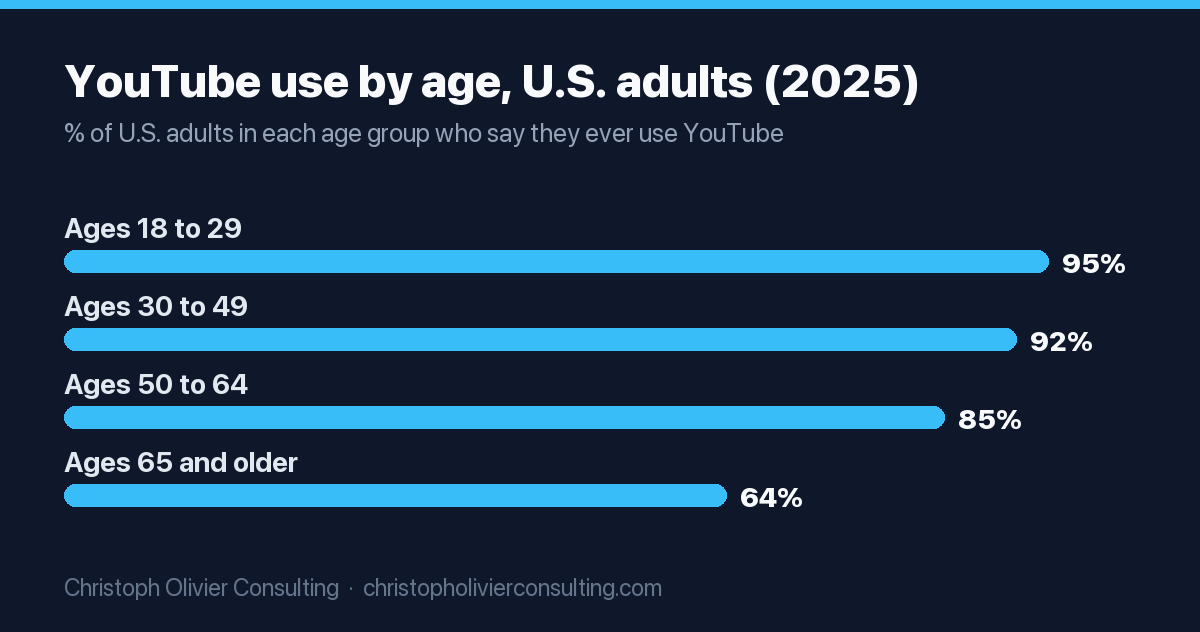
Usage stays high well into the age groups that hire accountants, lawyers, advisors and contractors. According to the Pew Research Center Social Media Fact Sheet (survey fielded February to June 2025), 85% of adults aged 50 to 64 use YouTube, and use rises with household income, from 77% under $30,000 to 89% at $100,000 and above. For the B2B case specifically, see how YouTube ads work for B2B service businesses, and for wider context on viewing habits, the video marketing statistics roundup.
The honest caveat: reach is not demand. YouTube ads often perform best as the layer that makes your search ads, referrals and retargeting convert better, and they tend to disappoint when a business expects a cold 30 second ad to book consultations on its own.
How much does a YouTube ads agency cost?
A YouTube ads agency has three cost layers: the management fee, video production and the media budget you pay Google. Published 2026 market ranges put management at about 10% to 25% of ad spend or a flat retainer, production at roughly $1,500 to $10,000 per video, and media on top of both.
These are published market ranges, not a price list, and they vary with scope and region.
| Cost layer | Published market range (2026) | Source |
|---|---|---|
| Paid YouTube ads management | 10% to 20% of ad spend, with minimum fees of $3,000 to $10,000 a month | MarketerHire |
| Management as a share of spend | 15% to 25% of monthly YouTube ad spend | NoGood |
| Ads management agency (Europe) | 15% to 20% of spend or a €5,000 to €12,000 flat fee, whichever is higher | Humble&Brag |
| Video production | $1,500 to $10,000 per video; $3,000 to $8,000 per single-camera shoot day | MarketerHire |
| Onboarding or setup | €2,000 to €10,000 | Humble&Brag |
| One-off audit or sprint | $1,000 to $5,000 | OutlierKit |
| Typical agency media minimum | $10,000 to $25,000 a month at many agencies | MarketerHire |
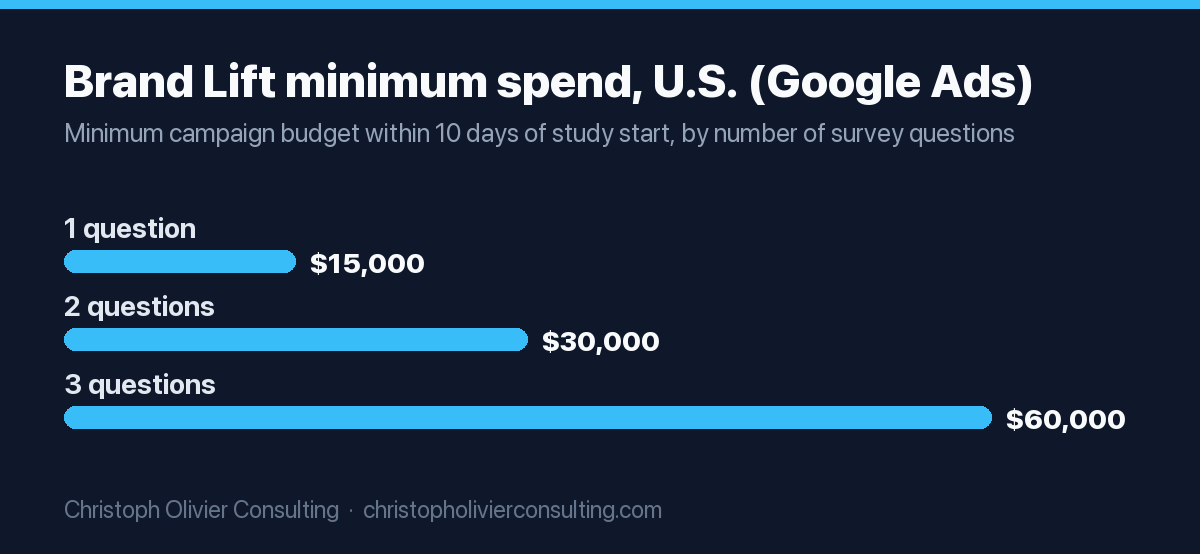
Media spend is the line you control. If you want formal brand measurement, budget for it up front: Google’s Brand Lift requirements set a minimum spend within 10 days of the study start that rises with each survey question, and the United States sits in the highest-cost country group.
A quick worked example shows how the layers stack. Say you spend $10,000 a month on media with an agency charging 15% and a $3,000 minimum. The fee is $1,500 by percentage, so the $3,000 minimum applies, which is 30% of spend. Add two $4,000 videos in month one and your first-month cost is $21,000 for $10,000 of media. That is why small budgets often fit a freelancer or fractional lead better.
Agency vs freelancer vs in-house vs fractional: which YouTube ads management model fits
A full-service agency suits budgets large enough to absorb retainers and production. A freelancer suits a clear, narrow scope. In-house suits ongoing high volume. A fractional marketing lead suits firms that need senior strategy and someone to direct specialists without paying agency overhead.
| Model | Published monthly cost range | Strengths | Watch-outs | Best fit |
|---|---|---|---|---|
| DIY in Google Ads | No fees, your time plus media | Full control, fast learning | Creative and tracking gaps, slow optimization | Tests under a few thousand dollars a month |
| Freelancer | €1,000 to €3,000 (Humble&Brag) | Low cost, direct access to the person doing the work | Capacity limits, production often not included | Defined scope, existing creative |
| Full-service agency | $5,000 to $25,000 plus ad spend (MarketerHire) | Strategy, production and media under one roof | Juniors on the account, long contracts | Larger budgets, frequent new creative |
| Fractional specialist or lead | $3,000 to $10,000 (MarketerHire) | Senior judgment, works across channels | Needs production partners | Firms wanting strategy plus oversight |
| In-house manager | $8,000 to $15,000 loaded (MarketerHire) | Deep business context | 3 to 6 months to hire, single point of failure | Ongoing high spend |
MarketerHire also estimates a senior fractional marketer costs about 40% to 60% of an equivalent agency retainer for comparable hours. Treat that as a directional market estimate. In my view the bigger question is not price but who owns the strategy: if nobody on your side can judge the creative and the numbers, any model will drift.
The ABCD creative framework your agency should be using
Google’s ABCD framework is the clearest public standard for YouTube creative: Attention (hook the viewer), Branding (brand early, often and richly), Connection (help people think or feel something) and Direction (ask them to act). Google reports ABCD-aligned ads deliver a 30% lift in short-term sales likelihood on average.
Those figures come from Google and Kantar’s 2021 study, cited in Google’s ABCDs explainer, which also reports a 17% lift in long-term brand contribution. Use the framework as a review checklist when an agency shows you scripts or cuts:
- Attention: does the first few seconds start in the action, with a close-up, strong contrast or sound that earns the next five seconds?
- Branding: is your brand visible or heard early, through product shots, on-screen logo, voice-over or a sonic cue? YouTube is mostly watched with sound on, so audio branding counts.
- Connection: does the ad humanize the problem with one focused message, rather than listing every service you offer?
- Direction: is there one clear next step, written and spoken, that matches the landing page?
Google publishes a before-and-after example of the framework applied to a single storyboard. It is a useful shared reference to send an agency before the first creative review.
How to hire a YouTube ads agency: a step-by-step process
Hire in this order: define the goal and budget, decide which model fits, shortlist three to five providers, verify their claims independently, run a paid audit or pilot, and sign a short initial term with clear ownership terms. Skipping the verification step is the most common and expensive mistake.
- Write down the business goal and the number that proves it. Qualified leads, booked consultations or brand search growth, with your current baseline.
- Set a realistic media budget. Compare it with the agency minimums above. If your budget sits under typical minimums, start with a freelancer or fractional lead.
- Decide who makes the videos. Agency production, a separate production partner or your own team. This one choice often moves total cost more than the management fee.
- Shortlist three to five providers. Look for named case studies in your type of business, not just your industry.
- Verify partner status and claims. Check the Google Partners directory yourself. Per Google’s requirements, a Partner must hold at least a 70% optimization score, $10,000 in managed spend over 90 days and certifications for at least half its strategists. Premier Partners are the top 3% of participating companies in a country. The badge proves baseline competence, not video skill.
- Ask for live data, not decks. Request a screen share of a real dashboard with view rate, conversions and cost per conversion trends.
- Run a paid audit or 90 day pilot. Agree on success measures before launch.
- Sign a short first term. A 90 day initial term then month to month, with full asset transfer on exit.
Questions to ask before you hire a YouTube ads agency
The best questions force specific answers: who will run the account, what they will produce each month, how results will be measured against your baseline, and who owns the account, the videos and the data. Vague answers to any of these are a signal to keep looking.
Copy this checklist into your evaluation notes and score each provider.
YouTube ads agency evaluation checklist
- Who, by name, manages the account day to day, and how many hours a month are allocated?
- Can you show two or three case studies with the same goal we have, and can we speak to a current and a former client?
- Which campaign types and formats would you use for our goal, and why? (Listen for Demand Gen, in-stream and Shorts, not one default.)
- Who produces the videos, how many cuts per concept, and how often is creative refreshed?
- How do you apply Google’s ABCD framework in creative reviews?
- What conversion tracking will you set up in Google Ads and GA4, and how do you treat view-through conversions?
- At what budget would you recommend a Brand Lift study?
- What does the monthly report show, and can we see a live example?
- Is ad spend billed separately from your fee, with a line-item breakdown?
- Do we own the Google Ads account, the YouTube channel, the raw footage and the edited files, in writing?
- What is the initial term, the notice period and the exit process?
- What is your average client tenure?
On tenure, MarketerHire suggests strong shops often hold accounts for 18 to 36 months on average.
Red flags when choosing YouTube ads management
Walk away from guaranteed results, agencies that run your ads from their own Google Ads account, ad spend bundled into an opaque retainer, 12 month contracts without an exit clause, and portfolios with no client you can verify. Each one shifts risk from the agency to you.
- Guaranteed outcomes. No one controls the auction or your sales process. Guarantees on views, leads or ROAS usually mean the agency will optimize toward whatever is easiest to hit.
- Account ownership held by the agency. If the account lives in their manager account and not yours, your data and history can leave with them.
- Bundled spend. A single invoice with no media breakdown makes it impossible to know the real fee.
- Lock-in contracts. Twelve months with no review gate or exit clause.
- Bait and switch staffing. The founder pitches, a junior runs the account.
- View-only reporting. Cheap views are easy to buy. Reports should tie spend to your business goal.
How to brief a YouTube advertising agency: template and worked example
A good brief fits on one page: the business goal, the audience, the offer, the proof, the budget, the creative assets you already have, the success metric and the constraints. Agencies that receive a clear brief return sharper proposals, and you can compare them on the same terms.
One page YouTube ads brief
- Business goal: what changes in the business if this works, with today’s baseline.
- Primary audience: who buys, what they search, what they watch, and any customer lists you can upload.
- Offer and next step: the single action you want (book a call, download a guide, request a quote).
- Proof points: credentials, reviews, outcomes you are allowed to cite.
- Media budget and timeline: monthly spend and the test window.
- Existing assets: footage, testimonials, brand guidelines, prior ads and their results.
- Success metric: the one number you will judge the pilot on, plus a secondary signal.
- Constraints: compliance rules, claims you cannot make, approval steps.
Worked example (illustrative, not a client case): a regional estate planning firm wants more consultation requests from adults aged 50 to 64 in two counties. It has $6,000 a month for media, a handful of client video testimonials it has permission to use, and bar rules that limit testimonial claims. The brief asks for a 90 day test of in-stream and Demand Gen ads with three cuts of one concept, retargeting to website visitors, and success measured by qualified consultation requests at a target cost, with branded search volume as a secondary signal. At that budget, the brief also tells you a full-service agency minimum may not fit, which points the firm toward a freelancer or fractional lead plus a production partner. If you are building the organic side at the same time, your YouTube marketing strategy should share the same audience and message.
When to skip the agency, and how I approach it
Skip a full agency when your media budget sits below typical minimums, when you have no plan for producing videos, or when YouTube is one channel among several and the real need is strategy across all of them. In those cases a specialist or fractional lead usually gives you more senior attention per dollar.
CO Consulting also offers a matching service for firms that want help choosing. I start with an audit of your account, tracking and creative, build a 90 day plan, and then match you with the right agency, freelancer or in-house hire for that plan. My background includes content systems that have generated more than 200 million organic views and millions of dollars in managed ad spend. I do not promise specific results, because no honest advisor can. You can see how this sits inside the wider paid advertising service.
If you would like a second opinion on a proposal you already have, or help writing the brief, you can book a consultation and we will go through it together.
Work with CO Consulting
Want ads that book qualified calls?
- Google, Meta, LinkedIn and YouTube campaigns built around qualified pipeline, not clicks
- Run by Christoph Olivier, who has managed millions of dollars in ad spend
- Tracking and follow-up fixed before budget is scaled
- No guaranteed leads, costs or revenue; we report what the auctions actually deliver
Frequently asked questions
What does a YouTube advertising agency do?
A YouTube advertising agency plans and runs paid video campaigns through Google Ads. Typical work covers audience strategy, video creative or production direction, campaign setup across in-stream, in-feed, Shorts and Demand Gen, bidding and optimization, conversion tracking and reporting. Some agencies also produce the videos; others expect you to supply them, which changes both price and results.
How much does a YouTube ads agency cost?
Published 2026 market ranges put YouTube ads management at roughly 10% to 25% of ad spend, or a flat retainer, often with minimum fees of a few thousand dollars a month. Video production is usually extra, commonly $1,500 to $10,000 per video, and your media budget is paid to Google on top. Treat these as market ranges, not quotes.
Is it better to hire a YouTube ads agency or a freelancer?
It depends on budget and scope. A full-service agency suits larger budgets that need strategy, production and media handled together. A freelancer suits a defined scope where creative already exists. If your monthly media budget is below typical agency minimums, a freelancer or a fractional marketing lead directing specialists is often the better value.
What should I ask before hiring a YouTube ads agency?
Ask who runs the account day to day and for how many hours, which formats they would use for your goal and why, who makes the videos and how often creative is refreshed, how conversions are tracked, what the monthly report shows, whether spend is billed separately, who owns the account and files, and what the exit terms are.
What are red flags when choosing a YouTube ads agency?
Common red flags include guaranteed results, running your ads from the agency's own Google Ads account, ad spend bundled into an unclear retainer, 12 month contracts with no exit clause, a senior pitch followed by junior staffing, and reports that focus on cheap views rather than outcomes tied to your business goal.
Does a Google Partner badge mean an agency is good at YouTube ads?
Not on its own. Google Partner status requires at least a 70% optimization score, $10,000 in managed spend over 90 days and certification for at least half of the agency's strategists. That shows baseline Google Ads competence. It does not prove video creative skill, so still ask for YouTube-specific case studies and live data.
What is the ABCD framework for YouTube ads?
ABCD is Google's creative framework for YouTube: Attention (hook viewers early), Branding (show and say your brand early and often), Connection (help people think or feel something) and Direction (ask for a clear action). Google reports that ABCD-aligned ads deliver a 30% average lift in short-term sales likelihood, based on a 2021 Google and Kantar study.