
Last reviewed: September 2026
Fractional marketing is a staffing model where you hire senior marketing talent part-time, on an ongoing retainer, instead of building a full in-house team or paying a full executive salary. A fractional marketer usually works a set block of hours each week and serves a small number of clients at the same time, so you buy the expertise you need and skip the fixed cost of a full seat.
This guide defines the model, breaks down real 2026 cost ranges, and shows when fractional marketing beats an agency or a full-time hire. If you want the direct salary math on the lead role, see our 2026 fractional CMO cost breakdown.
What is fractional marketing?
Fractional marketing means renting a fraction of a marketing leader’s or team’s capacity on a recurring basis. The person is embedded in your business, joins your meetings, and owns outcomes, but works 5 to 20 hours a week rather than 40. Most fractional marketers carry two or three clients at once, which is how they stay senior while charging far less than a full-time equivalent.
That ongoing, embedded arrangement is what separates fractional marketing from freelancing. A freelancer takes a defined project and hands it back. A fractional hire stays with you month to month, learns the business, and sets direction, closer to an employee who happens to work part-time.
The two layers of the fractional marketing model
Fractional marketing comes in two layers that often stack. The first is a fractional CMO, who owns strategy, positioning, and revenue accountability. The second is a fractional team of specialists (paid ads, content, SEO, lifecycle) who handle execution under that leader. Small companies often start with the CMO layer alone, then add specialists as the plan takes shape.
| Layer | What they own | Typical hours/week | Best for |
|---|---|---|---|
| Fractional CMO | Strategy, positioning, budget, revenue alignment, team and agency oversight | 5 to 20 | Companies with no senior marketing leader |
| Fractional specialist | Execution in one channel (ads, SEO, content, email) | 10 to 20 | Filling a specific skills gap |
| Fractional team | Leadership plus coordinated execution across channels | 20 to 40 total | Firms that need direction and delivery together |
The lead role is a part-time version of the same job a full-timer would do. If you are new to the title itself, our explainer on what a CMO actually does covers the remit that a fractional CMO condenses into a few days a month.
Fractional marketing vs agency vs full-time hire
Choose fractional marketing when you need someone to set direction and make tradeoffs, not just run tasks. Choose an agency when the strategy is settled and you need channel execution at volume. Choose a full-time hire when the work is stable, embedded, and central to your weekly operating cadence. Many companies combine a fractional CMO for direction with an agency for delivery.
| Model | What you get | Typical monthly cost | Use it when |
|---|---|---|---|
| Fractional marketing | Senior leadership and strategy, part-time, embedded | $3,000 to $20,000 | You need direction but not a full-time seat |
| Marketing agency | Channel execution and campaign delivery | $3,000 to $30,000+ | Strategy is set and you need output |
| Full-time hire | Dedicated employee, full week, full commitment | $18,000 to $27,000 loaded | The role is stable and always-on |
How much does fractional marketing cost?
Fractional marketing typically runs $3,000 to $20,000 a month, set by scope and seniority rather than a fixed rate. Advisory-only engagements sit at the low end. Standard two-to-three-day-a-week retainers cluster around $12,000 to $15,000. Full-remit engagements that include team leadership and agency oversight reach $18,000 to $22,000. Senior hourly rates run $200 to $450, with day rates of $1,500 to $3,500.
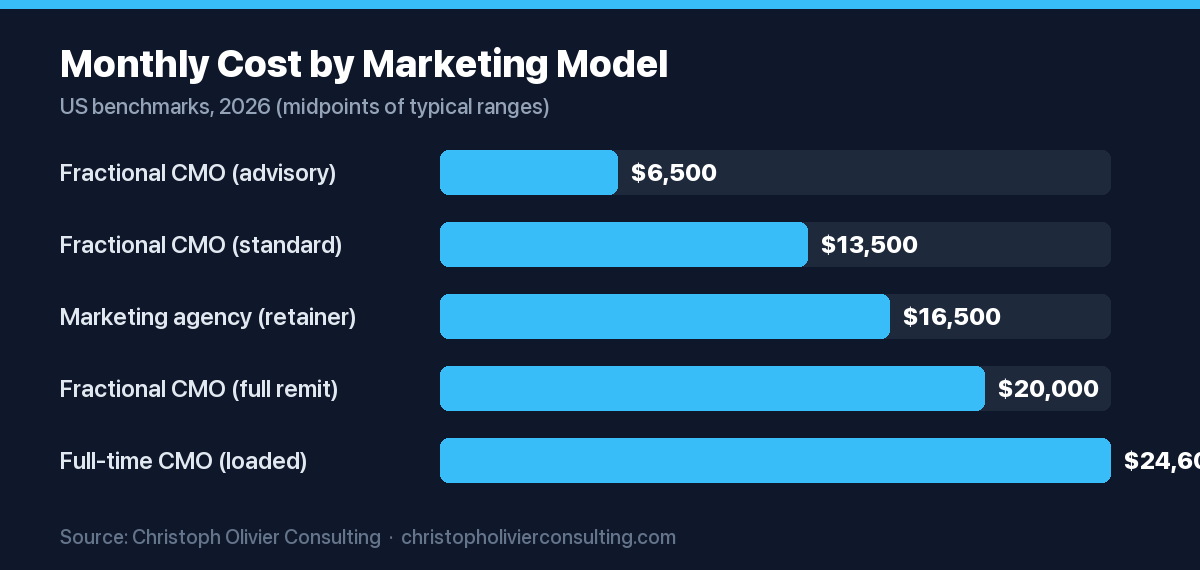
| Engagement type | Monthly range | Midpoint | What it covers |
|---|---|---|---|
| Fractional CMO (advisory) | $3,000 to $10,000 | $6,500 | Strategy, planning, monthly guidance |
| Fractional CMO (standard) | $12,000 to $15,000 | $13,500 | Two to three days a week, execution oversight |
| Fractional CMO (full remit) | $18,000 to $22,000 | $20,000 | Team leadership, agency management, reporting |
| Marketing agency (retainer) | $3,000 to $30,000 | $16,500 | Channel execution, no strategic ownership |
| Full-time CMO (loaded) | $270,000 to $320,000/yr | $24,600/mo | Salary plus benefits, bonus, and perks |
The pattern holds across published 2026 benchmarks: a fractional lead delivers executive marketing at roughly 30 to 50 percent of a full-time CMO’s loaded cost. The tradeoff is hours, not seniority. You get the same caliber of decision-maker for fewer days a week.
When fractional marketing is the right call
Fractional marketing fits when you need senior judgment on a budget that cannot carry a full-time executive. Common triggers include a founder still running marketing, a stalled pipeline that needs a strategy reset, a funding round that raised the bar on go-to-market, or an in-house team with no one to lead it. It works best when the problem is direction, not raw output.
It is the wrong call when the work is high-volume and predictable, such as always-on demand generation tied to weekly pipeline targets, or when the role must be present every day for internal coordination. In those cases a full-time hire earns its cost. If you only need one channel executed and the plan is already clear, an agency or specialist is usually cheaper.
How to structure a fractional marketing engagement
Structure the engagement around outcomes and a clear scope so the part-time arrangement stays accountable. A good setup defines the goal, the hours, the reporting rhythm, and the decision rights up front, then reviews progress on a fixed cadence. Use this sequence to set one up.
- Name the business outcome, such as pipeline growth, a repositioning, or a launch, and the timeframe to judge it.
- Agree the weekly hours and days, then match them to a retainer band that fits the scope.
- Decide the remit: advisory only, or strategy plus oversight of your team and agencies.
- Set decision rights, so the fractional leader can approve spend and direction within agreed limits.
- Fix a reporting cadence, usually a monthly review against a short list of metrics.
- Build in a 90-day checkpoint to confirm the model and scope still fit.
Where fractional marketing fits in AI-driven search
Fractional marketing now includes owning how a brand shows up in AI answers, not only in classic search results. A fractional leader can set the strategy for being cited by tools like ChatGPT, Perplexity, and Google’s AI Overviews, which is fast becoming a distinct channel. Our guide on how to rank on AI search covers that shift in detail.
If you want to talk through which layer of the model fits your stage, review our fractional marketing services and how engagements are scoped.
Frequently asked questions
What is fractional marketing in simple terms?
Fractional marketing is hiring senior marketing talent part-time on an ongoing retainer instead of building a full team or paying a full executive salary. The person works a set block of hours each week, often 5 to 20, and usually serves a few clients at once. You get experienced leadership and specialist skills at a fraction of the full-time cost.
How much does fractional marketing cost per month?
Fractional marketing typically costs $3,000 to $20,000 a month, set by scope and seniority. Advisory-only work sits near the low end, standard two-to-three-day-a-week retainers cluster around $12,000 to $15,000, and full-remit engagements with team and agency oversight reach $18,000 to $22,000. Senior hourly rates run $200 to $450, with day rates of $1,500 to $3,500.
What is the difference between fractional marketing and a freelancer?
A freelancer takes a defined project and hands it back when it is done. A fractional marketer stays embedded month to month, joins your meetings, learns the business, and owns direction and outcomes. The relationship is ongoing rather than project-based, which is closer to an employee who happens to work part-time across a few clients.
Is fractional marketing better than a marketing agency?
It depends on what you need. A fractional leader sets strategy, makes tradeoffs, and ties marketing to revenue, so pick that model when direction is the gap. An agency executes channels like ads, SEO, and content, so pick it when the strategy is already clear. Many companies pair a fractional CMO for direction with an agency for delivery.
How many hours a week does a fractional marketer work?
A fractional CMO usually works 5 to 20 hours a week per client, often on a two-to-three-day-a-week retainer. A full fractional team, including specialists handling execution, can total 20 to 40 hours a week across the group. Hours are set by scope in the engagement agreement and reviewed as the work changes.
When should you not use fractional marketing?
Skip fractional marketing when the work is high-volume and predictable, such as always-on demand generation tied to weekly pipeline targets, or when the role must be present daily for internal coordination. In those cases a full-time hire earns its cost. If you only need one channel executed and the plan is set, an agency or specialist is usually cheaper.
More marketing guides for rank on ai: get cited by ai search
- 31 Free Marketing Tools Worth Using in 2026
- How to Brand Yourself: A Step-by-Step Playbook for 2026
- How to Generate More Leads: 12 Tactics That Actually Work
- How to Make a Sales Call: Structure, Questions, and Openers
- Internet Advertising: Channels, Pricing Models, and How to Choose
- What Is a Marketing Consultancy? Services, Fees, and How to Choose
- Rank on AI: Get Cited by AI Search