
What is a CMO? A CMO, or chief marketing officer, is the senior executive who owns a company’s marketing strategy and ties it to revenue. The role sits in the C-suite, usually reports to the CEO, and covers brand, demand generation, product marketing, communications, and customer experience. This guide explains what a CMO does, how the title differs from a VP of marketing or a fractional CMO, who a CMO reports to, when a business needs one, and what the job pays in 2026.
Last reviewed: September 2026
What does a CMO do?
A CMO sets the marketing strategy for the whole company and is accountable for the outcome. The day-to-day work means owning the marketing budget, leading the marketing team, choosing which channels and markets to back, and reporting marketing’s contribution to revenue to the CEO and board. The job has shifted from campaign oversight to business leadership, so a CMO now defends spend with numbers, not opinions.
Core responsibilities usually include the following:
- Setting the overall marketing strategy and connecting it to company goals.
- Owning the marketing budget and proving return on it.
- Leading brand, demand generation, product marketing, and communications.
- Hiring, structuring, and coaching the marketing team.
- Working with sales so pipeline and revenue targets line up. See our view on sales and marketing strategy.
- Reporting results to the CEO and, at larger firms, the board.
CMO vs VP of marketing, marketing director, and fractional CMO
The simplest split is that a CMO decides what marketing does and why, while a VP of marketing and a marketing director run how it gets done. A fractional CMO delivers CMO-level strategy part time, usually 10 to 20 hours a week. The table below compares the four roles on scope, seniority, and typical cost.
| Role | Scope | Seniority | Typical US cost (2026) |
|---|---|---|---|
| CMO | Full marketing function plus business strategy; owns budget and the revenue number | C-suite; reports to CEO, works with the board | $237,000 to $440,000 total comp (about $316,000 average) |
| VP of marketing | Owns and runs the full marketing strategy and team | Senior executive; reports to CEO or a CMO | Below CMO level; an execution leader |
| Marketing director | Oversees campaigns, channels, and the team day to day | Mid-senior; reports to a VP or, in small firms, the CEO | Below VP level |
| Fractional CMO | CMO-level strategy, part time, no full-time seat | Interim or ongoing; reports to the CEO or founder | $3,000 to $22,000 per month |
For a deeper look at the part-time model, read our guide to what a fractional CMO is, its roles, and cost.
Who does a CMO report to?
A CMO almost always reports to the CEO and serves on the executive leadership team. In larger or public companies, the CMO also presents to the board and works alongside the CFO on budget and the COO on operations. Below the CMO, a VP of marketing or marketing director typically runs the team, though in smaller firms the CMO may lead directly with no layer between.
When does a company need a CMO?
A company needs a full-time CMO when marketing has grown complex enough to demand a permanent C-suite voice, often around $60M or more in annual recurring revenue, on an IPO track, or when the board asks for marketing representation. Below that, a VP of marketing or a fractional CMO usually fits better. Watch for these signals:
- Marketing spend is rising with no clear line to revenue.
- Nobody senior is deciding what marketing should do or why.
- The team needs direction, priorities, and accountability.
- The business is entering a growth, funding, or turnaround phase.
- The board or investors want marketing represented at the top table.
How much does a CMO make?
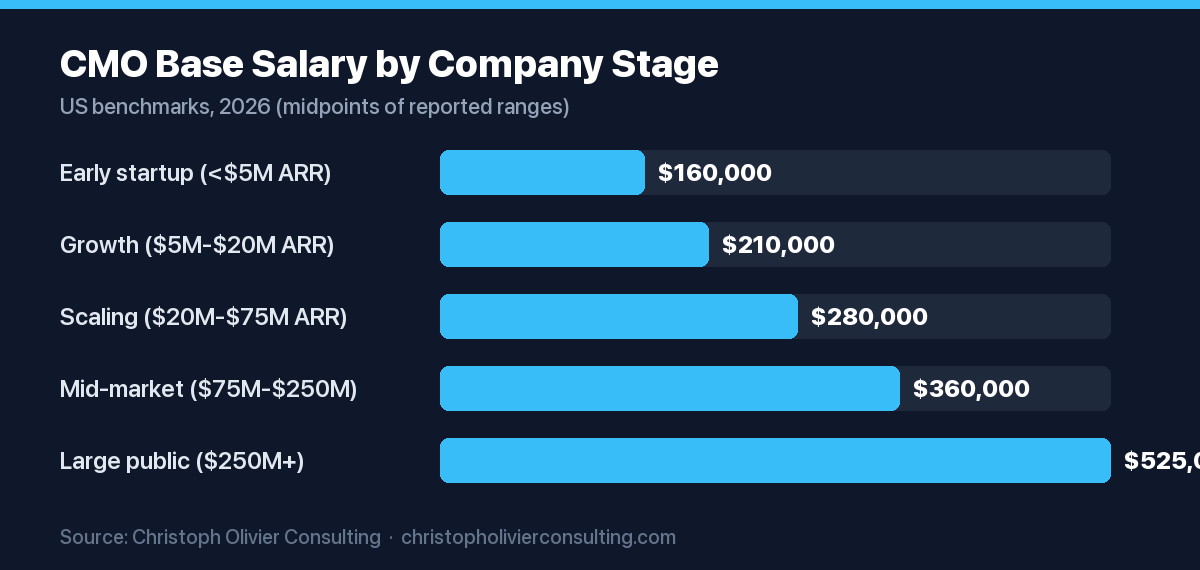
A CMO in the United States earns about $316,000 in total compensation in 2026, with a typical range of $237,000 to $440,000. Base salary tracks company size closely: an early-stage startup pays roughly $140,000 to $180,000, while a large public company can pay $350,000 or more in base alone, before bonus and equity. The table shows base salary by stage.
| Company stage | Base salary range | Notes |
|---|---|---|
| Early startup (under $5M ARR) | $140,000 to $180,000 | Often paired with 1% to 3% equity |
| Growth ($5M to $20M ARR) | $180,000 to $240,000 | Equity is a meaningful part of the offer |
| Scaling ($20M to $75M ARR) | $240,000 to $320,000 | Competing for experienced hires |
| Mid-market ($75M to $250M ARR) | $300,000 to $420,000 | A true C-suite seat |
| Large public ($250M+ ARR) | $350,000 to $700,000+ | Base only; bonus and equity add materially |
Full-time CMO or fractional CMO: which fits?
A full-time CMO makes sense once the role is a permanent, full-time job and the budget supports total compensation above $300,000 a year. A fractional CMO gives smaller and growth-stage companies the same strategic thinking part time, often for $3,000 to $22,000 a month, with no long-term commitment. Many firms start fractional, then hire full time once marketing scales. Compare the numbers in our fractional CMO cost breakdown for 2026, or see how we work on our services page.
Frequently asked questions
What is the difference between a CMO and a marketing director?
A CMO is a C-suite executive who sets the whole marketing strategy, owns the budget, and answers for revenue at board level. A marketing director sits below that, running campaigns, channels, and the team day to day. Put simply, the CMO decides what marketing does and why, while the director focuses on how it gets executed well.
Is a CMO higher than a VP of marketing?
Usually yes. A CMO holds a C-suite seat and owns marketing plus a voice in business strategy, while a VP of marketing is a senior execution leader who runs the strategy and team. In some companies a VP of marketing reports to the CMO. In smaller firms with no CMO, the VP is the top marketing role and reports to the CEO.
What qualifications does a CMO need?
Most CMOs hold a degree in marketing, business, or a related field and often an MBA, but experience carries the most weight. Employers look for a track record of leading teams, owning budgets, and tying marketing to revenue growth. Skills in brand, demand generation, analytics, and executive communication matter more than any single credential when a company hires at this level.
How much does a CMO make in 2026?
A US CMO earns about $316,000 in total compensation in 2026, with a common range of $237,000 to $440,000. Base salary depends on company size: roughly $140,000 to $180,000 at early-stage startups and $350,000 or more at large public companies. Bonus and equity can add materially on top, especially at venture-backed and public firms.
What is a fractional CMO?
A fractional CMO is an experienced marketing executive who works part time, usually 10 to 20 hours a week, giving a company CMO-level strategy without a full-time salary. US rates commonly run $3,000 to $22,000 per month. The model suits smaller and growth-stage companies that need senior direction but cannot justify total compensation above $300,000 a year.
More marketing guides for rank on ai: get cited by ai search
- AIDA Model: Attention, Interest, Desire, Action Explained
- Best Landing Page Builder in 2026: How to Choose
- The 12 Brand Archetypes: A Practical Reference for Choosing Yours
- Call to Action Examples That Convert (With Before and After Rewrites)
- CMO Salary in 2026: Base, Bonus, and Total Comp by Company Size
- Color Psychology in Marketing: What Colors Signal and How to Use Them
- Rank on AI: Get Cited by AI Search