

The speed to lead statistics that hold up come from two studies led by James Oldroyd. In the 2007 MIT and InsideSales.com Lead Response Management study, the odds of contacting a web lead were 100 times higher when it was called within 5 minutes instead of 30, and the odds of qualifying it were 21 times higher. In the 2011 Harvard Business Review study, firms that tried to reach a lead within an hour were nearly 7 times as likely to qualify it as firms that waited even one hour longer.
Most companies still miss that window. In Clay’s September 2026 test of 6,346 demo and contact forms, two thirds of companies never replied, 96% never called, and only 5% of replies arrived within five minutes. Below, every number is traced to the study it came from, with what the study actually measured, followed by named case study results, a copy-ready response-time SLA, and routing steps for HubSpot and Salesforce.
Speed to lead statistics: the verified table
Each row links to the original study or the publisher’s own page. Read the “measured” column before you quote anything: contact, qualification and conversion are different outcomes, and most mistakes on other stats pages come from swapping them.
| Statistic | What was measured | Sample | Source and year |
|---|---|---|---|
| Odds of contact drop 100x from a 5-minute to a 30-minute first call | Reaching the lead by phone | 6 companies, 3 years, 15,000+ leads, 100,000+ call attempts | Oldroyd, MIT/InsideSales.com, 2007 |
| Odds of qualifying drop 21x from 5 to 30 minutes | Qualification, not closed sales | Same as above | Oldroyd, MIT/InsideSales.com, 2007 |
| Contact odds fall more than 10x, qualify odds more than 6x, within the first hour | Contact and qualification | Same as above | Oldroyd, MIT/InsideSales.com, 2007 |
| Nearly 7x as likely to qualify when contact is tried within an hour vs an hour later; 60x+ vs 24 hours or more | “A meaningful conversation with a key decision maker” | 1.25 million leads at 29 B2C and 13 B2B US companies | Harvard Business Review, March 2011 |
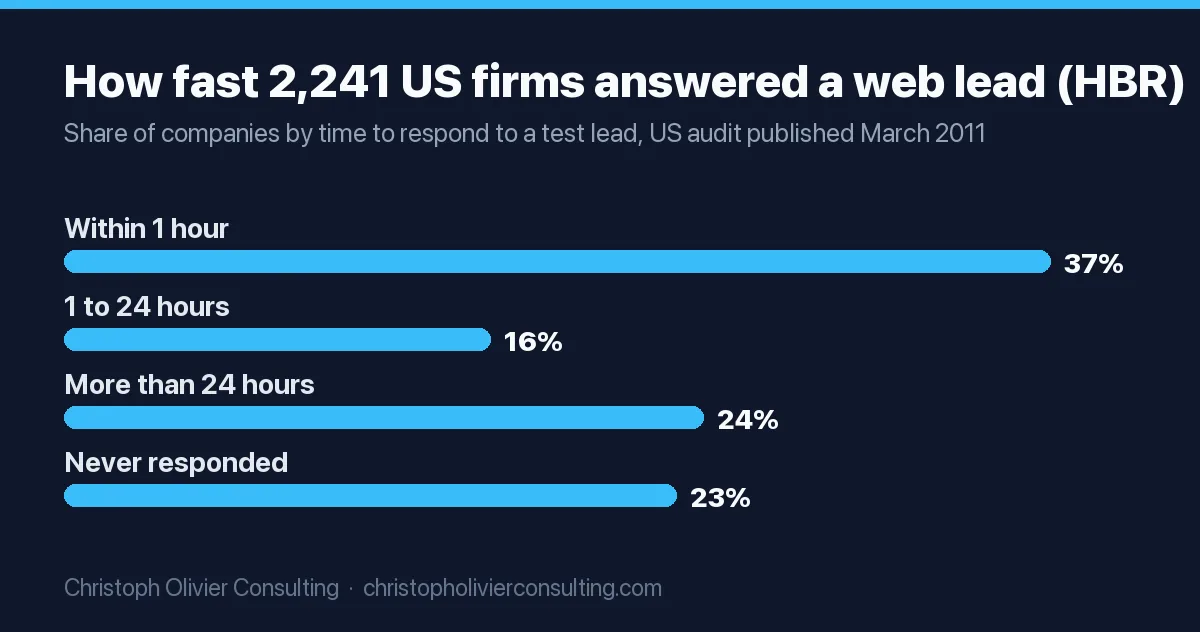
| Average first response: 42 hours; 23% never responded | Time to answer a test lead | 2,241 US companies | Harvard Business Review, March 2011 |
| Calling within 1 minute: 391% more likely to convert | Conversion, vendor customer data | Nearly 3.5 million leads | Leads360 (Velocify), reported Nov 2012 |
| 93% of converted leads were reached by the 6th call | Call attempts before contact | Nearly 3.5 million leads | Velocify study as summarized in 2016 |
| 77.17% of test leads never received a phone call; average phone response 44 hours | Mystery-shopper test leads | 4,723 leads | InsideSales.com ResponseAudit, 2016 |
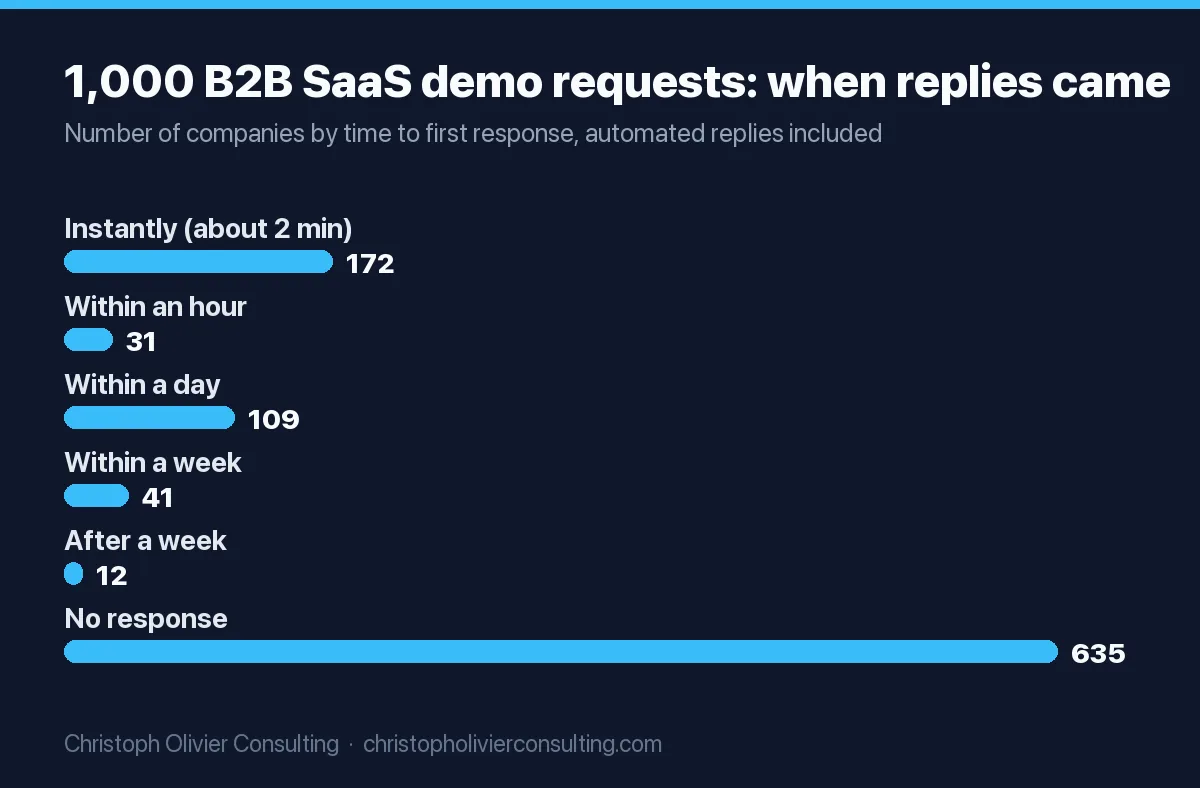
| 63.5% never responded to a demo request; responders averaged 1 day, 5 hours, 17 minutes | Demo requests, automated replies counted | 1,000 B2B SaaS companies | RevenueHero, March 2024 |
| More than 99% did not respond within 5 minutes; none called within 5 minutes | Demo requests | 114 B2B companies | Workato |
| Two thirds never replied; 96% never called; 5% of replies within 5 minutes | Demo and contact forms, 100 countries | 6,346 forms | Clay, September 2026 |
Where the 5-minute, 21x and 391% numbers actually come from
Most speed to lead stats pages repeat the same six numbers, often with the wrong outcome or the wrong publisher attached. Here is what each one traces back to, checked against the original document where one exists.
| As usually quoted | What the original says | Verdict |
|---|---|---|
| “Respond in 5 minutes and you are 21x more likely to convert” | The 2007 study says the odds of qualifying a lead drop 21 times between a 5-minute and a 30-minute call. It states plainly: “This study did not address close ratios.” | Real number, wrong outcome. Say “qualify,” not “convert” or “close.” |
| “100x more likely to connect within 5 minutes” | “The odds of contacting a lead if called in 5 minutes versus 30 minutes drop 100 times.” Six companies’ InsideSales.com call data, presented October 16, 2007 at MarketingSherpa’s B2B Demand Generation Summit. | Accurate if you keep “contact” and “5 vs 30 minutes.” |
| “Harvard: 15,000 leads and 100,000 call attempts” | Those counts belong to the 2007 MIT/InsideSales study. The HBR article used 1.25 million leads for its timing analysis and 2,241 companies for its audit. Workato’s study page, for example, credits the 15,000/100,000 sample to HBR. | Misattributed. Cite each study for its own sample. |
| “Leads go cold in an hour: 7x” | HBR, 2011: firms that tried to contact a lead within an hour were “nearly seven times as likely to qualify the lead” as those that tried an hour later, and more than 60 times as likely as those that waited 24 hours or longer. | Accurate. 2011 data. |
| “Calling within one minute boosts conversion 391%” | Leads360’s “The Ultimate Contact Strategy,” covered by Chief Marketer on November 27, 2012, nearly 3.5 million leads. A 2016 Velocify press release repeats it as “391 percent more likely to convert than those called any time after that.” The full report is no longer openly published, so the baseline and method cannot be checked. | Traceable to vendor data, not independently reviewed. Some pages credit it to Chili Piper, which is not the source. |
| “78% of customers buy from the first company to respond” | Usually credited to a “Lead Connect” survey. A 2026 trace by Carly found no title, year, sample size or link behind it, and this review found none either. | Untraceable. Do not quote it. |
| “80% of sales require 5 follow-ups” | SMEI, the successor to the National Sales Executives Association, searched its archives and found the figure came from a 1942 survey by its Long Island, NY chapter, with a sample of fewer than 40. | Real origin, 84 years old, under 40 respondents. Use Velocify’s six-call data instead. |
The mutation keeps happening because vendors summarize each other’s summaries: one page credits the 2007 sample to HBR, the next turns “qualify” into “convert,” and a third drops the 30-minute comparison so “5 minutes” reads like a hard deadline. None of this means fast response does not matter. It means you should quote the outcome each study measured.
The two original lead response studies
Lead Response Management study (MIT and InsideSales.com, 2007)
The 7-page executive summary describes two parts. Part 1 was a Kellogg survey of 495 companies (June to September 2007), which found no statistically significant answer to when leads should be called. Part 2 analyzed real call data: 3 years, six companies, more than 15,000 leads and more than 100,000 call attempts, all web-form leads called at least once. Its findings:
- Odds of contacting a lead: 100 times lower at 30 minutes than at 5 minutes. Odds of qualifying: 21 times lower.
- Within the first hour, contact odds fall more than 10 times and qualification odds more than 6 times.
- After 20 hours, “every additional dial your salespeople make actually hurts your ability to make contact to qualify a lead.”
- Wednesday and Thursday were the best days to call (contact 49.7% better than the worst day). 4 to 6 pm was the best block for contact (114% better than the worst); 8 to 9 am and 4 to 5 pm were best for qualifying (164% better than 1 to 2 pm).
- “Immediacy of response far overshadows both time of day and day of week.”
Limits to state when you cite it: six companies, one vendor’s platform, no closed-deal data, and Dr. Oldroyd notes the patterns appear “only when data from several companies is combined together.” The best-time-of-day findings also did not hold up in Velocify’s much larger dataset (see below).
Harvard Business Review: “The Short Life of Online Sales Leads” (2011)
Oldroyd, Kristina McElheran and David Elkington published this short article in HBR’s March 2011 issue. It reports two separate pieces of research:
- An audit of 2,241 US companies, each sent a web test lead. 37% responded within an hour, 16% within 1 to 24 hours, 24% took more than 24 hours, and 23% never responded. Among companies that replied within 30 days, the average was 42 hours.
- A timing study of 1.25 million leads at 29 B2C and 13 B2B US companies. Contact attempts within an hour were nearly 7 times as likely to qualify the lead as attempts an hour later, and more than 60 times as likely as attempts after 24 hours. “Qualify” meant “having a meaningful conversation with a key decision maker.”
The authors named three causes of slow response that still apply: pulling leads from the CRM daily instead of continuously, sales teams focused on self-generated leads, and lead distribution rules based on geography and “fairness.” If you came here searching for how fast a B2C company should respond, note that most of the companies in the 1.25 million lead study (29 of 42) were B2C, so the one-hour finding is not just a B2B result.
Velocify’s Ultimate Contact Strategy: 391% and the six-call rule
Leads360, the company whose study later circulated under the Velocify name, published “The Ultimate Contact Strategy: How to Best Use Phone and Email for Contact and Conversion Success” from nearly 3.5 million leads. The findings most often quoted, as summarized by The National Law Review in March 2016:
- A first call within one minute lifted the likelihood of conversion by almost 400% (the 391% figure). The lift fell to 160% in the second minute.
- 93% of converted leads were reached by the 6th call, so only 7% converted after more than six calls.
- Leads that needed more than 7 calls to reach were 45% less likely to convert.
- The optimal number of emails was 5. Earlier Velocify research had found that 50% of leads were called only once.
Velocify’s later report “When to Call Sales Leads” (press release, May 26, 2016) found the gap in contact rates between the best and worst time of day was only 2.6 percentage points. Sequencing calls relative to when the lead came in improved contact rates by 110%, against 7% for a time-of-day approach. My read: speed and a planned sequence matter far more than the hour you dial.
Lead response time statistics from audits, 2011 to 2026
These are mystery-shopper tests: the researcher fills in a real company’s form and times the reply. Methods differ, so compare direction, not decimals.
| Audit | Sample | No response | Speed | Phone |
|---|---|---|---|---|
| HBR, 2011 | 2,241 US companies | 23% never responded | 37% within 1 hour; 42-hour average | Not reported |
| InsideSales ResponseAudit, 2016 | 4,723 leads | 50% of leads got no response | 4.7% of companies hit 5 minutes | 77.17% never got a call; 44-hour average phone response |
| RevenueHero, 2024 | 1,000 B2B SaaS | 63.5% | 172 replied in about 2 minutes; average 1 day, 5 hours, 17 minutes | Not reported |
| Workato | 114 B2B companies | Nearly 1 in 5 sent no email | Personalized email average 11 hours 54 minutes | 31% called; average 14 hours 29 minutes; none within 5 minutes |
| Clay, 2026 | 6,346 forms, 100 countries | About two thirds | 15 to 24 hours average; 26 to 40 hours for human replies | 96% never called; calls came after 34.5 hours on average |
Four details from these audits are more useful than the headline averages:
- Automation is fast but impersonal. In Clay’s test, 64% of replies were automated, 75.8% of human replies were fully personalized, and only 4 of 1,281 automated replies were. Only 445 forms (7%) got a reply from a salesperson trying to start a conversation.
- Automating the first touch roughly tripled speed. RevenueHero measured 2 days, 3 hours, 11 minutes for manual responders against 17 hours, 20 minutes for companies that automated at least the first reply.
- Short forms and instant booking go together with speed. Only 113 of RevenueHero’s 1,000 sites had a scheduler. Companies with 1 or 2 form fields replied in 3 hours 14 minutes on average.
- Routing tools help but do not finish the job. Workato’s routing-tool users averaged 3 hours 32 minutes; companies without one took nearly 13 hours.
Caveats the researchers state themselves: RevenueHero found 30.86% of its non-responders ran an enrichment tool and may have screened out the test lead; Clay used one invented buyer for every form, some submissions may have hit spam filters, and AI judged human versus automated replies. Workato’s page is dated March 2026 but does not say when its forms were submitted. For how these numbers compare with funnel conversion rates, see our conversion rate benchmarks and lead generation statistics.
Speed to lead follow-up case study results
These are the published results I could find with a named company, a before and after, and the vendor’s own page as the source. All are vendor case studies, none has a control group, and most changed several things at once, so read them as what is possible, not what to expect.
| Company | What changed | Speed before and after | Reported result | Source |
|---|---|---|---|---|
| ChowNow (restaurant ordering software) | Instant routing and booking on the demo form | About one week to immediate booking | Inbound close rate 4x for meetings booked this way | Chili Piper |
| TetraScience | Near real-time lead routing | About 24 hours to under 5 minutes | MQL to SQL conversion up about 20% | LeanData (Director of Marketing Operations quote) |
| Zendesk | Automated routing, about 4,100 leads a week | Time to route 45 minutes to about 8; lead touches from 4 to 8 hours to 30 minutes | Manual assignment down 45%; about 55 hours of work saved weekly | LeanData |
| Workato | Leads book the right rep’s calendar instantly, routed by zip code | Not stated | Lead-to-meeting conversion from 40 to 55% up to 75 to 80%; 50% more booked demos; revenue up 10 to 15% | Chili Piper |
| MedPro Waste Disposal | Fast response plus a sequenced follow-up process | Not stated | 20% revenue increase in the first year (president’s quote) | Velocify press release, 2016 |
The pattern across all five: the gain came from removing a manual step (someone reading the lead, someone picking an owner, someone emailing to schedule), not from asking reps to try harder.
Speed to lead response time best practices: a copy-ready SLA
This is the service level agreement I would start from for a professional-service firm or a 7-figure service business. The thresholds are my recommendations built on the studies above, not figures from any single study. Adjust the tiers to your lead types, then agree on it in writing between whoever owns the form and whoever owns the phone.
| Lead tier | Examples | First touch (business hours) | After hours | Follow-up | Escalate if |
|---|---|---|---|---|---|
| Tier 1: hand-raiser | Demo, quote, consultation or callback request; inbound call missed | Automated confirmation instantly; human call within 5 minutes | Instant confirmation with a booking link; call within 15 minutes of opening | Up to 6 call attempts plus up to 5 emails over about 2 weeks | No logged call 10 minutes after assignment |
| Tier 2: inquiry | General contact form, chat question, pricing question | Personal reply within 1 business hour | First thing next business morning | 3 attempts across phone and email | No reply 1 business hour after assignment |
| Tier 3: content | Guide download, webinar signup, newsletter | Automated delivery instantly; no sales call unless scoring promotes it | Same | Nurture sequence | Score crosses your sales-ready threshold |
Copy and adapt this text:
Lead Response SLA, [Company], effective [date]
1. Scope: every inbound lead created in [CRM] from web forms, chat, phone and paid lead sources.
2. Assignment: leads are assigned automatically within 1 minute of creation. Unmatched leads go to [default owner or queue], never to “unassigned.”
3. First touch: Tier 1 leads receive an automated confirmation immediately and a call from the assigned rep within 5 minutes during [business hours, time zone]. Tier 2 leads receive a personal reply within 1 business hour.
4. Persistence: reps make up to 6 call attempts on Tier 1 leads before marking them unresponsive, logging every attempt in [CRM].
5. Escalation: if no call is logged 10 minutes after assignment, the lead is reassigned to [backup rep or queue] and [sales manager] is notified.
6. Marketing commitment: forms ask only for the fields sales uses to route and prepare; lead source and request type pass into [CRM] on every record.
7. Measurement: weekly report of median and 90th percentile time to first human touch, share of Tier 1 leads touched within 5 minutes, share of leads with zero touches, and contact rate within 24 hours. Reviewed by [names] every [cadence].
Why these numbers: 5 minutes is where the 2007 data shows contact odds at their highest; one hour is HBR’s qualification cliff; six calls is where Velocify found 93% of eventual conversions had already been reached; and the automated-plus-human first touch answers Clay’s finding that almost no company manages to be both fast and personal. The median and 90th percentile matter because one slow afternoon disappears inside an average. If you want help fitting this to your team, the inbound sales process guide covers the handoff, and you can book a consultation to work through your routing.
How to set up lead routing in HubSpot and Salesforce
HubSpot: Rotate record to owner
Per HubSpot’s knowledge base (last updated October 26, 2026), the Rotate record to owner workflow action needs Sales Hub or Service Hub Professional or Enterprise, and every rep in the pool needs a paid seat.
- Go to Automation, then Workflows, and create a workflow. Rotating the Lead object (a beta) requires Sales Hub Professional or Enterprise.
- Set the enrollment trigger to the form submission or lead creation event for your Tier 1 forms.
- Add an action, expand CRM, and choose Rotate record to owner. Pick specific users or a team.
- For leads, choose a distribution type: round robin, load balanced or random. Turn on “Assign to available users only” so reps set to Away are skipped.
- If you rotate leads, turn off the “Sync lead owner with contact or company owner” setting first, or ownership will be overwritten.
- Add Create task (call the lead) and Send in-app notification to the new owner. Then add a Delay of a set amount of time (10 minutes) and a branch based on one property, such as lead status, to reassign or alert a manager if nothing has changed.
Two gotchas from the same article: for standard rotation, HubSpot lets only one record through the action at a time, so bursts of leads can wait, and if the owner property syncs with Salesforce, Salesforce may push the old owner back.
Salesforce: lead assignment rules, queues and auto-response
From Salesforce’s Lead Implementation Guide (Spring ’23 edition):
- Set a default lead owner (Setup, Quick Find “Lead Settings”). It can be a user or a queue, and it catches every lead no rule matches.
- Create queues for shared territories or teams (Setup, Quick Find “Queues”), and choose whom to notify when records arrive.
- Create a lead assignment rule (Setup, Quick Find “Assignment Rules,” then Lead Assignment Rules). Rule entries run in order until one matches; each can assign to a user or queue and email the new owner. A rule can hold up to 3,000 entries, including 300 formula entries, and only one rule is active at a time.
- For web forms, set up Web-to-Lead with a Default Response Template, and add auto-response rules if different lead types need different confirmation emails.
Native assignment rules match criteria; the guide does not describe even rotation between reps. Teams that need round robin, availability checks or instant booking usually add Flow or a routing app, which is what the LeanData and Chili Piper case studies above used. Our CRM strategy guide covers how to decide what belongs in the CRM itself.
Run your own internet lead response audit
Every audit above was a mystery shop. You can run the same test on your own business in an afternoon. Submit each form from a personal email address, call your main number after hours, and send a chat message, then score the results.
| Check | Pass | Fail | Benchmark it beats |
|---|---|---|---|
| Any reply to a demo or quote form | Yes, every form | Any form unanswered after 1 business day | About two thirds of companies never replied (Clay, 2026) |
| Phone call on a hand-raiser form | Within 5 minutes in business hours | No call, or after 1 hour | 96% never called (Clay, 2026) |
| First human reply | Same business day and personalized | Next day or template only | Human replies took 26 to 40 hours (Clay, 2026) |
| Instant booking | Calendar offered on or right after the form | Email back-and-forth to schedule | 113 of 1,000 sites had a scheduler (RevenueHero, 2024) |
| Form length | Only fields used for routing | Fields nobody reads | Average demo form had 7 fields (RevenueHero, 2024) |
| Follow-up persistence | Several attempts across phone and email | One email, then silence | Average 4.47 touches; 9.4% of leads got 12 (InsideSales, 2016) |
| Ownership | Every lead has an owner within 1 minute | Leads sit in an unassigned view | Zendesk routed in about 8 minutes (LeanData) |
Then pull the real numbers from your CRM: time from lead creation to first logged call or email, by source and by rep. If your CRM cannot report that, the first fix is a timestamp field, not a new tool. Trades with heavy phone volume should also count missed calls as leads; the speed to lead guide for HVAC companies shows how, and the lead qualification guide covers what the first call should establish.
Frequently asked questions
Where does the 5 minute speed to lead rule come from?
It comes from the 2007 Lead Response Management study by James Oldroyd (MIT) and InsideSales.com, which analyzed six companies' call data: over 15,000 leads and 100,000 call attempts. The odds of contacting a web lead were 100 times lower at 30 minutes than at 5, and the odds of qualifying it 21 times lower. The study did not measure closed sales.
What did the Harvard Business Review speed to lead study find?
HBR's March 2011 article audited 2,241 US companies: 37% answered a test lead within an hour, 23% never answered, and the average was 42 hours. A separate analysis of 1.25 million leads found that trying to contact a lead within an hour made qualifying it nearly 7 times as likely as waiting one more hour.
What is the average lead response time?
It depends on the audit. HBR measured 42 hours in 2011. RevenueHero's 2024 test of 1,000 B2B SaaS firms averaged 1 day, 5 hours, 17 minutes among the 36.5% that replied. Clay's 2026 test of 6,346 forms found 15 to 24 hours on average, 26 to 40 hours for human replies, and two thirds never replied.
Is the 391% speed to lead statistic real?
It traces to Leads360's (later Velocify's) study The Ultimate Contact Strategy, reported in November 2012 from nearly 3.5 million leads: calling within one minute made conversion 391% more likely than calling later. It is vendor data from its own customers, the full report is no longer openly available, and it has not been independently reviewed.
What is the original source of "80% of sales require 5 follow-ups"?
SMEI, the successor to the National Sales Executives Association, searched its archives and traced the figure to a 1942 survey by its Long Island, New York chapter with fewer than 40 respondents. For a modern persistence benchmark, Velocify's data found 93% of converted leads had been reached by the sixth call.
How fast should a B2C company respond to a new web lead?
Within minutes during business hours, with an instant automated confirmation at all times. In HBR's 1.25 million lead study, 29 of the 42 companies were B2C, and contact attempts within an hour were nearly 7 times as likely to qualify the lead. The 2007 data shows contact odds highest at 5 minutes.
What is the Velocify Ultimate Contact Strategy?
It is a Leads360/Velocify study of nearly 3.5 million leads on phone and email follow-up. Its main findings: call within one minute (391% conversion lift, 160% in minute two), make up to six call attempts because 93% of converted leads were reached by the sixth call, and send about five emails.