
Last reviewed: October 2026
An inbound sales process is the repeatable set of steps your team uses to turn people who come to you (form fills, calls, chats, referrals) into clients: identify the right leads, connect fast, explore their situation in a discovery call, and advise on a fit-for-purpose solution. The three things that decide whether it works are response speed, a shared qualification standard, and a written handoff between marketing and sales.
This guide is for owners, partners and marketing leads at professional-service firms and 7-figure service businesses. It covers the four stages, how inbound differs from outbound, the response-time research, a comparison of qualification frameworks, a discovery call structure, an SLA template, CRM stages, the metrics to track, and an illustrative playbook you can adapt.
What is an inbound sales process?
An inbound sales process is the sequence your firm follows after a prospect raises their hand. It starts when someone submits a form, calls, books a meeting or replies to content, and ends with a signed engagement or a clear no. Each step has an owner, a time limit and a defined exit criterion, so no inquiry sits unanswered.
Inbound sales is not the same as inbound marketing. Marketing creates the demand: content, search visibility, referrals and offers that make the right buyers find you. If you want the marketing side in detail, read what inbound marketing looks like in 2026. Sales picks up the moment a person shows intent and turns that intent into a conversation, a proposal and a client.
The process sits inside your broader sales motion. If you have never mapped that motion end to end, start with the general sales process steps and then specialize them for inbound using the stages below.
Inbound leads behave differently from cold prospects in three ways:
- They arrive with context. They read a page, watched a webinar or got a referral. Your first message should reference it.
- They decay quickly. Interest is highest in the minutes after they reach out, which is why speed matters more here than anywhere else in sales.
- They are mixed quality. A contact form attracts ideal clients, poor fits, job seekers and vendors. Qualification has to be fast and consistent.
The 4 stages of the inbound sales methodology
The most widely taught inbound sales methodology has four stages: Identify, Connect, Explore and Advise. HubSpot Academy’s Inbound Sales course is built around them. Identify the active buyers worth your time, connect with relevant context, explore their goals and challenges, then advise with a tailored recommendation.
1. Identify
Decide who deserves a sales conversation. Write a short ideal client profile (industry, size, trigger events, service need) and score inbound leads against it. For a professional-service firm, the strongest signals are usually a direct consultation request, a referral, a return visit to a pricing or services page, and a reply to a newsletter.
2. Connect
Reach out quickly and personally. Reference what the person actually did (“You downloaded our succession planning checklist”) and offer one clear next step, usually a short call. A connect message that could have been sent to anyone is a cold email with better timing.
3. Explore
Run discovery. Find out what is happening, why now, what they have tried, who else is involved and what a good outcome looks like. This is where qualification happens, using one of the frameworks compared later in this guide.
4. Advise
Recommend a specific path, which can include “we are not the right fit, here is who is.” In professional services the advice is often the product preview: a scoped proposal, a short diagnostic or a clear engagement plan that shows how you think. Mark Roberge, HubSpot’s former chief revenue officer, explains the thinking behind a buyer-led inbound sales process in the short video below from HubSpot’s official channel.
Inbound vs outbound sales: what changes in the process
Inbound sales starts with buyer-initiated interest, so the job is response, diagnosis and advice. Outbound starts with seller-initiated contact, so the job is targeting, interruption and earning attention. Most firms need both, but they should run as separate workflows with different scripts, metrics and expectations rather than one blended pipeline.
| Dimension | Inbound sales | Outbound sales |
|---|---|---|
| Who starts the conversation | The prospect (form, call, chat, referral) | The seller (cold email, call, LinkedIn) |
| First goal | Respond fast and diagnose fit | Earn attention and a first reply |
| Main constraint | Response speed and follow-up capacity | List quality and message relevance |
| Typical first touch | Call or personal email within minutes | Researched sequence across channels |
| Qualification focus | Filtering mixed-quality demand | Confirming a problem exists at all |
| Key metrics | Speed to lead, lead-to-meeting, meeting-to-close | Reply rate, meetings booked per 100 contacts |
| Who owns the volume | Marketing generates it, sales converts it | Sales generates and converts it |
For B2B firms, the bigger shift is that buyers do much of their research before they contact you, so the first sales conversation starts later in their decision. The modern B2B sales process guide covers how to adapt each stage to that reality.
Speed to lead: why the first hour decides most inbound deals
Speed to lead is the time between an inquiry and your first real contact attempt. It is the single most controllable variable in an inbound sales process. Research published in Harvard Business Review found that firms contacting a lead within an hour were nearly seven times as likely to qualify it as firms that waited even one hour longer.
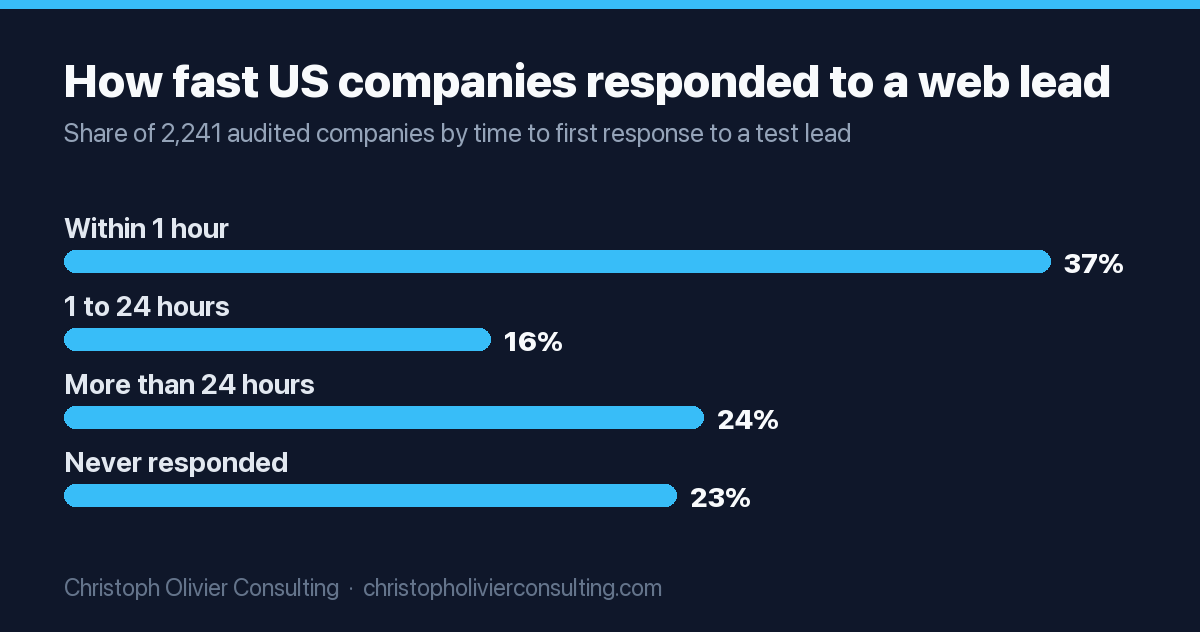
That study, “The Short Life of Online Sales Leads” (Oldroyd, McElheran and Elkington, Harvard Business Review, March 2011), had two parts:
- An audit of 2,241 US companies that measured how long each took to respond to a web test lead. 37% responded within an hour, 16% within one to 24 hours, 24% took more than 24 hours, and 23% never responded. Among companies that responded within 30 days, the average response time was 42 hours.
- A separate analysis of 1.25 million sales leads at 29 B2C and 13 B2B US companies. Firms that tried to contact a lead within an hour were nearly seven times as likely to qualify it (a meaningful conversation with a key decision maker) as firms that waited an hour longer, and more than 60 times as likely as firms that waited 24 hours or more.
The earlier Lead Response Management study by James Oldroyd, summarized in the InsideSales 2014 Lead Response Report, found the odds of contacting a lead were 100 times greater when the attempt came within 5 minutes rather than 30, and the odds of qualifying it were 21 times greater. In the same report’s 2013 audit, 47% of the 9,538 companies that received a test lead never responded, and the median first phone call came after 3 hours and 8 minutes.
Two honest caveats. These studies are more than a decade old and heavily weighted toward high-volume web leads, and response-time research shows correlation, not a guaranteed lift for your firm. The direction, though, is the same in both datasets: faster contact goes with better outcomes. For a wider roundup, see these speed to lead statistics.
Practical targets for a small firm:
- Instant automated confirmation that tells the person what happens next and when.
- A human call or personal email within 5 minutes during business hours.
- A booking link in every first touch so the prospect can self-schedule.
- An after-hours rule: first human contact by 9:30 a.m. the next business day.
Inbound sales sequences: how many follow-ups before you stop
An inbound sales sequence is the planned set of calls, emails and messages you send after the first contact attempt until the lead books, declines or goes silent. Most firms stop far too early. In the InsideSales 2013 audit, the median company made one contact attempt and the average was 2.2, while nearly half made none.
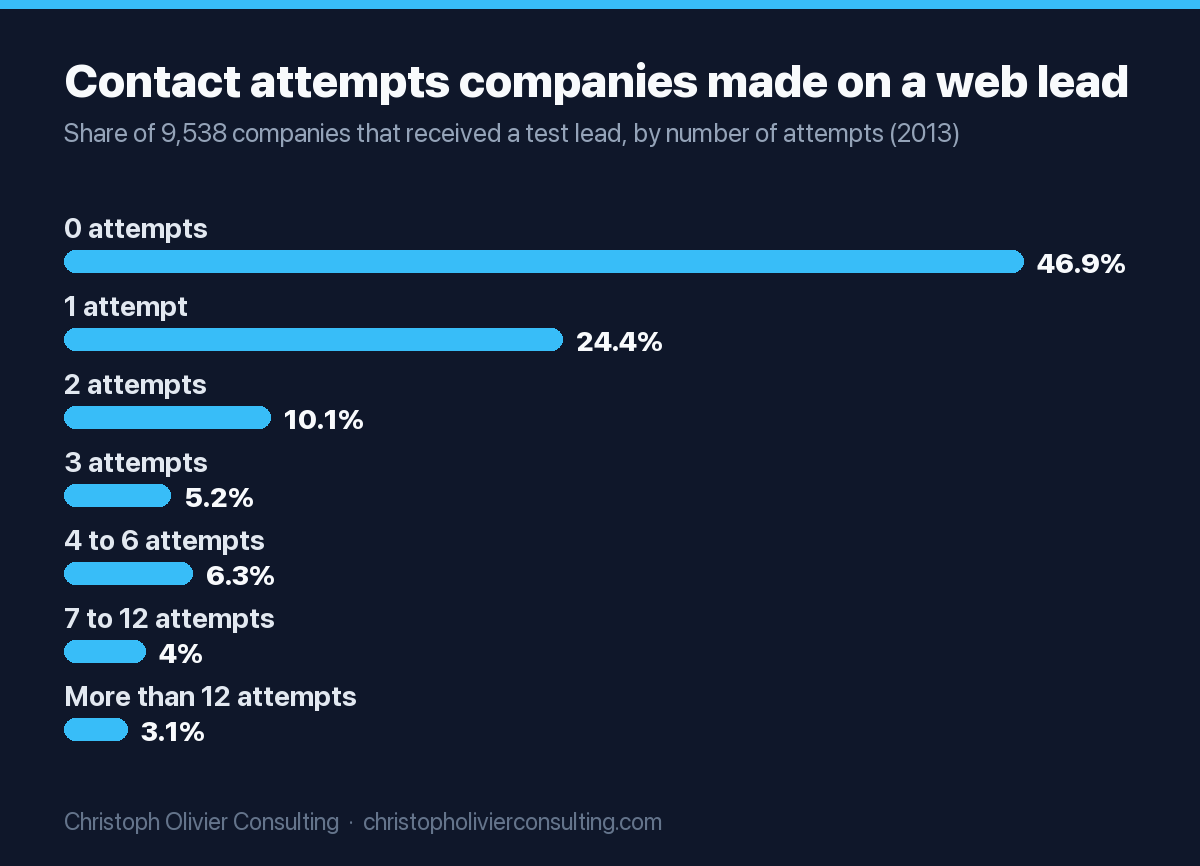
The same 2014 Lead Response Report found that only 22% of companies that received a web lead called it at least once, and 36% of those called only once. One call and one email is not a sequence. It is a coin toss on whether the prospect happened to be free.
A practical inbound follow-up sequence for a professional-service firm, over 10 business days:
- Minute 0: automated confirmation email with a booking link and what to expect.
- Within 5 minutes: phone call. If no answer, leave a 20-second voicemail and send a personal email referencing their inquiry.
- Day 1 (afternoon): second call attempt at a different time of day.
- Day 2: short email with one useful resource tied to their stated need.
- Day 4: third call plus a text message if they gave a mobile number and consent.
- Day 7: email that asks a single yes or no question (“Is this still a priority this quarter?”).
- Day 10: close-the-loop email. Tell them you will stop reaching out and how to restart the conversation, then move them to a nurture list.
Lead qualification frameworks: BANT vs MEDDIC vs CHAMP
A lead qualification framework is a shared checklist that decides whether an inbound lead gets a full sales effort. BANT checks budget, authority, need and timeline. MEDDIC maps the buying process in complex deals. CHAMP leads with the buyer’s challenges. Pick one, train everyone on it, and record the answers in your CRM.
BANT is widely attributed to IBM, as Capsule’s guide to BANT explains. MEDDIC was created by Dick Dunkel at PTC in 1996, in collaboration with Jack Napoli. CHAMP reorders the BANT ideas to put the prospect’s challenges first.
| Framework | What it stands for | Best for | Watch out for |
|---|---|---|---|
| BANT | Budget, Authority, Need, Timeline | Fast triage of high-volume inbound leads | Asking about budget first can feel transactional and stall discovery |
| CHAMP | Challenges, Authority, Money, Prioritization | Consultative first calls where the problem is not yet clear | Can run long without a firm timeline question |
| MEDDIC | Metrics, Economic Buyer, Decision Criteria, Decision Process, Identify Pain, Champion | Large, multi-stakeholder engagements with long cycles | Too heavy for a $5,000 engagement or a single decision maker |
My view for most professional-service firms: use a CHAMP-style order in the first call because it keeps the conversation about the client, use BANT fields in the CRM for quick filtering, and switch to MEDDIC only for engagements large enough to involve a buying committee.
How to run an inbound discovery call
An inbound discovery call is a structured 20 to 45 minute conversation that confirms fit, uncovers the real problem and agrees on a next step. The prospect called you, so lead with their reason for reaching out, ask more than you tell, and end with a specific, dated next action rather than “I’ll send something over.”
A simple 30-minute structure:
- Open (2 minutes): confirm time, state the agenda and the possible outcomes, including “we may not be the right fit.”
- Trigger (5 minutes): “What prompted you to reach out now?” The answer tells you urgency and the real problem.
- Situation and impact (10 minutes): current state, what it costs them, what they have already tried.
- Decision context (5 minutes): who else is involved, how they will decide, when they need it solved, what budget range they expect.
- Preliminary advice (5 minutes): share how you would approach it at a high level. This is the Advise stage in miniature.
- Next step (3 minutes): book the proposal review or diagnostic on the calendar before you hang up.
Questions that work well for professional services:
- “If we fixed this, what would be different in six months?”
- “What happens if you do nothing this year?”
- “Who besides you needs to be comfortable with the decision?”
- “Have you worked with a firm like ours before? What went well and what did not?”
The marketing-to-sales handoff: write an inbound lead SLA
An inbound lead SLA (service level agreement) is a one-page written agreement between marketing and sales. It defines what counts as a qualified lead, how fast sales must respond, how many attempts they make, what happens to leads that do not convert, and how feedback flows back to marketing. Without it, both sides blame each other for “bad leads.”
Template: inbound lead SLA (one page)
- Lead definitions: Marketing qualified lead (MQL) = [fits ICP + took a high-intent action, e.g. consultation request]. Sales qualified lead (SQL) = [discovery held + confirmed need, authority and timeline].
- Marketing commits to: [X] MQLs per month; complete contact data and source on every lead; routing to the right owner within [1] minute.
- Sales commits to: first contact attempt within [5] minutes in business hours; at least [6] attempts over [10] business days; disposition recorded within [24] hours of the last attempt.
- Disposition options: Booked, Disqualified (with reason), Nurture, Unresponsive, Referred out.
- Recycling rule: Unresponsive and Nurture leads return to marketing nurture after day [10].
- Review cadence: [Monthly] 30-minute review of volume, speed to lead, lead-to-meeting rate and disqualification reasons.
- Owners: Marketing owner [name]; Sales owner [name]; escalation path [name].
The disqualification reasons are the most valuable part. If 40 percent of leads are disqualified for “too small,” that is a message for your marketing and pricing pages, not a sales problem.
CRM setup for an inbound sales process
Your CRM should mirror the inbound sales process exactly: one pipeline, stages with clear entry criteria, required fields for source and qualification, and automation that handles routing, reminders and sequences. If a stage cannot be defined by an observable event, such as a meeting held or a proposal sent, remove it.
| Pipeline stage | Enters when | Required fields | Automation |
|---|---|---|---|
| New inquiry | Form, call or chat captured | Source, service interest | Instant confirmation, owner assigned, call task created |
| Contacting | First attempt logged | Attempt count, last attempt date | Sequence enrolled, overdue alert at 5 minutes |
| Discovery booked | Meeting on the calendar | Meeting date | Reminders to prospect, prep task for owner |
| Qualified | Discovery held and criteria met | Need, authority, timeline, budget range | Proposal task created |
| Proposal sent | Proposal or engagement letter sent | Value, expected close date | Follow-up tasks at day 2 and day 7 |
| Won / Lost | Signed or declined | Loss reason | Onboarding handoff or nurture enrollment |
Keep it lean. A five-person firm rarely needs more than these six stages. The HubSpot Academy walkthrough at the top of this section shows how lead management and prospecting are set up in one common CRM. The same principles apply in any system.
Inbound sales metrics: what to measure
The core inbound sales metrics are speed to lead, contact rate, lead-to-meeting rate, meeting-to-proposal rate, proposal-to-close rate and revenue per inquiry. Track them by lead source. They show exactly where inquiries leak, which matters more than any single conversion number or industry benchmark.
- Speed to lead: median minutes from inquiry to first human attempt. Use the median, because a few very slow responses pull the average up, a point the InsideSales report also makes.
- Contact rate: leads reached in a live conversation divided by total leads.
- Lead-to-meeting rate: discovery calls held divided by qualified-fit leads.
- Meeting-to-proposal rate: proposals sent divided by discovery calls held.
- Proposal-to-close rate (win rate): engagements signed divided by proposals sent.
- Sales cycle length: days from inquiry to signed engagement.
- Revenue per inquiry: first-year revenue from won clients divided by total inquiries. This is the number that tells you what a new lead is worth.
Resist publishing internal targets copied from someone else’s industry. Measure your own baseline for one quarter, then improve the weakest step first.
Sample inbound sales strategy and playbook for a professional-service firm
A workable inbound sales strategy for a small professional-service firm combines a five-minute response rule, a 10-day follow-up sequence, a CHAMP-style discovery call, a one-page SLA and a six-stage CRM pipeline. The illustrative playbook below shows how those pieces fit together. It is a model to adapt, not a client case study.
The scenario (hypothetical): a 12-person accounting and advisory firm gets about 40 inquiries a month from its website, Google Business Profile and referrals. Two partners take sales calls between client work. Today, inquiries land in a shared inbox and get answered “when someone has a minute.”
- Route every inquiry to one owner. Forms, calls and chats create a CRM record and assign it to the partner on sales duty that day, with a backup.
- Set the five-minute rule. The on-duty partner blocks two 30-minute “inquiry windows” daily and calls new leads immediately during office hours; an operations assistant handles first calls when both partners are in meetings.
- Triage in the first call. Three questions decide the path: service needed, size or complexity, timeline. Poor fits get a referral within one business day.
- Run discovery within three business days. 30 minutes, the structure above, with a proposal review booked before the call ends.
- Send proposals within two business days. Use scoped, fixed-fee options where possible so the decision is easy to compare.
- Follow the sequence. Every non-responsive lead gets the 10-day sequence, then moves to monthly nurture.
- Review monthly. Look at speed to lead, lead-to-meeting rate, win rate and the top three disqualification reasons. Change one thing at a time.
Illustrative funnel math (assumptions, not benchmarks): if 40 monthly inquiries include 25 good-fit leads, 15 of those book discovery, 10 receive proposals and 4 sign, then each step is visible and fixable. If speed to lead improves and 18 instead of 15 book discovery, with the other rates unchanged, the firm would expect roughly one more signed client a month, from leads it was already paying to generate.
The firms that struggle with inbound usually do not lack leads. They lack an owner for the process. If no one inside the firm can own the system, an inbound marketing consultant or fractional leader can design it and hand it over. If you would like a second set of eyes on your own inbound sales process, you can book a consultation and we will walk through it together.
Frequently asked questions
What are the 4 stages of the inbound sales process?
The four stages are Identify, Connect, Explore and Advise. Identify the active buyers who fit your ideal client profile, connect quickly with a message that references what they did, explore their situation in a structured discovery call, and advise with a specific recommendation or a referral if you are not the right fit.
What is the difference between inbound and outbound sales?
In inbound sales the prospect starts the conversation by filling in a form, calling, chatting or being referred, so the job is fast response and diagnosis. In outbound sales the seller starts it with cold email, calls or social outreach, so the job is targeting and earning attention. Most firms run both as separate workflows.
How fast should you respond to an inbound lead?
Aim for a human call or personal email within five minutes during business hours. A Harvard Business Review study found firms that tried to contact leads within an hour were nearly seven times as likely to qualify them as firms that waited an hour longer. Send an instant automated confirmation as well.
How many times should you follow up with an inbound lead?
Plan a sequence of roughly six to eight touches over about ten business days, mixing calls, personal emails and, with consent, texts. In the InsideSales 2013 audit the median company made only one attempt. End with a close-the-loop email and move unresponsive leads to a nurture list rather than deleting them.
Which lead qualification framework is best for inbound sales?
It depends on deal size. BANT works for fast triage of high-volume leads, CHAMP suits consultative first calls because it starts with the buyer's challenges, and MEDDIC fits large multi-stakeholder engagements. Many professional-service firms use a CHAMP-style call order with BANT fields recorded in the CRM.
What should an inbound lead SLA include?
An inbound lead SLA should define a marketing qualified lead and a sales qualified lead, marketing's volume and data-quality commitments, sales response time and number of attempts, disposition options, recycling rules for unresponsive leads, a monthly review cadence and named owners on both sides. Keep it to one page.
What metrics should you track in an inbound sales process?
Track median speed to lead, contact rate, lead-to-meeting rate, meeting-to-proposal rate, proposal-to-close rate, sales cycle length and revenue per inquiry, all broken down by lead source. Measure your own baseline for a quarter, then fix the weakest step first instead of chasing generic industry benchmarks.
More Sales Process & CRM guides
- The 7 Sales Process Steps (and How to Run Each One)
- B2B Sales Process: First Touch to Close
- CRM Tools List: Categories and How to Choose by Business Type and Size
- Customer Management Database: Fields, Structure, and Data Hygiene
- Sales Management Software: What It Does, the 5 Categories, and How to Choose
- Managing a Sales Force: The Operating System for Structuring, Coaching, and Paying a Team That Hits Quota
- All Sales Process & CRM guides →